

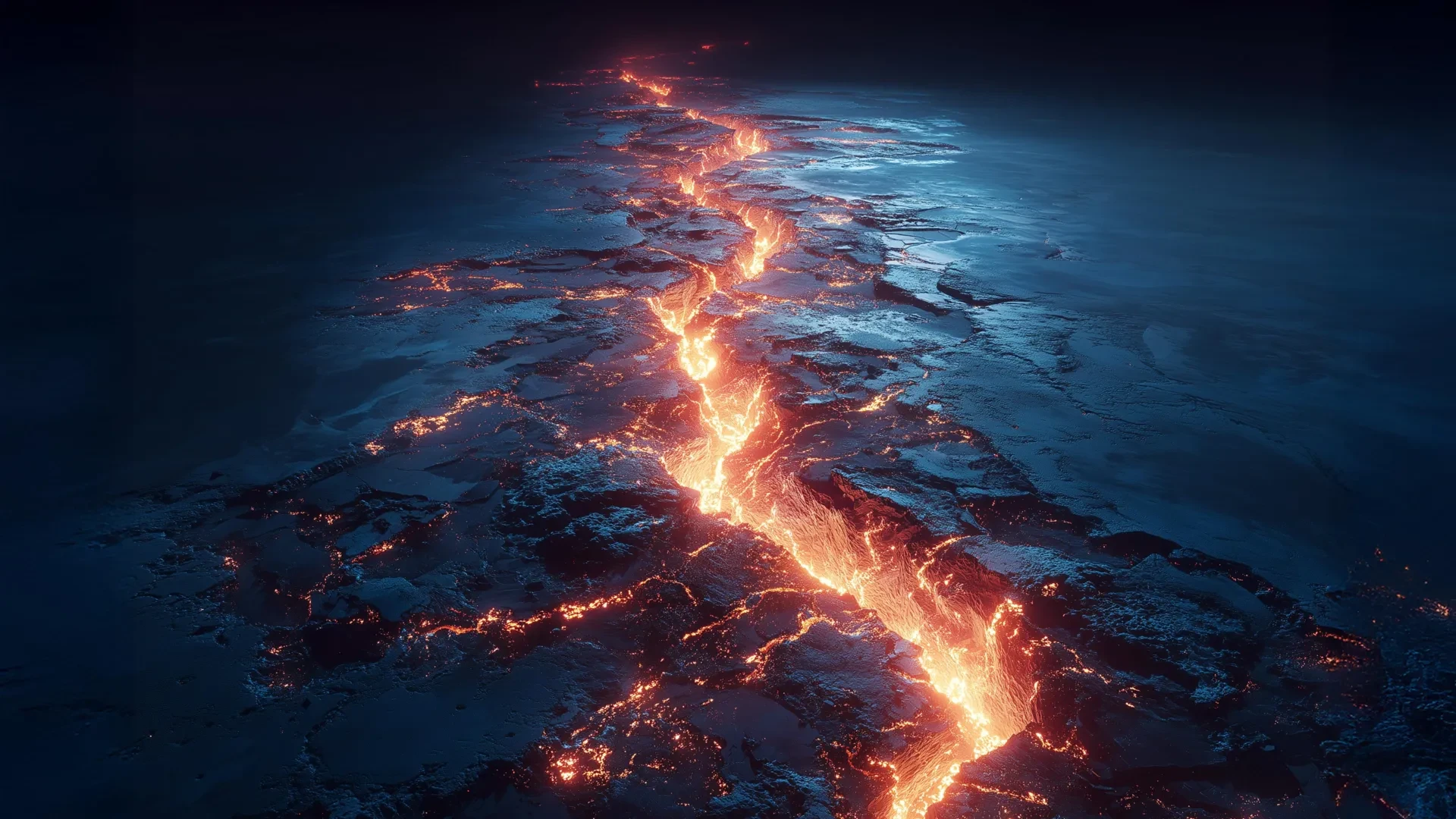
TOKYO & OKAYAMA — In the murky, crushing depths of the western Pacific Ocean lies the Ontong Java Plateau (OJP), a colossal submarine mountain range of basalt and solidified lava. Spanning an area roughly the size of Alaska, it stands as the largest oceanic plateau on Earth, born out of the most cataclysmic volcanic outpouring in our planet’s history.
For decades, geologists understood the OJP as a testament to unprecedented surface fury—a geological scar formed 110 to 120 million years ago when an immense engine of heat and magma erupted across the seafloor. However, a new, groundbreaking study published in Geophysical Research Letters reveals that the surface eruptions tell only half the story.
An international research team led by Lecturer Azusa Shito of the Okayama University of Science—in collaboration with Associate Professor Akira Ishikawa of the Institute of Science Tokyo and Professor Masako Yoshikawa of Hiroshima University—has discovered that this prehistoric super-volcanism did not merely coat the ocean floor. It fundamentally fractured, restructured, and chemically re-engineered the rigid tectonic plate deep beneath it. Utilizing high-frequency seismic waves as an acoustic microscope, the team has mapped a hidden interior of sprawling magma pathways and chemically altered rock that challenges standard models of oceanic plate formation.
Main Facts: A Complex Inner Architecture and Chemical Overhaul
The new research shatters the long-held geological assumption that oceanic plates—the vast, relatively uniform slabs of Earth’s lithosphere that carry the oceans—maintain a simple, predictable internal layering.
Instead of a uniform mantle beneath the OJP, the researchers uncovered a "composite interior." This hidden subterranean zone is defined by two major features:
- Complex Structural Layering: The plate is structured with horizontal laminations that are violently intersected by dense networks of vertical magma pathways, known to geologists as dike swarms.
- Profound Chemical Modification (Refertilization): Unusually slow seismic wave speeds recorded beneath the plateau indicate that the ascending magma did not merely pass through the crust and mantle; it interacted intimately with the surrounding rock, chemically transforming its mineral composition through a process called refertilization.
Rather than acting as a passive highway for lava headed to the seafloor, the pre-existing oceanic plate was internally plumbed, fractured, and chemically rewritten by the very forces trying to break through it.
Chronology: From Prehistoric Cataclysm to Modern Seismic Breakthrough
To understand the magnitude of this discovery, scientists must look back tens of millions of years, tracing a timeline from ancient planetary upheaval to modern technological precision.
110–120 Million Years Ago: The Ontong Java Event
During the mid-Cretaceous period, the western Pacific was subjected to an era of extraordinary submarine volcanism. A massive thermochemical plume—a colossal column of unnaturally hot, chemically distinct material originating deep within Earth’s mantle—began its slow, relentless ascent. Upon reaching the base of the Pacific oceanic plate, this plume generated catastrophic volumes of magma. The resulting eruptions flooded the seafloor with basaltic lava, building the OJP. This event was so massive that paleoclimatologists believe it dramatically disrupted global ocean chemistry, starved the oceans of oxygen, and contributed heavily to marine mass extinctions.
Decades Past: The Surface-Level Mystery
For years, geoscientists focused heavily on the physical basalts blanketing the seafloor of the OJP. While numerical models and geochemical assays hinted that the mantle plume involved recycled ancient oceanic crust, little was known about how this monumental surge of heat and molten rock interacted with the solid lithospheric plate it had to punch through to reach the surface.
Recent Years: Deploying the Seismic Array
To peer beneath the thousands of meters of water and basalt, researchers turned to specialized seismology. By deploying ocean-bottom seismometers (OBS) around the plateau and utilizing recording instruments on nearby isolated Pacific islands, scientists began capturing unique high-frequency seismic signals known as Po and So waves.
The Breakthrough Analysis
By applying advanced seismic waveform modeling to these wave patterns, Shito and her colleagues were able to reverse-engineer the physical and chemical properties of the deep plate. The anomalous behavior of the Po and So waves—alongside their sluggish travel speeds—allowed the team to map out the ancient vertical dikes and chemical alterations, culminating in their recent publication in Geophysical Research Letters.
Supporting Data: Decoding the Whispers of Po and So Waves
The findings of the Okayama, Science Tokyo, and Hiroshima research team are anchored in rigorous seismic data analysis. The key to unlocking the OJP’s subterranean secrets lay in the specific behavior of Po and So waves.
Under normal circumstances, Po and So waves are high-frequency seismic signals that propagate efficiently through oceanic plates rather than scattering exclusively into the ambient mantle. They form when primary (P) and secondary (S) waves bounce and scatter repeatedly through the horizontal layering of an oceanic plate, allowing them to travel distances spanning thousands of kilometers.
When the researchers analyzed waves recorded near the Ontong Java Plateau, however, they noticed a striking anomaly:
- Efficient Po Waves: Po waves managed to propagate through the region relatively well.
- Decimated So Waves: So waves, conversely, weakened and attenuated dramatically.
This divergent behavior provided the mathematical signature of a disrupted interior. Horizontal lamination allows certain waves to glide across distances, but the presence of dense swarms of vertical dikes—magma that forced its way into fractures and solidified—acts as a structural roadblock, scattering and destroying specific wave modes like So waves.
Furthermore, the data revealed that both Po and So waves traveled at significantly reduced speeds beneath the plateau compared to standard oceanic plates. Seismic waves slow down when encountering rock that is hotter, less rigid, heavily fractured, or chemically modified. Because structural fracturing alone could not account for the extreme drop in wave velocity, the team deduced that a profound chemical transformation had taken place.
This transformation is known as refertilization. The upper mantle is primarily composed of a rock called peridotite. When mantle rock undergoes partial melting, certain elements are stripped away and carried off in the resulting magma, leaving the remaining peridotite "depleted." However, when subsequent, massive waves of thermochemical plume magma surge through this depleted rock, they reintroduce those lost chemical components, altering the mineralogy and physical elasticity of the mantle rock.
Official Responses and Perspectives
While the study was spearheaded by Japanese institutions, its implications reverberate throughout the global solid-earth geophysics community.
Dr. Azusa Shito, lead author of the study, emphasized the shift in perspective required by these findings. "We traditionally viewed oceanic plateaus as the accumulation of eruptive products resting passively on top of an otherwise undisturbed seafloor," researchers noted in conceptualizing the work. "Our seismic data forces us to realize that the generation of a plateau of this magnitude is an invasive, deeply transformative event that alters the foundational architecture of the tectonic plate itself."
Co-author Associate Professor Akira Ishikawa pointed out the significance of the chemical signatures captured by the seismic anomalies. "The slowing of the seismic waves is a direct footprint of the dialogue between the rising plume magma and the host mantle. It proves that the refertilization of the mantle is not a localized chemical curiosity, but a widespread, large-scale consequence of super-plume activity."
Professor Masako Yoshikawa added context regarding the sheer scale of the energy involved. "To fracture an established, dense oceanic plate with complex networks of dikes requires pressures and volumes that defy everyday geological intuition. This study bridges the gap between surface volcanism and deep-mantle dynamics, showing us how the interior of our planet heals and changes in the wake of catastrophic events."
Implications: Rewriting the Lifecycle of Tectonic Plates
The revelations brought to light by the Ontong Java Plateau study extend far beyond the western Pacific. They offer a new paradigm for understanding how Earth’s interior operates, with several key implications for the geosciences:
1. A New Model for Large Igneous Provinces (LIPs)
Large Igneous Provinces—vast regions of accumulated basaltic crust found across oceanic and continental settings—are often studied primarily through their surface expressions. The OJP findings suggest that geologists must now incorporate internal lithospheric modification into their models of LIP formation. Understanding that plates can be structurally "plumbed" and chemically refertilized changes how scientists calculate the mass, heat, and chemical budgets of mantle plumes.
2. Revisiting Global Elemental Cycling
By demonstrating that rising magma can re-infuse depleted mantle peridotite with lost chemical components, the study provides a clearer picture of how elements are recycled between Earth’s deep mantle and its shallower lithosphere. This chemical exchange can influence the density and buoyancy of tectonic plates, potentially affecting how they eventually subduct back into the Earth’s interior over long geological timescales.
3. Advancing Seismic Exploration
Methodologically, the study showcases the immense power of high-frequency Po and So wave modeling as a tool for probing deep Earth structures. As seismometer arrays become more sophisticated and densely packed across the globe’s ocean floors, researchers can apply this analytical framework to other major oceanic plateaus—such as the Kerguelen Plateau or the Hikurangi Plateau—to determine whether internal dike injection and chemical refertilization are universal features of super-volcanism.
Summary of Core Scientific Definitions
- Thermochemical Plume: A mantle plume ascending from deep within Earth whose chemical composition differs significantly from the surrounding mantle, frequently bearing recycled components of ancient oceanic crust.
- Refertilization: The chemical restoration of melt components into mantle peridotite that had previously been depleted of those elements during earlier episodes of partial melting.
- Dike Swarms: Extensive networks of vertical or inclined sheets of once-molten rock that cooled inside fractures within a tectonic plate, preserving a permanent structural record of ancient volcanic plumbing.
As geoscientists continue to decode the seismic whispers trapped within the Pacific floor, the Ontong Java Plateau stands no longer just as a monument of cooled lava, but as a window into a violent subterranean process that cracked, altered, and permanently redefined the floor of the ancient world.
