

Published: September 1, 2026
Dateline: DALLAS, Texas & GRAND CANYON NATIONAL PARK, Arizona
Main Facts
On August 29, 2026, a catastrophic flash flood tore through Grand Canyon National Park, transforming tranquil desert washes into raging, chocolate-black torrents of water and debris. The disaster resulted in at least two confirmed fatalities and left more than a dozen individuals missing, triggering a massive, multi-agency emergency response.
Among those caught in the sudden deluge were David Gregory, an experienced Dallas-based backpacker, his college friend, and his friend’s two teenage sons. What was intended to be a classic rim-to-river-to-rim family hiking trip quickly devolved into a high-stakes survival scenario at Phantom Ranch.
Within minutes of receiving a park ranger’s warning, Gregory and his group were forced to abandon their cabins, dodge rising waters, and join more than 60 visitors and park workers who ultimately required emergency helicopter extraction. While Gregory and his companions escaped physically unharmed—aside from losing a few articles of clothing left behind in the hasty evacuation—the broader human toll of the disaster has left the outdoor community deeply shaken.
Chronology of the Disaster
A Promising Morning and False Security
For David Gregory, the Grand Canyon was a familiar and revered landscape. Having visited the iconic national park between six and ten times on various river trips and overnight treks, he felt confident tackling the terrain alongside his companions. The party included a close college friend and his friend’s two teenage sons, who were experiencing the Grand Canyon for the very first time.
The group’s carefully laid itinerary was straightforward: descend the steep, sun-baked switchbacks of the South Kaibab Trail, spend the night nestled at the historic Phantom Ranch at the bottom of the canyon, and climb back out to the South Rim the following day via the Bright Angel Trail.
Checking the weather forecast prior to their departure, Gregory noted that conditions appeared "pretty good." Although meteorologists had indicated a slight chance of thunderstorms, projected precipitation was minimal—merely a fraction of an inch.
"We didn’t have any reason to think we were going into a risky situation," Gregory recalled in an interview with Backpacker.
The hikers arrived at the South Kaibab Trailhead at approximately 6:30 a.m. on August 29. As they sat down to eat breakfast, a sudden storm rolled in. Seeking shelter under an overhang near the trailhead restrooms, they listened to the concussive sound of thunder, counting the seconds between flashes of lightning. Fortunately, the severe weather passed quickly. By 7:15 a.m., skies brightened, and the group set off down the canyon.
Roughly an hour into their descent, another brief downpour forced them to take cover beneath a rock overhang. Once the squall cleared, however, they were greeted by uninterrupted sunshine. By the time they reached the Black Bridge spanning the Colorado River, midday temperatures had spiked, and the hikers were sweating profusely.
The Storm Breaks at Phantom Ranch
Upon checking into their cabins at Phantom Ranch, the group still had hours to spare before a scheduled 4:00 p.m. ranger talk. Looking to stretch their legs, they embarked on a short, unburdened hike up the Clear Creek Trail toward the North Rim.
Just 30 to 45 minutes into the walk, ominous, ink-black clouds began massing over the South Rim. Recognizing the classic signs of deteriorating mountain weather, the group immediately turned around.
"We didn’t have any packs, so we were walking pretty quickly back, but it started to rain on us," Gregory said. "By the time before we even got to the [Phantom Ranch] canteen, it was just bucketing rain. It was just like a monsoon."
The hikers sprinted for the canteen, joining other stranded visitors who watched sheets of rain hammer the roofs of nearby structures. After roughly 30 minutes, the torrential downpour subsided. Soaked through, Gregory walked back to his cabin to change into dry clothes. That was when a park ranger knocked on his door to deliver an initial, cautious warning about a potential temporary evacuation.
The Mandatory Evacuation
"She says ‘you might want to just kind of gather your things. We may do a temporary evacuation,’" Gregory recounted. Under the impression that they would simply move away from camp for a short duration until receiving an all-clear, Gregory packed his gear—even remembering to bring his cabin key, fully confident he would soon return.
Barely ten minutes later, however, the gravity of the situation shifted dramatically. The ranger returned, this time announcing a strict, mandatory evacuation. There was no time to waste; everyone had to pack up and evacuate the area immediately.
Guided by park staff, Gregory and his companions crossed a bridge over Bright Angel Creek. The stream, normally a clear desert creek, was now surging dangerously high and running a thick, chocolate-black color.
The evacuees were directed first to the mule corrals at Phantom Ranch, where they huddled for shelter inside the stables as relentless rain lashed the tin roof. Water quickly began pooling and rushing down the walkways in front of the building, prompting another hurried relocation. The group pushed onward, crossing the Colorado River via the Silver Bridge to assemble along a protective rock wall on the far bank.
Realizing the Scale of the Catastrophe
Gathered on the opposite side of the river, park rangers initiated headcounts to account for all campers and visitors. It was here, looking back across the rushing water, that Gregory and his fellow evacuees began to realize that the flash flood was far more severe than a standard summer downpour.
"You could see the outflow from Bright Angel Creek, and we could see there was a tremendous amount of flow coming into the Colorado River," Gregory said. "There was some maintenance work that was going on, and we could see a bunch of the maintenance—I don’t know if it was a cabin, or, like, equipment—that was floating in the river."
Approximately 30 to 35 people comprised Gregory’s group on the north bank, consisting of a mix of tourists, park employees, and high-visibility-vest-clad maintenance workers who had been servicing a local water-treatment facility. Across the water, a smaller contingent of hikers who had scrambled to higher ground waited out the storm.
At around 5:50 p.m., the lead ranger informed the group that rising waters and compromised infrastructure necessitated an aerial evacuation. They were led back across the bridge to the water-treatment plant to await rescue. While waiting, maintenance workers shared alarming details with Gregory, noting that a massive "wall of water" had violently torn the very footbridge they had used minutes earlier completely off its concrete pylons.
Airborne Extraction
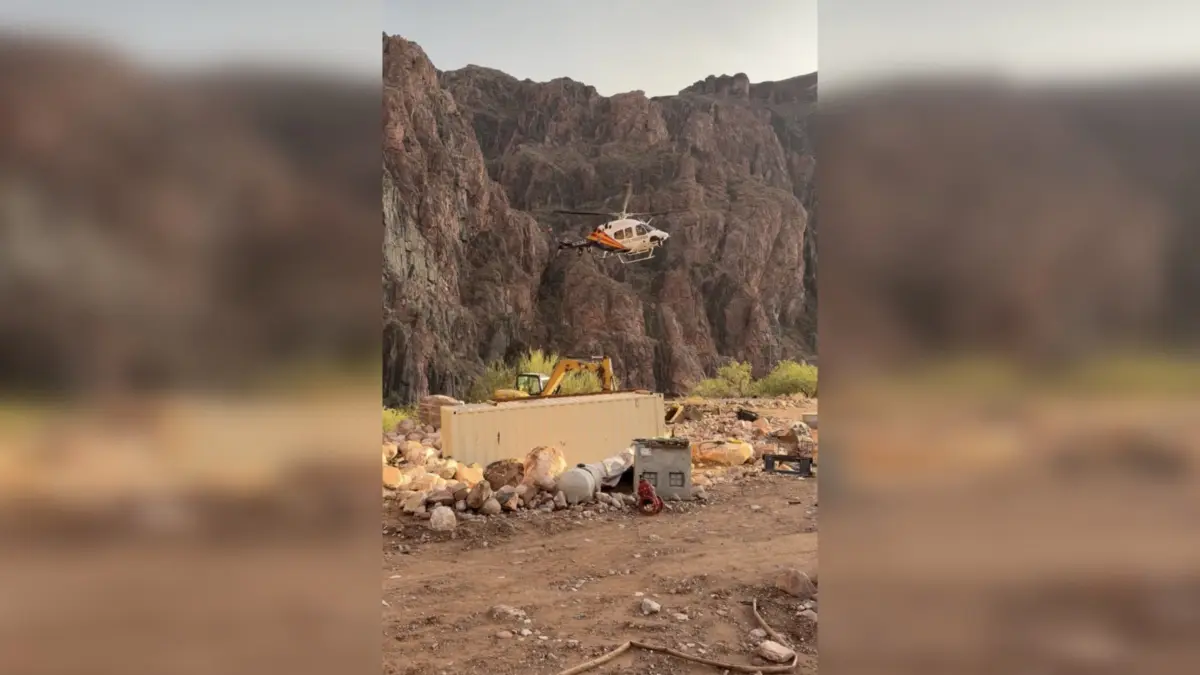
Just before 6:20 p.m., the first wave of rescue operations began. Gregory boarded an Arizona Department of Public Safety helicopter, lifting off and heading downriver.
Looking down from the aircraft, the Colorado River appeared deceptive. "It looked normal, even peaceful," Gregory noted. The water was churned into a milky, opaque brown, but surface debris was largely swept out of view. A video recorded by Gregory and later shared with the Grand Canyon Hikers Facebook Group captured a surreal juxtaposition: blue skies broken by fluffy clouds, with canyon walls glowing brilliantly in the late-afternoon light.
The helicopter touched down safely at Grand Canyon Airport at approximately 7:00 p.m., with the rest of Gregory’s hiking party arriving shortly thereafter on subsequent flights.
Supporting Data
- Date of Event: August 29, 2026.
- Date of Published Account: September 1, 2026.
- Location: Phantom Ranch, Grand Canyon National Park, Arizona.
- Evacuation Scale: More than 60 visitors, park staff, and maintenance workers rescued from the canyon floor.
- Casualties: At least 2 confirmed fatalities, with over a dozen individuals reported missing in the immediate aftermath of the flash flood.
- Itinerary of Gregory Party: Descended South Kaibab Trail, stayed at Phantom Ranch, planned ascent via Bright Angel Trail.
- Rescue Assets: Arizona Department of Public Safety helicopters, National Park Service (NPS) ground personnel, and local maintenance crews.
Official Responses and Emergency Management
In the wake of the disaster, the National Park Service (NPS) moved swiftly to secure compromised areas, close dangerous backcountry trails, and coordinate complex aerial extractions. Flash floods in deep canyons present unique tactical challenges for search-and-rescue teams, as communication lines are easily severed, trails washed out, and bridges destroyed within minutes.
Despite the chaos on the canyon floor, David Gregory offered high praise for the professionalism and efficiency of the park personnel.
"The NPS managed the evacuation exceptionally well," Gregory stated, emphasizing that at no point during the ordeal did he panic or fear for his group’s immediate safety. Rangers maintained strict order, conducted thorough headcounts, and successfully orchestrated the complex coordination required to land and load multiple helicopters in a confined space.
Park authorities have since launched comprehensive assessments of damaged infrastructure, focusing heavily on footbridges, water-treatment facilities, and trail beds along Bright Angel Creek and the Colorado River corridor. Official statements urge prospective hikers to monitor local weather warnings closely, as arid canyon environments are notoriously susceptible to sudden, highly localized monsoon events.
Implications and Lessons for Backcountry Hikers
While Gregory emerged from the disaster unscathed—remarking that losing a few articles of clothing was "no big deal"—learning about the fatalities among other canyon visitors cast a sobering shadow over the experience.
"Now I understand that not everybody got out," Gregory reflected. "Other people lost their lives."
The August 29 disaster serves as a grim reminder of the unforgiving nature of wilderness environments. Even for seasoned backpackers equipped with prior knowledge of the terrain, sudden meteorological shifts can turn benign vacation itineraries into fatal traps. Monsoon season in the American Southwest routinely produces flash floods capable of funneling massive walls of water down narrow canyon walls with little to no advanced warning.
Nevertheless, Gregory remains undeterred in his passion for the outdoors. Once recovery efforts conclude, trails are repaired, and debris is cleared from the canyon, he fully intends to return to the Grand Canyon.
"I don’t think it changes my opinion," Gregory concluded. "I know there’s always risks in hiking and doing outdoorsy things."
For the broader outdoor recreation community, the tragedy underscores the importance of maintaining situational awareness, respecting desert monsoon advisories, and acknowledging that preparedness cannot entirely eliminate the unpredictable power of nature.
