

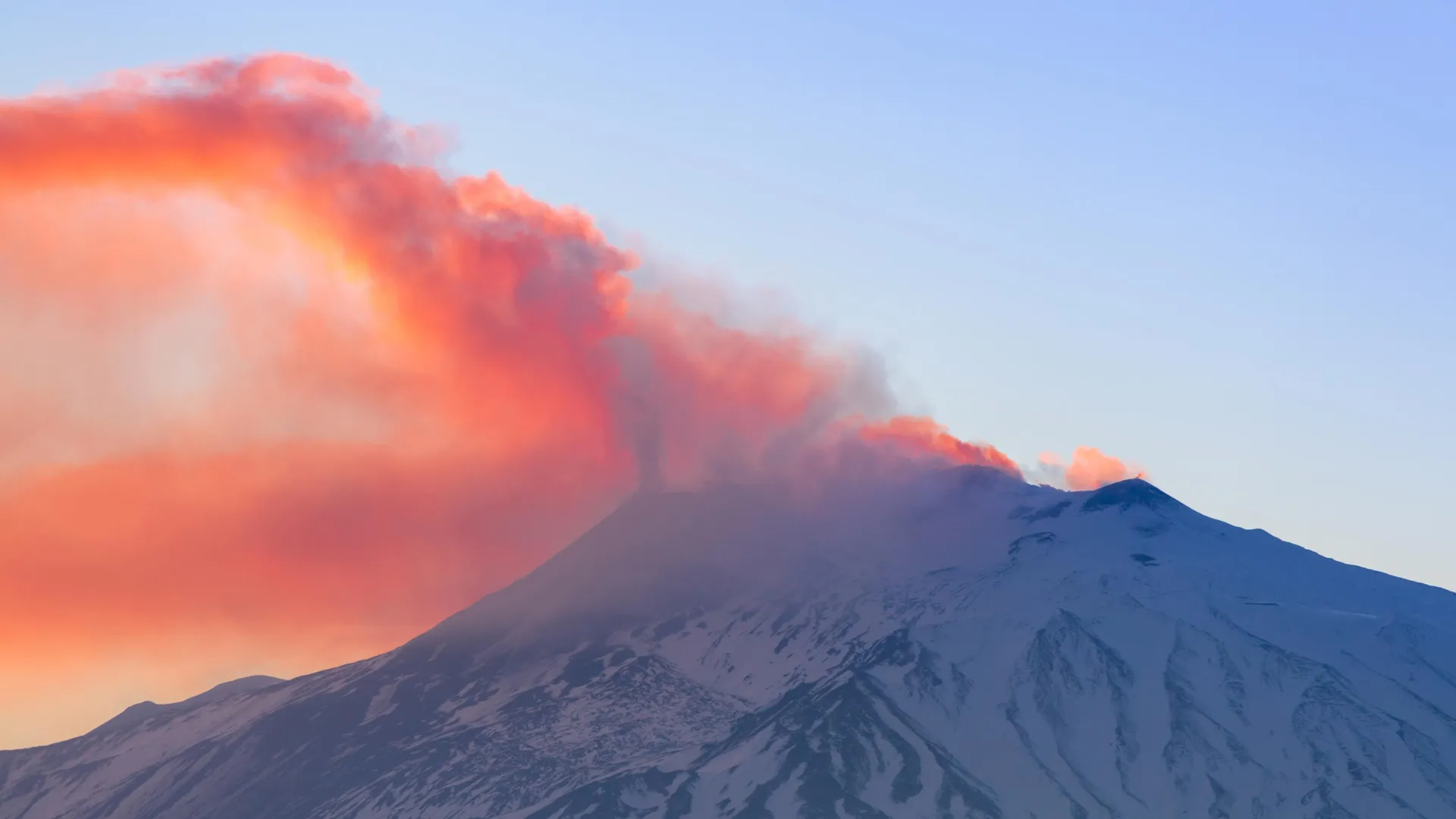
CATANIA, ITALY — Standing as a towering sentinel over the sun-drenched island of Sicily, Mount Etna has captivated the human imagination for millennia. From ancient Greek mythology, which housed the crippled blacksmith god Vulcan beneath its rumbling slopes, to the modern-day fascination of volcanologists worldwide, Europe’s most active volcano is a relentless force of nature. Erupting several times a year with spectacular displays of incandescent lava fountains and towering ash plumes, Etna is as mesmerizing as it is hazardous.
Yet, beneath its awe-inspiring geological theater lies a profound scientific mystery that has eluded geologists for decades: How did it actually form?
For generations, Mount Etna has refused to play by the rules of classical geology. It has stubbornly resisted all attempts to fit it into the textbook models of volcano formation that neatly categorize every other major volcanic structure on Earth. Now, an international team of researchers from the University of Lausanne (UNIL), in close collaboration with Anna Rosa Corsaro of the Istituto Nazionale di Geofisica e Vulcanologia (INGV) in Catania, has published a revolutionary study. Their findings suggest that Etna is not merely an anomaly—it may be entirely one of a kind, born from a rare volcanic process never before seen in a major stratovolcano.
Published in the prestigious Journal of Geophysical Research — Solid Earth, this new research proposes that the colossus of Sicily is powered by a mechanism previously thought exclusive to tiny, fleeting underwater vents. If proven correct, the study does not merely rewrite the biography of a single mountain; it introduces the terrifying and exhilarating possibility of a fourth, largely unrecognized category of volcanism on Earth. Beyond academic triumph, this breakthrough carries immediate, practical implications, potentially empowering INGV researchers in Catania to significantly sharpen volcanic hazard assessments and better protect the hundreds of thousands of residents living in Etna’s shadow.
Main Facts: The Enigma of Europe’s Highest Volcano
Rising more than 3,000 meters (9,800 feet) above the Mediterranean Sea and boasting a history that stretches back over half a million years, Mount Etna is a geological titan. To understand why its existence has baffled scientists, one must first look at how Earth’s plumbing system typically operates.
Conventionally, geologists group the Earth’s volcanoes into three distinct categories based on the origin and generation of their magma—the molten rock that fuels them:
- Divergent Boundaries: Where tectonic plates pull apart (such as the Mid-Atlantic Ridge), allowing magma from the mantle to ooze upward to fill the gap.
- Convergent Boundaries (Subduction Zones): Where one tectonic plate slides beneath another. The sinking plate releases water and gases, melting the overlying mantle and producing explosive volcanoes like those found along the Pacific "Ring of Fire."
- Hotspots: Plumes of abnormally hot rock rising independently from deep within the Earth’s core-mantle boundary, punching through the middle of tectonic plates to create massive shields like the Hawaiian Islands.
Mount Etna, however, gleefully breaks these rules. Geographically, it sits in a complex tectonic collision zone near the boundary of the African and Eurasian plates, a region heavily associated with subduction. Yet, when geologists analyze the chemical makeup of Etna’s lava, it stubbornly refuses to match the typical fingerprint of a subduction-zone volcano. Instead, its chemical signature closely resembles that of hotspot volcanoes—such as those in Hawaii or oceanic islands—despite the absolute absence of any deep mantle plume beneath Sicily.
For decades, this chemical identity crisis forced scientists to invent convoluted, stop-gap hypotheses. Some suggested a hidden window in the subducting slab; others proposed edge-driven convection. None of these theories could adequately account for the sheer volume, persistence, and chemical consistency of Etna’s eruptions over hundreds of thousands of years.
Chronology: Unraveling 500,000 Years of Volcanic History
To crack a case that has baffled generations of earth scientists, the research team at the University of Lausanne needed to look backward in time—way backward. They embarked on an exhaustive geochemical analysis of rock samples spanning roughly 500,000 years of Etna’s evolutionary history.
- The Prehistoric Genesis (c. 500,000 Years Ago): Volcanic activity in the region began as submarine eruptions off the coast of ancient Sicily before breaking the surface to build the earliest iterations of the volcano. From its very inception, the chemical composition of the lava was distinct from neighboring volcanic fields in the Aeolian Islands or southern mainland Italy.
- The Tectonic Squeeze: As the African tectonic plate relentlessly pushed northward, colliding with the Eurasian plate, the regional crust began to buckle, fracture, and bend.
- The 2006 "Petit-Spot" Paradigm Shift: A crucial historical milestone occurred when Japanese geologists formally identified a rare class of submarine volcanism known as "petit-spot" volcanoes. These tiny, localized volcanic structures provided tangible evidence for small, pre-existing pockets of melt trapped near the top of the Earth’s mantle—a theoretical concept first floated in the 1960s. Until recently, science assumed this mechanism was exclusively confined to microscopic, fleeting underwater anomalies.
- The Present Breakthrough: By meticulously reconstructing the chemical evolution of Etna’s lava across epochs and comparing those historical timelines with rigorous high-pressure laboratory experiments, the UNIL and INGV team realized something astounding. The chemical composition of Etna’s magma has remained remarkably stable over half a million years, completely unfazed by major shifts in the surrounding tectonic environment. This stability provided the smoking gun: the magma source was not being generated on-the-fly by modern subduction processes, but was instead being tapped from a pre-existing reservoir deep within the upper mantle.
Supporting Data: Inside the Hidden Magma Plumbing System
How does a mountain standing 3,000 meters high maintain its fiery output if it isn’t powered by a traditional magma chamber freshly brewed by subduction?
The new study paints a vivid picture of a hidden, deeply seated magma source residing in the upper mantle, roughly 80 kilometers (50 miles) beneath the surface of Sicily. In a typical volcano, magma is generated relatively quickly beneath the crust and ascends shortly before an eruption. Beneath Etna, however, small pockets of melt have apparently lingered in the upper mantle for extended periods, waiting in geological purgatory.
The engine driving these ancient magma pockets upward is the ongoing, grinding collision between the African and Eurasian tectonic plates. As the rigid African plate bends and flexes near the subduction zone, tensional stresses create deep fractures in the lithosphere. These fractures act like microscopic straws or cracks in a heavy-duty sponge. When the crust bends, it squeezes the upper mantle, forcing the trapped pockets of ancient magma upward through the crust.
[Eurasian Plate] <--- [Collision Zone] ---> [African Plate (Bending)]
                                                   |
                                           (Fractures Form)
                                                   |
                                                   v
                         [Mount Etna (3,000m+)] <== [Magma Squeezed from Upper Mantle (~80km Deep)]
This mechanical "squeezing" process effortlessly accounts for two of Etna’s greatest paradoxes:
- The Chemistry: Because the magma originates from small, pre-existing pockets in the upper mantle rather than melting crustal rocks dynamically, it retains its unique, hotspot-like chemical signature despite sitting in a subduction zone.
- The Longevity: The continuous flexure of the tectonic plates provides a reliable, long-term pump, explaining why Etna has remained persistently active for half a million years without exhausting its subterranean supply lines.
Official Responses and Expert Insights
The implications of this discovery have sent ripples through the international geological community. Lead author Professor Sébastien Pilet, of the Faculty of Geosciences and Environment at the University of Lausanne, emphasized just how unexpected these findings are.
"Our study suggests that Etna may have formed through a mechanism similar to the one that generates petit-spot submarine volcanoes," explains Professor Pilet. "This is unexpected, as such processes had previously only been observed in very small volcanic structures, typically rising no more than a few hundred meters. Mount Etna, by contrast, is a large stratovolcano, whose activity began around 500,000 years ago and which now towers more than 3,000 meters above sea level."
The collaboration with Italian institutions was vital to bridging theoretical models with empirical field data. Co-author Anna Rosa Corsaro, stationed at the INGV in Catania—an institution that monitors Etna’s every rumble, sigh, and tremor on a 24/7 basis—highlighted the practical value of the research. While theoretical geologists often look at timescales spanning millions of years, understanding the deep-seated plumbing of Mount Etna directly feeds back into modern hazard mitigation.
When local authorities need to assess the probability, scale, and composition of upcoming eruptions, knowing where the magma comes from and how it is transported through the crust is critical. By refining the underlying physics of Etna’s magma ascent, INGV scientists can better interpret real-time geophysical signals, such as seismic tremors and ground deformation, giving vulnerable communities crucial lead time when the giant awakens.
Implications: A New Chapter for Global Volcanology
Beyond the immediate borders of Sicily, the Lausanne-INGV study carries monumental implications for global geosciences. For decades, textbooks have taught that petit-spot volcanism is a geological curiosity—a minor footnote applicable only to tiny, insignificant submarine blisters on the ocean floor far away from civilization.
By demonstrating that this exact mechanism can scale up to construct one of the largest, most aggressive stratovolcanoes on the planet, the research challenges scientists to rethink the limits of tectonic and magmatic interactions. If petit-spot-like processes can build a 3,000-meter monster like Mount Etna, geophysicists must now ask a provocative question: How many other anomalous volcanoes around the world have been misclassified?
Researchers are already beginning to scour global geological datasets, looking for other enigmatic volcanoes—structures that similarly defy categorization by sitting stubbornly outside traditional divergent, convergent, or hotspot frameworks. Regions in the Mediterranean, parts of the East African Rift, and complex tectonic zones in Southeast Asia are prime candidates for re-examination under the lens of this new hypothesis.
Ultimately, Mount Etna remains a potent reminder of the Earth’s dynamic, restless nature. It has terrorized and inspired humanity for ages, pouring rivers of fire down its flanks and reshaping the Sicilian landscape. Yet, with every rock sample analyzed, every computer model refined, and every collaborative breakthrough achieved by institutions like UNIL and INGV, humanity strips away a little more of the mystery. Mount Etna may still be one of a kind, but thanks to modern science, its ancient secrets are finally coming to light.
