

Main Facts
For billions of years, the Moon has stood as a silent witness to the relentless fury of the solar wind, enduring an unceasing bombardment of high-energy charged particles streaming from the Sun. Devoid of a substantial atmosphere or a global intrinsic magnetic field to deflect this cosmic torrent, the lunar surface is constantly exposed, acting as a natural collector plate. However, groundbreaking new research published in the prestigious journal Nature Geoscience has revealed a profound asymmetry in this planetary battering.
According to an exhaustive analysis of precious lunar regolith brought back by China’s historic Chang’e 6 mission, the Moon’s near side and far side have not experienced solar wind bombardment in the same way. Particles striking the hemisphere facing Earth versus the hemisphere perpetually turned outward arrive at demonstrably different speeds, carry distinct energy profiles, and leave behind diverging isotopic signatures.
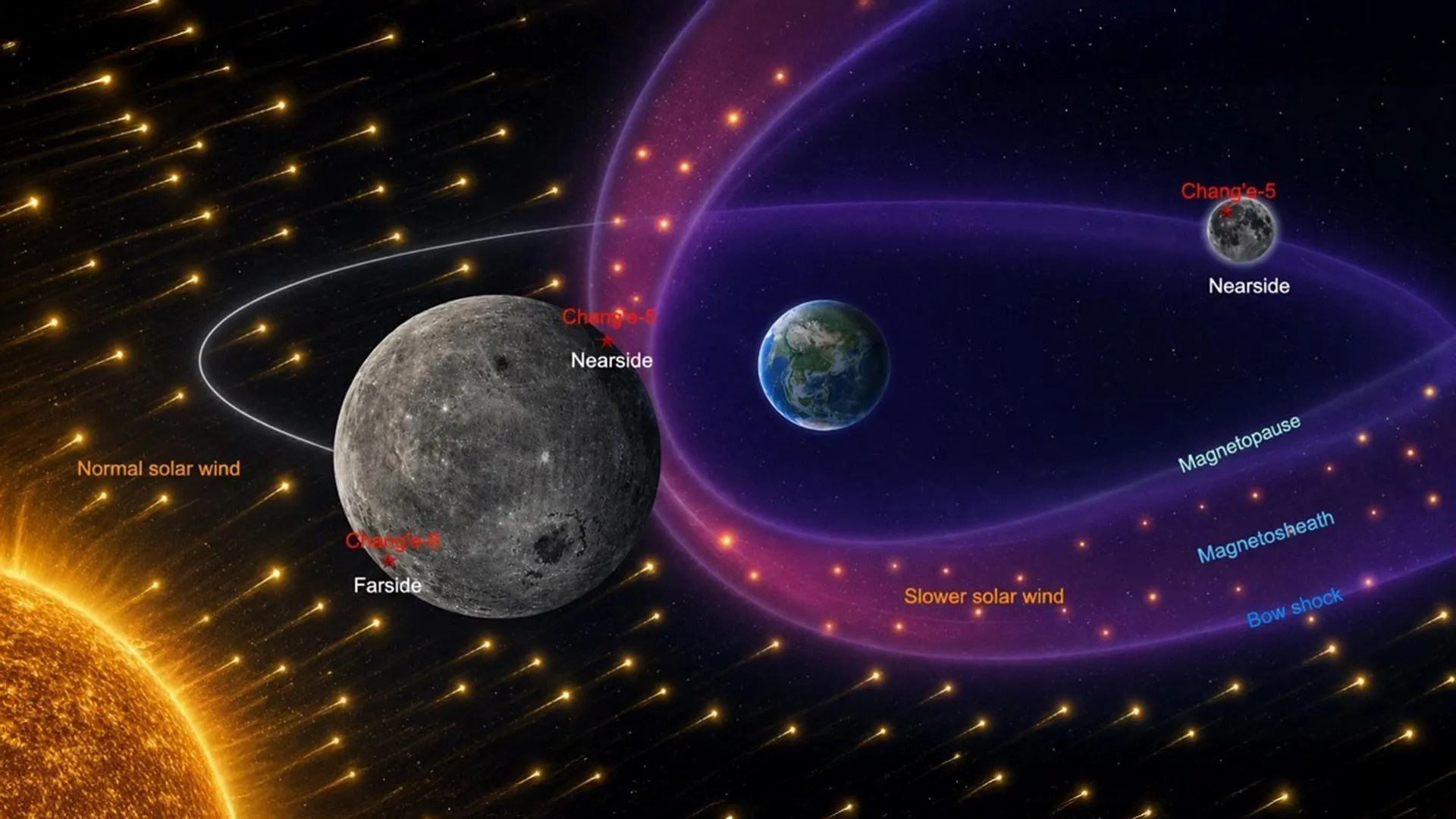
At the heart of this cosmic dichotomy is Earth itself. Our planet’s colossal magnetic bubble—the magnetosphere—acts as an invisible shield that alters the trajectory, velocity, and composition of the solar wind before it can settle onto the lunar near side. Meanwhile, the far side remains entirely unprotected, exposed to the raw, unadulterated fury of the interplanetary medium.
This monumental discovery was made possible by analyzing just 1.935 grams of soil retrieved from the South Pole-Aitken (SPA) basin on the lunar far side. By unlocking the chemical secrets held within this tiny pinch of lunar dust, scientists have not only rewritten the text on how space weathering affects planetary bodies, but they have also opened a revolutionary window into reconstructing Earth’s ancient magnetic history.
Chronology of Discovery
The Near-Side Blind Spot
For decades, humanity’s understanding of lunar regolith and solar wind implantation was strictly limited to samples gathered from the Moon’s near side. During the Apollo and Luna programs of the late 1960s and 1970s, and more recently through China’s Chang’e 5 mission, robotic and human explorers returned kilograms of material exclusively from the lunar near side.
While these legacy samples provided invaluable insights into solar history, they created an inherent scientific blind spot. Without material from the lunar far side for direct comparison, planetary scientists had no way of testing whether solar wind particles were being implanted uniformly across the entire lunar globe or if local environmental factors were skewing the data. Theoretical models suggested that Earth’s magnetosphere might interfere with the solar wind, but proving this hypothesis required physical samples from the hemisphere shielded from our planet’s view.
The Chang’e 6 Breakthrough
That limitation shattered in June 2024 when China’s Chang’e 6 ascent vehicle successfully lifted off from the lunar far side, carrying back 1.935 grams of pristine regolith from the ancient South Pole-Aitken basin—the largest, deepest, and oldest impact crater on the Moon.
The successful recovery of these samples marked a historic engineering milestone and provided researchers with the world’s first direct opportunity to cross-examine solar wind accumulation across both lunar hemispheres. A dedicated research team, led by postdoctoral researcher Xuhang Zhang and supervised by Professor He Huaiyu at the Institute of Geology and Geophysics (IGG) of the Chinese Academy of Sciences (CAS), immediately set to work analyzing the isotopic and elemental composition of the precious dust. Collaborating with researchers from the University of Science and Technology of China and members of the Chang’e 7 volatile payload team, the IGG scientists launched an intensive investigation into the noble gases trapped within the Chang’e 6 grains.
Supporting Data and Laboratory Analysis
To decipher the history written in the lunar soil, the research team focused on volatile materials delivered by the solar wind, specifically the noble gases: helium (He), neon (Ne), argon (Ar), krypton (Kr), and xenon (Xe). Because noble gases are chemically inert—meaning they rarely react or bond with other elements once they are trapped—they serve as pristine, unaltered markers of how solar wind particles entered and accumulated in the lunar regolith over geological timescales.
Isotopic Fractionation in Neon
The first major clue emerged from the analysis of neon isotopes. When the researchers measured the neon content in the Chang’e 6 regolith, they discovered an average $^20textNe/^22textNe$ ratio of $11.34 pm 0.22$. This value is notably lower than measurements recorded from all previously studied near-side samples.
Intriguingly, this lower ratio closely matches the theoretical composition predicted by models of intense solar wind fractionation. Isotopic fractionation occurs when lighter isotopes are preferentially scattered or accelerated differently than heavier ones. The stark difference between the near-side and far-side neon ratios demonstrated that the lunar far side had experienced a more aggressive degree of isotopic sorting, pointing to distinct environmental conditions during particle implantation.
Penetration Depth and Particle Energy
Further evidence of disparate solar wind conditions came from analyzing krypton and xenon isotopes through stepwise heating experiments in the laboratory.
During these controlled thermal tests, xenon trapped within the Chang’e 6 far-side material was released primarily at high temperatures, creating a distinct, single high-temperature peak. By contrast, samples from the Chang’e 5 near-side landing site revealed a markedly different release pattern, showing substantial amounts of xenon liberated at both low and high temperatures.
In planetary science, the temperature at which trapped gases escape during heating corresponds directly to how deeply those gases were buried within the mineral grains. Deeper implantation requires particles carrying greater kinetic energy. The single, high-temperature release peak in the Chang’e 6 samples proved that solar wind particles had penetrated much farther into the far-side regolith, confirming that the far side is consistently pelted by a faster, more energetic solar wind.
The Earth’s "Speed-Governing" Magnetosheath
To explain this disparity, the researchers looked to the mechanics of Earth’s magnetosphere. As the Moon orbits our planet, it regularly passes through the magnetosheath—a turbulent buffer region situated just outside the boundaries of Earth’s magnetic field.
Within this transition zone, the solar wind—which typically hurtles through interplanetary space at speeds averaging roughly 400 kilometers per second—is drastically slowed down to about 200 kilometers per second. Because the Moon’s near side constantly faces Earth, it frequently plunges into this sluggish buffer zone. The slower, lower-energy particles lack the velocity required to penetrate deeply into the lunar soil, leaving their chemical signatures concentrated near the very top of the regolith.
Conversely, the lunar far side perpetually turns its back on Earth. As it orbits, it remains largely outside the protective wake of the magnetosheath, leaving it fully exposed to the undisturbed, high-speed solar wind. Quantitative modeling by the research team estimates that roughly 25% of the total solar wind exposure recorded at the Chang’e 5 near-side site was subjected to this deceleration effect, whereas the far-side Chang’e 6 site showed zero evidence of such protection.
Official Responses and Expert Perspectives
The publication of these findings in Nature Geoscience has sent ripples through the global planetary science community, prompting enthusiastic commentary from researchers uninvolved in the study as well as the mission architects themselves.
"For decades, we treated the Moon as a uniform target when studying space weathering and solar history," noted Dr. Elena Vance, a senior planetary geochemist at the European Space Research and Technology Centre. "These findings prove that we cannot understand the Moon as a single body without accounting for its unique orbital dance with Earth. The Chang’e 6 samples have given us the Rosetta Stone for reading near-side versus far-side solar wind histories."
Professor He Huaiyu of the Chinese Academy of Sciences emphasized the technological triumph underpinning the scientific breakthrough. "Recovering samples from the South Pole-Aitken basin was an unprecedented engineering challenge," He stated during a press briefing following the paper’s release. "Without the foresight to target the far side and the precision engineering of the Chang’e 6 mission, this profound asymmetry between the two hemispheres would have remained entirely hidden from human knowledge."
Lead author Xuhang Zhang highlighted the broader implications for space physics, emphasizing that the interaction between planetary magnetic fields and stellar winds is far more dynamic than previously modeled. "We are not just looking at lunar dust; we are looking at a recording device that has been active for eons," Zhang explained. "Every grain of regolith on the far side tells a story of an unhindered solar wind, while the near side whispers of Earth’s protective embrace."
Implications for Future Research and Planetary Science
The revelation that Earth’s magnetosphere actively imprints itself onto the lunar soil opens up a thrilling new frontier in planetary science, with far-reaching implications for how scientists study both the Moon and Earth’s deep past.
A Fossil Record of Earth’s Magnetic History
One of the most exciting propositions put forward by the IGG research team is the potential to use heavy noble gases trapped in lunar soil as "fossil records" of Earth’s ancient magnetosphere. Earth’s magnetic field is not static; it fluctuates in strength, shifts its poles, and has evolved dramatically over the course of billions of years. However, finding direct geological evidence of Earth’s ancient magnetic environment—known as paleomagnetism—becomes increasingly difficult the further back in time scientists look, as Earth’s active plate tectonics constantly recycle and destroy crustal rocks.
The Moon, by contrast, does not experience plate tectonics. Its ancient regolith layers accumulate undisturbed over eons. By analyzing the isotopic ratios and implantation depths of noble gases in older layers of lunar soil across both hemispheres, scientists may soon be able to trace how Earth’s magnetosphere expanded, contracted, or fluctuated in intensity over billions of years. In essence, the Moon acts as an external hard drive, archiving the history of Earth’s magnetic shield.
Redefining Space Weathering Models
Furthermore, these discoveries necessitate a thorough revision of space weathering models used across the solar system. Planetary scientists study regolith on asteroids, Mars, and other moons to understand how cosmic radiation and solar winds alter surface minerals over time. The Chang’e 6 data demonstrates that planetary magnetic fields can create localized micro-environments that drastically alter space weathering rates between different hemispheres of the same world.
As space agencies look toward future crewed and robotic missions to the lunar surface—particularly with NASA’s Artemis program and China’s International Lunar Research Station (ILRS) initiatives—understanding the nuances of solar wind bombardment and radiation shielding becomes critical. Knowing how particle energies and fluxes differ between the near and far sides will help engineers design better radiation-resistant habitats, equipment, and spacesuits for astronauts operating in different lunar regions.
A More Complex Cosmic Trinity
Ultimately, the study underscores that the relationship binding the Sun, Earth, and Moon together is far more intricate and interdependent than 20th-century models suggested. The Moon is not merely a dead, inert rock orbiting our world in isolation; it is an active partner locked in a gravitational and magnetic tango with Earth, permanently recording the invisible forces that shape our cosmic neighborhood. As scientists continue to unpack the remaining treasures brought back by Chang’e 6, humanity stands on the brink of uncovering even more hidden chapters written in the dust of the lunar far side.
