

By Global Science Correspondent
Published in the Journal of Studies of Earth’s Deep Interior / Special Scientific Report
Introduction and Main Facts
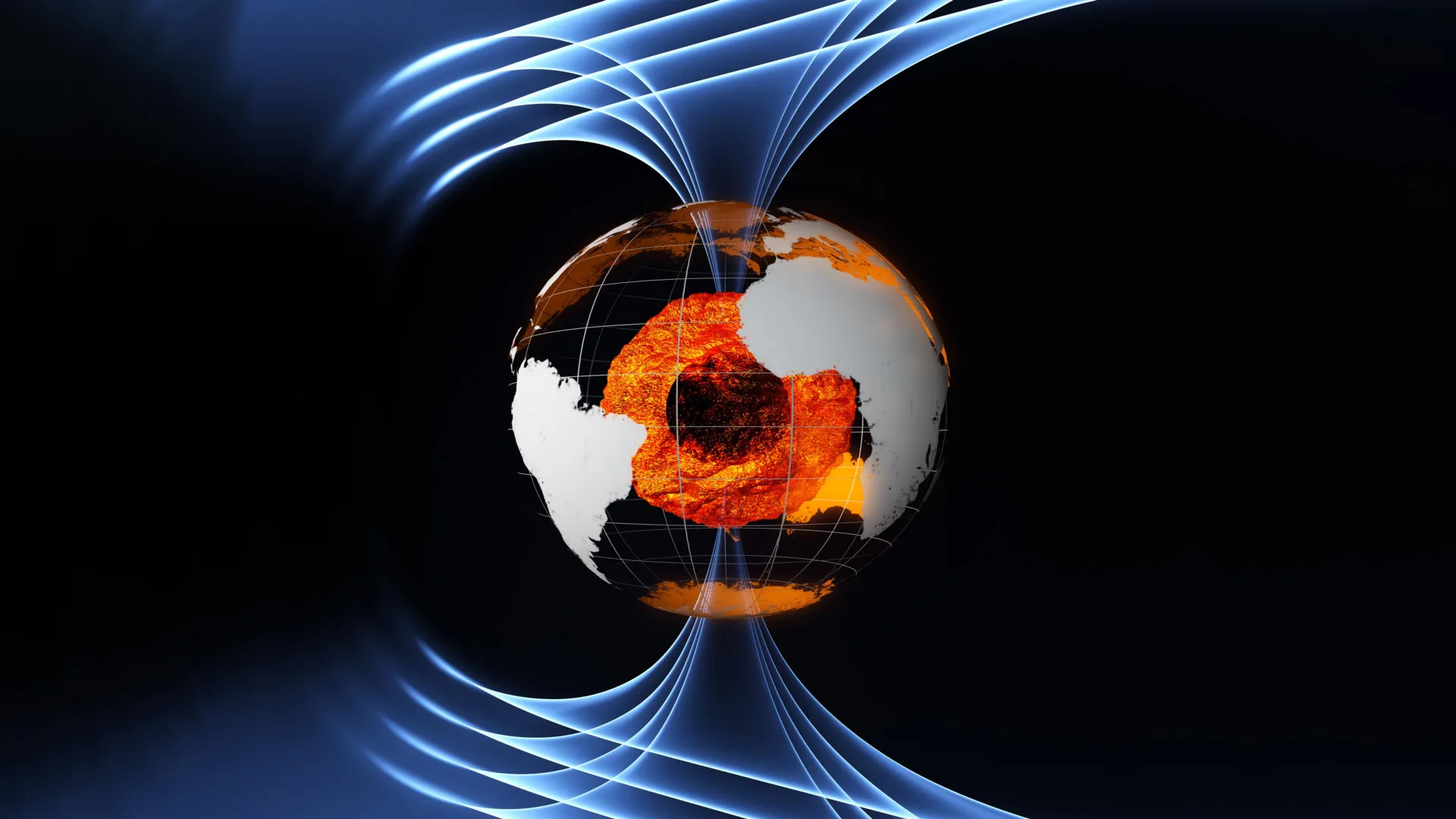
Deep beneath our feet, churning violently in absolute darkness, the liquid iron engine of our planet behaves in ways that continue to baffle theoretical physicists and geophysicists alike. Nestled roughly 2,200 kilometers (1,367 miles) beneath the Earth’s rocky crust lies the outer core—a tumultuous, electrically conducting ocean of molten metal whose swirling currents act as the ultimate generator for our planet’s geomagnetic field. For decades, the orthodox scientific consensus held that this vast subterranean sea was remarkably predictable on a macro scale, flowing predominantly in a steady, slow westward drift.
That comforting illusion of geological permanence was shattered recently when an international team of researchers, utilizing advanced orbital data from the European Space Agency (ESA), uncovered a startling anomaly. Beneath the vast expanse of the Pacific Ocean, a massive river of liquid iron completely reversed its trajectory. Abandoning its historical westward course, this subterranean torrent began barreling aggressively toward the east around the year 2010.
The discovery, published in the Journal of Studies of Earth’s Deep Interior, relies on a nearly three-decade synthesis of ground-based and satellite-derived geomagnetic measurements collected between 1997 and 2025. By blending legacy data with ultra-precise readings from modern orbital missions, researchers have mapped the inner dynamics of the Earth with unprecedented clarity. The findings not only upend decades of assumptions regarding the sluggish stability of the outer core but also hint at mysterious, profound mechanical connections spanning from the boundary of the inner core all the way up to the rocky mantle.
While these subterranean shifts occur at depths far beyond the reach of direct human exploration and pose zero direct threat to surface life or global climate systems, they strike at the heart of how we understand planetary evolution. The geodynamo—the physical process driven by this swirling molten iron—generates the invisible magnetic shield that deflects lethal solar radiation and protects Earth’s atmosphere. Understanding why this engine occasionally stutters, reverses, or accelerates is vital not only for fundamental science, but for safeguarding satellite infrastructure, navigation grids, and modern technological civilization against the whims of space weather.
Chronology of the Discovery: From 1997 to the Present
To understand how scientists managed to "see" thousands of kilometers through solid rock, one must examine the timeline of discovery, technological evolution, and the specific sequence of events that brought the Pacific reversal to light.
The Historical Baseline (1997–2009)
For generations, scientists studied the Earth’s magnetic field primarily through networks of surface observatories. While these ground stations provided continuous localized data, they struggled to cleanly separate the magnetic signals originating deep within the core from those generated by the Earth’s crust, the conductive oceans, and the sun-blasted ionosphere high above.
By the late 1990s and early 2000s, space agencies began deploying dedicated magnetic-field-mapping satellites. Missions such as Denmark’s Ørsted satellite (launched in 1999) and Germany’s CHAMP mission (launched in 2000) began providing global, space-borne perspectives. During this era, analyses of magnetic secular variation—the slow changes in the geomagnetic field over time—reinforced the long-held dogma of the outer core: a dominant, sluggish westward drift of fluid across most of the globe, occasionally punctuated by minor, localized perturbations.
The Turning Point: The 2010 Pacific Reversal
Without warning, the quiet consistency of the equatorial Pacific broke down around 2010. According to the new study led by Frederik Dahl Madsen of the University of Edinburgh’s School of Geosciences, a massive regional area of iron-rich fluid situated beneath the Pacific plate executed an abrupt dynamical U-turn.
Instead of creeping westward, this broad expanse of molten metal shifted dynamically into a strong eastward flow. Because the transition happened on a geological timescale of mere years, it caught researchers off guard. The event was subtle enough at first to be masked by the ambient "noise" of crustal and atmospheric magnetic interference, requiring years of subsequent orbital data to isolate, verify, and fully map.
The Swarm Era and the 2017 Geomagnetic Jerk (2013–2020)
Recognizing the desperate need for higher-resolution, long-term spatial data, the European Space Agency launched its trio of Swarm satellites in 2013. Flying in carefully coordinated, low-Earth orbits, the Swarm constellation was engineered specifically to untangle the complex web of magnetic influences acting upon the planet.
Although Swarm was launched shortly after the initial 2010 reversal, its ultra-sensitive magnetometers immediately began capturing the aftermath with astonishing fidelity. In 2017, the satellites recorded a sharp, localized disruption known as a "geomagnetic jerk"—an abrupt change in the acceleration of the Earth’s magnetic field. Researchers now understand that this jerk was intrinsically tied to the turbulent, wave-like adjustments occurring as the eastward-flowing core material interacted with surrounding fluid structures.
The Recent Slowdown and 2025 Synthesis (2020–Present)
As researchers integrated data stretching up through 2025, a new trend emerged. Mathematical models and satellite tracking indicate that the roaring eastward flow beneath the Pacific has not continued its unchecked acceleration; rather, it has begun to noticeably weaken since 2020. This recent deceleration has sparked intense debate among geophysicists, fueling theories that the 2010 reversal was not a permanent restructuring of the core, but rather a violent, short-lived fluctuation or part of a vast, multi-decadal natural oscillation cycle.
Supporting Data and Technological Marvels
Unlocking the secrets of the core from the safety of low-Earth orbit sounds like science fiction, but it is a triumph of modern engineering and data science. The research published in the Journal of Studies of Earth’s Deep Interior succeeds precisely because it bridges the gap between historical ground recordings and state-of-the-art orbital remote sensing.
Untangling the Magnetic Symphony
The Earth’s magnetic field is not a simple, static dipole like a bar magnet; it is a chaotic, overlapping symphony of signals.
- The Core Field: Accounts for more of the primary magnetic field, generated by convective currents in the liquid outer core.
- The Crustal Field: Produced by magnetized rocks in the Earth’s outer shell, acting as a static background noise to core researchers.
- External Fields: Currents flowing in the ionosphere and magnetosphere, driven by solar winds and solar radiation, constantly fluctuate on daily and seasonal cycles.
To isolate the minute variations caused by fluid movements 2,200 kilometers down, ESA’s Swarm mission utilizes three identical satellites flying in tandem formations (two side-by-side at lower altitudes, one slightly higher). By comparing simultaneous readings across these precise spatial baselines, scientists can mathematically subtract the crustal and atmospheric "noise," leaving a pristine window into the core-mantle boundary.
Wave-Like Accelerations in the Abyss
One of the most profound discoveries enabled by this high-precision orbital data was the identification of rapid, wave-like accelerations within the liquid iron. Traditionally, fluid dynamics within planetary cores were modeled as slow, viscous creeps. However, the satellite data revealed rapidly shifting flow structures—such as magnetohydrodynamic waves—that ripple through the core with surprising speed.
These rapid accelerations explain how a regional current can reverse its direction within a single decade. The data shows that the fluid is not merely drifting passively; it is experiencing intense, localized magnetic and thermal pressures that can whip massive volumes of molten metal into sudden, high-velocity currents.
Official Responses and Scientific Perspectives
The implications of this study have rippled across the global geophysical community, prompting deep reflection from mission leaders and lead researchers alike.
Frederik Dahl Madsen, lead author of the study from the University of Edinburgh, emphasized the disruptive nature of the findings:
"The large-scale flow reversal beneath the Pacific raises new questions about the behavior of Earth’s deep interior. Scientists now want to understand whether the reversal represents a short-lived fluctuation, part of a repeating oscillation, or a new stable equilibrium for core circulation. Continued monitoring will be essential to determine how the flow evolves over the coming years."
Madsen also highlighted a tantalizing correlation regarding the planet’s absolute center. The period during which the strong eastward flow emerged in the Pacific coincides with unusual behavioral shifts observed in the solid inner core through seismic and geodetic studies.
"We hypothesize that these changes in the deep interior are associated with the changes in flow beneath the Pacific," Madsen noted, pointing toward a deeply interconnected core system.
From the operational side, Anja Stromme, ESA’s Swarm Mission Manager, stressed the irreplaceable value of continuous, long-term orbital observation:
"Although Swarm was launched after the dramatic reversal event of 2010, it has provided high-precision data that tell us about Earth’s inner core in the period that followed. Importantly, Swarm provides continuous global coverage over many years, allowing scientists to track how core dynamics evolve over time rather than relying only on ground-based magnetic observatories."
Stromme added that long-duration satellite missions allow researchers to follow the geodynamo in near-real-time, permanently upgrading our evolutionary models of the planet’s magnetic shield.
Echoing these sentiments, Elisabetta Iorfida, ESA Swarm Mission Scientist, pointed out how the Pacific event shatters old textbook dogmas regarding core stability:
"This study shows that regional changes can emerge rapidly within just a decade. The findings may also help scientists investigate possible interactions between Earth’s outer core, inner core, lower mantle and, therefore, give more insights into core-mantle boundary, which is a critical region for the deep Earth dynamics."
Iorfida concluded that as the magnetic field continues to shift, satellite constellations are pulling back the curtain on a subterranean realm that is far more complex, variable, and dynamic than science ever previously imagined.
Implications: Why Earth’s Core Matters to Us
To the casual observer, news of a molten metal river changing direction halfway to the center of the Earth can sound unsettling. Yet, geophysicists are quick to reassure the public: these events are entirely natural processes that have occurred throughout our planet’s 4.5-billion-year history. They pose zero direct hazard to human life, tectonic stability, or the global climate.
However, the implications for our high-tech society and our scientific understanding of planetary habitability are immense.
Protecting Our Technological Civilization
The primary reason we must care about the churning outer core is the geodynamo. Without the relentless convection of liquid iron generating our planet’s vast magnetic field, Earth would be stripped of its protective magnetosphere.
When high-energy solar winds and coronal mass ejections slam into Earth, the magnetic field traps and deflects these deadly charged particles. If the core’s internal dynamics experience wild fluctuations—such as the rapid reversals and wave accelerations detected beneath the Pacific—the geometry and strength of the global magnetic field shift in tandem.
These shifts have direct, practical consequences:
- Navigation Systems: Compasses and digital navigation tools rely on accurate models of the Earth’s magnetic poles, which are constantly drifting and accelerating in response to core dynamics.
- Spacecraft and Satellites: Fluctuations in the magnetosphere alter the density and behavior of the ionosphere, increasing atmospheric drag on low-Earth-orbit satellites and threatening delicate electronics with radiation damage.
- Ground Infrastructure: Severe geomagnetic disturbances can induce electrical currents in power grids and communication cables, risking widespread blackouts.
A Window Into Planetary Evolution
Beyond practical technological safeguards, unlocking the secrets of the core-mantle boundary gives scientists a clearer lens through which to study rocky exoplanets across the universe. By learning how Earth maintains a stable, life-supporting magnetic shield despite turbulent, chaotic internal disruptions like the Pacific flow reversal, astrobiologists can better define what makes a distant world truly habitable.
As research continues into the late 2020s and beyond, teams utilizing ESA’s Swarm satellites and future orbital architectures will keep a watchful eye on the Pacific basin. Whether the recent deceleration of the eastward flow signals a return to historical norms or the beginning of a sweeping new epoch in core circulation remains to be seen. What is certain, however, is that our planet’s deepest secrets are slowly yielding to science, revealing an interior world far more alive and restless than we ever dared to imagine.
