

By Global Environmental Desk
Published: October 2023
1. Main Facts
Coastal communities across the globe are facing a profound and escalating environmental crisis driven by a dual threat: oceans are expanding due to climate change, while the ground beneath many of the world’s most densely populated coastal regions is actively sinking. This dynamic creates a dangerous "double jeopardy" scenario, dramatically accelerating relative sea level rise for hundreds of millions of people.
According to groundbreaking research published in the journal Nature Communications by scientists from the Technical University of Munich (TUM) and Tulane University, human populations living in heavily populated coastal zones are experiencing an average relative sea level rise of approximately 6 millimeters per year.
This figure is alarming when contrasted against global benchmarks:
- It is nearly three times the coastline-weighted global average of 2.1 millimeters per year.
- It is nearly twice the climate-driven absolute sea level rise of 3.15 millimeters per year.
The primary catalyst for this discrepancy is land subsidence—the gradual sinking or settling of the Earth’s surface. While melting ice sheets and thermal expansion drive water levels upward from the sea, human activities and geological phenomena are pulling the land downward from beneath our feet. With over half a billion people residing in low-lying coastal zones worldwide, this compounded vulnerability threatens urban infrastructure, global commerce, and human security on an unprecedented scale.
2. Chronology of Coastal Vulnerability and Scientific Discovery
Understanding how humanity arrived at this critical juncture requires tracking the convergence of historical industrial development, urban expansion, and the evolution of satellite-based earth observation.
- Early 20th Century – The Dawn of Intensive Extraction: As global industrialization accelerated, cities expanded rapidly along coastlines and river deltas. To support growing populations and industries, municipalities began drilling deep into underground aquifers for freshwater. Simultaneously, the discovery and extraction of oil and natural gas transformed coastal economies, initiating widespread subsurface depressurization.
- The Mid-to-Late 20th Century – Emergence of Subsidence Hotspots: By the mid-1900s, excessive groundwater withdrawal had triggered catastrophic land subsidence in several major cities. For instance, Tokyo experienced sinking rates exceeding 10 centimeters per year, with extreme locations plunging by up to 24 centimeters annually. Similar crises emerged in Houston and Galveston, Texas, prompting local authorities to take unprecedented regulatory action.
- 1975 – Regulatory Precedents: Recognizing that human activity was actively destabilizing the ground, the state of Texas established the Harris-Galveston Subsidence District in 1975. This marked one of the earliest institutional acknowledgments that land sinking could be mitigated through strict water management and the development of alternative municipal water supplies.
- The 21st Century – The Advent of Geodetic Tracking: With the advent of advanced satellite geodesy—including Interferometric Synthetic Aperture Radar (InSAR) and Global Navigation Satellite Systems (GNSS)—scientists gained the unprecedented ability to measure millimeter-scale deformations of the Earth’s crust from space.
- Recent Breakthroughs (DGFI-TUM & Tulane University): A joint research team from the German Geodetic Research Institute at TUM (DGFI-TUM) and Tulane University synthesized global geodetic data with population distribution metrics. Their published findings in Nature Communications provided the first comprehensive global assessment showing that population-weighted relative sea level rise along heavily populated coasts is far outpacing climate-driven absolute sea level rise alone.
3. Supporting Data and Regional Breakdown
The severity of land subsidence varies wildly by region, influenced by local geology, industrial practices, and municipal water management. The TUM and Tulane study categorized countries and metropolitan areas based on population-weighted coastal averages of relative sea level rise.
National Vulnerability Rankings
- High-Risk Nations (7 to 10 mm/year): Thailand, Bangladesh, Nigeria, Egypt, China, and Indonesia record the highest population-weighted relative sea level rises in the world.
- Moderate-to-High Risk Nations (4 to 5 mm/year): The United States, the Netherlands, and Italy exhibit elevated rates driven by a combination of historical industrial extraction, deltaic sediment compaction, and rising seas.
Major Subsidence Hot Spots (Average Sinking Rates)
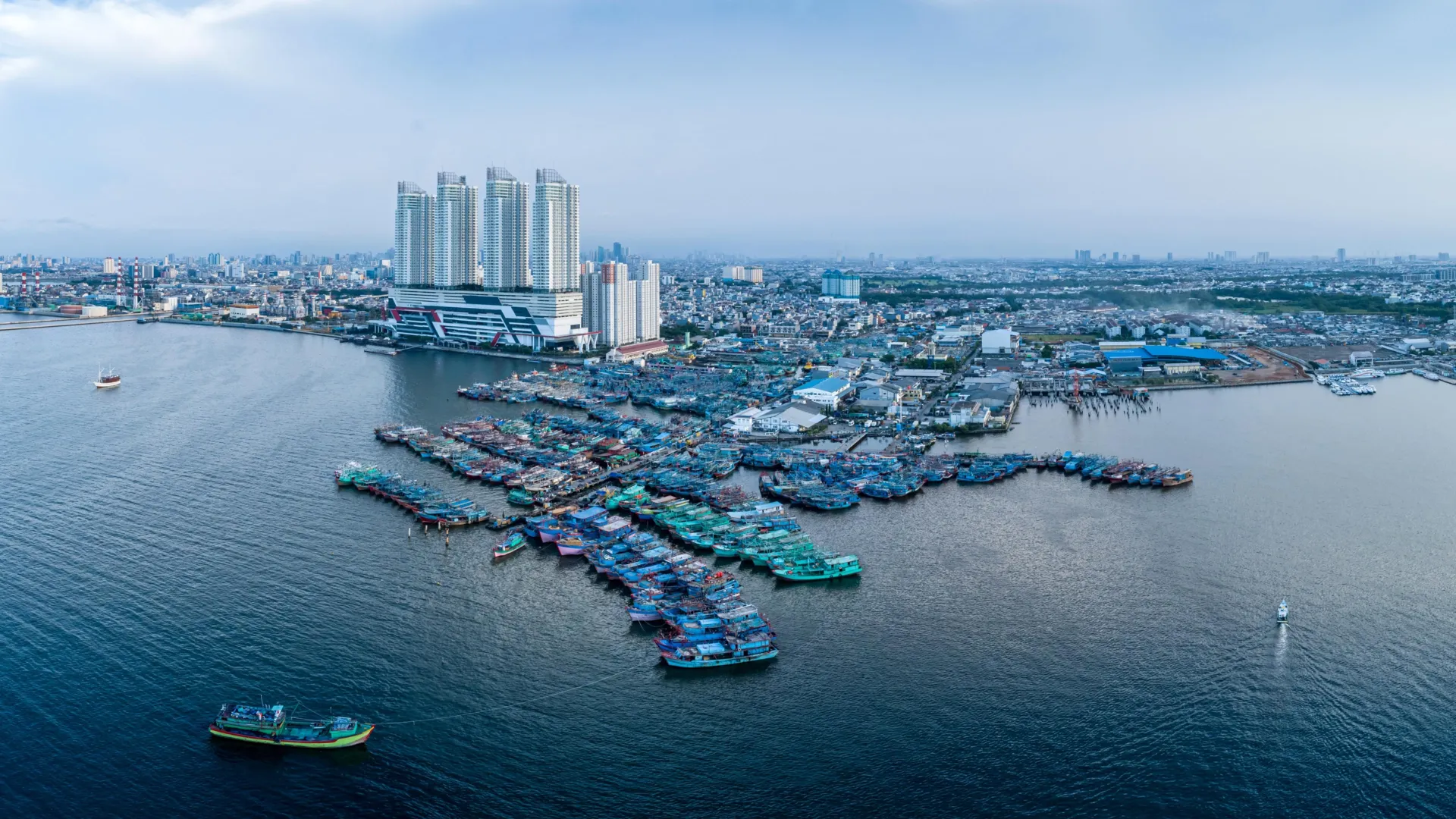
- Jakarta, Indonesia: 13.7 mm/year (Note: Micro-level variations reveal parts of Jakarta sinking by an extreme 42 millimeters per year, while isolated sections experience minor uplift).
- Tianjin, China: 13.5 mm/year
- Bangkok, Thailand: 8.5 mm/year
- Lagos, Nigeria: 6.7 mm/year
- Alexandria, Egypt: 4.0 mm/year
The Counter-Trend: Postglacial Uplift
Not every coastline on Earth is sinking. In northern Europe, particularly across parts of Sweden and Finland, geological processes are producing a relative decline in sea level. These regions are experiencing postglacial rebound—the continuous upward adjustment of the Earth’s crust following the melting of massive ice sheets from the last Ice Age. In these unique areas, the rate of land uplift is currently outpacing the rate of absolute sea level rise.
4. Official Responses and Scientific Insights
The scientific community stresses that addressing coastal inundation requires shifting focus from the oceans alone to an integrated approach that monitors and manages the land.
"If we want to understand sea-level rise along coastlines and respond effectively, we must not only observe the ocean but also the land itself," says Dr. Julius Oelsmann, lead author of the study and a researcher at DGFI-TUM. "Especially in densely populated coastal regions, human activities cause the land to subside more strongly—often due to excessive extraction of water and resources that previously stabilized the subsurface. The sheer weight of cities, along with long-term geological processes, can further intensify this subsidence. In doing so, we significantly amplify the effects of climate-driven sea-level rise."
Dr. Oelsmann’s insights highlight that while tectonic movements and the natural compaction of young river delta sediments play a role, anthropogenic (human-caused) pressures are the accelerators. The sheer weight of concrete skyscrapers, combined with the evacuation of subsurface fluids, collapses the porous geological layers that once provided structural stability.
However, experts emphasize that unlike melting polar ice sheets—which require global climate agreements to address—land subsidence can be directly influenced by local and regional policy decisions.
"In many large coastal cities, groundwater extraction is a major driver of land subsidence. This means that local political and water-management decisions can make a significant difference," explains Florian Seitz, Professor of Geodetic Geodynamics and Director of DGFI-TUM. "Improved groundwater management, stricter regulation of withdrawals, or targeted recharge of aquifers can at least slow subsidence rates and, in some cases, largely halt them."
Historical case studies prove that such interventions work. Tokyo’s aggressive shift toward alternative water sources and strict regulatory caps on groundwater extraction successfully brought its historic double-digit subsidence rates down to manageable levels. Similarly, the Harris-Galveston Subsidence District in Texas demonstrated that institutional oversight, public education, and resource conservation can effectively stabilize sinking terrain.
5. Implications for the Future
The convergence of sinking land and rising oceans carries profound socioeconomic, ecological, and geopolitical implications for the 21st century.
Infrastructure and Economic Devastation
As coastal land sinks at rates multiple times faster than global sea level rise, critical infrastructure—including ports, airports, roadways, power plants, and sewage treatment systems—faces premature obsolescence. Foundations weaken, drainage systems fail, and regular high tides increasingly transform into destructive inland floods. Financial markets are beginning to reprice coastal real estate and municipal bonds as the structural risks of subsidence become impossible to ignore.
Human Displacement and Climate Migration
More than half a billion people living in low-lying coastal zones face the mounting prospect of displacement. Megacities across Southeast Asia, West Africa, and the Mediterranean risk frequent inundation long before worst-case climate models predicted. In response, governments are grappling with difficult decisions regarding managed retreat, multi-billion-dollar sea wall construction, and the relocation of entire urban populations—such as Indonesia’s ongoing relocation of its capital from sinking Jakarta to the newly developed city of Nusantara.
Policy Imperatives: Integrating Land and Water Management
The findings from TUM and Tulane University issue a clarion call to urban planners, policymakers, and international climate bodies. Traditional climate adaptation strategies that focus solely on building higher seawalls or pumping sand onto beaches are insufficient if the ground beneath those defenses continues to collapse.
Effective coastal management moving forward must:
- Implement strict monitoring of subsurface aquifers using satellite InSAR technology.
- Enforce rigorous legal limits on industrial groundwater pumping and hydrocarbon extraction in vulnerable river deltas.
- Invest in managed aquifer recharge programs to replenish depleted underground water storage.
- Integrate geodetic land-motion data into every level of urban zoning and coastal defense planning.
Ultimately, while humanity cannot immediately halt the thermal expansion of the oceans or the melting of ancient glaciers, it holds the power to stop pulling the rug out from under its own coastal cities. By addressing the invisible crisis of sinking land, vulnerable nations can buy critical time in the race against rising seas.
