

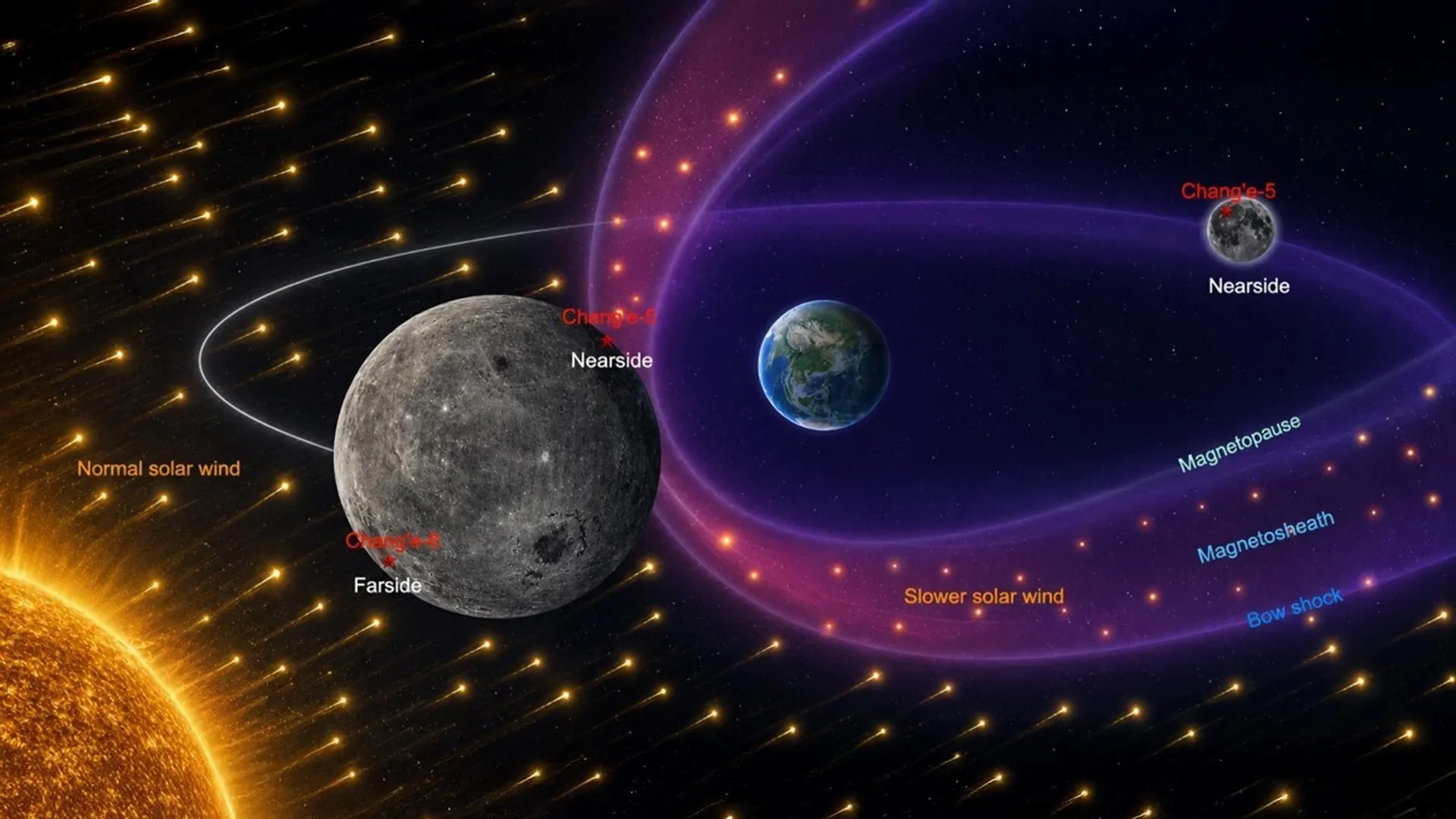
BEIJING — For billions of years, Earth’s desolate companion has stood as an exposed sentinel in the inner solar system. Devoid of a substantial atmosphere or a global intrinsic magnetic field, the Moon has served as an unshielded target, absorbing a continuous, high-speed gale of charged particles streaming outward from the Sun.
Yet, groundbreaking new research reveals that this celestial bombardment has been far from uniform. Analysis of pristine lunar regolith returned by China’s historic Chang’e 6 mission has provided definitive proof that the Moon’s near and far sides experience the solar wind in radically different ways. Particles striking the lunar near side—the familiar face turned toward our planet—arrive at slower speeds and carry lower energy levels than those hammering the enigmatic, perpetually hidden far side.
Published in the journal Nature Geoscience, the findings point to an unexpected culprit for this hemispheric divide: Earth’s own invisible magnetic shield, the magnetosphere. By acting as a cosmic speed bump, our planet’s protective bubble alters the solar wind before it hits the lunar surface, leaving a permanent, legible isotopic diary trapped within the dust of the lunar highlands and maria.
Main Facts: A Tale of Two Hemispheres
The revelation fundamentally shifts how planetary scientists view the space environment surrounding the Earth-Moon system. The core discovery centers on the dichotomy of solar wind implantation across the lunar globe.
- The Solar Wind Interface: Without an atmosphere or global magnetic field, the Moon is directly battered by the solar wind—a relentless stream of protons, electrons, and minor ions emitted by the Sun’s corona at speeds typically averaging 400 kilometers per second.
- The Chang’e 6 Breakthrough: For decades, science was limited to analyzing soil samples gathered exclusively from the lunar near side, courtesy of the Apollo, Luna, and Chang’e 5 missions. The lack of far-side samples meant researchers could only theorize about hemispheric differences in solar wind exposure. This changed when Chang’e 6 successfully retrieved 1.935 grams of regolith from the South Pole-Aitken (SPA) basin on the lunar far side.
- Isotopic and Energetic Contrasts: Laboratory analysis revealed stark contrasts between the near-side and far-side samples. Neon isotopes showed that the far side experienced more intense isotopic fractionation. Furthermore, stepwise heating experiments tracking heavy noble gases like krypton and xenon demonstrated that solar wind particles penetrated significantly deeper into the far-side regolith, pointing to higher particle velocities.
- Earth’s Shielding Role: The underlying mechanism is Earth’s magnetosphere. As the Moon orbits our planet, it regularly passes through the magnetosheath—a turbulent buffer zone where the solar wind is dramatically decelerated to roughly 200 kilometers per second. Because the near side faces Earth, it experiences this deceleration, while the far side remains exposed to the unmitigated, high-velocity solar wind of interplanetary space.
Chronology: From Unreachable Far Side to Revolutionary Sample Return
The path to uncovering this planetary asymmetry spans decades of theoretical space physics, culminating in a rapid sequence of milestone space missions by the China National Space Administration (CNSA).
The Era of Near-Side Assumptions (Pre-2020)
For over fifty years, lunar science was built on samples restricted to the near side of the Moon. While these samples provided profound insights into lunar geology, volcanism, and the history of the solar wind, they created an incomplete picture. Planetary scientists understood that Earth’s magnetosphere interacted with the solar wind, creating a long magnetic tail (the magnetotail) and a surrounding sheath, but they could only model how this affected the Moon theoretically. Without physical samples from the opposite hemisphere, hypotheses regarding differential solar wind weathering remained unprovable.
The Chang’e 5 Benchmark (December 2020)
A critical stepping stone arrived when China’s Chang’e 5 mission touched down on the near side of the Moon (specifically in Oceanus Procellarum) and returned 1.731 kilograms of younger volcanic regolith to Earth. Analyzed extensively by international and Chinese laboratories, these samples provided a high-precision baseline for near-side solar wind volatile inventory, including trapped helium, neon, argon, krypton, and xenon.
The Chang’e 6 Triumph (June 2024)
The paradigm shifted permanently in mid-2024. The Chang’e 6 mission executed a technically demanding, flawless landing within the South Pole-Aitken basin—one of the largest and deepest impact craters in the solar system, located squarely on the lunar far side. After collecting surface and subsurface material using a robotic arm and a drill, the ascent vehicle lifted off, transferred its payload to an orbiter, and dispatched a reentry capsule back to Earth. The capsule parachuted safely into the Siziwang Banner in China’s Inner Mongolia autonomous region on June 25, 2024, delivering 1.935 grams of precious far-side regolith.
Laboratory Analysis and Publication (Late 2024 – Early 2025)
Immediately following the curation of the Chang’e 6 samples, a dedicated research team led by the Institute of Geology and Geophysics (IGG) of the Chinese Academy of Sciences (CAS) set to work. Utilizing ultra-sensitive mass spectrometers, the team meticulously measured the concentrations and isotopic compositions of noble gases trapped inside the far-side mineral grains. By comparing these metrics against the Chang’e 5 near-side dataset, the researchers unlocked the comparative history of solar wind bombardment, culminating in their landmark publication in Nature Geoscience.
Supporting Data: What the Noble Gases Tell Us
Noble gases—helium (He), neon (Ne), argon (Ar), krypton (Kr), and xenon (Xe)—are chemically inert. Because they rarely react with surrounding elements once they are implanted into mineral grains by the solar wind, they act as near-perfect geological tape recorders. They retain the precise physical characteristics of the particles that embedded them eons ago.
The Neon Isotope Signatures
One of the most striking pieces of evidence emerged from the analysis of neon isotopes. The Chang’e 6 far-side regolith exhibited an average $^20textNe/^22textNe$ ratio of $11.34 pm 0.22$.
This value is significantly lower than the ratios measured in all previously studied near-side samples. In solar physics, a lower ratio corresponds to a higher degree of isotopic fractionation—a process where lighter isotopes are preferentially scattered or lost relative to heavier ones. The data confirms that the lunar far side has been subjected to a harsher, more direct, and unhindered solar wind regime, allowing this distinct isotopic fingerprint to develop without the moderating influence of a planetary shield.
Thermal Release Profiles of Xenon
Further proof of energetic disparity came from examining how heavy noble gases were bound within the soil matrix. During laboratory stepwise heating experiments—where mineral samples are heated incrementally to release trapped gases—the behavior of xenon proved telling.
- Near-Side Pattern (Chang’e 5): Samples from the near side released substantial amounts of solar-wind-derived xenon across both low-temperature and high-temperature phases, indicating a broad distribution of implantation depths, consistent with lower-energy, slowed particles.
- Far-Side Pattern (Chang’e 6): In stark contrast, xenon from the far-side material was released predominantly at high temperatures, creating a sharp, singular high-temperature peak.
According to solid-state physics, gases released only at high temperatures are locked deep within the crystal lattices of the regolith grains. Deep implantation requires high-velocity, high-energy ions. Thus, the thermal release data confirmed that the solar wind particles striking the far side possessed greater kinetic energy than those reaching the near side.
Official Responses and Scientific Perspectives
The implications of the study have drawn widespread praise from the global planetary science community, highlighting the value of sample-return missions from uncharted lunar terrains.
Leadership and Research Insights
Xuhang Zhang, a postdoctoral researcher at IGG and lead author of the study, emphasized the profound nature of the discovery.
"For decades, we treated the Moon as a uniform collector of solar wind," Zhang noted. "What these far-side samples show us is that the Earth is actively participating in shaping the lunar surface environment. We are seeing the direct footprint of Earth’s magnetic influence preserved in stone."
Professor He Huaiyu of IGG, who supervised the research, underscored the collaborative and multi-institutional nature of the breakthrough. The research project integrated expertise not only from the Chinese Academy of Sciences but also from the University of Science and Technology of China and payload specialists associated with the upcoming Chang’e 7 mission.
Broader Scientific Acclaim
International space scientists unconnected to the study have hailed the findings as a triumph of comparative planetology. Dr. Elena Rostova, a magnetospheric physicist based in Europe, remarked on the elegance of using the Moon as a remote sensor for Earth history:
"We often look at planetary protection and solar wind interactions through spacecraft like SOHO or Parker Solar Probe, which give us instantaneous snapshots. But the Moon has been recording this dynamic interplay for over four billion years. By reading these noble gases, we are essentially looking at historical space weather reports."
Implications: Rewriting Earth’s Magnetic Past and Space Weather Dynamics
The revelation that Earth’s magnetosphere dictates the nature of solar wind bombardment on the lunar near side opens up profound new avenues of research with implications spanning geophysics, astrobiology, and space weather forecasting.
1. A Fossil Record of Earth’s Ancient Magnetosphere
Perhaps the most exciting implication proposed by the research team is the potential to use lunar soil as a "fossil record" of Earth’s ancient magnetic field.
Earth’s magnetosphere is generated by fluid motions in its liquid iron outer core. Over billions of years, the strength, geometry, and extent of this magnetic shield have undoubtedly fluctuated. However, direct geological evidence of Earth’s ancient magnetosphere is notoriously difficult to extract due to intense plate tectonics, erosion, and weathering on Earth.
Because the Moon lacks plate tectonics and erosion, its regolith preserves a pristine chronological layer cake of solar wind exposure. By analyzing the heavy noble gas signatures in deeper, older layers of lunar regolith—and contrasting near-side data with far-side data—scientists may soon be able to reconstruct how Earth’s magnetosphere behaved hundreds of millions or even billions of years ago. When paired with paleomagnetic data from terrestrial rocks, this technique could unlock the history of Earth’s geodynamo.
2. Refining Space Weather and Interplanetary Models
Understanding the "speed-governing" effect of Earth’s magnetosphere on the solar wind refines our models of space weather. Space weather—comprising solar flares, coronal mass ejections (CMEs), and the ambient solar wind—poses severe risks to satellites, power grids, and human spaceflight.
By detailing how planetary magnetic fields decelerate and redirect charged particles within the magnetosheath, space physicists can better predict radiation dosages and particle energies in cislunar space. This is particularly vital as international space agencies prepare for sustained human habitation on the Moon under initiatives like NASA’s Artemis program and the International Lunar Research Station (ILRS) led by China. Knowing how radiation profiles differ between the near side and the far side will directly inform habitat shielding, extravehicular activity (EVA) planning, and equipment placement.
3. A Paradigm Shift in Planetary Science
Ultimately, the study underscores a fundamental truth of modern planetary science: celestial bodies do not exist in isolation. The Sun, Earth, and Moon form an interconnected, highly complex dynamical system.
The Moon is not merely a passive grey rock scarred by impacts; it is an active archive of the intricate choreography between solar output and terrestrial magnetism. As future missions—such as Chang’e 7 and Chang’e 8—continue to explore the lunar poles and far side, scientists anticipate unearthing even more hidden chapters of our cosmic neighborhood’s deep history, proving that Earth’s closest companion still holds answers to questions we have yet to think to ask.
