

Main Facts
The name Coco Chanel remains an indomitable pillar of the global luxury lexicon—a synonym for haute couture, timeless perfumes, and avant-garde branding that forever shifted the paradigm of modern dress. Born Gabrielle Bonheur Chanel in 1883 in a French charity hospital, her trajectory from destitute orphan to the most celebrated couturier in Paris is one of the 20th century’s most compelling narratives. Following her mother’s death and her subsequent abandonment by her father at a convent orphanage in rural Aubazine, France, Chanel forged an aesthetic language born directly from the harsh, monochromatic environment of her youth.
While her revolutionary fashion designs—characterized by fluid jersey fabrics, liberating silhouettes, and stark black-and-white palettes—actively dismantled the suffocating corsets and cumbersome skirts of the 19th century, her domestic spaces told a dramatically different story. Far from monastic, Chanel’s private apartments, rural villas, and hotel suites were maximalist jewel boxes. They were layered with ornate Coromandel screens, glittering gilded mirrors, classical statuary, and an eclectic collection of art and literature.

Operating at the intersection of stark minimalism in fashion and opulent maximalism in interior decoration, Chanel worked tirelessly until her death at the age of 87 in 1971. Her life was defined by dizzying heights of creative triumph, high-society romances, and complex historical entanglements, leaving behind an empire that continues to dictate global luxury standards.
Chronology of a Legacy
To trace the arc of Coco Chanel’s life is to journey through a series of iconic European properties, each serving as a physical manifestation of her evolving personal brand and artistic vision.

1883–1900: Humble Beginnings in Aubazine
Born into poverty, Chanel spends her formative preteen years at the Cistercian convent orphanage of Aubazine. Here, she learns the fundamentals of sewing. The stark black-and-white habits worn by the nuns, alongside the geometric floor mosaics and circular stained-glass windows, heavily inform her future design philosophy, notably inspiring the timeless black-and-white color schemes and the legendary interlocking "CC" logo.
1910–1928: The Genesis of Style and Success
Chanel opens her first millinery shop on Rue Cambon in Paris in 1910, later expanding into garments. Around this time, she shares a flat with her lover, polo player Arthur “Boy” Capel. According to biographers, this apartment establishes her lifelong interior decorating template: deep golden tones, lacquered Chinese screens, gilt-framed mirrors, and English silver. In 1918, she purchases an entire 18th-century building at 31 Rue Cambon, utilizing the ground floor for retail, the second for client receptions, and the upper levels as her private residence and personal design salon.

1928–1938: Architectural Ambitions and International Expansion
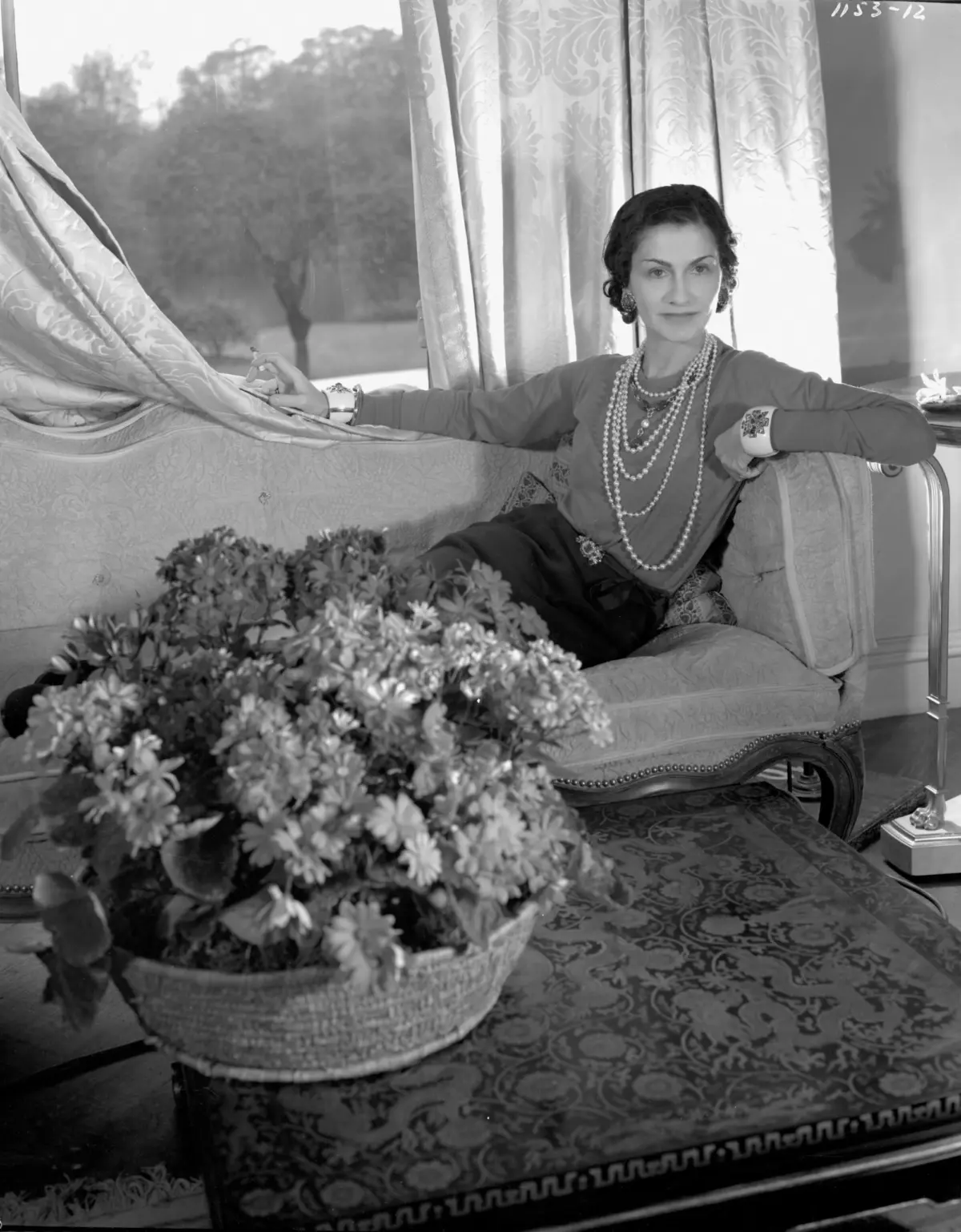
In 1928, Chanel collaborates with architect Robert Streitz to design La Pausa, a sprawling, beige-toned modern villa on the French Riviera in Roquebrune. Named after a local legend involving the Virgin Mary, the villa becomes her sunny sanctuary. By 1929 and into the early 1930s, she establishes her presence in elite social circles, posing for photographers like Cecil Beaton and renting a stately 18th-century home at 29 Rue Faubourg Saint-Honoré in Paris. In 1931, she travels to the United States at the behest of MGM studio chief Sam Goldwyn to design film costumes, residing temporarily at New York’s Hotel Pierre.
1937–1971: The Ritz Refuge and Postwar Triumph
In 1937, Chanel secures Suite 302 at the Hôtel Ritz Paris, making it her permanent nighttime residence for the remainder of her life. Following World War II—a period marked by a controversial romance with a German intelligence officer and a subsequent self-imposed exile in Switzerland—Chanel stages a triumphant fashion comeback in 1954 at the age of 70. She continues to design, entertain luminaries like Salvador Dalí and Elizabeth Taylor at 31 Rue Cambon, and work until her death on January 10, 1971, inside her suite at the Ritz.

Supporting Data & Spatial Analysis
Chanel’s mastery over her environment was calculated to serve her professional output. Her properties were not merely living quarters; they were laboratories of style.
- The Mirrored Staircase at 31 Rue Cambon: Perhaps the most famous architectural element of her empire, the mirrored staircase allowed Chanel to sit discretely on the upper landings, observing how models moved in her creations and watching the reflections of clients’ faces during fashion fittings without being directly seen.
- The Library at Rue Cambon: Chanel maintained an extensive, floor-to-ceiling collection of leather-bound literary classics. She infamously hired a young writer, Maurice Sachs, on a generous monthly retainer specifically to scour Paris antiquarian shops and curate books tailored to her intellectual and aesthetic standards.
- The Real Estate Portfolio: At the height of her influence, Chanel maintained multiple residences simultaneously: her private quarters at 31 Rue Cambon, her nightly suite at the Hôtel Ritz Paris, the modernist Riviera villa La Pausa, a moated Norman country estate at Mesnil-Guillaume (used briefly for rural aspirations), and a weekend retreat previously owned by author Colette in Montfort-l’Amaury.
- The Jewelry Milestone: In November 1932, Chanel hosted a landmark exhibition at her rented mansion on Rue Faubourg Saint-Honoré to launch her sole high-jewelry collection, Bijoux de Diamants. The collection, featuring dramatic comet and star motifs, drew direct inspiration from the floor mosaics of her childhood orphanage in Aubazine.
Official Responses and Preservation Efforts
Decades after her passing, the physical spaces curated by Coco Chanel are treated as sacred historical artifacts by the House of Chanel and international cultural preservationists.

The legendary apartment at 31 Rue Cambon remains meticulously preserved, appearing precisely as it did on the day of her death in 1971. While traditionally closed to the general public—accessible only to high-ranking VIP clients, select journalists, and authorized fashion houses for special shoots—the space serves as the spiritual heart of the brand. Current designers regularly draw inspiration from the intricate Coromandel screens, bronze animal sculptures (paying homage to her astrological sign, Leo), and amber-toned crystal chandeliers housed within.
Similarly, the Hôtel Ritz Paris cemented its historical ties to the designer by officially establishing the Suite Coco Chanel. Following an extensive multi-million dollar restoration of the historic hotel, Suite 302 was meticulously recreated to mirror the aesthetic choices Chanel favored during her decades-long residency. Featuring views of the Place Vendôme, the suite incorporates her preferred neutral color palettes, heavy oriental furnishings, and personal touches that honor her legacy as the hotel’s most famous permanent resident.

On the Riviera, the legacy of La Pausa was secured when the House of Chanel officially repurchased the historic property in 2015. After decades of passing through outside ownership (including American writer Emery Reves), the luxury house restored the villa to its original minimalist-beige splendor, utilizing the historic site for exclusive corporate events, brand retreats, and honoring the founder’s architectural contributions.
Implications for Modern Luxury and Design
The enduring fascination with Coco Chanel’s life, homes, and creative philosophy extends far beyond the realm of vintage apparel; it has fundamentally shaped how modern luxury houses cultivate brand mythology and immersive consumer experiences.

1. The Blurring of Brand and Lifestyle
Chanel was a pioneer in realizing that a luxury brand is not merely a product, but an entire ecosystem. By embedding her personal biography—from the monastic austerity of Aubazine to the sensory overload of her Parisian salons—into the physical architecture of her shops and homes, she created a blueprint that modern luxury conglomerates (such as LVMH, Kering, and Chanel S.A.) continue to deploy. Today, luxury flagships are no longer simple retail spaces; they are experiential museums, private residential-style salons, and cultural hubs.
2. The Commercialization of Heritage
The meticulous preservation of spaces like 31 Rue Cambon and the Ritz suite demonstrates the immense commercial power of historical narrative. In the 21st-century luxury market, heritage is currency. By safeguarding these physical nodes of Chanel’s history, the brand maintains an unbroken thread of authenticity that reassures modern consumers of the product’s pedigree and enduring value.

3. Feminist Paradox and Autonomy
Chanel’s architectural choices—particularly her desire to live in spaces she completely controlled, devoid of co-habitating spouses for the majority of her adult life—highlighted a radical form of female autonomy for the early-to-mid 20th century. While her complex wartime associations remain a subject of rigorous historical scrutiny and debate among historians, her spatial independence remains a testament to self-made female power. She dictated where she worked, how she lived, and on whose terms she engaged with the male-dominated elite of Europe.
Ultimately, Coco Chanel’s environments—whether the stark geometric lines of her orphanage beginnings or the gilded, mirrored opulence of Rue Cambon—prove that her greatest creation was not just the little black dress or the quilted handbag, but the mythical, impenetrable universe of Chanel itself.
