

LONDON — In the ever-evolving landscape of esoteric practices, contemporary divination, and self-exploration techniques, a new methodology has emerged that bridges the gap between modern psychological introspection and historical metaphysical traditions. Known as Ancient Echoes, this groundbreaking system utilizes a specialized Tarosophy "split-deck" technique designed to help practitioners uncover past lives and analyze how those historical incarnations directly influence their present-day existence.
Developed within the broader framework of Tarosophy—an approach that emphasizes the wisdom, philosophy, and creative application of tarot rather than rigid, fatalistic fortune-telling—Ancient Echoes has rapidly gained traction among esoteric scholars, professional readers, and individuals seeking alternative pathways to personal growth.
This comprehensive report examines the main facts of the Ancient Echoes layout, the precise chronology of its step-by-step execution, the supporting data and interpretive nuances that elevate it beyond a simple parlor trick, official perspectives from the esoteric community regarding its psychological and spiritual utility, and the broader implications of integrating past-life regression models with cartomancy.
Main Facts: What Is "Ancient Echoes"?
At its core, Ancient Echoes is an innovative cartomantic layout and reflective framework. Unlike traditional tarot spreads that look strictly at immediate futures, relational dynamics, or general psychological states, Ancient Echoes operates on the metaphysical premise that human consciousness experiences a continuum of lifetimes. These past incarnations leave emotional, spiritual, and behavioral residues—or "echoes"—in the present.
The primary mechanics of the practice rely on a "split-deck" methodology. A standard 78-card tarot deck is physically divided into three distinct categorical piles:
- The Court Cards: Representing personalities, archetypes, and soul states.
- The Major Arcana: Representing grand karmic lessons, spiritual milestones, and overarching life themes.
- The Minor Arcana: Representing the day-to-day environment, actions, experiences, and practical manifestations of a lifetime.
By systematically drawing cards from these separated stacks according to a structured narrative grammar, the practitioner constructs a multi-layered genealogical map of the soul. This map connects the present-day persona to a sequence of historical influences, charting a clear course from who we are today back through the corridors of time.
Chronology of the Spread: A Step-by-Step Guide
For those wishing to practice Ancient Echoes, precision is vital. The method follows a deliberate chronological and spatial sequence designed to anchor the reading in the present before journeying into the historical past. Below is the exact operational sequence required to perform the spread.
Phase 1: Establishing the Present-Day Baseline
- Step 1: Sorting the Deck. Begin by physically separating your tarot deck into three distinct stacks: Court Cards, Major Arcana, and Minor Arcana.
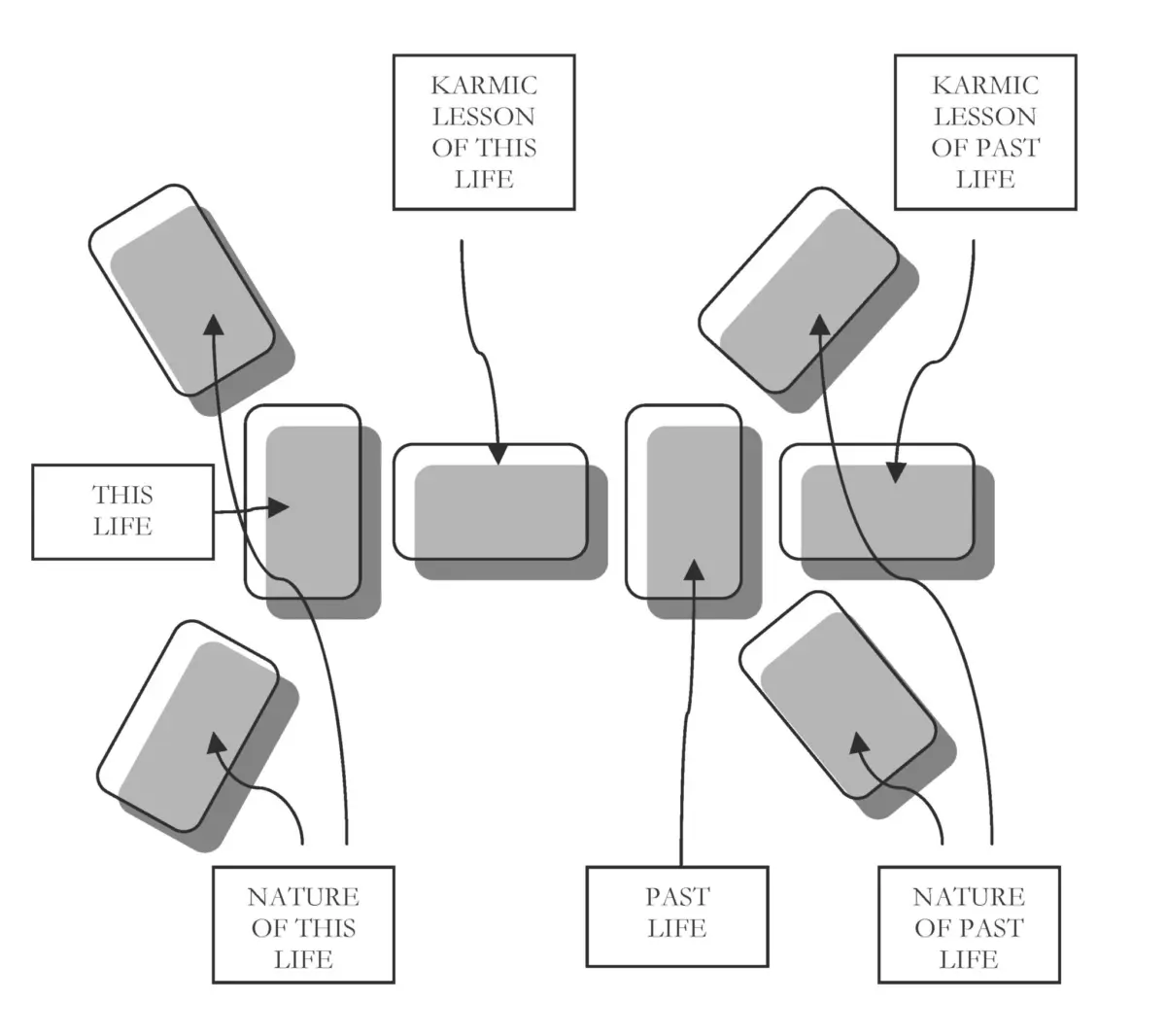
- Step 2: The Soul Card. Take the stack of Court Cards, shuffle them thoroughly while focusing on your current state of being, and draw one card. Place this card in the absolute centre of your table or reading space. Accompany this placement with the verbal affirmation: “This is the nature of my Soul in present-time.” This card acts as your anchor, defining your core energetic archetype right now.
- Step 3: The Current Lifetime Context. Next, take the Minor Arcana stack and shuffle it. Draw two cards and place them flanking or surrounding the central Soul Card. Declare aloud: “This is the nature of my lifetime in this life.” These two cards describe the immediate environment, challenges, and day-to-day reality of your current incarnation.
Phase 2: Bridging to the Past
- Step 4: The Previous Lifetime Persona. Return to the Court Card stack and shuffle them once more, keeping the visual anchor of the two Minor cards in your mind. Select one Court Card and place it to one side (top, bottom, left, or right) of the Minor cards. Affirm: “This is an echo of my previous lifetime self.” This card introduces the specific personality archetype or social station of the past incarnation.
- Step 5: The Karmic Lesson. Take the Major Arcana stack, shuffle it, and select a single card. Place this card directly between the present-day Court Card (your Soul card) and the previous-life Court Card. Declare: “This is the Karmic lesson I must learn in this lifetime.” This serves as the spiritual bridge—the unfinished business or evolutionary lesson transmitted from that past life into your current existence.
- Step 6: Flesh and Bone of the Past. Pick up the Minor Arcana stack again, shuffle them while meditating on the newly revealed Karmic Lesson Major card. Draw two cards and place them directly against or adjacent to the previous-life Court Card. State: “This was the nature of that previous life.”
Phase 3: Weaving the Narrative and Expanding the Echoes
Once the cards are laid out in this precise geometric configuration, the practitioner’s task shifts from mechanical placement to narrative synthesis. You must weave a cohesive, compelling story out of the two Minor cards associated with the past life, interpreting how they express themselves through that particular Court Card personality, modified by the central Karmic Lesson.
Furthermore, the method is infinitely expandable. Practitioners are not limited to a single past life. By taking a new Major Arcana card as a subsequent Karmic Lesson for the previous life’s Court Card, you can work outward in a chain reaction, uncovering deeper layers through successive historical lifetimes.
Supporting Data and Interpretive Nuances
While Ancient Echoes functions primarily as an intuitive and creative tool, experienced Tarosophists note that structural analysis yields rich, data-like patterns across readings. To elevate the practice from subjective guesswork to a rigorous art form, practitioners are encouraged to analyze specific secondary signifiers within the layout:
- Gender and Archetypal Ratios: When examining the previous-life Minor cards and Court cards, a reader can observe whether the energies lean predominantly masculine or feminine. Are the Court cards dominated by Pages and Knights (suggesting youth, movement, and subordinate roles) or Kings and Queens (suggesting authority, mastery, and leadership)?
- Elemental Dignities and Suits: The suits of the Minor Arcana (Cups, Pentacles, Swords, Wands) offer immediate data regarding a past life’s primary sphere of endeavor. A predominance of Pentacles may denote an agrarian, merchant, or labor-intensive existence. Swords could point toward intellectual, military, or legal professions. Cups might highlight artistic, emotional, or religious vocations, while Wands suggest pioneering, entrepreneurial, or nomadic lifestyles.
- The Progression of Major Arcana: By laying out multiple Karmic Lesson cards in a linear sequence over successive historical regressions, practitioners can look for numerical or thematic patterns. Does the sequence show a progression from the material struggles of early Major Arcana cards toward the spiritual integration of higher numbers? Such patterns often reveal an overarching soul evolution across millennia.
Official Perspectives and Esoteric Community Responses
The introduction of Ancient Echoes has sparked considerable dialogue within modern tarot circles, bridging traditional cartomancy with contemporary therapeutic modalities.
Eminent figures in the Tarosophy movement emphasize that the method does not require a literal belief in reincarnation to be profoundly effective. From a Jungian psychological perspective, past-life spreads can be viewed as a brilliant metaphorical mechanism for accessing the collective unconscious and addressing deep-seated psychological complexes.
"Whether one views past lives as literal historical fact or as rich, archetypal metaphors generated by the subconscious mind, Ancient Echoes provides a structured container for deep self-inquiry," notes one prominent esoteric researcher. "It takes the fragmented nature of human memory and identity and organizes it into a narrative that the conscious mind can finally integrate and heal."
Traditional esoteric practitioners have similarly praised the method for its intellectual rigor. By strictly segmenting the deck into its three foundational pillars—Courts, Majors, and Minors—the system respects the traditional architecture of the tarot while subverting it in a highly functional, creative way. Rather than pulling cards at random from a chaotic, jumbled deck, the partition-and-shuffle technique ensures that each category of card speaks directly to its corresponding metaphysical domain (Soul, Karma, and Manifestation).
Implications: The Future of Divinatory Self-Discovery
As interest in alternative spirituality, mindfulness, and personal ancestry continues to surge globally, frameworks like Ancient Echoes carry significant implications for both practitioners and seekers.
1. Shift from Prediction to Psychological Integration
For centuries, popular culture reduced tarot to a tool for predicting external events—romance, financial windfalls, or impending doom. Methods like Ancient Echoes decisively shift the paradigm back toward deep internal agency. By framing past lives as a repository of unfinished karmic lessons, the practice empowers individuals to take responsibility for their present emotional and psychological patterns.
2. Therapeutic Applications in Holistic Spaces
Holistic life coaches, regression therapists, and intuitive counselors are increasingly adopting split-deck methods as adjunct tools in client sessions. Because the spread creates a literal "story," clients often find it easier to project internal blocks onto the narrative of a past-life persona, thereby bypassing psychological resistance and ego defenses.
3. The Democratization of Esoteric Wisdom
Ancient Echoes strips away the mysticism and gatekeeping traditionally associated with past-life regression. By utilizing the accessible, visual medium of the tarot deck, anyone with a standard 78-card set can safely and systematically explore the multi-dimensional architecture of their own identity—no hypnosis or trance state required.
Conclusion
Ancient Echoes stands out as a sophisticated, elegant contribution to modern cartomancy. By ingeniously dividing the tarot deck and assigning specific narrative roles to Courts, Majors, and Minors, it transforms a simple card layout into an expansive archetypal journey through time. Whether used as a literal window into historical incarnations or as a profound psychological mirror reflecting our deepest karmic obligations, Ancient Echoes offers a timeless invitation: to understand who we are today by listening closely to the whispers of who we used to be.
