

Main Facts
TUCSON, Ariz. — For nearly eight decades, the Mountain Oyster Club has stood as an architectural and cultural anchor in the American Southwest. Since its founding in 1948, the private institution has cultivated a reputation not merely as a social haven, but as a premier custodian of regional heritage. True to its mission as "a society of Westerners dedicated to western traditions, art and the western way of life," the club is preparing to host its crown jewel event: the 57th Annual Mountain Oyster Club Contemporary Western Art Show and Sale.
Scheduled for Sunday, November 22, from 3:00 p.m. to 5:30 p.m., the exclusive gathering will transform the historic Pond Mansion into a bustling salon of fine art. More than 200 nationally renowned masters and rising talents will converge on Tucson to exhibit their latest creations. Spanning traditional interpretations and forward-thinking contemporary styles, the showcase offers an eclectic cross-section of what defines modern Western art.
Unlike traditional white-cube galleries or sprawling convention centers, this prestigious exhibition unfolds within the opulent, history-drenched rooms of the Pond Mansion—a landmark listed on the National Register of Historic Places. Attendees, navigating the historic halls with cocktails and artisanal hors d’oeuvres in hand, will experience a rare convergence of elite artistry and early-20th-century Southwestern architecture.
Participation in this elite event remains tightly regulated. Space within the historic mansion is strictly limited, and attendance relies on an invitation-only model, with advance tickets required through the club. Yet, despite its exclusivity, the exhibition wields an outsized influence on the broader art market, serving as a bellwether for trends, tastes, and rising stars in the genre of Western American art.
Chronology
To understand the weight of the upcoming 57th annual exhibition, one must trace the institutional lineage of the Mountain Oyster Club and the physical vessel that houses it, the Pond Mansion.
- The Early Decades and the Pond Mansion: Constructed during an era when Tucson was rapidly evolving into a desert metropolis, the Pond Mansion was designed to reflect the grandeur and permanence of the expanding West. Its thick walls, elegant woodwork, and sprawling reception rooms were built for high society. Decades later, these very spaces would find a second life as the permanent home of the Mountain Oyster Club.
- 1948: The Mountain Oyster Club is officially established. Conceived as a private dining and social club, it rapidly evolves into a cultural collective. Early members, bound by a mutual appreciation for ranching, desert landscapes, and frontier history, begin acquiring artwork to adorn the club’s wood-paneled walls.
- The Late 20th Century: Recognizing the wealth of regional creative talent—and the historical deficit of dedicated exhibition spaces—the club formalizes its annual art gathering. What begins as a modest, localized display of member-owned or locally sourced pieces gradually expands into a major national event.
- The 21st Century: The annual art show evolves into a premier destination for serious collectors. It bridges generations by intentionally pairing blue-chip artists with cutting-edge innovators, ensuring that the visual vocabulary of the West continues to evolve rather than stagnate in nostalgia.
- November 22 (Current Year): The 57th Annual Mountain Oyster Club Contemporary Western Art Show and Sale opens its doors. Over 200 artists present new works, carrying forward a nearly 60-year tradition of artistic patronage within the historic Pond Mansion.
Supporting Data
The allure of the Mountain Oyster Club exhibition lies in its rigorous curation, exceptional diversity of media, and the caliber of the works selected for display. While the roster boasts more than 200 artists, several standout pieces encapsulate the thematic and technical ambitions of this year’s show.

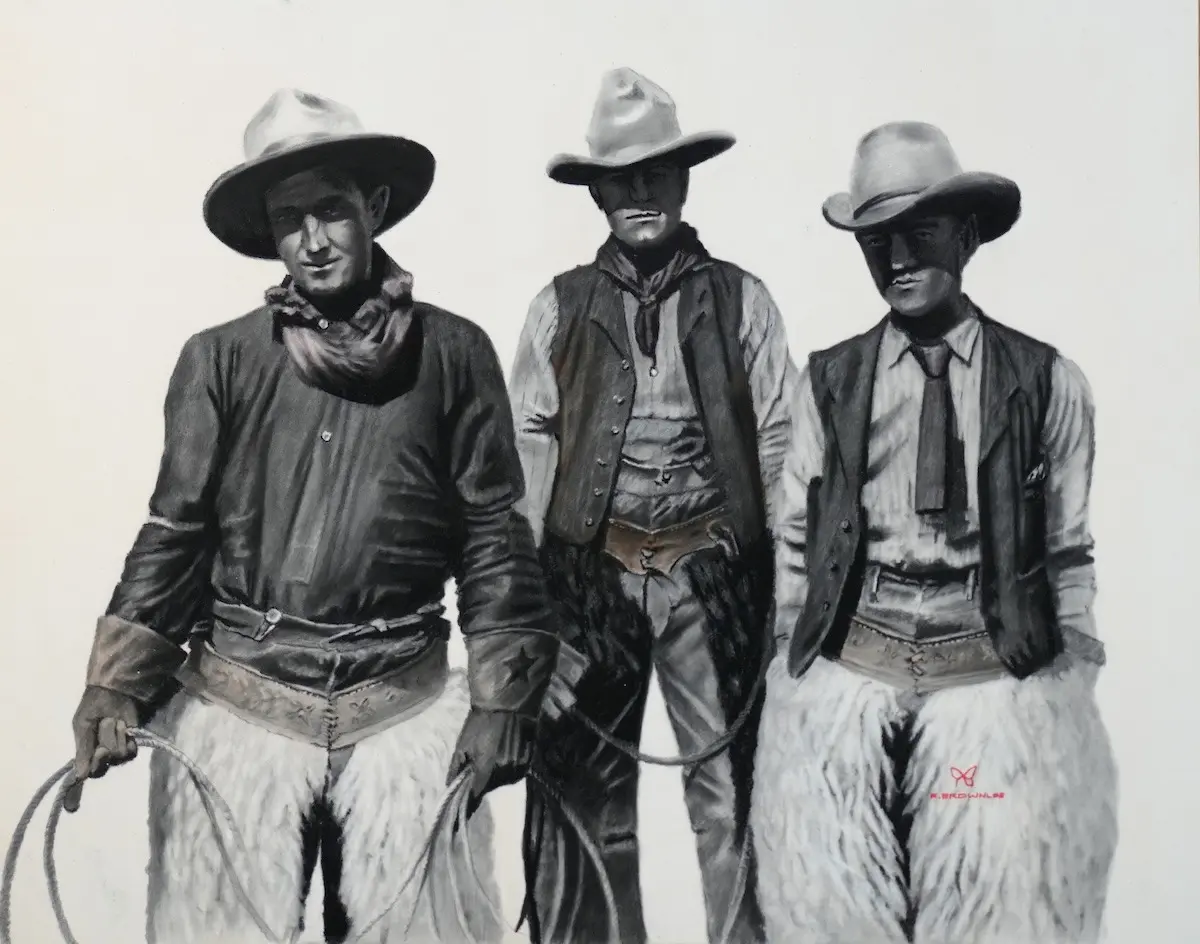
Wild and Woolly by Rachel Brownlee
- Medium: Charcoal and gouache
- Dimensions: 11 x 14 inches
- Analysis: Rachel Brownlee subverts traditional artistic hierarchies in her striking triple portrait. Historically, charcoal and gouache have been relegated to the preparatory phases of art-making—the preliminary sketches and studies that precede the "serious" oil painting or bronze casting. Brownlee elevates this fugitive medium into a finished, highly polished statement. The piece captures three distinct iterations of contemporary and historical cowboy style. From intricately tooled chaps to rakishly angled hats, the subjects exude a brash, unyielding confidence that mirrors the shifting identity of the modern West.
Under a Red Sun by Maia Chávez Larkin
- Medium: Oil on canvas
- Dimensions: 24 x 18 inches
- Analysis: Maia Chávez Larkin achieves a remarkable optical illusion in Under a Red Sun, deploying oil paint with the soft, velvety palette and delicate mark-making characteristic of dry pastel. The painting centers on a figure possessing a calm, almost divine neutrality. The subject gazes outward, establishing an unsettling, direct dialogue with the viewer. Overhead, a stark red sun casts concentric, ruddy reverberations across an expansive blue sky. The composition carries the distinct weight and ambiguity of a major arcana tarot card, inviting—and demanding—personal interpretation from every collector who stands before it.
Born of Clay by Kim Seyesnem Obrzut
- Medium: Bronze
- Dimensions: 21.5 x 8.5 x 10 inches
- Analysis: Sculptor Kim Seyesnem Obrzut presents a multi-layered narrative in bronze. The sculpture depicts a woman cradling a beautifully formed clay vessel. Obrzut constructs a labyrinth of potential meanings: Is the woman an artist proudly exhibiting her own creation? Is she a collector, tucking a fresh acquisition securely under her arm? Or is she a traditional owner, carrying the functional vessel back to her home for daily use? This deliberate narrative ambiguity forms the core of the piece’s power. Furthermore, Obrzut employs a clever visual trick: only when the viewer steps back to take in the sculpture’s silhouette does the entire figurative composition resolve into the overarching shape of a handled jar or vase.
Official Responses and Perspectives
The philosophy driving the Mountain Oyster Club’s exhibition is anchored in accessibility to quality, historical preservation, and the deliberate cultivation of new talent. Laura Davis, chair of the club’s art committee, offers critical insight into what makes the gathering an indispensable fixture on the national arts calendar.
"The show also distinguishes itself through the exceptional quality and diversity of its artists," Davis explains, emphasizing the deliberate strategy behind the artist roster. "The exhibition features both nationally recognized, established artists and outstanding emerging talent, giving collectors the opportunity to discover tomorrow’s favorites alongside celebrated names."
Davis also points to the venue itself as a vital component of the artistic ecosystem, noting how the environment redefines the viewing experience.
"One thing that sets the Mountain Oyster art show apart from others is the venue," Davis notes. "Rather than a typical art gallery, the show is held in a private dining club, a beautiful historic mansion listed on the National Register of Historic Places. This unique setting offers visitors an experience that is as memorable as the artwork itself."
Art critic and historian James D. Balestrieri, reflecting on the broader cultural footprint of the exhibition, underscores the unique ecosystem the club has managed to sustain over decades. By removing the sterile, commercial pressure typically found in high-street galleries and replacing it with the intimacy of a historic private club, the event fosters genuine discourse between creators and patrons.
Implications
The longevity and prestige of the Mountain Oyster Club Contemporary Western Art Show and Sale carry profound implications for the trajectory of regional American art. In an era where many traditional institutions struggle to remain relevant or succumb to commercial homogeneity, the Tucson exhibition offers a masterclass in cultural stewardship.

1. Re-defining the Boundaries of Western Art
For decades, mainstream art markets frequently stereotyped Western art as nostalgic, formulaic, or overly dependent on historical tropes of the 19th-century frontier. By showcasing avant-garde techniques—such as Brownlee’s elevation of charcoal studies into finished masterworks, Larkin’s symbolic and psychological oil paintings, and Obrzut’s sculptural sleight-of-hand—the Mountain Oyster Club actively expands the genre’s boundaries. It proves that the West is not merely a static historical period to be memorialized, but a living, breathing landscape of contemporary human experience.
2. The Value of Intimate Curation
The event’s reliance on the Pond Mansion as a venue challenges the modern architectural consensus that art requires vast, white, neutral spaces to be properly appreciated. By placing contemporary bronze, charcoal, and oil works within rooms rich with dark wood, historical artifacts, and private club heritage, the exhibition demonstrates how context enhances meaning. It suggests that art patronage is most successful when rooted in community, history, and shared physical spaces rather than transient commercial marketplaces.
3. Economic and Cultural Vitality for Emerging Artists
By deliberately placing more than 200 emerging artists shoulder-to-shoulder with nationally celebrated masters, the club provides a vital economic and professional springboard. For young creators, an acquisition by a collector attending the Mountain Oyster Club show can launch a national career. For the seasoned collector, the show offers a rare, unfiltered look at the future direction of the American art market.
As the doors of the Pond Mansion swing open on November 22, the Mountain Oyster Club will once again prove that tradition and innovation are not mutually exclusive. Through careful curation, historic preservation, and an unyielding commitment to artistic excellence, the club ensures that the spirit of the American West continues to thrive, adapt, and inspire.
