

By Investigative Cultural Desk
For over seven decades, one of the most influential visual artists of the 20th century lay in near-complete obscurity, her final resting place swallowed by the passage of time, bureaucratic misfortune, and the quiet erasure that often plagues historical women artists. Pamela Colman Smith—the brilliant creative mind behind the world’s most widely used tarot deck—died in relative penury in 1951. While her artistic legacy has achieved global immortality, the physical ground that received her mortal remains has remained shrouded in mystery.
Recent investigative efforts spearheaded by tarot historians have finally shed light on the elusive burial site of the woman affectionately known as "Pixie." Combining surviving parish registers, chronological cemetery mapping, and independent historical validation, researchers have narrowed down her probable grave to a tranquil corner of a churchyard in Cornwall. This discovery offers a poignant epilogue to a life characterized by artistic brilliance, spiritual exploration, and eventual obscurity.
Main Facts: Unearthing the Final Chapter of "Pixie"
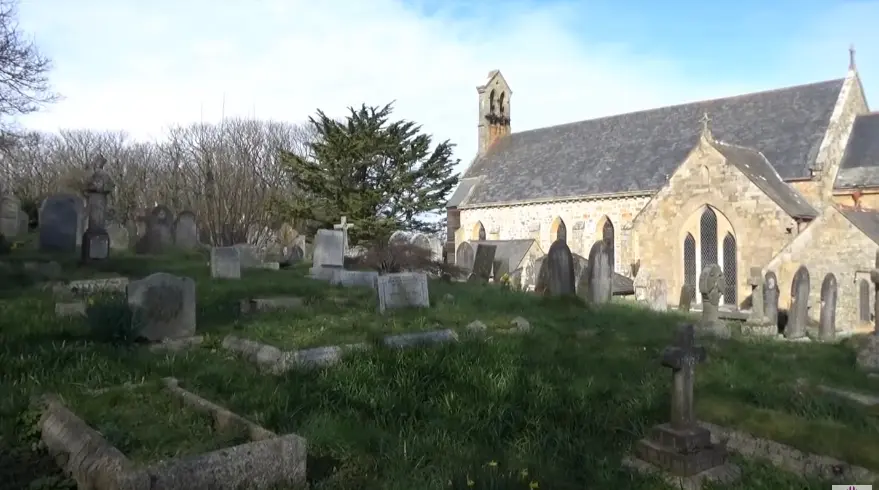
Pamela Colman Smith (1878–1951) was laid to rest on September 25, 1951, in the churchyard of St. Michael & All Angels in Bude, Cornwall. Her funeral service was conducted by a well-regarded Roman Catholic priest, Father Joseph Henry du Moulin-Browne.
Despite the formal recording of her burial in surviving parish registries, physical markers pointing directly to Smith have been missing for generations. Her original grave marker—likely a modest wooden cross or perhaps no permanent monument at all, reflecting her modest financial standing at the time of her death—did not survive the decades. Compounding this loss, the church’s original plot maps and burial ledgers for that era were destroyed in a devastating fire.
According to accounts gathered during recent site inspections, the fire broke out inside a builder’s hut where parish records were temporarily stored during church renovation work. With the primary documentation reduced to ash, researchers faced a formidable historical puzzle: how to locate a specific, unmarked grave in a historic cemetery without a map.
The solution required forensic historical analysis. By cross-referencing the surviving written parish registers—which listed Smith’s burial date—with the chronological layout of the graveyard and the dates inscribed on surrounding headstones, investigators successfully triangulated her likely plot. Located in a secluded, far corner of the churchyard, the target area contains a cluster of marked graves dating specifically to 1950 and 1951, aligning perfectly with the cemetery’s historical practice of burying individuals in strict chronological order. This zone also houses at least three unmarked plots, one of which almost certainly holds the remains of the woman who brought the Fool, the Magician, and the High Priestess to visual life.
Chronology of a Forgotten Legacy: From Spotlight to Silence
To understand how Pamela Colman Smith came to rest in an unmarked grave, one must examine the trajectory of her life—a journey that transitioned from vibrant cosmopolitan artistic circles to quiet isolation in coastal Cornwall.
Early Life and Artistic Awakening (1878–1900s)
Born in London to American parents on June 16, 1878, Smith spent her childhood moving between London, Jamaica, and New York. Displaying an early aptitude for the arts, she attended the Pratt Institute in Brooklyn under the instruction of Arthur Wesley Dow, a pioneer of the American Arts and Crafts movement. Smith developed a distinctive, evocative illustrative style heavily influenced by symbolism, theatrical design, and folklore.
Returning to England, she immersed herself in the bohemian art scene. She became a member of the elite In Wittlesbach art collective, illustrated works for notable figures like Bram Stoker and W.B. Yeats, and gained recognition for her synesthetic ability to "see" music, translating classical compositions into vibrant watercolors. In 1901, she even established her own magazine, The Green Sheaf, which showcased contemporary art and literature.
The Waite-Smith Collaboration (1909)
In 1909, Smith’s life intersected with the occult scholar Arthur Edward Waite. Both were members of the Hermetic Order of the Golden Dawn, a prominent 19th-century secret magical society. Waite commissioned Smith to create a 78-card tarot deck that would break away from traditional European designs by fully illustrating the Minor Arcana—assigning narrative, emotional scenes to every card rather than simple pints of suits.
Working under tight deadlines, Smith produced a masterwork. Published by Rider & Company later that year, the deck—originally known as the Rider-Waite tarot, and now widely referred to by historians and practitioners as the Rider-Waite-Smith or Waite-Smith deck—revolutionized cartomancy. Its rich, symbolic imagery provided a visual lexicon that shaped modern esoteric thought, psychology, and popular culture. Yet, true to the publishing norms of the era, Smith received a flat fee for her monumental labor, retaining no royalties for a deck that would eventually sell in the tens of millions worldwide.
Decline and Solitude in Cornwall (1911–1951)
Following her conversion to Roman Catholicism around 1911, Smith’s public artistic output diminished. She moved to Cornwall—a region renowned for its dramatic coastlines, mythical resonance, and artistic communities—living in relative seclusion. Over the ensuing decades, her financial situation deteriorated.
By the time of her death on October 18, 1951 (though records note her funeral occurred on September 25, discrepancies common in historical registry transcriptions point to her passing in the autumn of that year), Smith had largely faded from the public consciousness of the art world. She died unmarried, without immediate surviving family of note in the area, and with very few financial assets. Her possessions, including art and personal effects, were auctioned off to settle debts—a tragic, unceremonious end for an artist whose imagination now blankets the globe.
Supporting Data: Mapping the Sacred Ground
The recent breakthrough regarding Smith’s burial site was not the result of a lucky guess, but rather rigorous fieldwork and archival corroboration.
Researchers from prominent tarot historical societies conducted an exhaustive on-site investigation at St. Michael & All Angels Churchyard. Their methodology relied on three core pillars of historical forensics:
- Chronological Plot Layout Analysis: Cemeteries of this era typically expanded organically, interring individuals sequentially as deaths occurred. By mapping the legible tombstones from late 1950 through late 1951, investigators mapped a definitive physical timeline moving from the center of the churchyard toward its perimeter.
- Parish Register Correlation: Surviving textual records housed outside the destroyed builder’s hut confirmed that Smith was interred on September 25, 1951, alongside a small cohort of local parishioners.
- Independent Validation: Following the initial mapping and site assessment by the research team, an independent local historian—who had extensively researched the parish records and cemetery layout thirty years prior—visited the site. Without prior prompting, the historian independently arrived at the exact same conclusion, identifying the same cluster of unmarked and marked plots in the far corner of the churchyard as Smith’s most probable resting place.
The location itself carries a poignant poetic justice. Situated in a far corner of the churchyard, the plot sits close to the Cornish shoreline—an environment that Smith adored during her decades living in the region. Surrounded by mature woodland, the site is filled with the natural symphony of birdsong. During the recording of documentary footage at the site, the church bells unexpectedly rang out, an occurrence that researchers and visitors described as an ambient validation of peace for an artist who spent her final years in quiet obscurity.
Official Responses and Academic Context
The rediscovery of Smith’s probable burial context has sent ripples through the international esoteric and academic communities. For decades, the history of tarot was dominated by the names of its male occult architects, such as Arthur Edward Waite and Aleister Crowley, while Smith—the artistic engine of the tradition—was relegated to a footnote.
Scholars have increasingly worked to correct this historical imbalance. The publication of specialized research, such as the seminal book Secrets of the Waite-Smith Tarot (Llewellyn, 2015) by Marcus Katz and Tali Goodwin, brought forward new photographs, correspondence, and biographical discoveries that illuminated Smith’s vibrant personality, her artistic process, and her deep connections within Edwardian literary and mystical circles.
Organizations such as the Tarot Association have incorporated these findings into specialized educational resources for their members. Under dedicated archival modules—such as the research paper titled "The Kiss of the Sun for Pardon: A Memory of Pamela Colman Smith"—members have been given unprecedented access to new discoveries, rare photographs, and contextual analyses of Smith’s life in Cornwall.
Historians emphasize that locating Smith’s resting place is not merely an exercise in sentimental antiquarianism. Rather, it anchors the abstract history of modern esotericism in tangible reality, reminding contemporary practitioners of the human cost behind cultural artifacts. As academic interest in the intersections of gender, art, and the occult continues to expand, understanding the final days of creators like Smith provides a vital counter-narrative to the romanticized myths of occult history.
Implications: Restoring Dignity to an Artistic Pioneer
The identification of Pamela Colman Smith’s likely burial plot carries profound implications for how the modern tarot community honors its foundational figures.
1. Cultural Rectification and Public Recognition
For generations, millions of tarot readers worldwide have engaged with Smith’s artwork daily without knowing her name—often referring to the deck solely as the "Rider-Waite" deck, thereby erasing her contribution from the title. The concerted effort to locate her grave is part of a broader cultural reckoning aimed at restoring Smith to her rightful place in art history. By identifying where her physical journey ended, historians provide a focal point for public appreciation, memorialization, and collective gratitude.
2. Future Preservation and Memorialization Efforts
The confirmation of the burial zone opens doors for potential memorial projects at St. Michael & All Angels Churchyard. While the exact plot remains unmarked due to the loss of municipal records, the consensus among independent researchers provides a reliable geographic anchor. Advocacy groups are now discussing the possibility of installing a commemorative plaque or headstone in the identified corner of the churchyard, ensuring that future generations of artists, historians, and tarot enthusiasts can pay their respects to "Pixie" in person.
3. A Catalyst for Ongoing Esoteric Research
The rigorous investigative framework used to find Smith’s resting place sets a new standard for occult and biographical historiography. It demonstrates that even when primary archives are destroyed by fire or neglect, multidisciplinary approaches—combining local history, topographical analysis, and community memory—can resurrect lost narratives from the shadows of history.
As the global fascination with tarot continues to surge in the 21st century, the rediscovery of Pamela Colman Smith’s final resting place serves as a powerful reminder of the enduring legacy of her brush. In the quiet, bird-filled corner of a Cornish churchyard, the woman who mapped the human soul through 78 illustrated cards finally rests within the very landscape she loved so dearly, her memory forever illuminated by the sun she captured so brilliantly on paper.
