

By Global Tarot Journal Staff
Published in Commemoration of World Tarot Day
Main Facts: The Enduring Legacy of Rachel Pollack’s Philosophical Vision
In the pantheon of modern esoteric studies, few figures loom as large, or as warmly remembered, as Rachel Pollack. An acclaimed author, comic book writer, and preeminent authority on the Tarot, Pollack spent decades redefining how seekers, artists, and academics approach the seventy-eight cards of the deck.
At the core of her philosophy—articulated vividly in essays penned for milestones like World Tarot Day—was a deceptively simple yet radical proposition: "Story. It’s all story."
Rejecting the rigid dogmas that often plague esoteric traditions, Pollack viewed the Tarot not as a static tool for fortune-telling or a monolithic spiritual science, but as a dynamic machine for generating narrative. Quoting the celebrated Italian author Italo Calvino, who once wrote that "the tarot is a machine for constructing stories," Pollack aligned her life’s work with the idea that human consciousness is fundamentally narrative-driven.
This article explores the core tenets of Pollack’s philosophy, examining how her introduction to the cards in 1970 shaped a lifetime of literary and esoteric exploration, challenging conventional boundaries between truth, fiction, and the nature of reality itself.
Chronology: From a 1970 Encounter to a Global Legacy
To understand Pollack’s profound impact on modern cartomancy, it is essential to trace the timeline of her engagement with the Tarot and her broader contributions to literature and esoteric thought.
1970: The Awakening
In the early spring of 1970, Pollack’s life shifted on its axis during a casual encounter with a friend. Presented with a reading utilizing the rare University Press edition of the Rider-Waite-Smith deck and interpreted through Eden Gray’s foundational book, Pollack experienced an epiphany. Rather than focusing on predictive outcomes or deterministic futures, she became instantly enraptured by the visual artistry of the cards. Each card struck her as a "frozen moment in a story," with the melancholic and mysterious Six of Swords etching itself permanently into her memory.
1970s–1990s: Establishing the Authority
Throughout the subsequent decades, Pollack synthesized her passion for literature, comic writing, and mysticism. She authored seminal texts that revolutionized Tarot interpretation, most notably 78 Degrees of Wisdom: A Book of Tarot, which many practitioners consider the "Bible of modern Tarot." Her work elevated the cards from parlor tricks to profound psychological and mythological mirrors.
July 2009: The Tarosophy Gathering
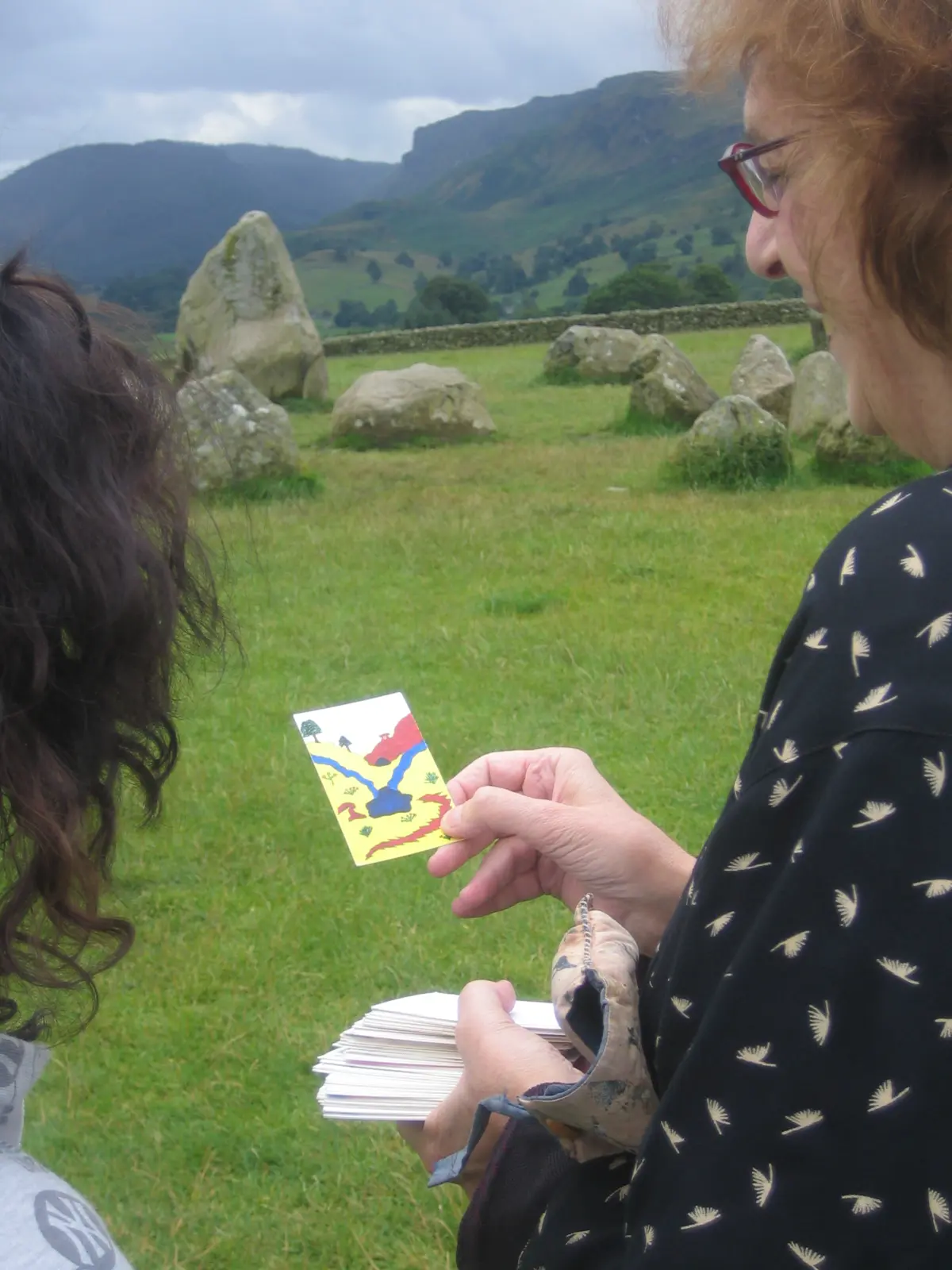
Decades into her illustrious career, Pollack remained an active, accessible pillar of the global Tarot community. In July 2009, she appeared as a keynote presence at the Tarosophy Tarot Conference held in the picturesque Lake District of England. Photographed walking among the ancient monoliths of the Castlerigg Stone Circle—an image that remains iconic within the community—Pollack embodied the seamless bridge between ancient mythos and contemporary psychological inquiry.

May 25, 2015: Articulating the Philosophy
Writing for World Tarot Day on May 25, 2015, Pollack crystallized her lifelong philosophical musings into a poignant essay. Reflecting on mortality, existentialism, and the nature of the cards, she summarized her worldview with a phrase she half-jokingly considered for her own epitaph: "The world is not what we think it is."
Supporting Data: The Interlocking Stories of Tarot, Science, and Myth
Pollack’s perspective on the Tarot challenges the conventional dichotomy between "objective truth" and "subjective imagination." She argued that categories like time, science, and spirituality are ultimately interlocking sets of stories that humans construct to make sense of a chaotic universe.
| Domain | Traditional View | Rachel Pollack’s Narrative View |
|---|---|---|
| Tarot | A predictive tool to glimpse fixed future events or absolute spiritual laws. | A dynamic engine for narrative creation, bringing together subject, reader, and image. |
| Science | A collection of immutable, objective facts waiting to be discovered. | A framework of predictive stories; even sub-atomic particles may rely on human observation to be brought into being. |
| Spirituality | Dogmatic adherence to sacred texts and rigid esoteric systems (e.g., the Kabbalah). | Fluid pathways and living myths that engage human consciousness to create meaning. |
To support this non-dogmatic approach, Pollack often recounted conversations with physicists. When she asked a physicist friend whether sub-atomic particles might not truly exist until scientists predicted and searched for them, the scientist confirmed it was entirely plausible. For Pollack, this fluidity applied equally to the Tarot. Truth is not a static rock lying passively on the ground; it is brought into existence through active human engagement.
Official Responses and Community Reflections
The global esoteric and literary communities have continually responded to Pollack’s work with profound reverence. Upon the publication of her foundational essays and her subsequent passing, fellow authors, psychologists, and Tarot scholars shared reflections on her unique intellectual footprint.
- The Tarot Association: Highlighted Pollack’s rare ability to blend academic rigor with deep mystical intuition, noting that her essays—such as her 2015 World Tarot Day reflection—continue to serve as foundational reading for new generations of readers.
- Literary Critics: Celebrated her work in speculative fiction and comic books (including her acclaimed run on DC Comics’ Doom Patrol), observing that her narrative sensibilities in fiction directly informed her empathetic, story-driven approach to cartomancy.
- Fellow Practitioners: Frequently cite the "three-person dynamic" introduced in Pollack’s writings: during a reading, there are three active participants—the subject, the reader, and the cards themselves. Together, they conjure a living narrative that helps unlock vital human decisions.
Implications: Redefining Reality and the Future of Cartomancy
The implications of Rachel Pollack’s philosophy extend far beyond the velvet cloth of a Tarot table. By insisting that "It’s all story," Pollack liberates seekers from the anxiety of fatalism. If the future is not a locked room waiting to be unlocked by a psychic, but rather a narrative in progress, then the individual retains agency.
1. Empowering the Seeker
When a client approaches a Tarot reader seeking guidance, the anxiety often stems from a desire for certainty. Pollack’s framework reframes the experience. The cards do not dictate an inescapable doom or a guaranteed triumph; instead, they act as a mirror, helping the seeker navigate complex emotional and psychological landscapes to make empowered choices. As Pollack observed, while daily readings can offer general resonance, the deck occasionally produces an uncanny, mathematically improbable precision precisely when a seeker stands at a critical life crossroad.
2. Bridging Art, Science, and Esotericism
Pollack’s worldview dissolves the artificial walls separating empirical science, artistic creation, and spiritual mysticism. By viewing all human systems as sophisticated storytelling mechanisms, she invites a more humble, curious approach to existence. We do not need absolute dogmatic certainties to find profound meaning in our lives; we need compelling, resonant narratives that inspire transformation.
3. A Lasting Epitaph
As the Tarot community continues to study her extensive bibliography—from 78 Degrees of Wisdom to her visionary novels—Pollack’s hypothetical epitaphs remain a guiding light for modern seekers. Whether remembering her love for the Gabon Pygmy song ("All lives, all dances, and all is loud"), her appreciation for Egyptian magic ("Give me not words of consolation. Give me magic"), or her ultimate reduction of existence ("Story. It’s all story"), her legacy ensures that the world will forever look a little less ordinary.
In the end, Rachel Pollack taught us that reality is infinitely more malleable, mysterious, and magical than our conventional frameworks suggest. As we shuffle the deck and lay out the cards, we are reminded of her ultimate truth: The world is not what we think it is—it is the story we choose to tell.
