

As global agriculture searches for sustainable pathways to feed a growing population while slashing carbon emissions, innovations in on-farm fertilizer production have captured the imagination of investors, policymakers, and growers alike. Among these, decentralized atmospheric nitrogen fixation systems—most notably technologies marketed under names like "Green Lightning"—have promised a revolution. By using electricity and air to synthesize nitrogen-rich water directly on the farm, these systems offer the tantalizing prospect of freeing growers from volatile global supply chains and natural gas-dependent Haber-Bosch fertilizers.
However, a rigorous examination of the underlying science, mass-balance equations, and recent independent field trials reveals a striking divergence. While the core plasma chemistry of Green Lightning is entirely genuine, a profound mathematical and agronomic chasm separates the physical amount of nitrogen the machine produces from the sweeping claims made about how much conventional fertilizer it can replace.
Navigating this gap requires a meticulous look at mass balances, energy inputs, thermodynamic realities, and the fundamental biochemistry of plant nutrition.
Main Facts: The Core Disconnect Between Production and Claims
To understand the controversy surrounding Green Lightning, one must first understand what nitrogen actually is to a plant. Nitrogen is not a vague catalyst or a magical growth tonic; nitrogen atoms become structural components of the crop itself. They are systematically incorporated into essential biological molecules, including amino acids, proteins, chlorophyll, and DNA.
Conventional synthetic fertilizers—such as urea and urea-ammonium nitrate (UAN)—supply these vital nitrogen atoms in concentrated, predictable, and highly usable forms. When a farmer applies a conventional fertilizer program, they are adding a quantifiable mass of nitrogen to the soil to match crop demand.
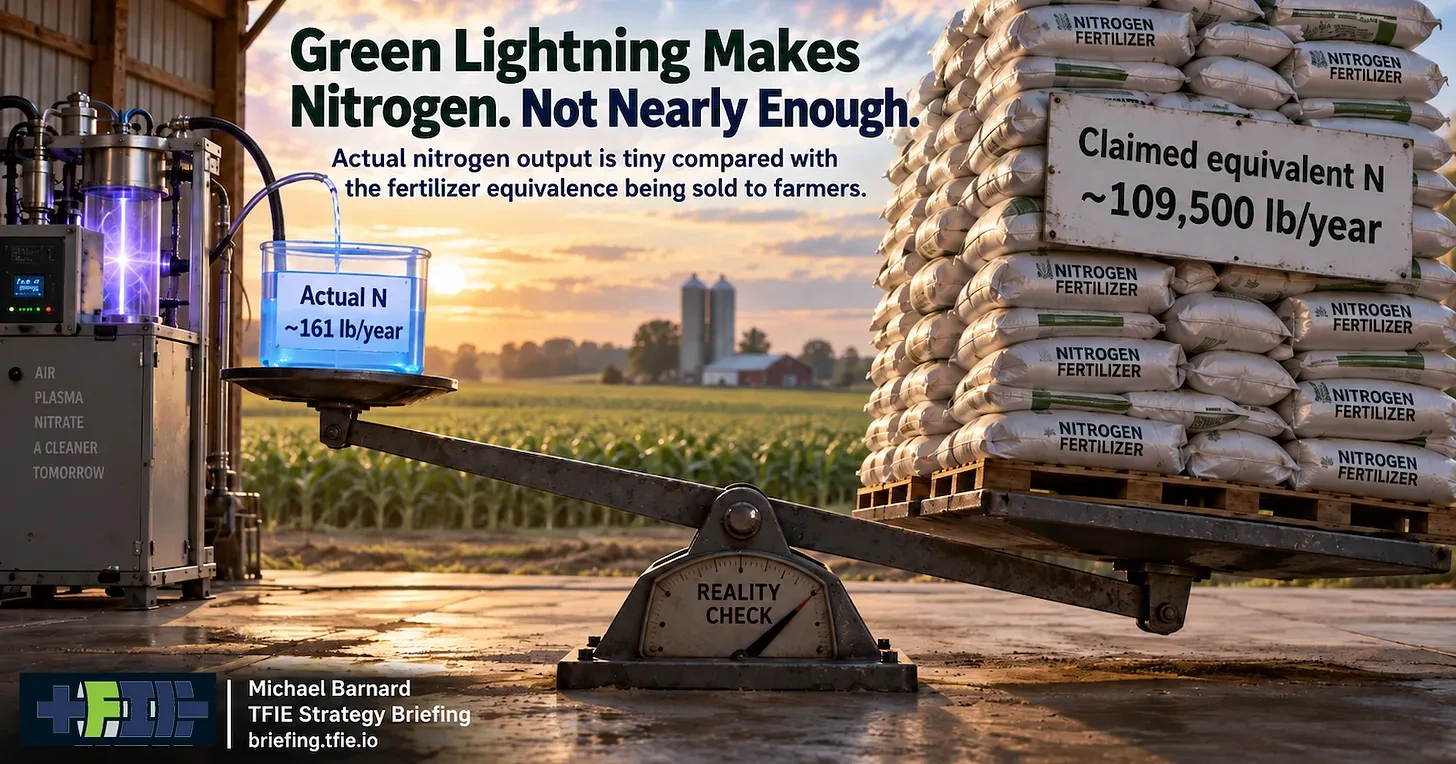
Green Lightning attempts to mimic natural lightning by using electrical discharges to oxidize atmospheric nitrogen, dissolving the resulting compounds into water to create a dilute nitrate solution. According to nitrate concentration metrics reported by Washington State University Extension, a standard Green Lightning machine running at a production rate of 100 gallons per day will physically fix approximately 161 pounds of actual elemental nitrogen per year.
Yet, marketing and promotional literature for similar decentralized plasma systems often frame output differently. They have been described as yielding an equivalence of roughly three pounds of conventional nitrogen per gallon of product. At the same 100-gallon-per-day operational rate, this translates to a claimed conventional-nitrogen replacement of a staggering 109,500 pounds per year.
This represents a roughly 680-fold discrepancy between the nitrogen physically created by the machine and the nitrogen supposedly offset or replaced in the field. This glaring mathematical contradiction forms the heart of the debate: plants cannot build tissue out of thin air or marketing promises. If a crop maintains its harvest yield after a conventional fertilizer program is heavily slashed, and a Green Lightning system supplies only a tiny fraction of new nitrogen, the remaining atoms must originate from somewhere else already present in the field—such as soil organic matter, residual fertilizer from past seasons, manure, or biological fixation.
Chronology: From Century-Old Chemistry to Modern Field Trials
The journey of plasma-based nitrogen fixation is a long one, rooted in foundational chemical principles that predate modern industrial agriculture.
Early 20th Century: The Birkeland-Eyde Process
The concept of using electric arcs to fix atmospheric nitrogen is not new. At the dawn of the 20th century, Norwegian scientist Kristian Birkeland and engineer Sam Eyde commercialized the Birkeland-Eyde process, which used powerful electric arcs to oxidize nitrogen from the air, producing nitric acid. While scientifically successful, the process was notoriously energy-intensive. It was largely abandoned when Fritz Haber and Carl Bosch developed the catalytic high-pressure synthesis method that dominates global fertilizer production today.
Modern Revival and Plasma Tech Evolution
Decades later, modern engineering firms and clean-tech startups revisited plasma oxidation, aiming to downscale the technology into modular, on-farm units. By leveraging advancements in localized electronics and renewable electricity, companies sought to make plasma nitrogen generation economically viable for individual growers. Green Lightning emerged from this wave, promising localized, zero-carbon nitrate production driven by solar or grid power.
2024: The Precision Planting Field Trials
As commercial interest grew, independent agronomists sought to test these machines under rigorous, real-world farming conditions. In 2024, Precision Planting conducted a landmark field test to evaluate the complete replacement of a conventional nitrogen program with Green Lightning in corn production.
Over the course of the growing season, the Green Lightning treatment applied 120 gallons per acre across six separate applications. The resulting corn harvest yielded 235.9 bushels per acre. By contrast, the control group utilizing a conventional UAN nitrogen program produced 280.7 bushels per acre—a substantial yield penalty of nearly 45 bushels per acre for the plasma-treated plots.

While researchers noted operational challenges during the trial—including issues with hard water scaling and maintaining consistent fluid outputs—the trial provided a rare, direct empirical test of the replacement proposition. It demonstrated clearly that simply substituting a conventional nitrogen regimen with a low-output plasma generator failed to maintain baseline crop performance.
Supporting Data: Energy Sanity Checks and Mass Balance
To evaluate whether technological iterations or higher nitrate concentrations can bridge the 680-fold gap, analysts have turned to fundamental mass-balance accounting and energy physics.
The Mass-Balance Problem
In agronomy, mass balance is an inescapable law: what goes into the plant must come from the soil-plant-atmosphere system. If an acre of high-yielding corn requires roughly 200 to 240 pounds of available nitrogen per season to reach optimal yields, and a localized machine supplies only a fraction of a pound per acre through direct fertigation, the crop is facing a severe nutritional deficit.
Proponents often argue that better fertilizer management—such as split applications, precision timing, and reduced volatilization losses—allows farmers to grow more with less. While it is true that enhanced efficiency fertilizers and precise micro-dosing can improve nutrient use efficiency (NUE), agronomic efficiency has hard biological limits. Improved timing does not create atoms out of nothing. If a farmer removes thousands of pounds of conventional fertilizer and replaces it with negligible quantities of machine-fixed nitrate, the crop is inevitably mining legacy nitrogen reserves. Over time, this practice depletes soil organic matter, strips the soil of its long-term fertility, and results in diminishing yields.
Energy Efficiency and Thermodynamics
Physics also imposes severe constraints on plasma nitrogen synthesis. The energy required to break the strong triple bond of atmospheric nitrogen ($N_2$) via electrical discharge is immense. When calculated against the thermodynamic cost of electricity, generating significant quantities of nitrogen fertilizer via on-farm plasma reactors typically consumes vastly more electrical energy than producing equivalent nitrogen through centralized green ammonia facilities powered by electrolysis and the Haber-Bosch process.
When a farm runs a high-draw plasma generator using standard electricity, the economic and carbon footprint trade-offs must be factored against the actual volume of usable nutrient produced. If the energy input yields only trace amounts of nitrate, the cost per pound of actual plant-available nitrogen can become prohibitively expensive compared to purchasing bulk commercial fertilizers.
Official Responses and Industry Perspectives
The commercialization of decentralized plasma fertilizer systems has sparked a vigorous debate across the agricultural technology sector.
- Manufacturer and Developer Claims: Developers of plasma nitrogen systems, including companies like Nytro, maintain that newer generations of equipment exhibit significantly higher nitrate concentrations and improved operational reliability. Proponents point to select trials showing positive crop responses and argue that early-generation tests do not reflect the capabilities of optimized, next-generation hardware. Industry advocates emphasize that even modest supplemental nitrogen streams can reduce a farm’s total reliance on imported inputs, providing a valuable hedging tool against fertilizer price spikes.
- Independent Agronomists and Researchers: Independent research bodies, including university extension services and strategy briefing analysts (such as TFIE), urge caution. They argue that while higher nitrate concentrations are welcome, they do not magically rewrite the laws of mass balance. Researchers stress that until manufacturers publish peer-reviewed, controlled experiments demonstrating exactly how crops survive on drastically reduced nitrogen inputs, extraordinary claims must be treated with skepticism. Agronomists emphasize that distinguishing a machine’s direct contribution from residual soil nitrogen is vital to protecting farmers from making costly capital investments based on inflated ROI projections.
Implications for Farmers, Investors, and the Clean-Tech Sector
As agricultural technology investments pivot heavily toward decarbonization and localized resilience, the Green Lightning controversy offers critical lessons for the entire clean-tech ecosystem.
1. The Danger of Over-Promising in AgTech
Farmers are pragmatic business operators. They do not purchase fertilizer-equivalence claims in the abstract; they invest capital in equipment to replace tangible inputs and protect their bottom lines. When a technology is marketed as a complete fertilizer replacement but performs as a minor supplement, it risks alienating the very agricultural community it aims to serve. Trust, once lost through underperforming field trials, is difficult to rebuild.
2. Finding the Realistic Niche for Plasma Technology
Acknowledging that Green Lightning cannot replace tens of thousands of pounds of conventional fertilizer does not render the technology useless. A machine that produces a reliable, on-demand supplemental stream of nitrate can still find valuable applications in niche markets:
- Organic Production: Providing compliant, locally sourced fertility inputs where synthetic fertilizers are restricted.
- Foliar Micro-Dosing: Delivering targeted micronutrient or supplemental nitrate boosts during critical growth windows.
- Remote Operations: Assisting remote or isolated farming operations where transporting bulky chemical fertilizers incurs prohibitive shipping costs.
However, positioning these devices as direct replacements for industrial fertilizer infrastructure is a fundamentally different and vastly larger commercial proposition—one that current empirical evidence fails to support.
Conclusion
Green Lightning is a genuine technological achievement rooted in fascinating plasma chemistry. It successfully harnesses electricity to fix atmospheric nitrogen into water-soluble nitrate. Yet, the physics of energy consumption and the unyielding realities of agronomic mass balance create an insurmountable barrier between physical output and marketing hype.
Until developers can provide transparent, independently verified mass-balance accounting and reproducible field trials proving that trace inputs can sustain high yields without depleting underlying soil health, growers and investors should view Green Lightning not as a miraculous fertilizer replacement, but as what it physically is: a modest, supplemental tool in a much broader agronomic toolkit.
