


As the critical 2026 midterm elections draw closer, political strategists in Washington are working overtime to sharpen their economic messaging. Democrats are navigating a fractured political landscape, attempting to balance cost-of-living concerns with broader geopolitical tensions, while Republicans scramble to counter shifting public sentiment. Yet, framing the upcoming midterms as purely an economic referendum misses a vital, highly energized demographic: voters who recognize that Congress must step up to drive climate action following years of federal regression.
Despite mounting evidence that climate change is inflicting tangible economic and health damage on communities across the United States, a curious phenomenon has taken hold among progressive candidates. Dubbed "climate-hushing," a growing number of Democratic campaigns have actively scrubbed climate change from their public messaging, choosing instead to lean entirely into traditional pocketbook issues. However, recent academic research suggests this strategy is not only unnecessary—it actively alienates the party’s most reliable and passionate base of voters.
Main Facts: The Reality of Climate-Hushing vs. On-the-Ground Crises
The strategy of "climate-hushing" is well-documented. An analysis of congressional press releases by researchers at the University of California, Santa Barbara (UCSB), working alongside the 2035 Initiative and Inside Climate News, reveals a staggering trend: mentions of climate change by congressional Democrats have plummeted by roughly 80% since 2021. Political advisors have largely convinced candidates that the term "climate change" is a toxic, polarizing buzzword that turns off moderate and independent voters.
Yet, this strategic silence stands in stark contrast to the physical reality unfolding outside. From coast to coast, the consequences of a warming planet are no longer abstract projections; they are immediate, high-cost economic crises.
- The Spokane Wildfires: In early August 2026, three fast-moving wildfires tore through Spokane County, Washington, destroying over 640 structures—many within the city limits of Spokane itself—and forcing thousands to evacuate under urgent "leave now" warnings.
- National Smoke and Public Health: The Spokane disaster follows weeks of intense heat waves and heavy Canadian wildfire smoke blanketing the US Northeast. According to a landmark study published in the journal Frontiers in Environmental Health, rising wildfire pollution over the last 16 years has entirely offset public health gains made by reducing industrial and transportation emissions. Wildfire smoke is now the single primary pollutant negatively affecting pregnant women in the US, driving up rates of low birthweights and pre-term births.
- The Political Disconnect: While health researchers and scientific journals sound the alarm, federal leadership remains gridlocked or distracted. Notably, US Health and Human Services Secretary Robert F. Kennedy Jr. bypassed traditional public health amplifier channels to launch a television cooking show rather than prioritizing CDC wildfire smoke advisories.
Chronology: A Summer of Escalating Disasters and Polling Realities
The convergence of environmental disasters and political re-strategizing over the summer of 2026 highlights a profound disconnect between campaign advisers and the voting public.
- Late Spring 2026: As data center booms and AI-driven energy demands strain regional power grids, early polling for the midterm cycle shows cost of living dominating voter concerns. Pundits advise campaigns to drop polarizing environmental terminology.
- Early July 2026: Canadian wildfire smoke drifts southward, impacting air quality for tens of millions of Americans. Investigative analyses show that congressional Democrats have successfully dropped climate references from roughly 80% of their official communications compared to five years prior.
- Late July 2026: Stateline and academic researchers release studies highlighting that wildfire smoke has officially become the primary pollutant impacting pregnancy outcomes across the United States, even in non-traditional wildfire regions like the American Southeast.
- Early August 2026: Spokane County, Washington, erupts into multiple destructive wildfires that consume over 600 buildings. Concurrently, UCSB researchers release the results of a comprehensive two-survey national study of approximately 3,500 adults, putting the "climate-hushing" hypothesis to an empirical test.
Supporting Data: What the UCSB Study Reveals
To determine whether avoiding the word "climate" is actually sound electoral advice, the UCSB research team tested three common political assumptions against hard survey data collected over the summer.
Claim 1: Climate is not a top issue.
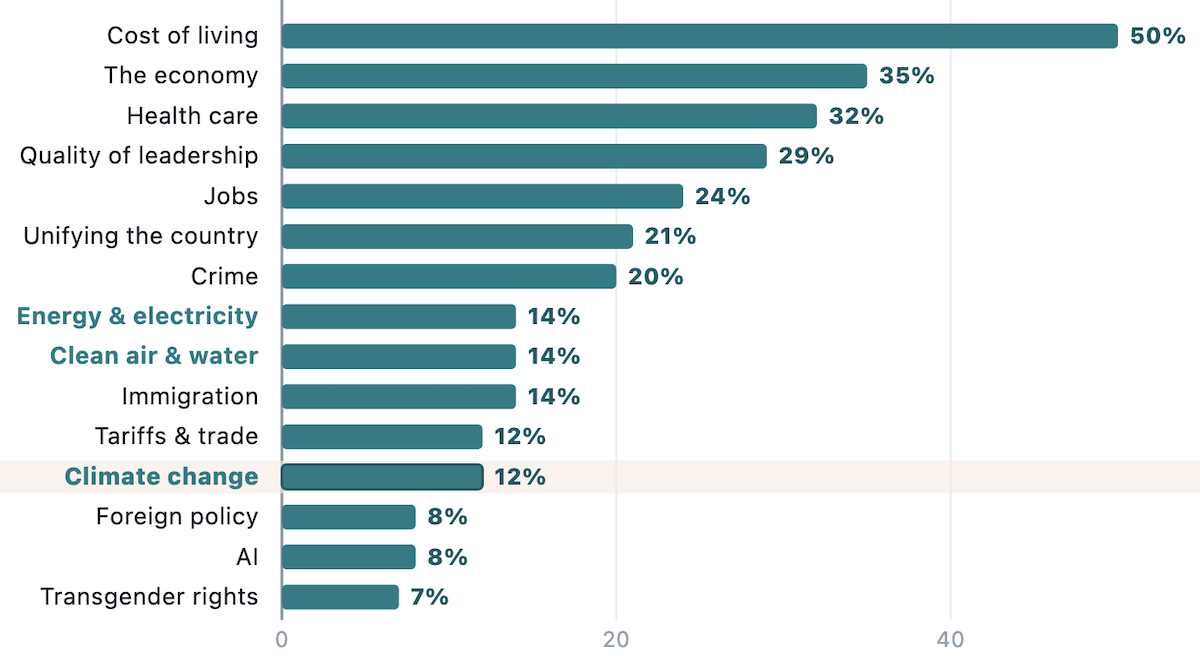
- The Verdict: True, but misleading. When surveyed on top priorities, "climate change" sat at #12 out of 15, while cost of living, the broader economy, and health care dominated the top three spots.
- The Catch: While raw concern for climate change sits lower on general priority lists, the issues it directly impacts—energy costs, public health, and clean air—rank much higher. Clean air and water secured 14% of top-three rankings, and energy and electricity matched it at 14%, proving that voters care deeply about the components of climate policy even if they do not lead with the terminology.
Claim 2: The phrase "climate change" is polarizing.
- The Verdict: False. The UCSB study found that saying the word "climate" does not inherently polarize voters. Identical policies drew the exact same level of support whether they were framed under the banner of "climate," "energy," or "clean air." Voters are fundamentally pragmatic; they care far more about the policy mechanism than the overarching ideological label.
Claim 3: Emphasizing climate change loses votes.
- The Verdict: False. This does not follow from Claim 2. In fact, the data showed an enormous motivational asymmetry between climate supporters and climate opponents.
- The Numbers: Climate supporters rated the importance of climate change on their vote at nearly 75 out of 100. Conversely, climate opponents rated its negative pull at under 38 out of 100—a massive 37-point enthusiasm gap. Clean energy followed a virtually identical pattern with a 36-point gap. This indicates that while opponents remain largely indifferent to climate rhetoric, passionate climate supporters are significantly more motivated to reward pro-climate candidates at the ballot box.
Furthermore, the data showed overwhelming, non-partisan support for specific decarbonization technologies. Rooftop solar led the pack with a 69% favorability rating against a mere 20% unfavorable rating, with onshore wind, large-scale solar farms, and heat pumps enjoying similarly broad margins.
Official Responses and Political Implications
The implications of the UCSB findings point to a major strategic miscalculation by mainstream political operators. By attempting to appeal to a mythical "median voter" through strategic silence, campaigns risk demobilizing their most loyal base.

Political scientists emphasize that elections are won not just by persuading undecided voters, but by turning out core constituencies. In a tight midterm cycle where turnout is everything, leaving a 37-point enthusiasm gap on the table is dangerous. The data suggests that candidates do not need to tiptoe around environmental issues; rather, they need to ground their messaging in tangible, popular clean technologies—such as rooftop solar and lower electricity bills—that directly address the cost of living.
Moreover, the current economic anxieties of the American electorate—spanning housing costs, health insurance premiums, and surging energy demands from the tech and AI sectors—are inextricably linked to energy policy. When energy grids are strained by extreme weather events like the Spokane wildfires or fossil fuel volatility tied to foreign conflicts, energy independence and grid modernization become primary economic issues.
Conclusion: Moving Forward in the 2026 Midterms
As the 2026 midterm election cycle enters its final stretch, Democratic candidates face a clear choice. They can continue down the path of climate-hushing, relying solely on generic economic talking points that fail to ignite enthusiasm, or they can reframe climate action as a core pillar of economic resilience, public health, and household savings.
The science is definitive, the public health impacts of unchecked pollution are visible in hospital wards and scorched neighborhoods, and the polling data proves that climate-conscious voters are waiting to be mobilized. For politicians looking to survive a turbulent political climate, the smartest move may simply be to speak the truth about the world burning around them—and offer the clean energy solutions voters already love.
