

BERLIN — Europe’s automotive landscape is undergoing a structural transformation at an accelerating pace. Propelled by a combination of new, lower-priced electric vehicle (EV) offerings, competitive pricing from Chinese automakers, and traditional manufacturers scaling up their portfolios, the European plugin vehicle market achieved a landmark performance in June.

According to the latest registration data, plugin vehicles—comprising both battery-electric vehicles (BEVs) and plug-in hybrids (PHEVs)—captured a formidable 37% market share across Europe during the month. The surge highlights a consumer shift toward electrification, even as traditional internal combustion engine (ICE) vehicles see their market share steadily erode toward historic lows.

Main Facts: A Record-Breaking June for European EVs
The month of June was defined by robust growth across the board for electrified transport, comfortably outpacing the broader automotive market’s year-on-year growth rate:
- Total Plugin Share: Plugin vehicles reached 37% of the total European auto market in June, fueled by a 41% year-on-year (YoY) increase.
- BEVs Lead the Charge: Fully electric vehicles accounted for roughly 366,000 registrations in June. This represents a staggering 50% increase YoY—the fastest growth rate recorded so far this year—and marks a brand-new all-time monthly record for BEV volume.
- PHEVs Lose Momentum: Plug-in hybrids grew by a more modest 23% YoY. Consequently, BEVs dominated the plugin category, capturing 71% of June’s total plugin sales and pushing their year-to-date (YTD) average to 69%, the highest share for pure electrics since 2012.
- Year-to-Date Gains: The YTD market share for BEVs now stands at 23% (with combined plugins at 33%), already outperforming the final 2025 results (20% for BEVs, 29% combined).
- The Death of Diesel and Petrol: Traditional fuel types are rapidly contracting. Petrol vehicles fell 12% in June to a 21% market share, while diesel plummeted 17% YoY to a near-irrelevant 6% of the market. Conversely, plug-in hybrids and full hybrids (HEVs) combined with BEVs mean that 72% of all cars sold in Europe in June featured some level of electrification.
Chronology: How the Market Shifted Through the First Half of the Year
The road to June’s record-breaking figures was paved by steady consumer adaptation and strategic product rollouts throughout the first half of 2026:

- Q1 2026: Automakers began feeling the pinch of tightening EU emissions standards alongside a massive influx of cost-competitive entries from Chinese manufacturers. Price corrections initiated late last year by market leaders began stimulating demand among budget-conscious buyers.
- April–May 2026: As fuel prices remained stubbornly high and delivery bottlenecks eased, reservation backlogs cleared. Tesla’s refreshed lineup and aggressive pricing strategies stimulated a massive wave of deliveries, pulling the broader market upward. Meanwhile, legacy European automakers scrambled to adjust production targets in response to accelerating orders for affordable urban EVs.
- June 2026: A convergence of factors culminated in the historic 37% penetration rate. A massive delivery wave from Tesla, combined with volume scaling from BYD and legacy European stalwarts like Renault and BMW, pushed BEVs to unprecedented monthly volumes.
Supporting Data: Best-Selling Models and Brand Dynamics
Top 5 Individual EV Models in June
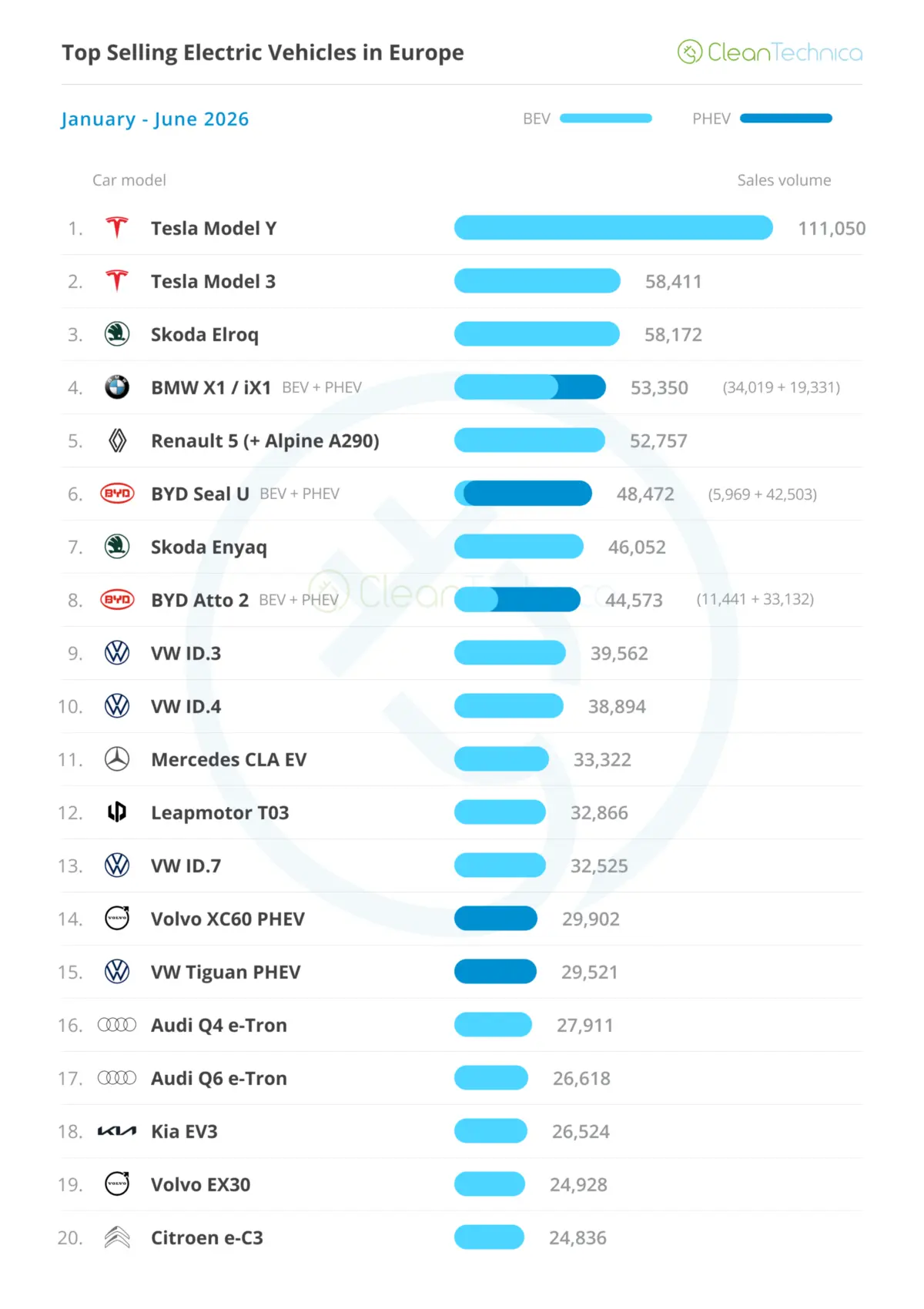
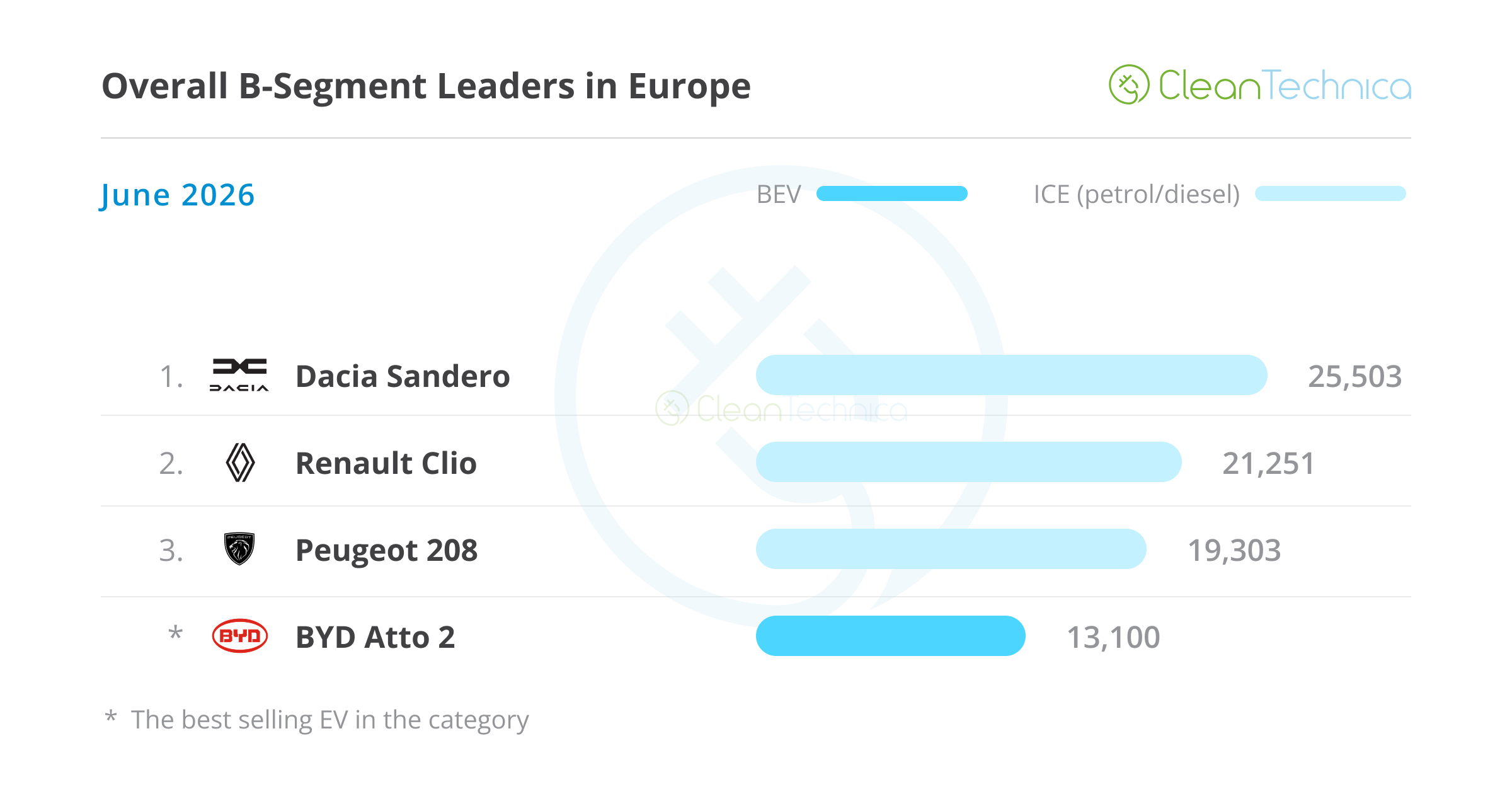
- Tesla Model Y: Reclaiming the crown with 34,480 registrations (a 43% YoY increase), the midsize crossover was not only the top EV but the best-selling vehicle across the entire European market—beating the runner-up Dacia Sandero by a massive 9,000 units. It dominated individual markets including the UK, Netherlands, Switzerland, Norway, Denmark, and Iceland.
- Tesla Model 3: Benefitting from similar macroeconomic tailwinds and a starting price near €35,000, the sedan secured 18,028 registrations (up 67% YoY), placing it 7th overall in the broader European market.
- BYD Atto 2 (BEV + PHEV): The Chinese compact SUV hit a new record of 13,100 registrations, largely driven by its long-range PHEV variant offering up to 90 km (56 miles) of electric range and Vehicle-to-Load (V2L) capabilities.
- BMW iX1 / X1 PHEV: BMW’s bread-and-butter crossovers continued their steady trajectory with 11,778 registrations, sustained by favorable lease structures and strong regional demand.
- Renault 5 (incl. Alpine A290): Renault’s nostalgic electric hatchback secured 10,785 sales (up 38% YoY), proving that the French manufacturer’s affordable EV strategy is paying rich dividends.
Brand and Automotive Group Rankings
- Brands: Volkswagen retained its lead among plugin brands with an 8.9% market share, though it dipped slightly from May. BYD surged into second place with 7.9%, closely tracking the market leader in its home region. Tesla climbed to third place with 7.1%, followed by BMW (7%) and Mercedes-Benz (5.8%).
- Automotive Groups: Volkswagen Group commands the overall group leaderboard at 24% market share despite a minor 0.8% drop. BMW Group captured the silver medal position with 8.6%, narrowly edging out a struggling Stellantis (8.3%), which faces mounting pressure from both Chinese competitors and internal sales cannibalization.
Official Responses and Industry Commentary
Industry analysts and corporate leaders have pointed to affordability and battery technology advancements as the critical turning points for European EV adoption.

During a recent briefing on surging electric vehicle orders, Renault executives emphasized that proactive adaptation to consumer expectations—specifically regarding battery efficiency and cost—is the only way legacy automakers can survive the shifting landscape.
Conversely, market observers have criticized certain legacy product planners for hedging their bets. For instance, critics argue that decisions by brands like Stellantis to offer legacy internal combustion engine variants alongside new EV architectures (such as upcoming city cars) risk diluting their own electrification momentum. As the market pivots decisively toward value-driven EV buyers looking to slash operating costs, vehicles built from the ground up as dedicated electric platforms are consistently outperforming converted legacy platforms.

Implications: The Road to the Mid-2030s
June’s performance carries profound implications for the European Union’s long-term climate and transportation goals:

- Accelerated Timelines: With year-to-date BEV adoption already exceeding the total figures recorded in 2025, Europe is running ahead of schedule in its transition toward near-100% zero-emission vehicle sales by the mid-2030s.
- Intensifying Competition: The rapid ascent of brands like BYD—bolstered by localized manufacturing plans in Hungary and versatile plug-in powertrain options—signals that European automakers can no longer rely on brand loyalty alone. Competitiveness will be dictated by battery costs, software integration, and aggressive pricing.
- The Squeezing of the ICE Market: As petrol and diesel variants retreat into single-digit and low double-digit market shares, service stations, secondary automotive markets, and municipal infrastructure planning will face an accelerated imperative to pivot toward mass EV charging and grid reinforcement.
As the second half of the year unfolds, the battle for segment leadership—particularly in the high-volume B and C segments—promises further price adjustments, new model introductions, and a rapidly shrinking space for traditional combustion-only vehicles.
