

Every November, major fine art auction houses across the United States open their doors—and digital bidding platforms—to a specialized audience of international collectors. As the gavel falls and the traditional cry of “SOLD!” echoes through salesrooms, a dynamic sector of the broader American art market achieves new milestones. Spanning historical Western landscapes, sun-drenched California impressionism, and pioneering Indigenous creations, these categories continue to command robust prices, driven by a deeply dedicated base of patrons and an expanding mainstream appeal.
Main Facts and Market Dynamics
The vitality of the autumn fine art season is rooted in a resilient collecting ecosystem that bridges historic regional movements with contemporary Indigenous expression. Recent single-owner capsules and estate dispersals have demonstrated extraordinary strength. At Bonhams, private collections focusing on Western and Native American works have consistently surpassed pre-sale projections. For instance, The Gene Hackman Collection: A Life in Art featured Fritz Scholder’s powerful canvas Dancer and Nicolai Fechin’s charcoal drawing Carmen (Head of a Girl), which realized $152,900 and $23,040, respectively—both well above their pre-sale estimates.

This momentum is not limited to historical masters. Contemporary Western art has captured the imaginations of both new and seasoned bidders. Aaron Bastian, director of fine arts at Bonhams San Francisco, observes that works by modernist Southwestern painter Ed Mell routinely exceed their high estimates. This trend was underscored during Bonhams’ white-glove sale, Diane Keaton: The Architecture of an Icon, where Maynard Dixon’s 1941 nocturne Train on the Desert achieved $35,840, and Mell’s 1992 piece Light in the Valley reached $40,960.
Following his passing in 2024, Mell’s market has experienced accelerated growth. Alissa Ford, vice president of American and Western art at Heritage Auctions, notes a broader paradigm shift in the marketplace. "Collectors of Western art champion not only established artists but also emerging artists or those who are lesser known around the country," Ford explains. "As a result, artists who once appealed primarily to regional audiences, such as Ed Mell, have achieved national recognition, reflecting the expanding reach, relevance, and appeal of Western art across the broader collecting landscape."

Parallel to the Western market, California art remains a cornerstone regional segment. Landscapes by historical luminaries like Guy Rose and Edgar Payne continue to attract fierce competition. Katherine Halligan, director of fine art at John Moran Auctioneers, highlights the deeply personal nature of this segment. "The collecting audience tends to have some sort of personal connection to the Golden State, whether they reside in California or in other states," she notes. Intriguingly, Halligan has also observed that within broader American paintings sales, collectors exhibit heightened interest in California artists even when they depict non-California subjects.
Meanwhile, the market for Native American and Indigenous art is being propelled forward by contemporary paintings, sculptures, pottery, and jewelry. Santa Fe Art Auction has carved out a commanding niche in this category, with President and CEO Gillian Blitch reporting that Indigenous works account for more than half of their total sales. "Contemporary Indigenous art has certainly become one of the most exciting collecting areas in recent times," Blitch remarks, "particularly mid- to late-20th-century pieces that cross collecting categories into post-war modern art."

Chronology of the Autumn 2026 Auction Season
The autumn season unfolds through a rapid succession of flagship sales at premier auction houses, each presenting carefully curated lots that reflect these shifting market dynamics.
November 5: Heritage Auctions – Western Art Signature Auction (Dallas, TX)
Kicking off the November calendar, Heritage Auctions presents more than 100 fine paintings and sculptures. Headlining the sale is Clark Hulings’s 1993 oil on canvas Street Vendors (estimated at $40,000–$60,000), alongside G. Harvey’s atmospheric Raindrops and Puddles ($30,000–$50,000). Other notable inclusions range from Earl Biss’s 1979 canvas Taking Shelter Before Crossing Pryor Gap to E. Martin Hennings’s intimate portrait Max Baca.

November 6–7: Santa Fe Art Auction – The Signature Sale (Santa Fe, NM)
Spanning two days, Santa Fe Art Auction offers a comprehensive cross-section of historic and contemporary works. The sale features rare pieces by modernist Rebecca Salsbury James—notably her 1941 reverse oil on glass White Roses at Twilight (estimated at $200,000–$300,000)—alongside works by Jaune Quick-to-See Smith, Ed Mell, and E. Martin Hennings, plus the complete John B. Stetson set of Edward S. Curtis’s landmark publication The North American Indian.
November 11: Bonhams – California & Western Art Auction (Los Angeles, CA)
Bonhams returns with a catalog of over 125 lots representing foundational groups such as the Society of Six, the Taos Society of Artists, and the Cowboy Artists of America. Highlights include Amédée Joullin’s 1897 historical painting The Passing of the Wampum Belt ($12,000–$18,000) and Edgar Payne’s quintessential Western landscape Riders on the Mesa (Indian Riders) ($100,000–$150,000), alongside a dedicated Western art capsule from the Estate of Ed and Bonnie Harvey.

November 17: John Moran Auctioneers – California & American Fine Art (Monrovia, CA)
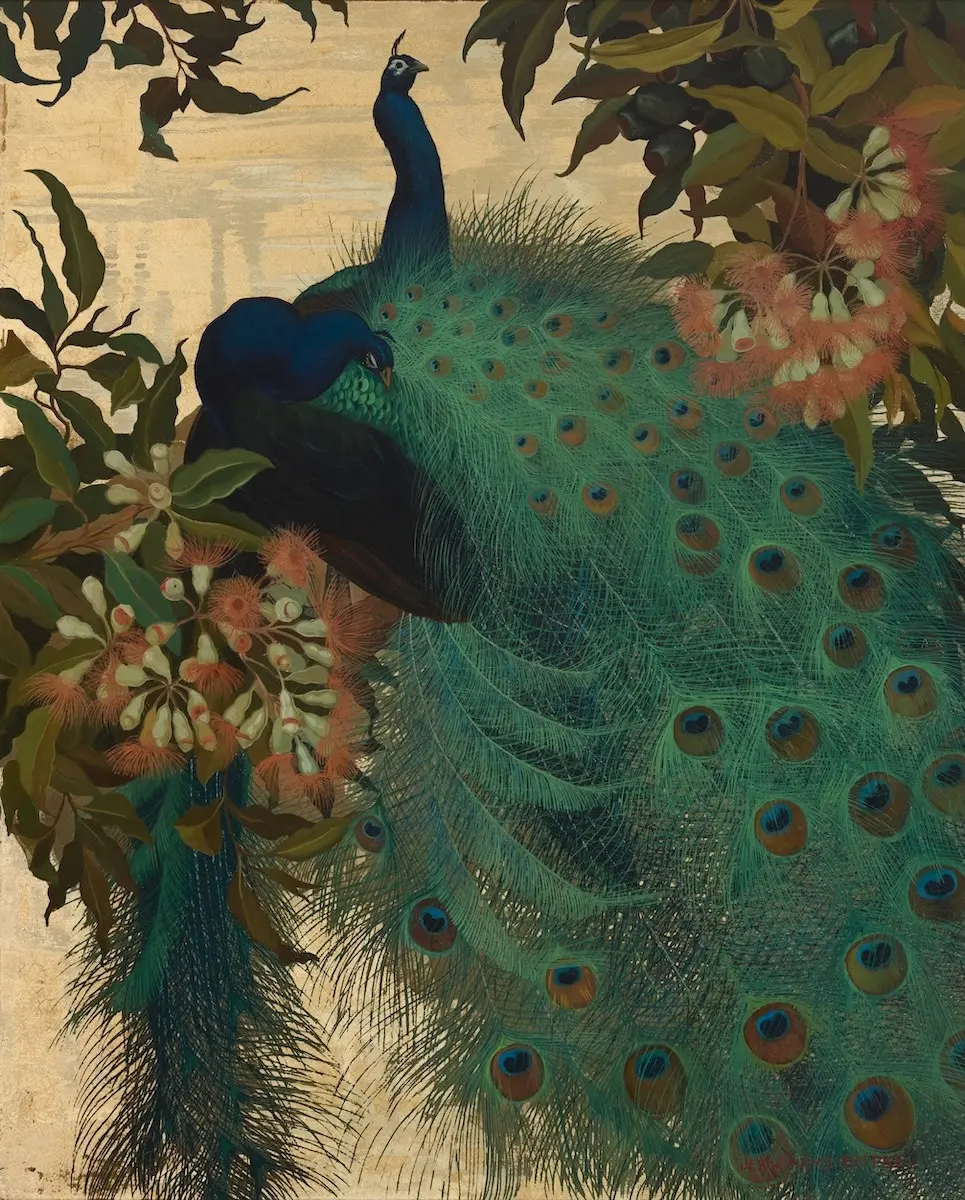
Concluding the major November sales, John Moran Auctioneers offers approximately 250 lots of paintings, works on paper, prints, and sculpture. Drawn largely from prominent regional estates, the auction features the fine art collection of Sybil Rosen and Robert Fisher of Montecito, anchored by Daniel Ridgway Knight’s A Trysting Place, alongside Jessie Arms Botke’s exquisite gold-leaf masterwork Black Peacocks from the Saperstein Collection of Oakland.
Supporting Data and Highlight Lots
A closer examination of the catalog highlights reveals the exceptional craftsmanship and investment potential driving these sales:

- Edgar Payne (1883–1947), Riders on the Mesa (Indian Riders): Oil on canvas, 25.25 x 30 inches. Estimated at $100,000–$150,000 (Bonhams). Following his pivotal 1916 commission for the Santa Fe Railroad, Payne developed a radiant color palette uniquely suited to the American Southwest, making his canyon and mesa scenes enduring symbols of the region.
- Clark Hulings (1922–2011), Street Vendors (1993): Oil on canvas, 28 x 44 inches. Estimated at $40,000–$60,000 (Heritage Auctions). Described by experts as a dynamic masterwork bursting with complex color harmonies, life-like produce, and an animated ensemble of everyday figures.
- Rebecca Salsbury James (1891–1968), White Roses at Twilight (1941): Reverse oil on glass, 19.625 x 15.75 inches. Estimated at $200,000–$300,000 (Santa Fe Art Auction). Executed in an exacting, unforgiving medium, James’s rare works represent a vital reevaluation of female modernism in the American Southwest.
- Jessie Arms Botke (1883–1971), Black Peacocks: Oil and gold leaf on Masonite, 34 x 26 inches. Estimated at $50,000–$70,000 (John Moran Auctioneers). A dazzling synthesis of ornithological precision and decorative, Asian-inspired gold-leaf aesthetics.
- Jaune Quick-to-See Smith (French-Cree/Shoshone/Salish, 1940–2025), What is an American? (2003): Lithograph with chine collé, acrylic, and metal grommets, 69 x 40 inches. Estimated at $8,000–$12,000 (Santa Fe Art Auction). Coming to auction for the first time in an edition of 20, this work arrives on the heels of the artist’s acclaimed retrospective at the Whitney Museum of American Art.
Official Responses and Expert Perspectives
Industry leaders emphasize that the strength of the current market lies in its ability to embrace both tradition and revisionist art history.
Commenting on the shifting national awareness of regional masters, Alissa Ford of Heritage Auctions notes that contemporary collectors are dismantling old geographical boundaries. "Artists who once appealed primarily to regional audiences… have achieved national recognition," she states, pointing to the broader cultural resonance now enjoyed by Southwestern modernism.

Addressing the institutional and market momentum behind Indigenous creators, Gillian Blitch of Santa Fe Art Auction points directly to major museum programming as a catalyst for commercial success. "Demand for [Jaune Quick-to-See Smith’s] oeuvre has strengthened significantly over the past years," Blitch observes, "and her recent retrospective at the Whitney Museum of American Art has cemented her as a force within contemporary art."
Similarly, market specialists are working to correct historical omissions by elevating under-recognized modernist voices. Discussing the rare output of Rebecca Salsbury James, Blitch notes: "Like many women modernists, James’s work has been historically overshadowed by her more famous counterparts such as Georgia O’Keeffe and Paul Strand, but there has been recent momentum in her market and a push to reposition her work."

Broader Implications for the Art Market
The robust health of the Western, California, and Native American art sectors carries several distinct implications for the global fine art trade:
- De-marginalization of Regional Movements: The rising national profiles of artists like Ed Mell and regional modernist painters demonstrate that contemporary collectors increasingly value artistic merit and unique aesthetic vision over strict geographic categorization.
- Institutional Validation of Indigenous Art: The integration of mid- to late-20th-century Native American works into post-war contemporary art discussions has expanded the buyer base. Institutional retrospectives are proving to be direct drivers of secondary market liquidity and price appreciation.
- The Rise of Single-Owner and Estate Capsules: Major houses are finding immense success with thoughtfully curated collections (such as the Gene Hackman Collection, the Ed and Bonnie Harvey estate, and the Sybil Rosen and Robert Fisher collection). These provenance-rich capsules provide buyers with trusted, high-quality entries into specialized markets.
- Generational Shifts in Collecting: As younger collectors enter the market, they show a distinct willingness to cross traditional collecting boundaries—seamlessly blending historical Hudson River or California Impressionist canvases with contemporary Indigenous sculptures and post-war modern prints.
As the November auction series unfolds across Dallas, Santa Fe, Los Angeles, and Monrovia, the steady strike of the auctioneer’s gavel will once again confirm that America’s regional and Indigenous art markets are not merely surviving, but thriving at the forefront of the international fine art world.
