

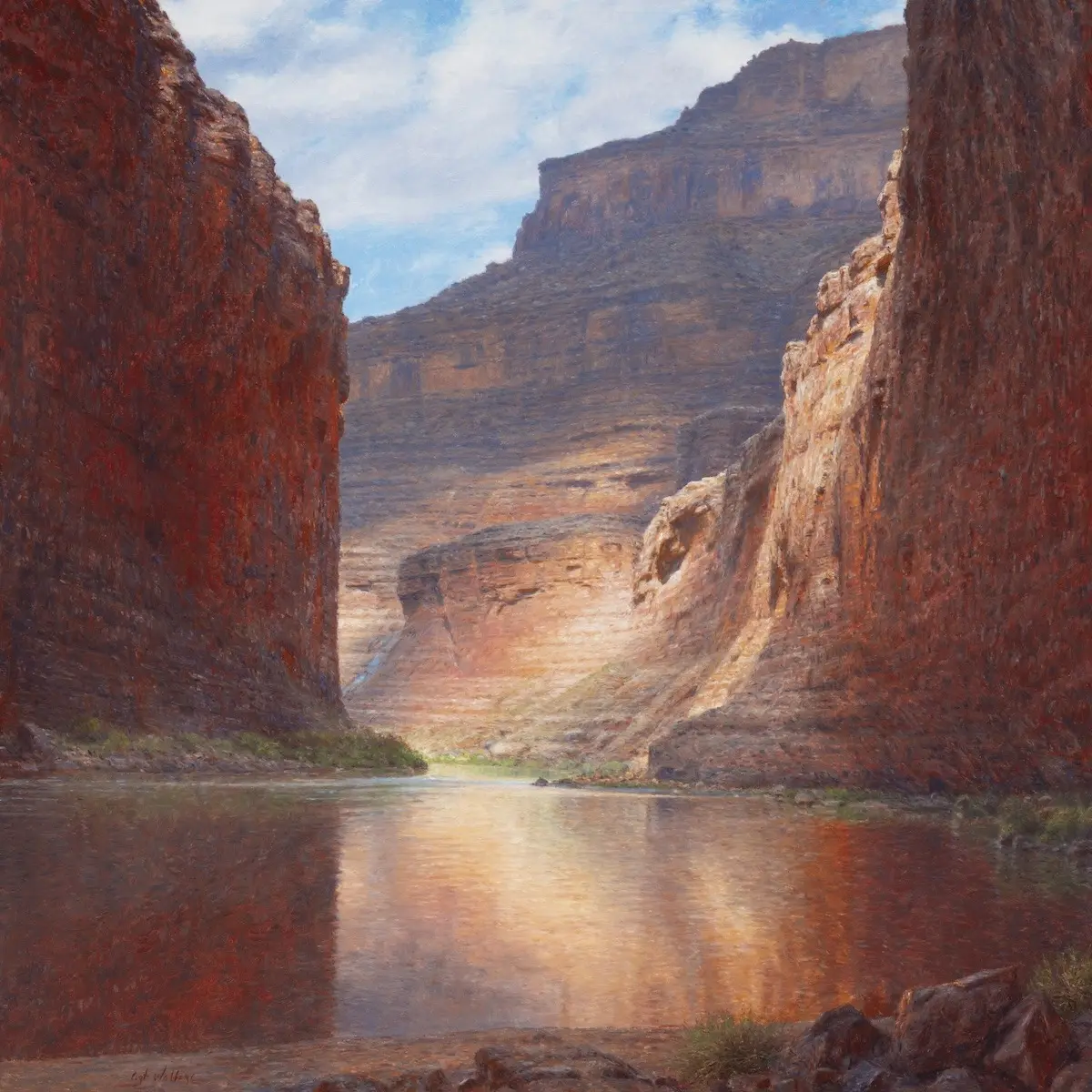
SEDONA, Ariz. — For more than half a century, the name Curt Walters has been inextricably linked to the majestic, shifting chasms of the Grand Canyon. Widely regarded as the preeminent living painter of America’s most iconic natural wonder, Walters has spent his life chasing the transient light, atmospheric violence, and staggering scale of the canyon. Now, art enthusiasts, historians, and collectors have a rare opportunity to witness the full breadth of his monumental career through a landmark, two-venue retrospective currently unfolding across Sedona, Arizona.
Titled A Lifetime in Art and hosted by the Fine Art Museum of Sedona, the exhibition runs through November 30. Spanning 48 carefully curated artworks created between 1979 and the present day, the retrospective offers an immersive journey into the mind and palette of a master landscape artist. Rather than occupying a single gallery, the exhibition spills across the town that Walters has called home for 47 years, utilizing two distinct venues to tell the dual stories of his lifelong obsession with the Grand Canyon and his evolving relationship with the fragile, rapidly changing ecosystems of the American Southwest.
Main Facts: A Dual-Venue Retrospective in Sedona
The exhibition is strategically split across two locations in Sedona, giving visitors a comprehensive look at both his grandest vistas and his intimate, localized studies:
- Primary Venue: The Mary D. Fisher Fine Art Complex houses the bulk of the retrospective, focusing primarily on Walters’ large-scale, breathtaking depictions of the Grand Canyon.
- Secondary Venue: Located two miles west in a museum pop-up space behind the Sedona Heritage Museum, a companion exhibition titled Impressions of Sedona 1980–2000 showcases paintings depicting the immediate landscape surrounding his adopted hometown during his earlier decades in the area.
- Duration: The exhibition is open to the public daily through November 30.
- Multimedia Additions: Both venues feature regular screenings of Painting the Air, an intimate biographical documentary directed by the artist’s daughter, Miranda Foreman, alongside the release of a new illustrated biography, Resilience: The Life History and Grand Canyon Art of Curt Walters, penned by his grandson, Damien Foreman.
Chronology: From a Teenage Epiphany to a Master’s Legacy
To understand Curt Walters is to understand a lifelong dedication that began before he could legally vote. His journey toward becoming the definitive chronicler of the Grand Canyon started in earnest in 1969 when, still in his teens, he made his first pilgrimage to the geological marvel. Standing on the rim at just 19 years old, Walters experienced an epiphany that would dictate the trajectory of his entire existence.
"The first time I visited the Canyon, at the age of 19, I saw an incredible diorama there of the conquistadors, and it just stuck in my head all these years," Walters recalls, reflecting on the foundational memory that planted the seeds for decades of creative output.
That initial spark launched what would become an arduous yet deeply fulfilling career. Eschewing easy shortcuts, Walters committed himself to mastering the elusive physics of desert light—capturing how dawn, dusk, monsoons, and cloud inversions transform the red, purple, and ochre rock faces. Over the decades, his dedication yielded critical acclaim and sweeping institutional recognition. He has consistently captured top honors at premier Western art showcases across the United States, including:

- The Prix de West at Oklahoma City’s National Cowboy & Western Heritage Museum.
- The Quest for the West exhibition at the Eiteljorg Museum in Indianapolis.
- The Masters of the American West exhibition at the Autry Museum in Los Angeles.
After settling in Sedona 47 years ago—placing him within a convenient two-and-a-half-hour drive of his ultimate muse—Walters refined his craft, evolving from a plein air painter capturing local flora into an artistic titan capable of handling massive canvases that dwarf the viewer.
Supporting Data: Masterworks on Display
The 48 pieces featured in A Lifetime in Art highlight the technical mastery and emotional resonance that define Walters’ career. Among the standout works on display at the Mary D. Fisher Fine Art Complex are massive canvases that transport viewers directly to the precipice of the canyon.
Instant Opus (Oil, 48 x 48 inches, 2020)
This striking recent work captures an epic sunset lightning storm witnessed firsthand by the artist from Yavapai Point. Rather than relying solely on memory, Walters stands on the front lines of nature’s fury to gather data for his compositions. "I was right there, with big bolts of lightning everywhere," he notes of the dramatic meteorological event that inspired the piece. The canvas pulses with kinetic energy, contrasting the ancient, static stone of the canyon with the violent, electric dynamism of an Arizona summer monsoon.
Tenebristic Spectacle (Oil on Canvas, 48 x 78 inches, 2018)
A massive, moody exploration of light and shadow, this painting exemplifies Walters’ mastery of chiaroscuro in a natural setting. The term tenebrism—traditionally used to describe dramatic, theatrical illumination in Renaissance and Baroque painting—is brilliantly adapted here to describe how low-angle sunlight cuts through deep canyon shadows, carving out three-dimensional drama from flat geological formations.
Venturing into Historical Narrative
Beyond pure landscape, Walters is expanding his repertoire with an ambitious new series that bridges history and art. Remembering the conquistador diorama that captivated him at age 19, the artist has taken steps to bring historical reality to his canvas. He has begun collecting period-accurate costumes, saddles, and bridles, hiring live models to pose as early Spanish explorers.
One notable painting from this emerging series depicts García López de Cárdenas—the Spanish commander who led the first European party to discover the Grand Canyon—standing in full military attire at the South Rim in 1540. "Now, I’ve collected all the costumes and saddles and bridles, and I have models coming to pose," Walters says with palpable enthusiasm. "I’m determined to do it. It’s a blast!"

Vicissitude (Oil, 30 x 48 inches, 1993)
Displayed at the Sedona Heritage Museum pop-up, this plein air piece offers a poignant counterpoint to the grand vistas of the canyon. Vicissitude depicts a lush, idyllic scene of yuccas in glorious springtime bloom, backed by Sedona’s iconic red rock cliffs.
However, the beauty of the painting carries a bittersweet undertone. The title—meaning a change or variation of circumstances, usually one unfavorable or unwelcome—serves as an elegy for a lost landscape. "That place doesn’t exist anymore," Walters says ruefully. "It’s now a shopping center and parking lot."
Official Responses and Family Perspectives
The exhibition is not merely a commercial or institutional retrospective; it is a deeply personal family affair. The dual-venue setup is complemented by the unique perspectives of two family members who have documented Walters’ life and career through film and literature.
Miranda Foreman, Walters’ filmmaker daughter, directed Painting the Air, a feature-length documentary that explores the grueling physical labor, philosophical framework, and artistic discipline required to paint en plein air in extreme desert environments. Screenings of the documentary are hosted at both the Mary D. Fisher Fine Art Complex and the Sedona Heritage Museum pop-up during the run of the exhibition, giving audiences a rare, behind-the-scenes look at the artist at work.
Concurrently, Damien Foreman, the artist’s grandson, has authored a comprehensive illustrated biography titled Resilience: The Life History and Grand Canyon Art of Curt Walters. The book dives deep into the personal trials, artistic breakthroughs, and unwavering persistence that allowed Walters to carve out a singular niche in American art history.
Art critics and museum organizers note that Walters’ ability to merge rigorous technical observation with raw emotional power is what separates him from his contemporaries. By presenting his work in Sedona—the town that nurtured his creative spirit for nearly half a century—the Fine Art Museum of Sedona has created a tribute that feels both intimate and monumental.

Implications: A Call for Environmental Stewardship
While A Lifetime in Art celebrates a prolific 45-year creative journey, it also delivers a profound, underlying message regarding the fragility of the American West.
Through works like Vicissitude, Walters moves beyond mere documentation to sound a subtle yet urgent alarm. The rapid commercial development that swallowed the blooming yucca fields of Sedona serves as a microcosm of the pressures facing natural wonders across the United States. As tourist numbers swell at the Grand Canyon and surrounding wilderness areas face ecological stress from climate change, urban sprawl, and resource extraction, Walters’ paintings take on a new layer of responsibility.
The retrospective reminds viewers that landscapes once thought eternal are vulnerable to human alteration. By immortalizing the fleeting play of monsoon light over ancient strata and recording ecosystems before they vanish beneath asphalt, Walters acts as both an artist and an archivist. His canvases challenge the public not only to admire the breathtaking scale of America’s natural splendors, but to actively participate in preserving them for future generations.
Visitor Information
- Event: Curt Walters: A Lifetime in Art
- Dates: Through November 30
- Locations:
- Mary D. Fisher Fine Art Complex (Main Exhibition)
- Museum Pop-Up behind the Sedona Heritage Museum (Impressions of Sedona 1980–2000)
- Phone: (888) 602-2667
- Website: fineartmuseumofsedona.org
