

Introduction: The November Auction Phenomenon
Every November, major auction houses across the United States pivot their focus toward a vibrant, culturally rich corner of the fine art market: Western, California, and Native American art. As collectors from around the globe tune in online, place bids by phone, or pack auction rooms to hear the sharp crack of the gavel and the triumphant cry of “Sold!”, these specialized sectors continue to demonstrate robust resilience and dynamic growth.
Far from being mere regional submarkets, these categories represent foundational pillars of American art history. Driven by a dedicated, highly passionate base of patrons, auctions featuring these works consistently shatter previous benchmarks, commanding renewed attention from the global art world. From rare single-owner capsules to comprehensive estate dispersals, the autumn season serves as the ultimate litmus test for the health and trajectory of the American heritage art market.
Chronology of the Fall Sales Circuit
The autumn auction season operates on a fast-paced, high-stakes schedule, drawing collectors from one premier event directly into the next across various cultural hubs:
- November 5: Heritage Auctions kicks off the major November circuit in Dallas, Texas, with its highly anticipated Western Art Signature Auction, featuring over 100 fine paintings and sculptures.
- November 6–7: Santa Fe Art Auction takes center stage in New Mexico for its prestigious two-day Signature Sale, highlighting a heavy concentration of contemporary and historic Native American art, modernist works, and rare prints.
- November 11: Bonhams hosts its flagship California & Western Art auction in Los Angeles, California, showcasing more than 125 curated lots from renowned historic art groups and private estates.
- November 17: John Moran Auctioneers wraps up the heavy November slate in Monrovia, California, with its California & American Fine Art sale, presenting roughly 250 lots sourced primarily from distinguished local estates and private collections.
Supporting Data and Market Trends
Recent sales data underscores a powerful evolution within the market, marked by rising price points, expanding geographic appeal, and cross-category collecting habits.

Single-owner capsules and specialized private collections have proven exceptionally lucrative for major houses like Bonhams. For instance, the November release of The Gene Hackman Collection: A Life in Art featured standout pieces such as Fritz Scholder’s Dancer (Luiseño) and Nicolai Fechin’s charcoal drawing Carmen (Head of a Girl). Both lots comfortably outperformed their presale estimates, fetching $152,900 and $23,040, respectively.
This momentum carried effortlessly into earlier summer events, such as the white-glove sale Diane Keaton: The Architecture of an Icon. During that auction, Maynard Dixon’s atmospheric 1941 nocturne Train on the Desert achieved $35,840, while a 1992 modernist Southwestern piece by Ed Mell, Light in the Valley, pulled in $40,960.
Market observers note that Mell’s work has experienced a steady upward trajectory since the artist’s passing in 2024. According to Alissa Ford, Vice President of American and Western art at Heritage Auctions, collectors today are increasingly willing to champion not only blue-chip masters but also emerging talents or artists who previously enjoyed only localized recognition.
"As a result," Ford explains, "artists who once appealed primarily to regional audiences, such as Ed Mell, have achieved national recognition, reflecting the expanding reach, relevance, and appeal of Western art across the broader collecting landscape."

Similarly, California art remains an enduring regional heavyweight. Katherine Halligan, Director of Fine Art at John Moran Auctioneers, points out that the demographic collecting this genre often maintains deep, personal ties to the Golden State, whether they currently reside there or have relocated elsewhere. Interestingly, Halligan notes that within the American paintings category, collectors are also demonstrating a growing appetite for California artists’ explorations of non-California subjects.
In the realm of Native American art, contemporary paintings, sculptures, pottery, and jewelry are driving the conversation. At the Santa Fe Art Auction, president and CEO Gillian Blitch reports that Indigenous works consistently account for more than 50 percent of their total sales volume.
"Contemporary Indigenous art has certainly become one of the most exciting collecting areas in recent times," Blitch observes, "particularly mid- to late-20th-century pieces that cross collecting categories into post-war modern art."
Highlights from the Auction Blocks
Bonhams (Los Angeles, CA — November 11)
Bonhams’ upcoming California & Western Art auction brings together more than 125 lots spanning legendary movements, including the Society of Six, the Taos Society of Artists, and the Cowboy Artists of America.

Among the premier lots is The Passing of the Wampum Belt (1897) by Amédée Joullin (1862–1917). Born in San Francisco to French parents, Joullin trained extensively at the San Francisco Art Institute, the École des Beaux-Arts de Paris, and the Académie Julian. His oeuvre is celebrated for documenting California landscapes and the daily lives of Native Americans in New Mexico. This canvas carries an estimated value of $12,000 to $18,000.
Another anchor of the sale is Edgar Payne’s (1883–1947) iconic canvas, Riders on the Mesa (Indian Riders), estimated between $100,000 and $150,000. Aaron Bastian, Director of Fine Arts at Bonhams San Francisco, emphasizes Payne’s profound connection to the American West, which began with a 1916 commission for the Santa Fe Railroad.
"There he visited the Grand Canyon, Canyon de Chelly, and northern New Mexico, developing a new color palette to match the light and earth of the region," Bastian says. "Along with his Sierra Nevada mountain scenes and Mediterranean boat paintings, Riders on the Mesa is one of Payne’s most iconic subjects and continues to resonate with collectors as a quintessential expression of the American West."
The sale will also feature a curated Western art capsule from the Estate of Ed and Bonnie Harvey of Little Rock, Arkansas, highlighting works by G. Harvey and Harry Jackson.

Heritage Auctions (Dallas, TX — November 5)
Heritage Auctions’ Western Art Signature Auction presents over 100 fine paintings and sculptures, led by Clark Hulings’s 1993 masterwork, Street Vendors (est. $40,000–$60,000).
Hulings, famous for his detailed depictions of vibrant public markets during his travels across the Southwestern U.S., Mexico, and Europe, captures a moment of everyday life. Alissa Ford describes the piece as "dynamic and complex with its panoply of vibrant colors, graphic array of shapes, lifelike fruit and vegetables, and multitude of figures, each going about a different activity as if caught in a candid moment of everyday market life."
Another crowd-favorite, G. Harvey (1933–2017), is represented by Raindrops and Puddles (est. $30,000–$50,000). Known for capturing turn-of-the-century urban life in cities like New York, Boston, and Dallas, Harvey’s rain-slicked street scenes showcase his technical mastery over light, shadow, atmospheric depth, and reflection. Additional highlights include Earl Biss’s Taking Shelter Before Crossing Pryor Gap (est. $20,000–$30,000), Charles Schreyvogel’s Haying Time (est. $25,000–$35,000), and E. Martin Hennings’s intimate portrait Max Baca (est. $40,000–$60,000).
Santa Fe Art Auction (Santa Fe, NM — November 6–7)
Spread across two days, the Santa Fe Art Auction’s Signature Sale features a diverse inventory of paintings, mixed media, and sculptures by both established masters and rising contemporary voices.

Contemporary Indigenous creations take center stage, featuring works by Steven Yazzie, Malcolm Furlow, and a specialized collection of Pueblo pottery by Lisa Holt and Harlan Reano. Jaune Quick-to-See Smith (French-Cree/Shoshone/Salish, 1940–2025) is represented by several works, including the lithograph What is an American? (est. $8,000–$12,000).
Gillian Blitch notes a sharp increase in demand for Smith’s work, accelerated by her major retrospective at the Whitney Museum of American Art, which firmly cemented her legacy in contemporary art history. This particular edition—number 15 of 20—marks its debut appearance at public auction.
Another major museum-caliber lot is Rebecca Salsbury James’s White Roses at Twilight (1941), carrying an ambitious estimate of $200,000 to $300,000.
"Like many women modernists, James’s work has been historically overshadowed by her more famous counterparts such as Georgia O’Keeffe and Paul Strand," Blitch explains. "But there has been recent momentum in her market and a repositioning of her work. James worked slowly and meticulously in the difficult, exacting medium of reverse-painted glass, so her pieces are quite rare and sought-after."

The auction will also offer Ed Mell’s 1997 oil View from Ward Terrace (est. $60,000–$90,000), E. Martin Hennings’s landscape Amongst the Aspens (est. $70,000–$100,000), and a complete John B. Stetson set of Edward S. Curtis’s monumental photographic survey, The North American Indian.
John Moran Auctioneers (Monrovia, CA — November 17)
Closing out the major November auctions, John Moran Auctioneers will present roughly 250 lots of paintings, works on paper, prints, and sculptures. A significant portion of the catalog stems from prominent regional estates, including a major selection of American figurative paintings from the Montecito collection of community leaders, collectors, and dealers Sybil Rosen and Robert Fisher.
The Rosen and Fisher grouping includes works by Martin Lewis, Gifford Beal, and Saul Kovner, anchored by Daniel Ridgway Knight’s A Trysting Place (est. $20,000–$30,000). Katherine Halligan notes that Knight is celebrated for his idealized portrayals of French peasants in lush outdoor settings. A Trysting Place serves as a pristine example, depicting a young woman clutching flowers on a footbridge over a river, seemingly awaiting a beau.
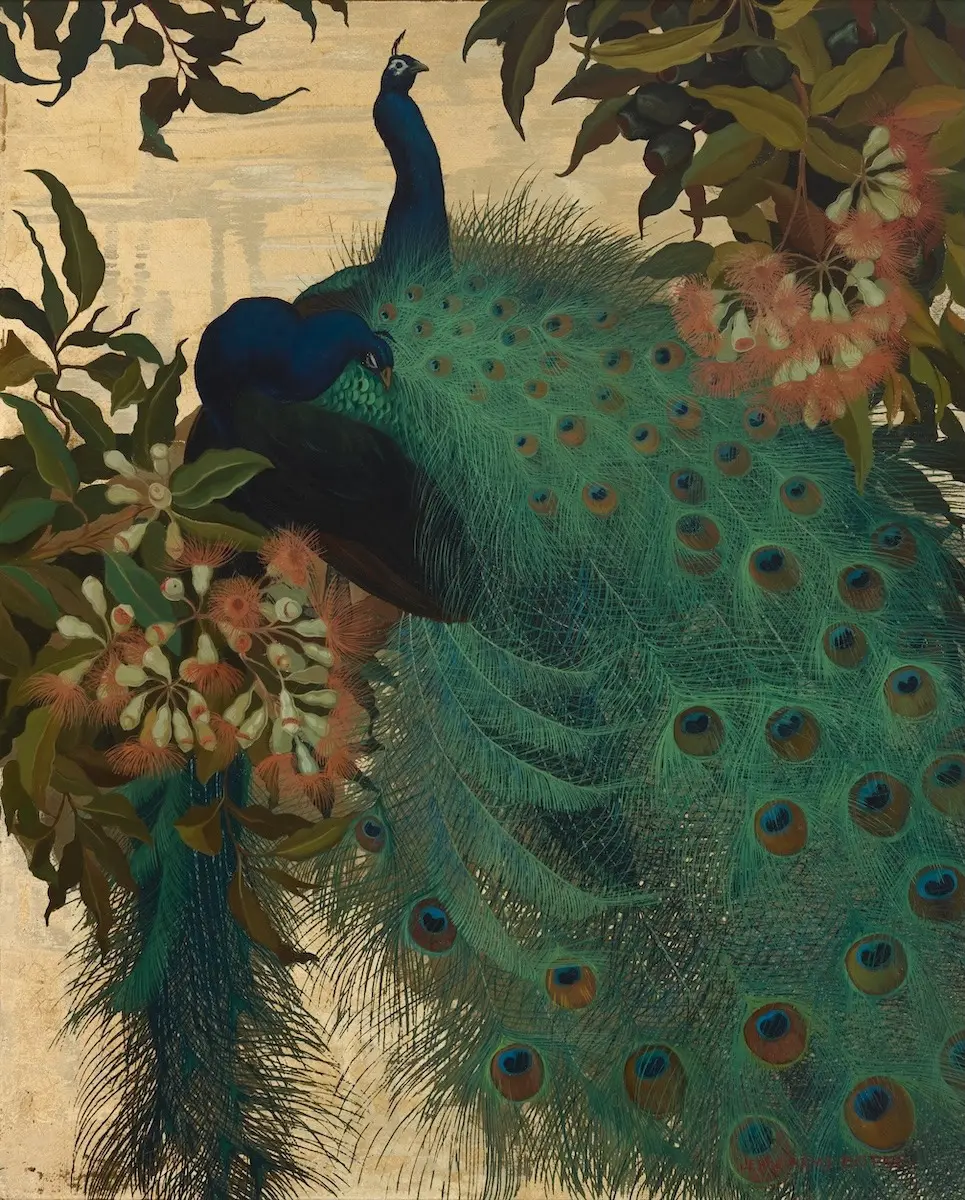
From another prominent regional holding—the Saperstein Collection of Oakland—comes Black Peacocks by Jessie Arms Botke (est. $50,000–$70,000). Halligan notes that this piece perfectly highlights Botke’s exceptional technical skill, combining precise avian anatomy and local flora within a lavish, Asian-inspired gold leaf framework. Additional highlights include Adam Emory Albright’s Make Believe Time (est. $12,000–$18,000) and Eugene Higgins’s Covered Wagon (est. $3,000–$5,000).

Official Responses and Expert Insights
Industry leaders agree that the strength of the autumn auction market lies in its ability to adapt and broaden its appeal without alienating core traditionalists.
According to Aaron Bastian of Bonhams, the cross-pollination between historical Western movements and contemporary reinterpretations is vital for drawing fresh faces to the bidding blocks. Collectors are no longer bound strictly by geographical lines or rigid period definitions; instead, they are looking for technical mastery, narrative depth, and historical relevance.
Alissa Ford of Heritage Auctions echoes this sentiment, emphasizing that the art world’s growing appreciation for regional artists on a national scale indicates a maturing marketplace. By elevating artists who were once viewed through a strictly local lens, auction houses are expanding the tent of American art appreciation.
Similarly, Gillian Blitch of the Santa Fe Art Auction points out that the blurred lines between post-war modernism and contemporary Indigenous art have created a fertile breeding ground for new investment. As institutional museums increasingly open their doors to retrospectives of Native American and modernist female artists—such as Jaune Quick-to-See Smith and Rebecca Salsbury James—private collectors are racing to secure comparable works on the secondary market.

Implications for the Broader Art Market
The outcomes of this November’s slate of auctions will reverberate far beyond the salesrooms of Dallas, Los Angeles, Santa Fe, and Monrovia. They serve as a vital barometer for the health of the American fine art market at large.
- Broadened Geographic Horizons: The increasing national and international demand for artists once categorized as strictly "regional" (such as Ed Mell or mid-century California painters) demonstrates that collectors are evaluating art based on aesthetic and emotional resonance rather than geographic pedigree.
- Institutional Validation Drives Private Collecting: Major museum retrospectives—such as those dedicated to Jaune Quick-to-See Smith—directly correlate with heightened market performance, proving that institutional recognition continues to shape private collecting habits and drive up auction estimates.
- The Rise of Cross-Category Collecting: The merging of Native American art with post-war modernism is expanding the collector base, introducing contemporary buyers to historical works and inviting traditional Western collectors to explore indigenous modernism.
As the gavels fall this November, the message from the auction floor is clear: the markets for Western, California, and Native American art are not just surviving—they are thriving, evolving, and commanding a permanent, prominent place in the global fine art conversation.
