

SEDONA, Ariz. — For more than half a century, the American landscape has found its most reverent and ambitious interpreter in Curt Walters. Widely celebrated as the preeminent living painter of the Grand Canyon—America’s most iconic natural wonder—Walters has dedicated his life to translating the immense scale, shifting atmospheric light, and profound geological drama of the Southwest into oils on canvas.
Now, the artistic community and the public have a rare opportunity to witness the arc of this extraordinary career. Through November 30, the Fine Art Museum of Sedona is hosting A Lifetime in Art, a major dual-venue retrospective that brings together 48 definitive works spanning from 1979 to the present. The exhibition not only honors a foundational figure in contemporary Western art but also highlights a deeply personal journey of artistic devotion anchored in Sedona, the town Walters has called home for 47 years.
Main Facts: A Dual-Venue Retrospective of a Master
A Lifetime in Art is uniquely structured across two distinct locations in Sedona, reflecting the dual currents of Walters’ artistic evolution: his deep immersion in the monumental vistas of the Grand Canyon and his intimate documentation of the local Arizona landscape.
The primary exhibition is housed at the Mary D. Fisher Fine Art Complex, where visitors can encounter mostly large-scale Grand Canyon paintings that showcase Walters’ mastery of light, color, and drama. Among the standout pieces is the recent large-format canvas Instant Opus, which captures a chaotic, electrifying sunset storm witnessed firsthand from the canyon’s Yavapai Point.
Two miles west, a museum pop-up space situated directly behind the Sedona Heritage Museum hosts Impressions of Sedona (1980–2000). This complementary exhibition turns the focus inward, presenting plein air paintings and historical landscapes that capture the immediate environment surrounding Walters’ longtime home base.
Beyond the gallery walls, the retrospective offers an immersive multimedia experience. Both venues have hosted opening receptions and continue to feature regular public screenings of Paintingthe Air, a documentary film chronicling the artist’s life and process directed by his filmmaker daughter, Miranda Foreman. Additionally, visitors can explore Resilience: The Life History and Grand Canyon Art of Curt Walters, a newly published, richly illustrated biography authored by the artist’s grandson, dDamien Foreman.

Chronology: From Teenage Aspiration to Critical Acclaimed Mastery
To understand Curt Walters’ position in the pantheon of Western American art, one must retrace a trajectory that began in his youth and spans decades of relentless labor and critical acclaim.
Early Beginnings and the Grand Canyon Call (1969)
Walters’ lifelong obsession with the Grand Canyon began in 1969. Still in his teens, he made his first pilgrimage to the abyss at age 19. That initial encounter left an indelible imprint on his psyche. Standing at the rim, a young Walters was struck not only by the sheer physical scale of the geological wonder but also by a historical diorama of Spanish conquistadors that sparked a lifelong fascination with the canyon’s human history alongside its natural beauty. That foundational trip set him on a deliberate, singular path: to master the art of painting the Grand Canyon.
Settling in Sedona and Developing the Craft (1979–2000s)
By the late 1970s, Walters relocated to Sedona, Arizona—positioning himself within a convenient two-and-a-half-hour drive of his ultimate subject. This proximity allowed him to study the canyon under every conceivable atmospheric condition: blinding midday summer glare, moody winter snowfalls, and the ephemeral, fiery glow of dramatic desert sunsets.
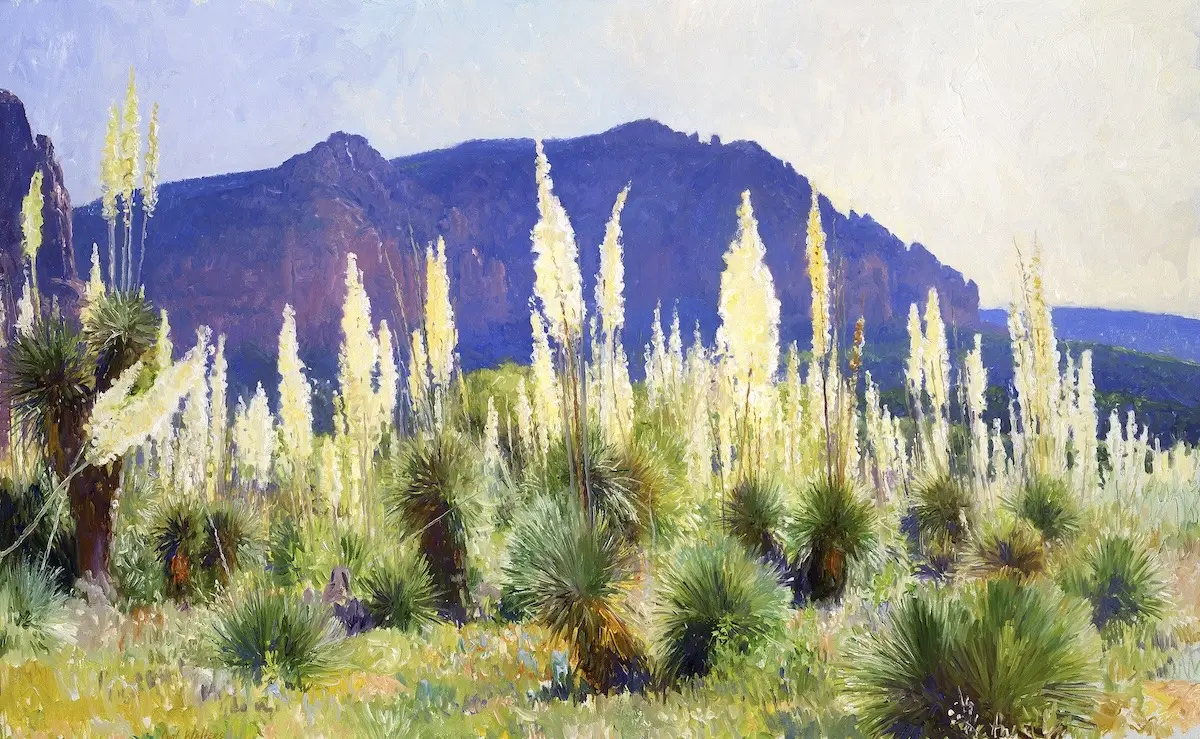
During the 1980s and 1990s, Walters balanced his monumental canyon commissions with intimate plein air studies of the surrounding Sedona landscape. Works from this era, such as the poignant 1993 painting Vicissitude, captured the vibrant, fragile beauty of the region, documenting fields of blooming yuccas backed by the iconic red rock cliffs before rampant regional development transformed the terrain.
National Recognition and Top-Tier Awards
As his technical proficiency and distinct stylistic voice matured, Walters earned virtually every major accolade the Western art world has to offer. His name became a fixture among the honor rolls of elite museum invitational shows:
- Prix de West: Garnering top awards at the prestigious exhibition hosted by Oklahoma City’s National Cowboy & Western Heritage Museum.
- Quest for the West: Earning critical honors at the Eiteljorg Museum in Indianapolis.
- Masters of the American West: Winning prominent awards at the celebrated annual exhibition formerly held at the Autry Museum in Los Angeles.
Supporting Data: The Retrospective Highlights
The 48 artworks curated for A Lifetime in Art offer a cross-section of Walters’ technical versatility, emotional depth, and relentless experimentation. Key pieces featured in the exhibition illuminate different chapters of his artistic philosophy:

- Tenebristic Spectacle (Oil on canvas, 48 x 78 inches, 2018): A stunning masterclass in light and shadow (tenebrism), demonstrating Walters’ ability to manipulate dramatic contrasts to evoke the monumental, theatrical nature of the canyon at dusk or dawn.
- Instant Opus (Oil, 48 x 48 inches, 2020): Created from memories of an intense weather event at Yavapai Point, this work captures the sensory overload of a localized thunderstorm cutting through the canyon depths, complete with jagged atmospheric electricity.
- Vicissitude (Oil, 30 x 48 inches, 1993): A historical anchor from the Sedona Heritage Museum pop-up, this plein air piece portrays yuccas in springtime bloom against ancient red rock formations, serving as both a pastoral tribute and a quiet elegy for a lost landscape.
- The Conquistador Series: Representing a thrilling new direction in Walters’ career, these canvases trace the legacy of Spanish explorer García López de Cárdenas, who led the first European party to the Grand Canyon in 1540. Driven by the memory of the museum diorama he saw at age 19, Walters went so far as to collect authentic period costumes, saddles, and bridles, hiring live models to pose in full military attire at the South Rim to achieve absolute historical and visual authenticity.
Official Responses and Artist Perspectives
Speaking on the motivations behind his work and the retrospective itself, Walters reflects a blend of deep humility and boundless enthusiasm.
Regarding his epic depiction of weather events in works like Instant Opus, Walters recalls the visceral thrill of the encounter:
"I was right there, with big bolts of lightning everywhere."
His pivot toward historical narrative in his new Conquistador series highlights an artist who, decades into a legendary career, refuses to rest on his laurels. Driven by a childhood memory, Walters shares the pure joy of the creative process:
"The first time I visited the Canyon, at the age of 19, I saw an incredible diorama there of the conquistadors, and it just stuck in my head all these years. Now, I’ve collected all the costumes and saddles and bridles, and I have models coming to pose. I’m determined to do it. It’s a blast!"
At the same time, Walters does not shy away from the sobering realities of time and environmental change. Discussing his older Sedona landscapes, such as Vicissitude, his tone shifts to one of poignant reflection regarding the relentless march of suburban expansion:

"That place doesn’t exist anymore. It’s now a shopping center and parking lot."
Implications: A Call for Preservation and a Legacy Cemented
While A Lifetime in Art is ostensibly a celebration of Curt Walters’ technical wizardry and aesthetic achievements, the exhibition carries deeper, more urgent implications for contemporary audiences.
By juxtaposing pristine, timeless canvases of the Grand Canyon alongside localized works like Vicissitude—where once-wild desert blooms have been paved over for commerce—Walters’ retrospective delivers a subtle yet powerful underlying message. The art serves as both an urgent reminder of America’s breathtaking natural splendors and an implicit plea for their preservation. In an era marked by rapid ecological shifts, climate pressures, and unchecked development across the American West, Walters’ paintings function as historical archives of what was, visual testaments of what is, and cautionary notes for what might be lost.
Furthermore, the dual-venue exhibition, paired with a documentary by his daughter Miranda Foreman and a biography by his grandson dDamien Foreman, elevates the retrospective from a simple gallery showing to a generational family tribute. It cements Curt Walters not merely as a master of Southwest painting, but as a defining cultural pillar of Sedona and a steward of the American landscape whose brushstrokes will echo far into the future.
Visitor Information
- Event: A Lifetime in Art – Retrospective of Curt Walters
- Dates: Through November 30
- Venues:
- Mary D. Fisher Fine Art Complex (Main Exhibition)
- Museum Pop-Up behind the Sedona Heritage Museum (Impressions of Sedona 1980–2000)
- Contact Information:
- Phone: (888) 602-2667
- Website: fineartmuseumofsedona.org
