

By Special Feature Desk
Published in Commemoration of World Tarot Day
Main Facts: The Core Philosophy of a Tarot Icon
In the expansive universe of esoteric studies, few figures left as profound, creative, and intellectually rigorous a mark as the late Rachel Pollack. Author, poet, comic book writer, and preeminent tarot scholar, Pollack dedicated decades to reframing how humanity perceives the ancient deck of cards.
At the core of her philosophy lies a deceptively simple yet revolutionary proposition: "Story. It’s all story."
Originally penned for World Tarot Day on May 25, 2015, Pollack’s reflections on the nature of the tarot transcend traditional fortune-telling and mystical dogmas. Rather than viewing the 78 cards of the tarot as static tools for prophecy or rigid occult machinery, Pollack championed them as dynamic narrative devices. Citing Italian author Italo Calvino’s famous observation—"The tarot is a machine for constructing stories"—alongside the Hasidic saying, "God made humans because God loves stories," Pollack positioned the tarot as a mirror reflecting the human condition through the universal medium of narrative.
This article examines Pollack’s enduring manifesto on the tarot, exploring how her lifelong engagement with the cards redefined modern cartomancy, blurred the lines between subjective truth and objective reality, and cemented her legacy as one of the most influential esoteric thinkers of the 20th and 21st centuries.
Chronology: A Lifelong Journey Into the Narrative Art of Tarot
To understand Pollack’s profound relationship with the cards, one must trace her journey back to its serendipitous beginnings, a timeline marked by intellectual curiosity, artistic appreciation, and groundbreaking literary contributions.
1. Spring 1970: The Awakening
Pollack’s encounter with the tarot occurred in the early spring of 1970. A friend offered to read her cards using the University Press edition of the Rider-Waite-Smith deck—a rare collector’s item even at the time. Guided by Eden Gray’s foundational explanatory books, Pollack quickly realized she had little interest in the mechanics of prediction. Instead, she was transfixed by the visual artistry of the cards. To her, each card did not merely foretell a future event; it represented a frozen moment in an unfolding story. She particularly recalled the mysterious Six of Swords as an anchor memory from that very first reading, symbolizing the journey across troubled waters into calmer realms.
2. The Decades of Scholarship and Creation
Throughout the 1980s, 90s, and beyond, Pollack emerged as a towering authority on the tarot. She published seminal texts, most notably 78 Degrees of Wisdom (widely regarded as the "bible" of modern tarot reading), which completely transformed how readers interacted with the symbolism of the Major and Minor Arcana. By integrating Jungian psychology, mythology, and modern literary theory, Pollack transitioned the tarot from a parlor trick into a sophisticated psychological and spiritual mirror.
3. July 2009: The Tarosophy Conference
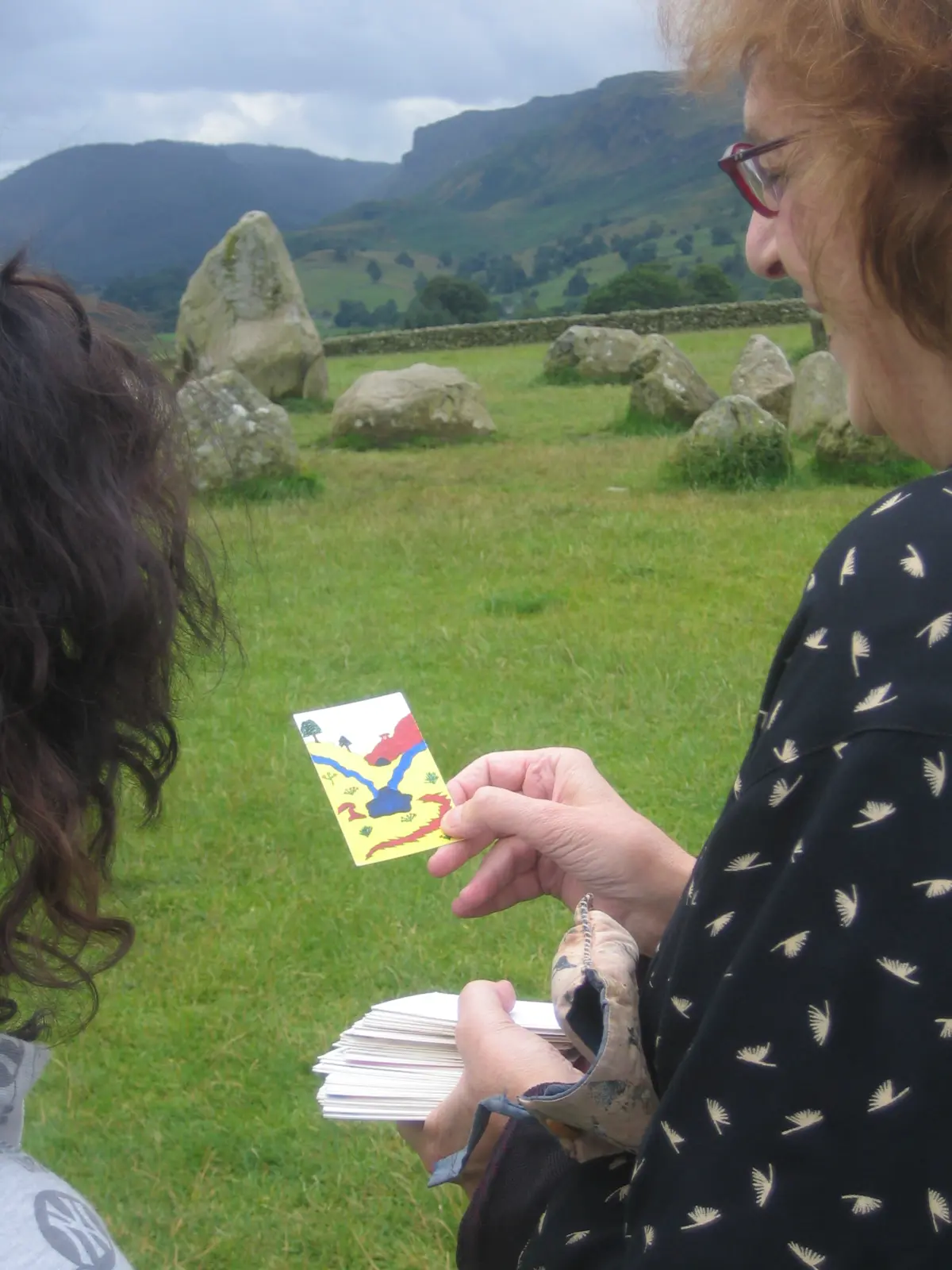
A snapshot of Pollack’s enduring influence in the global esoteric community is captured in her appearance at the Tarosophy Tarot Conference in July 2009. Standing amidst the ancient stones of the Castlerigg Stone Circle in England’s picturesque Lake District, Pollack bridged the gap between ancient historical traditions and contemporary esoteric practice, captivating audiences with her profound wisdom, warmth, and storytelling prowess.
4. May 25, 2015: World Tarot Day Manifesto
On World Tarot Day in 2015, Pollack crystallized her life’s philosophy in an essay reflecting on mortality, meaning, and the nature of reality. Posing a playful yet deeply philosophical exercise regarding what epitaph she would choose for a tombstone, she bypassed grandiose mystical quotes in favor of her ultimate realization: "Story. It’s all story."
Supporting Data and Philosophical Frameworks: Challenging the Nature of Truth
Pollack’s perspective on the tarot challenges rigid definitions of "truth" and "reality." In her writings, she addresses the common skepticism directed toward esoteric practices—the idea that because tarot readings are subjective, they are somehow "fake" or "made up."
Pollack countered this by questioning the very nature of truth itself:

"I’m not sure truth is something that simply lies there, like a rock. We engage it, we bring it into being."
To illustrate this, Pollack shared an anecdote from a conversation with a physicist friend. She asked whether the complex array of subatomic particles studied in modern physics actually existed before scientists predicted them and looked for them. Her physicist friend conceded that it was entirely possible that human observation and narrative construction brought those realities into being.
The Tripartite Reading Dynamic
According to Pollack, a tarot reading is not a unilateral transmission of hidden knowledge from the cards to the seeker. Instead, it is an active, collaborative ecosystem involving three distinct participants:
- The Subject: The seeker asking the question, bringing their lived experience, emotional state, and immediate needs to the table.
- The Reader: The facilitator who interprets the visual language and navigates the symbolic landscape.
- The Cards Themselves: The ancient, immutable images that act as catalysts for the imagination.
Together, these three elements forge a temporary narrative collective. When asked by skeptics, "How does the Tarot work?" Pollack characteristically embraced the mystery, offering a humbling and pragmatic response: "Nobody knows, but it does."
She noted that while tarot readings often provide general, resonant themes, they frequently culminate in uncanny precision—delivering the exact card a seeker needs to see at a critical crossroads in their life. This phenomenon led her to another profound summary of her worldview, and a potential epitaph: "The world is not what we think it is."
Official Responses and Cultural Impact
The esoteric community, literary critics, and fellow authors have long praised Rachel Pollack not only for her technical mastery of tarot symbolism but for her inclusive, deeply humanistic approach to spirituality.
- Bridging Divides: Traditional cartomancy has frequently oscillated between dogmatic fatalism and outright dismissal as mere superstition. Pollack’s work bridged these extremes by framing tarot as an empowering, creative act. She empowered readers to become co-authors of their own destinies rather than passive victims of fate.
- Literary and Artistic Acclaim: Beyond her non-fiction tarot guides, Pollack was an accomplished fiction writer, winning the prestigious Arthur C. Clarke Award for her novel Unquenchable Fire. Her fluency in speculative fiction deeply informed her tarot work; she viewed the Major Arcana not as a series of rigid moral injunctions, but as a mythical hero’s journey—a sprawling, interconnected epic novel waiting to be read.
- Global Legacy: Organizations such as the Tarot Association and international conferences continually celebrate Pollack’s contributions. Her essays, decks (such as the radiant Shining Tribe Tarot), and novels remain foundational touchstones for new generations of seekers, artists, and writers.
Implications: What Pollack’s Vision Means for the Future of Tarot and Human Consciousness
As we reflect on Rachel Pollack’s contributions—immortalized in reflections like her 2015 World Tarot Day essay—the implications for modern spirituality and self-reflection are profound.
1. Moving Beyond Literalism
Pollack’s philosophy urges contemporary spiritual practitioners to move away from rigid, literal interpretations of the cards. If the tarot is a "machine for constructing stories," then memorizing a list of static dictionary definitions for each card misses the point. The true power of the tarot lies in its fluidity—its ability to adapt its narrative to the ever-changing complexities of the human experience.
2. Embracing the Co-Creation of Reality
By asserting that we bring truth into being through engagement and narrative, Pollack aligns esoteric philosophy with modern constructivist psychology and quantum concepts. A tarot reading becomes an exercise in agency. The cards do not dictate what will happen; they illuminate the narrative threads currently active in a person’s life, inviting them to rewrite the ending if they so choose.
3. A Lasting Epitaph
Whether contemplating mortality through the poetic verses of Gabon Pygmy songs, Normandi Ellis’s translations of The Egyptian Book of the Dead, or simply looking out over the ancient stones of Castlerigg, Rachel Pollack understood that human existence is defined by our search for meaning.
In distilling her philosophy down to three words—"Story. It’s all story"—Pollack offered humanity a liberating truth. We are not trapped by predetermined scripts; we are the authors, readers, and subjects of an infinite, unfolding masterpiece. And in that realization lies both true magic and profound freedom.
