

Introduction: The Skeptic’s Paradigm Shift
In the fast-evolving landscape of renewable energy, conventional wisdom holds a powerful grip. For decades, the global wind industry has converged on a singular, highly optimized design paradigm: the massive, three-bladed, upwind horizontal-axis wind turbine. This standard layout is ubiquitous for a reason—it works, it is bankable, and decades of iterative engineering have ironed out many of its operational vulnerabilities.
When novel designs emerge promising disruption, skepticism is not just healthy; it is financially mandatory. Enter OceanX, a radical floating wind energy prototype that instantly triggers skepticism from seasoned engineers. It defies standard conventions in two major ways: it mounts two distinct wind turbines onto a single floating platform, and it places the rotors downwind of their supporting structures rather than in front of them. Historically, both ideas have been sidelined due to severe fatigue penalties, aerodynamic turbulence, and maintenance complications.
However, engineering theories are ultimately tested by the unforgiving forces of nature. Recently, OceanX found itself directly in the crosshairs of Super Typhoon Yagi—one of the most violent meteorological events to sweep through the region in recent years. The survival of the platform is impressive enough, but the real engineering takeaway goes far beyond structural endurance. The empirical data harvested during the storm has forced a serious re-examination of downwind, stayed-support, and weather-vaning floating wind architecture.
Main Facts: Anatomy of the OceanX Platform
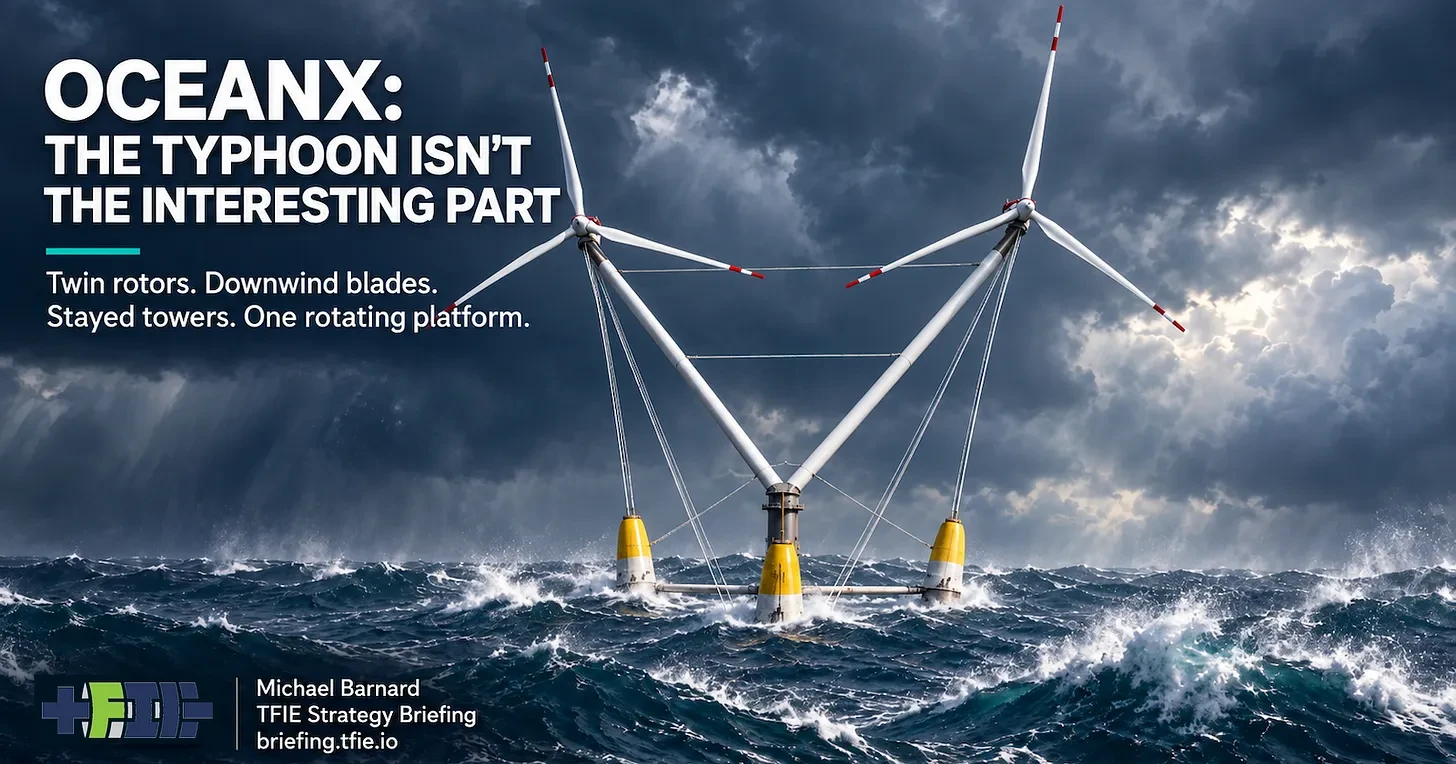
To understand why OceanX has sparked intense debate among offshore wind strategists, it is necessary to break down its core structural and mechanical characteristics. The platform’s design diverges sharply from conventional fixed-bottom or standard semi-submersible floating turbines across four primary pillars:
- Twin Rotors: Instead of concentrating power generation into a single massive nacelle, OceanX splits the generation area across two distinct turbines mounted on the same floating foundation.
- Downwind Operation: The rotors are positioned behind the supporting structures relative to the oncoming wind.
- Stayed-Support Architecture: Rather than relying on traditional, bulky, freestanding tubular towers, the structure utilizes slender, inclined members stabilized by a complex network of pretensioned stays (cables).
- Whole-Platform Weather-Vaning: The entire floating structure is designed to rotate organically relative to its moorings, passively aligning itself with shifting wind directions rather than depending on traditional, localized nacelle yaw motors.
While the dual-rotor setup immediately catches the eye in photographs, engineering analyses—such as those detailed in the TFIE Strategy Briefing—reveal that the true technical innovation lies not in the doubling of the rotors, but in the structural interplay between the slender stayed supports, downwind alignment, and passive platform weather-vaning.
Chronology: Facing the Wrath of Super Typhoon Yagi
The ultimate test for any offshore installation is not a computer simulation in a controlled laboratory, but a catastrophic meteorological event in the open ocean.
- Pre-Storm Deployment & Simulation: Prior to the arrival of Super Typhoon Yagi, developers and engineers had established comprehensive computer models simulating the platform’s expected hydrodynamic and aerodynamic behaviors under extreme loads.
- The Strike of Typhoon Yagi: Mingyang instrumentation recorded ferocious environmental conditions as the storm made its presence felt. Nacelle-height sustained winds surged past 41.5 meters per second (approx. 93 mph). Meanwhile, significant wave heights reached 6.5 meters, punctuated by destructive maximum wave crests towering up to 9.8 meters.
- Real-Time Data Capture: As the storm battered the floating structure, internal sensors logged critical telemetry regarding platform attitude, mooring tension, and structural deflection.
- Post-Storm Inspection & Assessment: Following the dissipation of Yagi, initial reports confirmed that the OceanX structure had survived the tempest with virtually no catastrophic failures and, crucially, a remarkably low reported nacelle inclination.
Supporting Data: What the Numbers Tell Us
The empirical data retrieved from the OceanX platform during the height of Super Typhoon Yagi provides a rare, high-value window into how unconventional floating architectures handle extreme sea states.
According to reports released by Mingyang and subsequent technical evaluations:

- Nacelle Inclination: Despite experiencing winds exceeding 41.5 m/s and wave heights approaching 10 meters, the nacelle inclination of the OceanX turbines varied by only zero to three degrees. For a full-scale floating machine carrying dual rotors on long, inclined, flexible structures, maintaining such high angular stability under heavy wave and wind loading is a critical engineering milestone.
- Platform Response vs. Simulation: Crucially, the measured real-world platform response closely mirrored pre-storm hydrodynamic and structural simulations. Engineers observed no obvious abnormal resonance and no lasting change in platform attitude once the storm front passed.
- System-Wide Stress Testing: The storm successfully exercised the entire mechanical and structural ecosystem simultaneously. Rotor loads, direct aerodynamic pressures, wave slamming, mooring line tensioning, and the upper stayed-support network were all violently engaged at once.
While surviving a single typhoon does not instantly prove that OceanX is economically viable or optimized for a 25-year operational lifecycle, it definitively proves that the coupled structural system behaves credibly and safely under severe hydrodynamic and aerodynamic duress.
Official Responses and Expert Analysis
The survival of OceanX has triggered a wave of analysis across the clean energy sector, prompting engineers to revisit long-held dogmas regarding downwind turbine physics.
Reconsidering the Downwind Penalty
In traditional wind energy engineering, "downwind" configuration—where the wind passes the support structure before reaching the blades—is widely avoided. On conventional fixed-bottom turbines, every time a blade rotates past a massive tubular tower, it crosses through disturbed, turbulent air. This wake interaction introduces rapid, cyclical changes in aerodynamic loading, accelerating structural fatigue and generating the classic low-frequency, rhythmic noise historically associated with downwind machines.
However, expert analysis highlights that OceanX fundamentally alters the nature of the obstacle creating that wake. Rather than relying on massive, rigid tubular towers, OceanX uses slender, inclined structural members held in place by pretensioned stays. Because these members present a radically narrower profile, the wake deficit is drastically reduced. Consequently, the historical "downwind penalty"—which forces engineers to design heavier blades and complex control compensations—is mitigated at its source rather than merely absorbed by the hardware.
The Power of Passive Weather-Vaning
Another breakthrough identified in the engineering breakdown is the whole-platform weather-vaning capability. Traditional floating wind turbines require active yaw systems within each nacelle to constantly rotate the heavy generation equipment into the wind.
OceanX bypasses this mechanical burden by allowing the entire floating foundation to pivot organically around its mooring system. This ensures that the slender supports, stays, and downwind rotors remain in a consistent, optimized aerodynamic relationship with incoming airflow without relying on energy-draining, high-maintenance active yaw motors.
The Twin Rotor Debate: Innovation vs. Complication
Despite the triumphs of the stayed supports and weather-vaning hull, industry experts remain divided on the utility of the twin-rotor configuration.
A dual-rotor setup inherently increases mechanical complexity:

- Two distinct nacelles instead of one.
- Two separate drivetrains and hubs.
- Six individual blades to manufacture, transport, and maintain.
Splitting the swept rotor area across two smaller machines allows for reduced hub heights and lighter individual components, which can simplify offshore assembly and component lifting logistics on a floating barge. Nevertheless, it duplicates expensive, failure-prone drivetrain hardware and introduces complex aerodynamic interactions between the twin rotors that a single, unified machine never has to manage. As analysts point out, the stayed support, downwind rotor, and weather-vaning platform are entirely separable concepts; they do not strictly necessitate strapping two complete turbines onto a single hull.
Implications for the Future of Offshore Wind
The successful weathering of Super Typhoon Yagi by the OceanX platform carries profound implications for the trajectory of deep-water wind energy deployment.
1. Fresh Consideration for Floating Architecture
For years, the wind industry’s absolute convergence on the three-bladed, upwind design has created a bottleneck in innovation. OceanX has successfully demonstrated that alternative configurations—particularly those utilizing slender, stayed upper structures and passive alignment—deserve a second look. By proving that a flexible, unconventional architecture can maintain stability in a Category 4-equivalent storm, OceanX has lowered the psychological and technical barrier for investors and developers willing to explore alternative floating concepts.
2. The Long-Term Economic Question Mark
While survival in extreme weather is a mandatory box to check, the ultimate arbiter of any energy technology is its Levelized Cost of Energy (LCOE) over a 25-year operational window. Unresolved questions remain:
- What will long-term fatigue data reveal after years of cyclic wave loading on the pretensioned stays?
- How will maintenance procedures for underwater rotating interfaces scale in harsh open-ocean environments?
- Will the added capital expenditure (CapEx) of dual drivetrains outweigh the savings of lighter individual components?
Answering these questions will require extended operational data, comprehensive mass-production analyses, and rigorous head-to-head comparisons against conventional single-rotor semi-submersibles.
3. A Catalyst for Advanced Engineering Briefings
The industry-wide conversation sparked by OceanX underscores the value of rigorous, multi-disciplinary engineering breakdowns. Rather than dismissing radical designs based on historical rules of thumb, or blindly praising them based on glossy promotional renders, the clean tech sector is learning to isolate specific design choices—separating the merits of stayed supports and weather-vaning hulls from the ongoing debate surrounding twin drivetrains.
Conclusion
OceanX may still have to prove that its dual-rotor layout is economically superior to standard single-rotor configurations, but its performance during Super Typhoon Yagi has achieved something far more important. It has cracked open the door to innovation in an otherwise dogmatic industry. By showing that slender, stayed, downwind, weather-vaning platforms can stand firm against the ocean’s worst fury, OceanX has fundamentally shifted how engineers view the future limits of floating wind technology.
