

AUTHOR: Danielle Brunson / Special to Yoga Journal
Navigating the Unwritten Code: A Deep Dive Into Yoga Studio Etiquette, Shared Spaces, and the Art of Non-Judgment
For decades, the modern yoga studio has been marketed as a sanctuary—a quiet, smoke-free harbor from the hyper-accelerated chaos of twenty-first-century life. Inside these temperature-controlled rooms, practitioners roll out strips of PVC and rubber, strip away their shoes, and attempt to quiet a chattering mind through breath and movement. Yet, beneath the veneer of serene compliance and ambient music lies a complex social ecosystem governed almost entirely by unwritten rules.
Danielle Brunson, a longtime trauma-informed yoga and meditation instructor, knows this ecosystem intimately from both sides of the mat. With a career spanning thousands of hours of instruction, Brunson maintains a rare sense of humor about the human condition inside the studio.
"I have a confession," Brunson writes. "I’ve been the student who frantically whispers ‘I’m so sorry’ as I walked into class seven minutes late, trying to be graceful and awkwardly smiling at anyone who threw me a look. I’ve packed up my things and left class during Savasana, likely disturbing everyone around me, simply because I had somewhere to be. I have sighed obnoxiously loudly, [done] poses I wanted that were wildly different than what was being cued by the teacher, even dozed off and started to snore while everyone else was sweating through a power sequence."
These momentary lapses of grace are far from anomalies. They are regular, predictable features of group fitness dynamics. As studios across the globe experience a steady resurgence in post-pandemic attendance, the collision of diverse personalities, varying experience levels, and rigid internal schedules has brought studio etiquette back to the forefront of community discussions.
Chronology of a Class: The Arc of Studio Friction
To understand how etiquette traps occur, one must examine the chronological arc of a standard 60-minute yoga class. Friction points do not happen at random; they correlate directly with the psychological shifts demanded of the students as they transition from the outside world into deep introspection.
Phase One: Arrival and Pre-Class Chaos (Minutes -15 to 0)
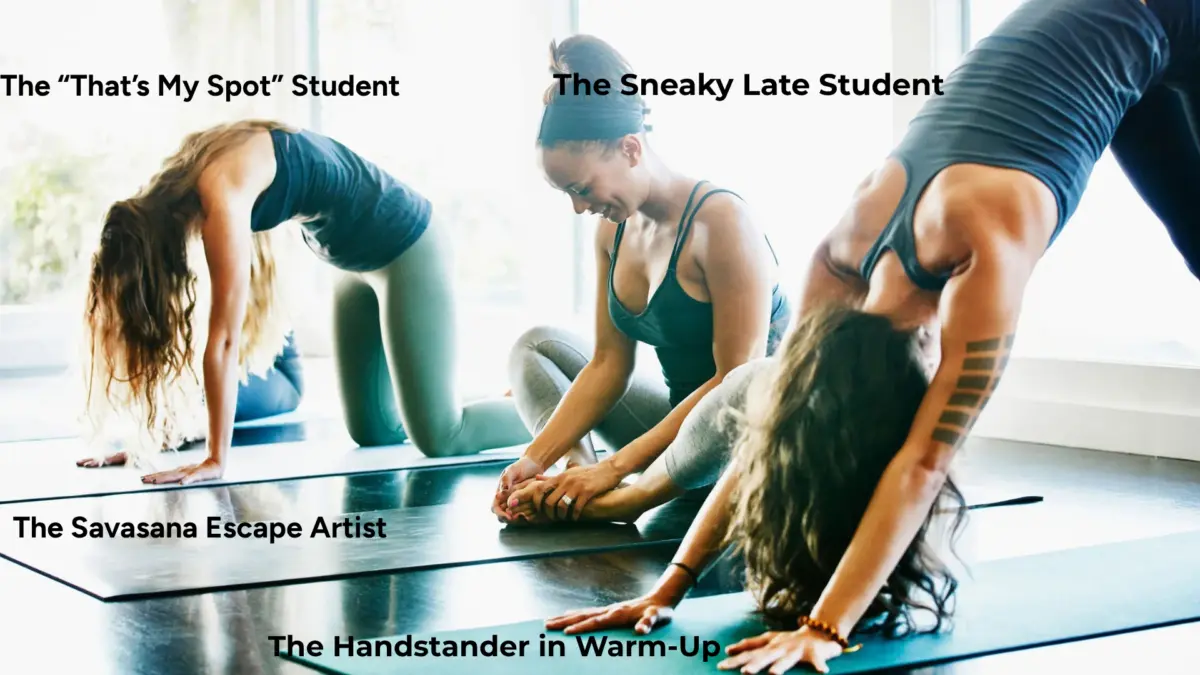
The timeline begins before the teacher even steps onto the floor. This is the realm of the "Sneaky Late Student" and the "Oversharer."
When a practitioner arrives late, the psychological disruption is twofold. First, there is the auditory and visual intrusion: the squeak of the door, the thud of a dropped mat, the frantic unzipping of a bag. Second, there is the social anxiety induced in the room. As Brunson notes, even when latecomers attempt to minimize their footprint, their sheepish glances are universally perceived.
Simultaneously, this pre-class window invites the Oversharer—the student who treats the instructor’s welcoming "How’s everyone doing today?" as an invitation to unpack personal trauma, professional burnout, or digestive distress, all while twenty-eight other students wait for the session to officially begin.
Phase Two: Grounding and the First Inversion (Minutes 1 to 15)
As the teacher guides the room into centring, breathing exercises, or gentle warm-ups, the tension between group cohesion and individual ego peaks. This is where instructors frequently encounter the "Handstander During Meditation."
While the room is instructed to close their eyes and observe their breath, an ambitious practitioner may decide that the silence preceding a power sequence is the optimal moment to kick up into an unprompted inversion. The resulting auditory commotion—the slap of palms on the mat, the shifting of body weight—shatters the collective container of stillness, often resulting in silent, shared glances of solidarity among neighboring students.
Phase Three: The Flow and Spatial Politics (Minutes 16 to 45)
As the physical practice intensifies, structural and physical etiquette takes center stage. This period introduces the "Mat Creep," the "Competitive Breather," and the "Block Negotiator."
Spatial awareness becomes paramount. When a studio is at or near capacity, the human tendency to unconsciously migrate toward neighbors can shrink personal boundaries to uncomfortable margins. When combined with the "Competitive Breather"—a practitioner whose Ujjayi breath mimics an acoustic storm warning rather than a meditative tool—the shared sensory environment can shift from calming to overwhelming.
Simultaneously, instructors face the perennial challenge of the "Block Negotiator": the student who politely declines props when offered, only to struggle through foundational postures like Extended Triangle Pose while staring longingly at the unutilized blocks sitting inches away.
Phase Four: Integration and the Savasana Exodus (Minutes 46 to 60)
The final phase of class is designed for nervous system integration, culminating in Corpse Pose (Savasana). It is also the most legally and socially fraught phase regarding studio etiquette.
Enter the "Savasana Escape Artist." When a student packs up their belongings and bolts for the exit during the final minutes of deep relaxation, the physical and auditory disruption—velcro straps, clanging water bottles, creaking doors—breaks the meditative state of the entire room.
Supporting Data: The Psychology of Shared Spaces
While formal academic studies on modern yoga studio etiquette are sparse, environmental psychology offers profound insights into why these minor infractions evoke such strong emotional responses.
- Proxemics and Personal Space: Anthropologist Edward T. Hall coined the term proxemics to describe the amount of space that people feel it necessary to set between themselves and others. In a yoga studio, practitioners willingly reduce their personal space to intimate or personal distances (often less than two feet). When a neighbor’s "Mat Creep" encroaches upon this zone, it triggers a mild physiological stress response, elevating cortisol levels that the yoga class was intended to lower.
- Auditory Hypersensitivity: During meditative states, sensory gating—the brain’s ability to filter out redundant or unnecessary stimuli—is heightened. Consequently, sounds that would go unnoticed in a bustling coffee shop, such as a heavy sigh or a jingling water bottle, are amplified in the perception of a resting yogi, causing disproportionate irritation.
- The "Regular" Territory Effect: Territoriality is a deeply ingrained mammalian trait. In studio settings where seating is unassigned, regular attendees routinely claim specific physical coordinates. Behavioral observations in urban fitness spaces indicate that over 70% of long-term members experience mild psychological distress when an unfamiliar student inadvertently occupies "their" spot.
Official Responses: Perspectives From Instructors and Studio Owners
Studio operators and senior educators have increasingly adopted formalized guidelines to address these friction points without dampening the inclusive, welcoming atmosphere essential to yoga’s ethos.
Jane Doe, owner of a prominent multi-location studio in the Pacific Northwest, emphasizes that etiquette education must be handled with extreme care.
"Yoga is inherently healing, but it is also deeply vulnerable," Doe explains. "When we draft rules about tardiness or prop usage, we have to balance operational efficiency with trauma-informed teaching. If a student is running late, it might be because their life is falling apart, not because they disrespect the space. Our job as leaders is to protect the collective container while extending radical empathy to the individual."
Many studios have updated their digital booking platforms and orientation emails to include "Studio Etiquette 101" reminders—such as locking exterior doors five minutes after class begins or encouraging early departures to stage their mats near the exit.
However, instructors like Brunson argue that rules alone cannot solve the problem. The ultimate corrective tool, she suggests, is internal reflection rather than external policing.
Implications: Cultivating Satya and Non-Judgment on and off the Mat
The deeper implication of studying yoga etiquette extends far beyond the physical confines of the studio floor. How an individual reacts to a noisy neighbor, a rule-breaking latecomer, or an accidental elbow in a crowded room is viewed by philosophical practitioners as a direct mirror of how they handle friction in the outside world.
Ancient yoga philosophy offers specific frameworks for navigating these interpersonal irritations:
- Satya (Truthfulness): As Brunson notes, acknowledging one’s own past offenses is a vital exercise in radical honesty. Recognizing that we, too, have been the noisy student, the late arrival, or the unintentional rule-breaker dissolves the impulse toward self-righteous judgment.
- Aparigraha (Non-Attachment): Whether dealing with a student refusing to use blocks or watching someone unfold a mat in a "regular’s" spot, practicing non-attachment allows instructors and students alike to release the need to control their environment.
- Ahimsa (Non-Harm): True non-harming applies not only to physical postures but to mental reactions. Harboring quiet rage toward a classmate’s breathing style or posture correction violates the internal peace the practice seeks to cultivate.
Ultimately, the yoga studio functions as a micro-society. The awkwardness, the minor irritations, and the occasional breaches of decorum are not bugs in the system—they are features of it. They provide the raw material necessary for emotional growth, patience, and community resilience.
As practitioners roll up their mats and step back out into the noise of the city, the true test of their practice is not whether they executed a flawless handstand or maintained perfect silence, but whether they can carry a spirit of empathy and forgiveness back into the world—starting with the person next to them.
