

Published August 4, 2026
From the Yoga Journal Archives (Originally published in the July–August 1988 issue)
Main Facts: Deconstructing the Forearm Balance
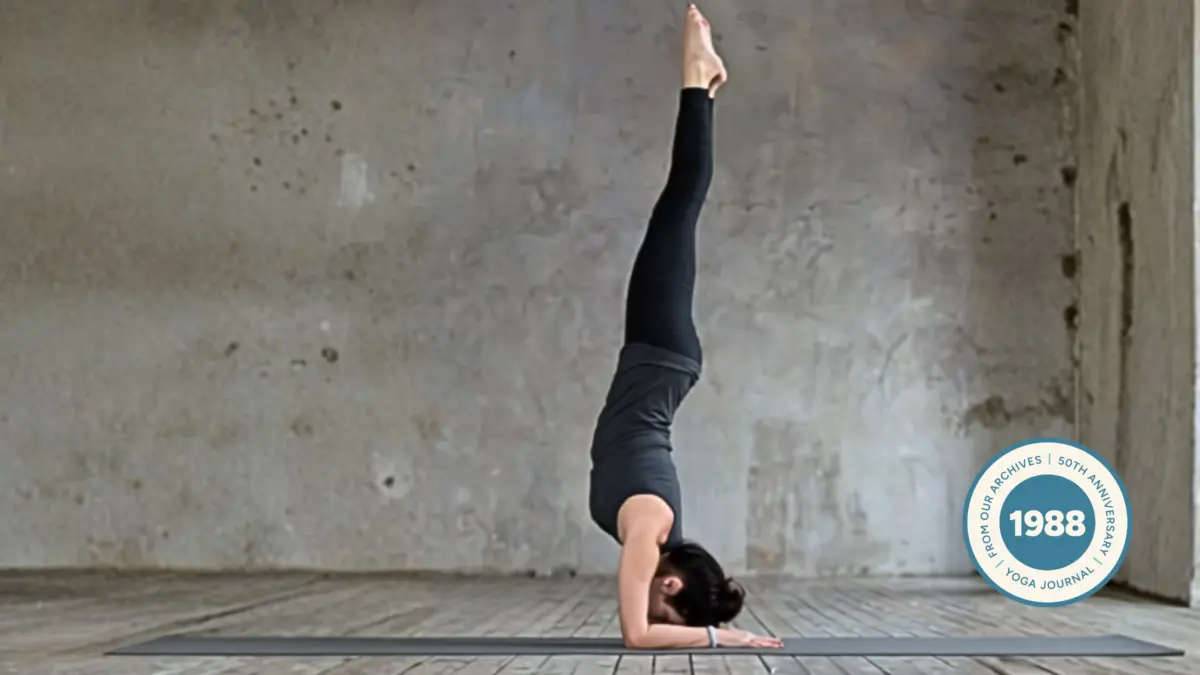
In the vast lexicon of yoga asanas, few postures demand the simultaneous intersection of physical engineering and psychological surrender quite like Pincha Mayurasana. Commonly referred to in English as Elbow Balance Pose or Forearm Balance, its Sanskrit nomenclature translates literally to "feather peacock pose." The imagery is deliberate: when properly executed, the practitioner’s inverted body mimics a magnificent peacock fanning its radiant plumage.
First highlighted in the archives of Yoga Journal in the summer of 1988—drawing deep inspiration from B.K.S. Iyengar’s seminal text, Light on Yoga—Pincha Mayurasana remains a cornerstone of advanced-beginner and intermediate inversion sequences. Unlike bipedal standing postures, this inversion requires the practitioner to bear the entirety of their body weight on the forearms and hands, turning the traditional relationship between the shoulder girdle, thoracic spine, and gravitational pull completely on its head.
However, the core challenge of Pincha Mayurasana extends far beyond raw physical conditioning. It serves as a masterclass in overcoming primordial anxieties, navigating the tricky waters of mental complacency, and translating the equilibrium found on the mat into the turbulence of everyday life.
Chronology of the Practice: From Fear to Complacency to Presence
The evolutionary arc of learning Pincha Mayurasana can be mapped across distinct psychological phases. Understanding this timeline is crucial for practitioners aiming to move past superficial execution and touch the deeper philosophy of the asana.
Phase 1: Confronting the Fear of Falling
When a student first approaches Forearm Balance, they are immediately forced to confront one of the most fundamental, hardwired human fears: the fear of falling. Without the tactile security of the feet on the earth, the nervous system panics, often triggering bracing, shallow breathing, and erratic attempts to kick up into the void.
According to archival insights, this fear cannot be bypassed; it must be systematically dismantled. Through regular, disciplined practice, the nervous system adapts. The body learns that the ground is close, the wall can catch a misstep, and falling is not a catastrophic failure, but a normal data point in the learning process.
Phase 2: Overcoming Complacency
Once the fear of falling is systematically eliminated, a second, more insidious hurdle arises: complacency.
When a student achieves the confidence to kick up into Pincha Mayurasana without anxiety, the mind frequently checks out. Freed from immediate physical peril, the ego slips into autopilot. The practitioner can hold the shape of the pose while their mind drifts entirely elsewhere—planning dinner, reviewing work emails, or ruminating on past conversations.
As historical teachings emphasize, this is precisely where the real practice begins. Mastery of the physical shape is merely the entry ticket. The authentic challenge is remaining fully present, awake, and watchful of body, breath, and tumbling thoughts while resting in a state of absolute ease.
Supporting Data: The Anatomy and Biomechanics of Pincha Mayurasana
Achieving the delicate alchemy of strength and flexibility required for Pincha Mayurasana relies on specific physiological mechanisms. Anatomists and veteran instructors break down these requirements into two primary pillars: targeted muscle recruitment and unconventional joint mobility.
1. The Muscular Blueprint: Strength
Pincha Mayurasana places extraordinary demands on specific muscle groups to maintain structural integrity:
- Triceps Brachii: Filling the back of the upper arm, the triceps act as primary shoulder and elbow extensors, working tirelessly to keep the arms straight and prevent the elbows from buckling under the weight of the torso.
- Pectoralis Major and Minor: Running diagonally from the breastbone to the upper arms, these chest muscles are tasked with holding the humerus (upper arm bones) close to the chest wall. If the pectorals fail, the elbows splay outward, destabilizing the entire foundation.
- Core Stabilizers: Both the abdominal wall and spinal erectors must engage synergistically to prevent the body from collapsing into an exaggerated "banana back" shape.
2. The Kinesthetic Shift: Flexibility
Flexibility requirements in Pincha Mayurasana are concentrated in two tightly linked anatomical zones:
- The Glenohumeral (Shoulder) Joint: In daily life, we typically stabilize the scapula (shoulder blade) and move the humerus. In forearm balance, this paradigm is inverted: the humerus is locked in place against the floor, and the concave surface of the scapula must move around it. This demands radical neuromuscular adaptation.
- The Thoracic Spine (Mid-Back): Anatomically, the mid-back is engineered for stability, making backward bending difficult. Yet, a subtle backbending action in the upper thoracic spine is entirely necessary to lift cleanly into the pose.
Experiment in Kinematics: Try rounding your upper back, drawing your chest inward, and freezing it. Now, attempt to raise your arms overhead to open the shoulders. It is nearly impossible. However, the moment you allow the upper back to gently soften inward (a micro-backbend), the shoulder range of motion instantly unlocks.
Official Recommendations: Step-by-Step Methodology and Preparation
For practitioners safely cleared for inversions—those without hypertension, eye pressure issues, or active menstruation—integrating Pincha Mayurasana requires meticulous setup.
Step 1: Prepping the Foundation
Begin by placing a non-skid mat near a solid wall (avoid slippery blankets). Beginners are strongly advised to place a yoga block or a sturdy book on the floor, positioned slightly narrower than shoulder-width, between the hands.
- The Purpose: The block prevents the hands from sliding inward. If the hands creep inward, the elbows flare out, shifting the load from the skeletal bones onto exhausted soft tissue, making the pose exponentially harder.
Step 2: Alignment and Stance
Position your thumbs and index fingers tightly around the corners of the block, keeping hands and elbows in clean parallel lines. Stand firmly on your outer elbows with your fingers splayed on the mat. Lift your shoulders actively away from your forearms, maintaining a steady, even breath.
Step 3: Elevation and Shape
Straighten your knees into a modified Downward-Facing Dog with your elbows grounded. Exhale, and lightly swing your legs up one by one until they brush the wall.
- Crucial Correction: Avoid arching solely from the lower back, which creates an unstable "banana shape." Instead, lift intensely from the backs of the thighs and turn your breastbone toward the ceiling to open the chest safely.
Step 4: Weaning Off the Wall
Once reliable entry is established, practice taking one leg away from the wall at a time. Eventually, inch your starting position slightly further from the wall, treating it strictly as a psychological safety net until you can float into the center of the room with absolute poise.
Implications: Translating Mat Awareness into Daily Life
The true measure of a yoga practice has never been static endurance in a gravity-defying pose; it is the quality of life cultivated outside the studio doors.
The parallels between Pincha Mayurasana and human psychology are striking. In daily life, when stressors mount and crises occur, it is often quite easy to examine our values, motivations, and emotional needs. Pain—such as chronic lower back discomfort—acts as an undeniable incentive to carve out time for relaxation, mindfulness, and yoga.
Conversely, when times are easy and our bodies feel vibrant, we frequently slip into psychological complacency. We lose our edge of self-awareness. Yoga teaches that without self-awareness, we live only partial lives. The ultimate challenge is bringing the same razor-sharp consciousness to our moments of ease and delight that we summon during moments of struggle.
Furthermore, Pincha Mayurasana instills poise. Just as physical balance stabilizes the body against gravity, mental poise stabilizes the mind against shifting external circumstances. Inversions teach the nervous system to rapidly adapt to radical shifts in perspective, proving that regardless of outer chaos, we can remain profoundly grounded in the center of our being.
The Ripple Effect of Practice
Practicing asanas for personal physical and spiritual development is admirable, but it gains true meaning when those benefits ripple outward. You do not need to be a certified yoga instructor to transmit lessons of peace; the most powerful transmissions are silent.
A successful, mindful practice empowers a student to diffuse the balance, poise, and self-understanding they have cultivated directly into their families, friendships, and communities. An asana exists only for a few fleeting seconds or minutes. But the awareness, emotional adaptability, and goodwill born from that brief window can be shared without limitation. Transcending perceived limitations on the mat—one forearm balance at a time—remains the greatest, most enduring lesson that yoga has to offer.
