

By Investigative Cultural Desk
Published by Special Arrangement with Tarot Research Archives
Main Facts: The Enigma of Pamela Colman Smith’s Final Days and Grave
Decades after her death in relative obscurity, the final resting place of Pamela Colman Smith—affectionately known to art historians and esoteric practitioners as "Pixie"—remains one of the most poignant mysteries in modern occult history. Smith (1878–1951) was the brilliant, visionary artist who illustrated the iconic Rider-Waite-Smith tarot deck, a masterpiece that continues to serve as the global standard for cartomancy, psychology, and esoteric art. Yet, despite her monumental cultural legacy, Smith died impoverished and virtually forgotten, laid to rest in a pauper’s grave that eventually lost its marker to the relentless passage of time.
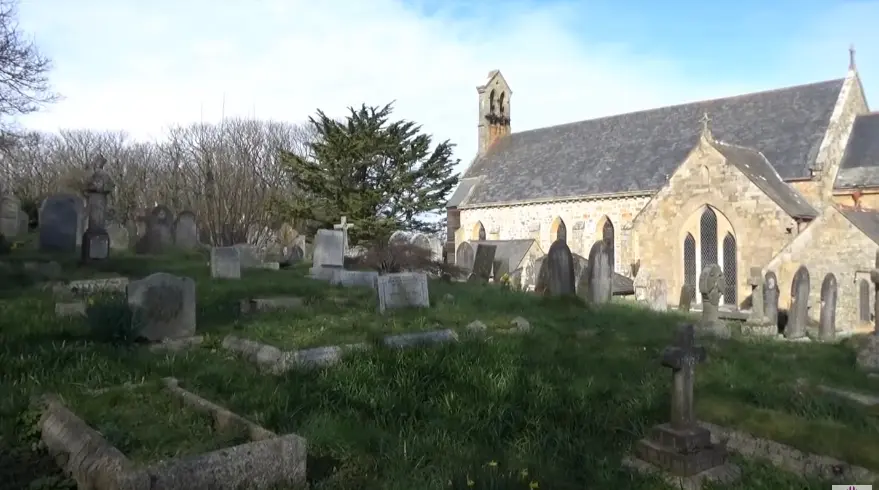
Recent collaborative field research conducted on-site at St. Michael & All Angels Churchyard has successfully narrowed down the exact location of Smith’s burial. While her original marker—likely a modest wooden cross or perhaps no marker at all—has long since vanished, meticulous cross-referencing of surviving parish registers with chronological burial plots has brought researchers to a compelling conclusion. Smith was interred on September 25, 1951, by the esteemed Roman Catholic priest Joseph Henry du Moulin-Browne, in a secluded corner of the churchyard overlooking the coastal landscape she held so dear.
The discovery relies on a combination of forensic genealogy, historical site surveys, and spatial chronology. Because the graveyard’s plots were laid out in a strict chronological sequence during the mid-20th century, researchers were able to pinpoint the quadrant containing graves dated from late 1950 to late 1951. This specific area—situated in a tranquil, wooded pocket of the churchyard near the shoreline—contains approximately three marked graves from the period, alongside at least three unmarked plots.
Independent validation by a local historian who first mapped the site thirty years ago has lent significant weight to the finding. While a catastrophic fire in a builder’s hut during past church renovations permanently destroyed the primary plot ledger, the convergence of oral history, parish burial dates, and topographical analysis offers the closest approximation humanity will likely ever have to the physical ground where Pixie rests.
Chronology: From Bohemian Brilliance to Quiet Obscurity
To understand the tragic anonymity of Pamela Colman Smith’s passing, one must examine the extraordinary, albeit turbulent, trajectory of her life. Born in London in 1878 to American parents, Smith spent an itinerant childhood moving between London, Jamaica, and New York. This early exposure to diverse cultures—particularly the vibrant folklore of Jamaica—imbued her artistic style with a distinct, organic dynamism that set her apart from the rigid academic traditions of the Victorian era.
Early Career and the Arts and Crafts Movement
By the late 1890s, Smith had returned to England, enrolling in the Pratt Institute in Brooklyn under the renowned avant-garde artist Arthur Wesley Dow. Returning to London, she quickly immersed herself in the bohemian theater and arts scene. She became heavily influenced by the Arts and Crafts movement, working as a scenic and costume designer for the celebrated miniature theater company of Gordon Craig and exhibiting alongside luminaries of the William Butler Yeats circle.
Smith’s unique illustrative style—characterized by flowing lines, flat planes of watercolor, and an atmospheric, dreamlike quality—earned her the admiration of the theatrical and literary elite. She was the first illustrator to be published by W.B. Yeats and illustrated works for Bram Stoker, author of Dracula. In 1907, she even hosted her own exhibition at Alfred Stieglitz’s prestigious New York gallery, 291, marking her as a pioneering American modernist.
The Collaboration That Changed Esoteric History
The defining moment of Smith’s career occurred around 1909, when she was commissioned by the occultist and esoteric scholar Arthur Edward Waite to create a new set of tarot cards. Waite, a prominent member of the Hermetic Order of the Golden Dawn, envisioned a deck that would transcend traditional fortune-telling and encapsulate deep mystical truths.
Working with breathtaking speed and profound intuitive depth, Smith produced 78 distinct illustrations. While Waite provided the overarching framework and traditional attributions, it was Smith’s artistic genius that birthed the enduring imagery. Notably, she broke with centuries of tradition by populating the Minor Arcana with vivid, narrative-driven human scenes rather than simple geometric arrangements of suits. Her rendition of the Three of Swords, the Ten of Wands, and the Fool transformed the cards into psychological mirrors. Published by William Rider & Son in 1909, the deck became known as the Rider-Waite-Smith (RWS) tarot, eventually evolving into the undisputed archetype for modern tarot worldwide.
Financial Hardship and Conversion to Catholicism
Despite the monumental cultural impact of the deck, Smith received a meager one-off flat fee for her work and retained no copyright royalties. As the decades progressed, commissions dwindled, and the cultural tides shifted away from her romantic, Symbolist aesthetic.
Seeking spiritual solace, Smith converted to Roman Catholicism in 1911. In her later years, she relocated to the coastal town of Bude in Cornwall, living a quiet, increasingly impoverished life. When she passed away on October 18, 1951—though parish burial records note her interment on September 25, reflecting historical discrepancies in record entry dates—she left behind very few physical possessions. Her art, her books, and her personal belongings were auctioned off to settle debts, effectively erasing her footprint from the physical world.
Supporting Data and Field Research Methodology
The recent breakthrough regarding Smith’s grave is the result of rigorous investigative research by tarot historians Marcus Katz, Tali Goodwin, and associated archival teams. Reconstructing the final chapters of a forgotten historical figure requires an interdisciplinary approach that bridges genealogy, architectural history, and forensic topography.
The Parish Record Disaster
The primary obstacle faced by researchers was the loss of the church’s primary interment ledger. According to local accounts gathered during the recent site visit, a fire broke out in a temporary builder’s hut during church renovation works decades ago. Stored inside this hut were the official, handwritten parish record books documenting exact plot assignments for the mid-20th century. With these documents turned to ash, standard archival verification became impossible.
Circumstantial Topography and Chronological Sequencing
Faced with this roadblock, the research team adopted a forensic methodology:
- Death and Burial Verification: Confirming the exact date of burial (September 25, 1951) and the officiating clergyman (Father Joseph Henry du Moulin-Browne) through surviving secondary diocesan records.
- Plot Mapping by Chronology: Analyzing the layout of St. Michael & All Angels Churchyard, researchers established that nineteenth- and twentieth-century burials in this specific parish followed a strict chronological pathway, beginning near the church structure and radiating outward toward the perimeter.
- Marker Analysis: Identifying surviving headstones from 1950 and 1951. This placed the target window directly in the far corner of the churchyard, immediately adjacent to the southern boundary.
- Unmarked Plot Identification: Locating three distinct, unmarked depressions in the earth immediately adjacent to the verified 1950–1951 graves.
- Independent Peer Validation: Submitting these findings to a veteran local historian who had spent thirty years mapping and researching the parish churchyard. The historian independently arrived at the identical quadrant the following day, confirming that the remaining unmarked plots in this specific zone represent the most viable candidates for Smith’s interment.
Sensory and Environmental Resonance
Describing the atmosphere of the site, researchers noted a profound emotional resonance. Situated on a bluff near the Cornish coast, the churchyard is continuously serenaded by the sound of coastal gulls, the whispering of mature woodlands, and the crash of distant waves—elements of the natural world that Smith famously celebrated in her art and life. Adding an almost cinematic weight to the investigation, the church bells began to peal spontaneously while video footage of the presumptive gravesite was being captured, creating an unforgettable moment for the team.
Official Responses and Archival Revelations
The rediscovery of the context surrounding Smith’s final resting place has ignited renewed academic and public interest, prompting major publishing houses and esoteric societies to release previously uncatalogued materials.
Scholarly Publications
The release of Secrets of the Waite-Smith Tarot (Llewellyn, 2015) by Marcus Katz and Tali Goodwin represented a watershed moment in tarot scholarship. The book brought to light rare photographs, correspondence, and artistic drafts that dismantled long-held myths about the creation of the deck. For decades, popular culture attributed the entire design to Arthur Edward Waite, often omitting Smith’s name entirely (referring to the deck merely as the "Rider Tarot"). Katz and Goodwin’s work decisively restored Smith to her rightful place as co-creator.
Exclusive Member Discoveries
In tandem with the physical site visit, the Tarot Association has opened a dedicated archival portal for its members. Titled "The Kiss of the Sun for Pardon: A Memory of Pamela Colman Smith," the new digital collection features:
- Newly digitized photographs of Smith from her active artistic period.
- Transcripts of rare letters detailing her spiritual transition and artistic frustrations in Cornwall.
- Detailed cartographic breakdowns of the St. Michael & All Angels Churchyard research data.
Association leadership has emphasized that understanding the factual realities of Smith’s life provides an essential ethical foundation for modern practitioners. Rather than viewing the tarot through purely mystical or dogmatic lenses, grounding the tool in the historical reality of its impoverished, brilliant creator honors the human sacrifice behind the art.
Implications: Reclaiming Pixie’s Legacy in the Modern Era
The ongoing efforts to map, remember, and honor Pamela Colman Smith carry profound implications for contemporary esoteric communities, art historians, and cultural preservationists alike.
1. Correcting Historical Erasure
Smith’s story is a textbook example of the historical marginalization of women artists, particularly those who operated outside conventional societal structures. Unmarried, eccentric, financially unstable, and working in the "low art" realm of illustration rather than oil painting, Smith was easily sidelined by her male contemporaries. By reclaiming her gravesite and disseminating her true history, researchers are actively correcting a decades-long injustice. The global adoption of the descriptor "Rider-Waite-Smith"—placing her name last alphabetically but ensuring it is present at all—stands as a hard-won victory of modern revisionist history.
2. Shifting the Paradigm of Tarot Innovation
For decades, the study of tarot was dominated by dogmatic interpretations that treated the RWS deck as a static, sacred text handed down from antiquity. The rigorous historical research spearheaded by organizations like the Tarot Association democratizes the field. By understanding how Smith synthesized Jamaican folklore, theatrical design, and Golden Dawn philosophy into her 1909 commission, contemporary readers are empowered to engage in practical innovation. Knowing the human artist behind the brush allows readers to view the cards not as infallible decrees from the cosmos, but as a deeply human, empathetic language of psychological self-reflection.
3. Proposed Memorialization
Discussions are currently underway among independent researchers and cultural preservationists regarding the feasibility of establishing a formal memorial marker at St. Michael & All Angels Churchyard. While budgetary and ecclesiastical hurdles remain, the identification of her most likely resting place provides a concrete focal point for admirers worldwide who make pilgrimage to Cornwall. For a woman who spent her final years in quiet oblivion, the prospect of a permanent memorial ensures that future generations of artists and esotericists will know precisely where to find Pixie.
As interest in tarot surges to unprecedented heights in the 21st century—fueled by digital platforms, wellness culture, and a renaissance in esoteric art—the spirit of Pamela Colman Smith lives on in millions of homes around the globe. Every time a seeker shufflings a deck, lays out a Celtic Cross, or gazes into the lush watercolors of the Ace of Cups, they are engaging with the enduring vision of an extraordinary artist who found her peace by the sea.
For further access to documents regarding the research at St. Michael & All Angels Churchyard and exclusive archival photographs, members of the Tarot Association may log into their portal to view the complete "Kiss of the Sun for Pardon" dossier.
