

LOS ANGELES — Deep beneath the sun-baked chaparral of Southern California, an invisible and relentless countdown has been ticking for nearly two hundred years. According to a landmark study recently published in the Journal of Geophysical Research: Solid Earth, tectonic stress along two of the region’s most formidable fault systems has accumulated to levels unseen in the last one thousand years.
The research, led by Dr. Liliane Burkhard of the Division of Space Research and Planetary Sciences (WP) at the Physics Institute of the University of Bern, offers an unprecedented look into the subterranean mechanics of the San Andreas and San Jacinto fault systems. By combining a millennium of paleoseismic data with cutting-edge, four-dimensional computer modeling, scientists have arrived at a sobering conclusion: the region is not only critically stressed, but it has entered a structural configuration historically associated with catastrophic, multi-fault ruptures.
While the findings do not constitute a calendar prediction for an imminent tremor, they serve as a stark wake-up call for seismologists, emergency planners, and the nearly 24 million residents living in the shadow of these geological giants.
Main Facts: The Anatomy of a High-Stakes Geological Junction
Earthquakes are the planet’s violent mechanism for releasing energy stored by the relentless motion of tectonic plates. In Southern California, the Pacific Plate and the North American Plate slide past one another at a rate of several centimeters per year. However, this movement is rarely smooth. Friction locks the jagged edges of the Earth’s crust together, allowing elastic strain to build up over decades, centuries, or even millennia until the rock finally shears.
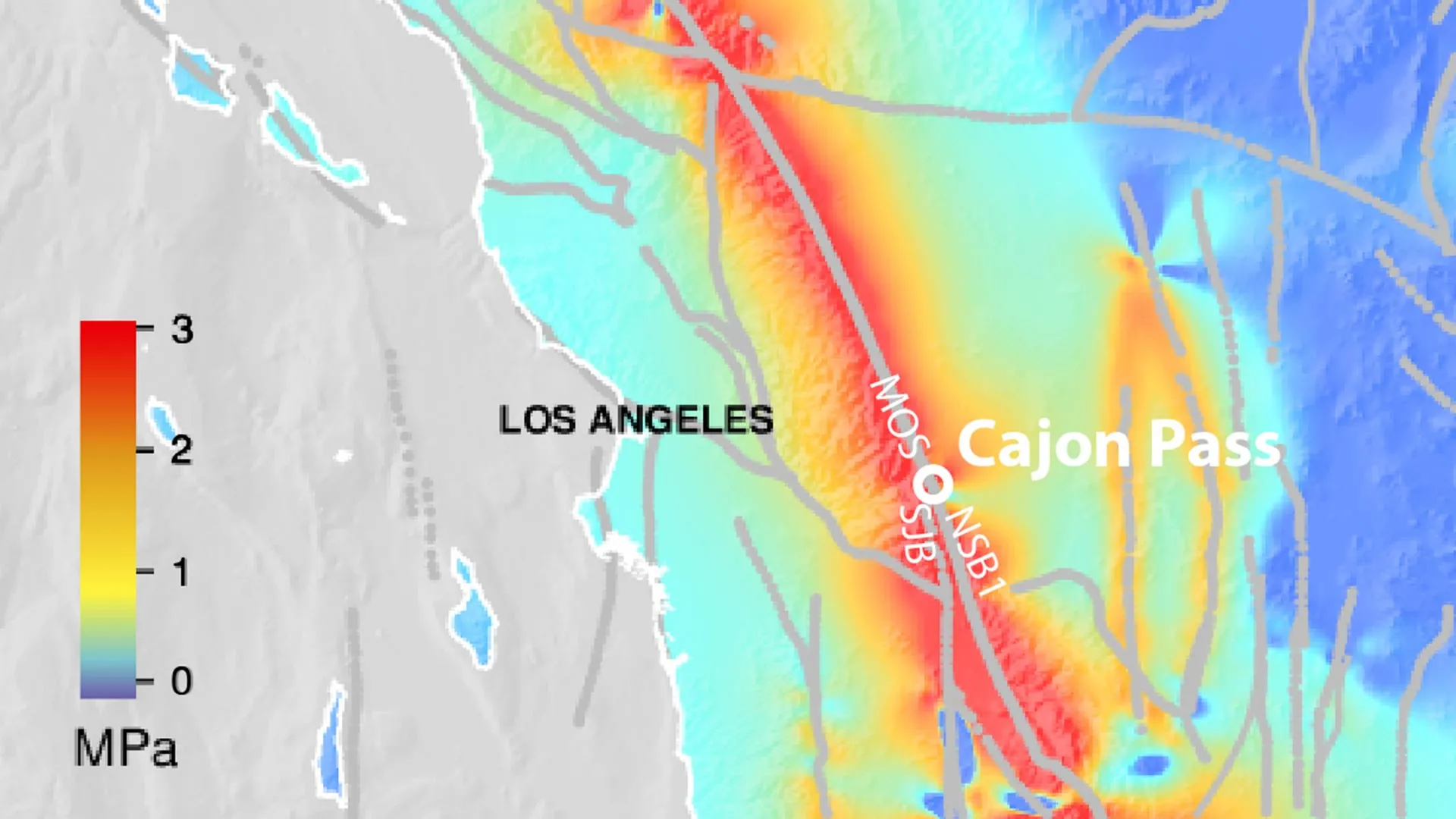
The new study zeroes in on the Cajon Pass, a geologically intricate mountain pass situated northeast of Los Angeles. Here, the San Andreas Fault and the San Jacinto Fault—the twin engines of the region’s tectonic activity—converge dangerously close to one another.
At the heart of the researchers’ discoveries is the introduction of a new seismic concept: the "earthquake gate." Rather than merely acting as a physical barrier that stops a rupture dead in its tracks, or a simple conduit that channels energy, Cajon Pass functions as a dynamic junction. Whether a seismic rupture remains confined to a single fault or successfully leaps the gap to ravage both systems simultaneously depends entirely on the delicate balance of stress conditions within this gate.
The study’s international team—which included researchers from the University of Hawaiʻi at Mānoa, the U.S. Geological Survey (USGS) Earthquake Science Center in Pasadena, and the Scripps Institution of Oceanography at UC San Diego—calculated that stress levels at Cajon Pass have shattered historical baselines. Specifically, stress on the San Jacinto-Bernardino section has climbed to an unprecedented 3.6 megapascals (MPa), while the neighboring Mojave South section of the San Andreas Fault stands at 2.8 MPa.
Because these stress levels are not only historically high but are also approaching a symmetrical balance between the two faults, the stage is set for a high-consequence scenario: a simultaneous, dual-fault rupture.
Chronology: A 1,000-Year Window and the 1857 Silence
To understand how today’s high-stress environment developed, the researchers had to look backward through the centuries. The timeline of Southern California seismology reveals a profound puzzle that has vexed scientists for generations: the unusually long quiet period following the last major seismic event.
The 1857 Fort Tejon Earthquake
The last great rupture on the southern segment of the San Andreas Fault occurred on January 9, 1857. Known as the Fort Tejon earthquake, this colossal event is estimated to have been a magnitude 7.9. It tore through the ground for roughly 225 miles (360 kilometers) from near Parkfield down through the Cajon Pass area, snapping trees, altering river courses, and opening massive fissures in the earth.
Crucially, historical and geological evidence shows that the 1857 rupture stopped at Cajon Pass, failing to jump to the parallel San Jacinto Fault system.
The 1812 Wrightwood Precedent
In stark contrast, an earlier earthquake—the Wrightwood event of December 8, 1812—demonstrated the terrifying potential of the Cajon Pass earthquake gate. Geological data indicates that the 1812 rupture did not stop at the junction. Instead, it successfully hopped the gap, propagating through both the San Andreas and San Jacinto fault systems in a single, sustained cataclysm.
The Modern Seismic Drought
Since the 1857 Fort Tejon earthquake, the southern segments of these fault systems have experienced an unusually prolonged seismic drought. While smaller earthquakes continually rattle the region, the colossal releases of energy that reset the tectonic clock have not occurred on these specific segments for nearly 170 years.
This extended quiet interval has allowed tectonic pressure to accumulate continuously, pushing the system past the thresholds recorded at any point in the millennium-long computer simulation.
Supporting Data: Reconstructing the Past with 4D Modeling
To peer into the current stress state of the Earth’s crust, Dr. Burkhard and her colleagues bypassed traditional observational limits by constructing a sophisticated, physics-based four-dimensional earthquake cycle model.
Building the Model
The construction of this model was a monumental multi-disciplinary undertaking. Researchers fed the simulation a robust 1,000-year earthquake history compiled from rigorous geological evidence. This data included:
- Radiocarbon dating of organic material buried by ancient sediment displacements.
- Tree-ring records (dendrochronology) that capture the subtle stresses and disruptions experienced by long-lived trees situated near fault traces.
- Historical accounts of ground ruptures, Indigenous oral histories, and early settler documentation.
How the Physics Engine Works
Unlike static models that merely snapshot a fault line, the four-dimensional approach simulates fault behavior in three spatial dimensions while continuously tracking time over centuries.
"The model tracks how each earthquake changes stress on neighboring fault segments, how stress accumulates during the quiet intervals between events, and how the deeper layers of the crust slowly relax following large ruptures," Dr. Burkhard explained.
By running a millennia-long simulation of Southern California’s tectonic history, the team could accurately estimate the exact degree of stress currently locked within the earth. The results were unambiguous: modern stress levels outstrip any comparable period in the past thousand years.
Furthermore, the model unlocked the secret of the earthquake gate. The researchers discovered that the absolute magnitude of stress on a single fault is only half the equation. The critical metric is stress symmetry—how closely the stress levels on the San Andreas and San Jacinto systems match each other. When both systems are critically loaded to similarly high levels, the barrier function of Cajon Pass collapses, making a multi-fault "super-quake" far more likely.
Official Responses and Scientific Consensus
The publication of the study in the Journal of Geophysical Research: Solid Earth has sent ripples through the global geoscience and emergency management communities, prompting careful evaluation from regulatory and scientific institutions.
Dr. Burkhard and her co-authors have been proactive in contextualizing their findings for the public, taking pains to separate rigorous scientific modeling from sensationalism.
"The study is not a prediction of when an earthquake will occur," Dr. Burkhard emphasized. "What we can say is that the system is critically stressed and that physics-based models like ours give a clearer picture of the range of scenarios we should be prepared for. This information is important for hazard assessment, infrastructure planning, and emergency preparedness."
The U.S. Geological Survey (USGS)—a key partner in the research—has long maintained that Southern California is overdue for significant seismic activity along its major fault lines. While USGS scientists emphasize that earthquake prediction in terms of exact days, months, or even years remains impossible with current technology, probabilistic forecasting models like the one developed by the University of Bern provide invaluable parameters for civil engineers.
Local emergency management agencies in Los Angeles, San Bernardino, and Riverside counties have pointed to the study as validation for ongoing, long-term resilience initiatives. Rather than triggering panic, public safety officials view the research as a mandate to accelerate retrofitting programs, upgrade early-warning sensor networks (such as ShakeAlert), and refine regional evacuation and disaster response protocols.
Implications: The Shadow of a Multi-Fault Catastrophe
The true weight of the University of Bern study lies in its implications for human life, economic stability, and national infrastructure. An earthquake confined to a single fault system is a regional disaster; a multi-fault rupture sweeping through Cajon Pass is an entirely different order of magnitude.
A Multi-County Impact Zone
A simultaneous rupture of the San Andreas and San Jacinto faults would unleash seismic waves across some of the most densely populated and economically vital territory in the United States. The impact zone would not be restricted to a single valley or municipality; it would simultaneously envelop:
- The greater Los Angeles metropolitan area
- San Bernardino and the Inland Empire
- Riverside County
- The Coachella Valley and Palm Springs corridor
Lifeline Vulnerability at Cajon Pass
Compounding the danger is the geographic significance of Cajon Pass itself. The pass is not merely a line on a geological map; it is a critical artery of modern civilization. Threaded through this narrow mountain corridor are major transcontinental freight rail lines, vital interstate highways (such as Interstate 15), high-voltage electrical transmission grids, and major petroleum and natural gas pipelines connecting Southern California to the rest of the nation.
A major rupture originating in or jumping across the Cajon Pass earthquake gate could simultaneously sever these lifelines, paralyzing supply chains, cutting off power to millions, and isolating the coastal basin from the interior United States for weeks or months.
Global Applicability
Beyond its immediate local urgency, the methodological framework developed by Dr. Burkhard’s team holds global significance. Complex fault junctions—where multiple tectonic structures intersect, merge, or run parallel—are common worldwide, from the Anatolian Fault in Turkey to the Alpine Fault in New Zealand.
"The question of when and how the next major earthquake will occur in this region is one of the most pressing problems in applied geoscience," Dr. Burkhard noted. "Our results provide a clearer, physics-based picture of the current stress state of the fault system, and the framework we developed is not just applicable to California, but also for other complex fault junctions worldwide."
Conclusion: Preparing for the Unseen
As Southern California continues to grow, the subterranean clock ticks ever onward. The revelation that tectonic stress along the San Andreas and San Jacinto systems has reached a millennium high is a reminder of the dynamic, volatile planet we inhabit.
While science cannot yet name the day or the hour when the earth will finally yield, studies like this transform abstract risk into actionable knowledge. By understanding how the Cajon Pass earthquake gate operates under extreme pressure, society is better equipped to reinforce its infrastructure, educate its populace, and prepare for the day when the sleeping giant awakens.
