

STOCKHOLM/SHANGHAI — For decades, the scientific consensus surrounding the planet’s thawing permafrost has been stark, linear, and deeply concerning. As global temperatures rise at rates outpacing historical averages, the vast, ancient expanses of frozen ground locked away in the Arctic and high-altitude mountain ranges have begun to thaw.
For climate modelers, this process has long been viewed as a one-way street toward greater atmospheric warming. As permafrost degrades, long-dormant organic matter—trapped in ice for millennia—is exposed to awakening microbes. These microorganisms rapidly break down the ancient carbon, releasing massive quantities of methane and carbon dioxide ($CO_2$) into the atmosphere in a classic, dangerous feedback loop.
However, a landmark study published in the prestigious journal Nature reveals a critically overlooked twist in this planetary narrative. An international team of researchers from Umeå University in Sweden and East China Normal University in China has discovered that the very degradation of permafrost can also accelerate a powerful, natural geological process that actively pulls carbon dioxide out of the atmosphere.
While thawing ground undeniably unlocks greenhouse gases, it simultaneously triggers accelerated rock weathering—a chemical process that consumes atmospheric $CO_2$ and can, in certain landscapes, completely neutralize the carbon emissions surging from northern rivers.
Main Facts
The groundbreaking study upends traditional carbon-cycle accounting by bridging two domains of Earth science that are traditionally studied in isolation: the biological carbon cycle and the geological carbon cycle.
- The Dual Nature of Thawing: While microbial decomposition of ancient organic matter continues to release greenhouse gases from thawing soils, the breakdown of permafrost also exposes fresh mineral surfaces to water and air.
- Chemical Weathering Acceleration: This exposure supercharges chemical weathering. As water interacts more extensively with newly fractured and exposed rock surfaces, it strips $CO_2$ from the atmosphere and converts it into dissolved inorganic carbon.
- Substantial Offsets: Across the expansive Qinghai-Tibet Plateau—the world’s highest and largest cryosphere outside of the polar regions—researchers calculated that rock weathering naturally offsets approximately 35 percent of all river-borne $CO_2$ emissions.
- Landscape Dependence: The buffering effect varies dramatically by region. In areas with continuous, unbroken permafrost, the offset is modest. However, in regions where permafrost has become discontinuous or patchy, weathering-driven carbon uptake frequently exceeds 100 percent of the river’s carbon emissions, entirely neutralizing the biological release.
- Model Omissions: Current global climate models heavily factor in biological emissions from thawing permafrost but largely fail to account for the dynamic, concurrent geological carbon sinks highlighted by this research.
Chronology: How the Discovery Unfolded
The path to this discovery required a shift in how scientists approach the interconnected systems of the cryosphere. For years, biogeochemists noted discrepancies in how much carbon was entering aquatic networks versus how much was ultimately reaching the atmosphere.
Step 1: Recognizing the Blind Spot in Arctic and Alpine Research
Historically, climate research in permafrost-heavy regions focused downstream. Scientists tracked the efflux of gases bubbling out of lakes, streams, and rivers, attributing the high concentrations of $CO_2$ almost entirely to the microbial respiration of ancient terrestrial carbon washed into the waterways. Yet, geochemical equations governing water-rock interactions in alpine and sub-polar zones suggested that something else might be happening beneath the surface.
Step 2: Selecting the Ultimate Laboratory
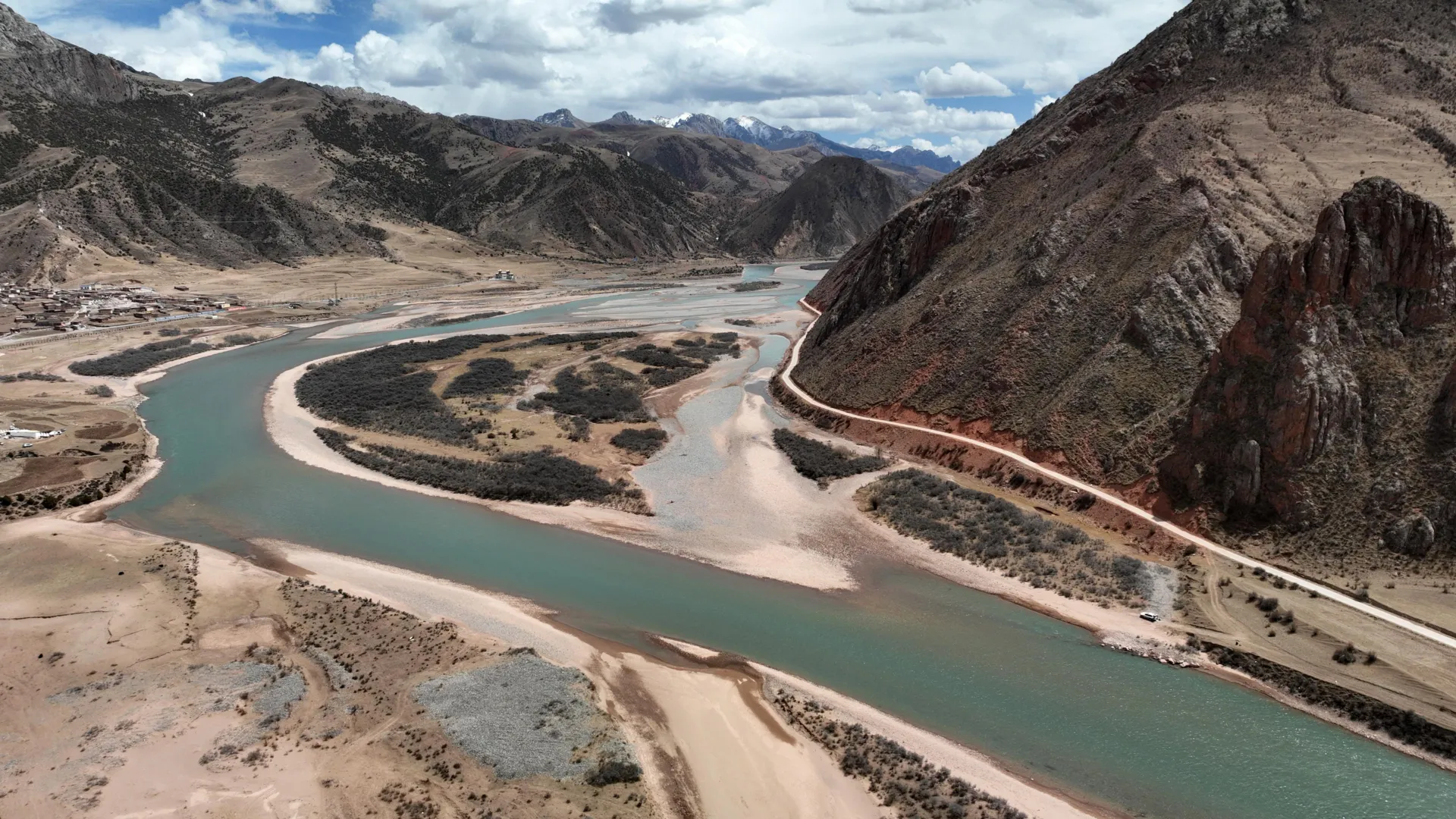
To test whether geological processes could meaningfully alter carbon budgets, the research team turned to the Qinghai-Tibet Plateau. Often referred to as the "Roof of the World" or the "Third Pole," this massive high-altitude region contains the largest expanse of high-elevation permafrost on Earth. Its rapidly changing climate gradients make it an ideal, accelerated laboratory for observing landscape-scale permafrost degradation.
Step 3: Comprehensive Field Sampling
Between 2018 and recent field campaigns, the international team mounted expeditions across 50 distinct river catchments spanning the Qinghai-Tibet Plateau. They gathered a comprehensive dataset by:
- Measuring direct riverine $CO_2$ emissions across varying altitudes and thawing gradients.
- Analyzing dissolved organic and inorganic carbon concentrations in the water columns.
- Utilizing isotopic tracers to fingerprint the exact origins and transformations of the carbon moving through the system.
- Deploying advanced geochemical models to reconstruct the journey of the carbon from bedrock to atmosphere.
Step 4: Synthesizing the Data and Publishing in Nature
Upon compiling the geochemical data, the researchers ran simulations to map the relationship between permafrost coverage and river emissions. The results were startling: rather than a uniform increase in net carbon release as permafrost thied, catchments with degraded permafrost exhibited a profound shift in chemistry. The data proved that enhanced rock weathering was actively consuming atmospheric carbon at rates high enough to demand a rewriting of regional carbon models. The findings were formally accepted and published in Nature, drawing immediate attention from the global climate research community.
Supporting Data and Quantitative Findings
The empirical weight of the study rests on meticulous geochemical measurements across the Tibetan river systems. The numbers demonstrate that geological processes can occasionally rival biological ones in the global carbon budget.
+---------------------------------------------------------------------------------+
|                        PERMAFROST THAWING & CARBON FLUXES                       |
+---------------------------------------------------------------------------------+
|                                                                                 |
|   [ Thawing Permafrost ]                                                        |
|           │                                                                     |
|           ├──> Biological Pathway: Microbes degrade organic matter              |
|           │    Result: Release of greenhouse gases ($CO_2$, $CH_4$)               |
|           │                                                                     |
|           └──> Geological Pathway: Minerals exposed to water & air              |
|                Result: Accelerated Chemical Weathering                          |
|                       │                                                         |
|                       └──> Consumes Atmospheric $CO_2$                          |
|                            (Offsets ~35% of river emissions on average;         |
|                             up to >100% in patchy permafrost zones)             |
|                                                                                 |
+---------------------------------------------------------------------------------+
The Spatial Gradient: Continuous vs. Patchy Permafrost
The research team categorized river catchments based on the integrity of their underlying permafrost:
- Continuous Permafrost Zones: Where the ground remains frozen solid year-round, water has minimal access to fresh, unweathered mineral strata beneath the organic soil layer. Here, chemical weathering is limited, and the biological release of $CO_2$ dominates the carbon budget.
- Discontinuous and Isolated Permafrost Zones: As warming degrades the permafrost into a fragmented, patchy mosaic, the landscape undergoes physical shifts. Slumping soils, increased hydrological connectivity, and deeper groundwater percolation expose fresh, highly reactive mineral surfaces. In these specific catchments, the rate of weathering-driven carbon uptake skyrocketed, frequently neutralizing or even eclipsing the biological $CO_2$ emissions.
Quantitative Breakdown
- Average Regional Offset: Across all 50 river basins studied on the Qinghai-Tibet Plateau, rock weathering was found to offset an average of 35 percent of total riverine $CO_2$ emissions.
- Maximum Local Offset: In localized sub-catchments characterized by advanced permafrost degradation, the carbon consumed by weathering surpassed 100 percent of the carbon emitted by the river system, turning those specific hydrological networks into net carbon sinks rather than sources.
Official Responses and Expert Perspectives
The publication of the study has sparked significant dialogue among biogeochemists, geomorphologists, and climate modelers worldwide. Experts emphasize that while the findings are a revelation, they demand nuanced interpretation.
Liwei Zhang, a biogeochemist at East China Normal University and a lead contributor to the research, explained the counterintuitive dynamics observed in the field:
"We found that river $CO_2$ emissions decline while carbon uptake through rock weathering increases as permafrost cover decreases," Zhang noted. "In some catchments where permafrost has become patchier, weathering-driven carbon uptake was large enough to offset or even exceed river $CO_2$ emissions."
Zhang and her colleagues stress that the sheer scale of these geological reactions forces a departure from the traditional, one-dimensional view of thawing landscapes as simple "carbon bombs."
Jan Karlsson, a professor at the Department of Ecology, Environment and Geoscience at Umeå University, underscored the vital connection between realms of science that are rarely synthesized:
"Our findings show that biological and geological carbon cycles are tightly linked," Karlsson said. "To understand whether thawing permafrost ultimately amplifies or dampens climate warming, we need to consider both the carbon released from ancient soils and the carbon consumed through rock weathering."
Karlsson cautioned, however, against misinterpreting the results as a silver bullet for global warming. Weathering is not a simple, uniform, or permanent atmospheric cleanup mechanism. Depending on the specific mineralogy of the bedrock undergoing erosion—such as sulfuric acid-driven weathering versus carbonic acid-driven weathering—some geological reactions can actually release $CO_2$ rather than consume it.
Other independent scientists not involved in the study have praised its methodological rigor while echoing the call for caution. The research highlights a missing feedback mechanism, but integrating it into global General Circulation Models (GCMs) will require massive amounts of additional empirical data from other critical permafrost regions, such as the vast Siberian taiga and the North American Arctic.
Implications for Global Climate Models and Policy
The implications of the Umeå and East China Normal University study extend far beyond academic debates in geochemistry. They strike at the heart of how humanity forecasts future warming trajectories and designs climate mitigation policies.
1. Rewriting Climate Models
Current global climate models rely heavily on biogeochemical algorithms that simulate soil respiration, plant uptake, and aquatic outgassing. By ignoring the geological counter-fluxes triggered by chemical weathering, these models may be operating with a systematic blind spot. While the net effect of permafrost thaw will likely remain a net release of greenhouse gases globally due to the sheer volume of ancient organic carbon stored in high latitudes, local and regional carbon budgets could be significantly miscalculated if rock weathering is omitted.
2. A Shift in Arctic Science Priorities
The research signals a shift toward multidisciplinary Arctic and alpine science. Future expeditions to the poles and high-altitude mountain ranges will increasingly require geologists and mineralogists to work hand-in-hand with microbiologists and hydrologists. Understanding the exact mineral composition of thawing mountain ranges will become just as critical as measuring microbial respiration rates in thawing peatlands.
3. Dispelling Reductionist Narratives
While climate communication often relies on straightforward, easily digestible metaphors—such as permafrost acting strictly as a ticking carbon bomb—the reality of Earth systems physics is infinitely more complex. Acknowledging that biological emissions and geological sinks occur simultaneously does not diminish the urgency of cutting anthropogenic emissions; rather, it underscores the intricate, delicate feedback loops that govern our planetary life support systems.
Looking Ahead
As global temperatures continue to rise and the permafrost boundary steadily retreats poleward and uphill, the interplay between thawing soils and accelerating rock weathering will intensify. Whether these geological sinks can keep pace with accelerating microbial emissions in other regions remains the central question for the next generation of Earth system scientists.
What is certain is that the Arctic and the Third Pole are far more dynamic than previously understood. As researchers continue to decode the complex chemical conversations unfolding beneath thawing landscapes, climate science must adapt to embrace the deep, hidden connections between the rocks beneath our feet and the air above our heads.
