

In the rapidly evolving landscape of global electric vehicle (EV) adoption, certain regions consistently command the spotlight. Western Europe, China, and parts of North America frequently dominate industry headlines. However, shifting market dynamics across the Global South are revealing unexpected frontrunners. Among them, Ecuador has emerged as a compelling anomaly.
Once considered an undeniable laggard in Latin America’s nascent electromobility sector, the Andean nation is undergoing a profound automotive transformation. Driven by shifting economic policies, the removal of legacy fuel subsidies, and an influx of affordable next-generation models, Ecuador is rapidly closing the gap on regional powerhouses. If current market trajectories hold, the country is poised to unseat Colombia as the third-largest and most advanced EV market in Latin America.
Main Facts: The 2026 Breakthrough
The scale of Ecuador’s current electromobility boom defies earlier industry projections. Historically anchored to the bottom tier of regional EV adoption metrics alongside Peru and Argentina, Ecuador has experienced an extraordinary acceleration in battery-electric vehicle (BEV) and plug-in hybrid electric vehicle (PHEV) sales throughout 2026.
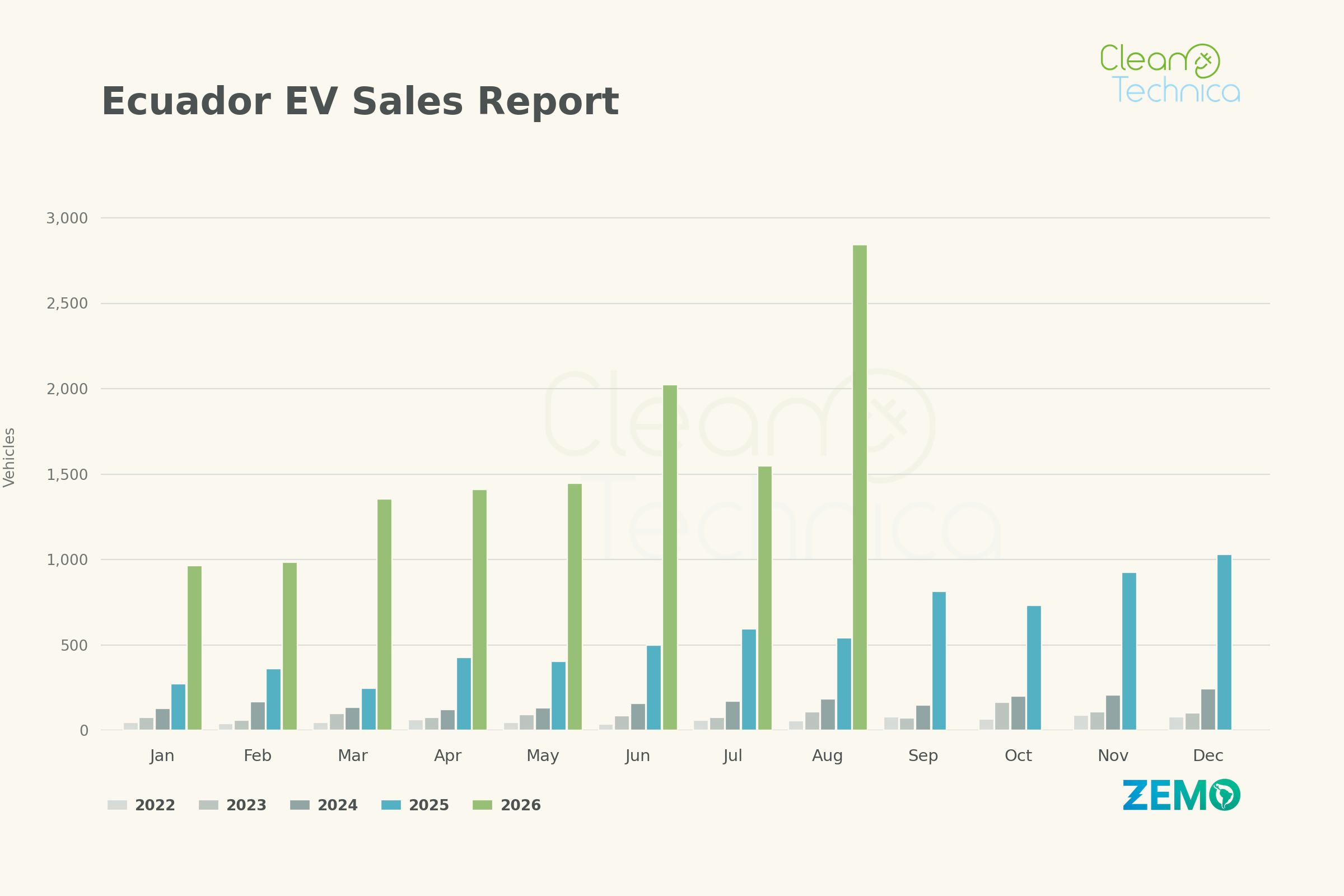
- Explosive Sales Growth: Year-to-date sales figures for 2026 have surged by 276%, with August data revealing a staggering 426% year-over-year increase. Having crossed the milestone of 1,000 cumulative sales as recently as December 2025, the market approached nearly 3,000 monthly registrations by August 2026.
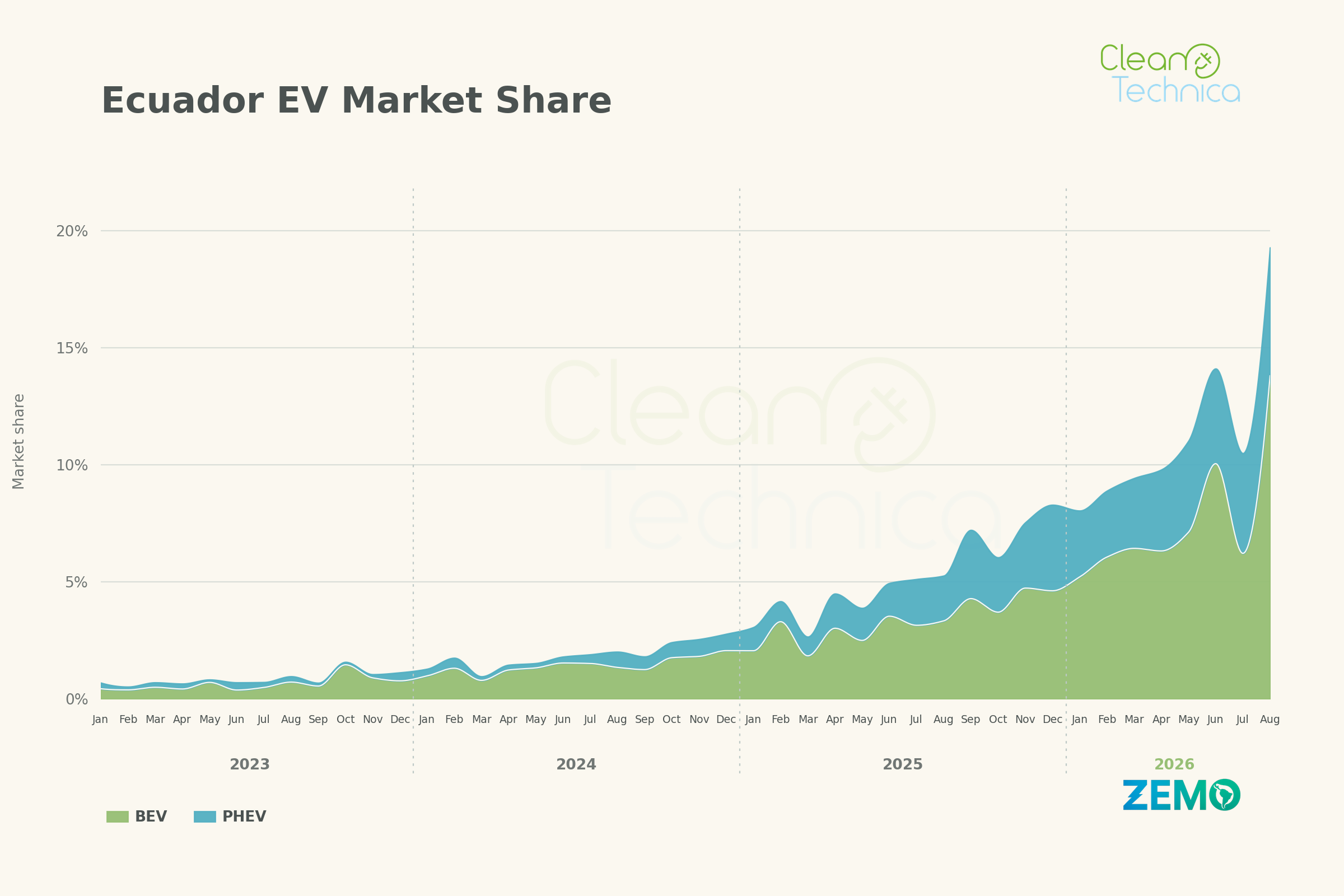
- Soaring Market Share: By the first quarter of 2026, BEVs alone captured 6% of the market. By August, BEV market share reached 13.8%, while PHEVs added another 5.5%, bringing total electrified vehicle penetration to an impressive 19.3%—hovering tantalizingly close to the 20% threshold.
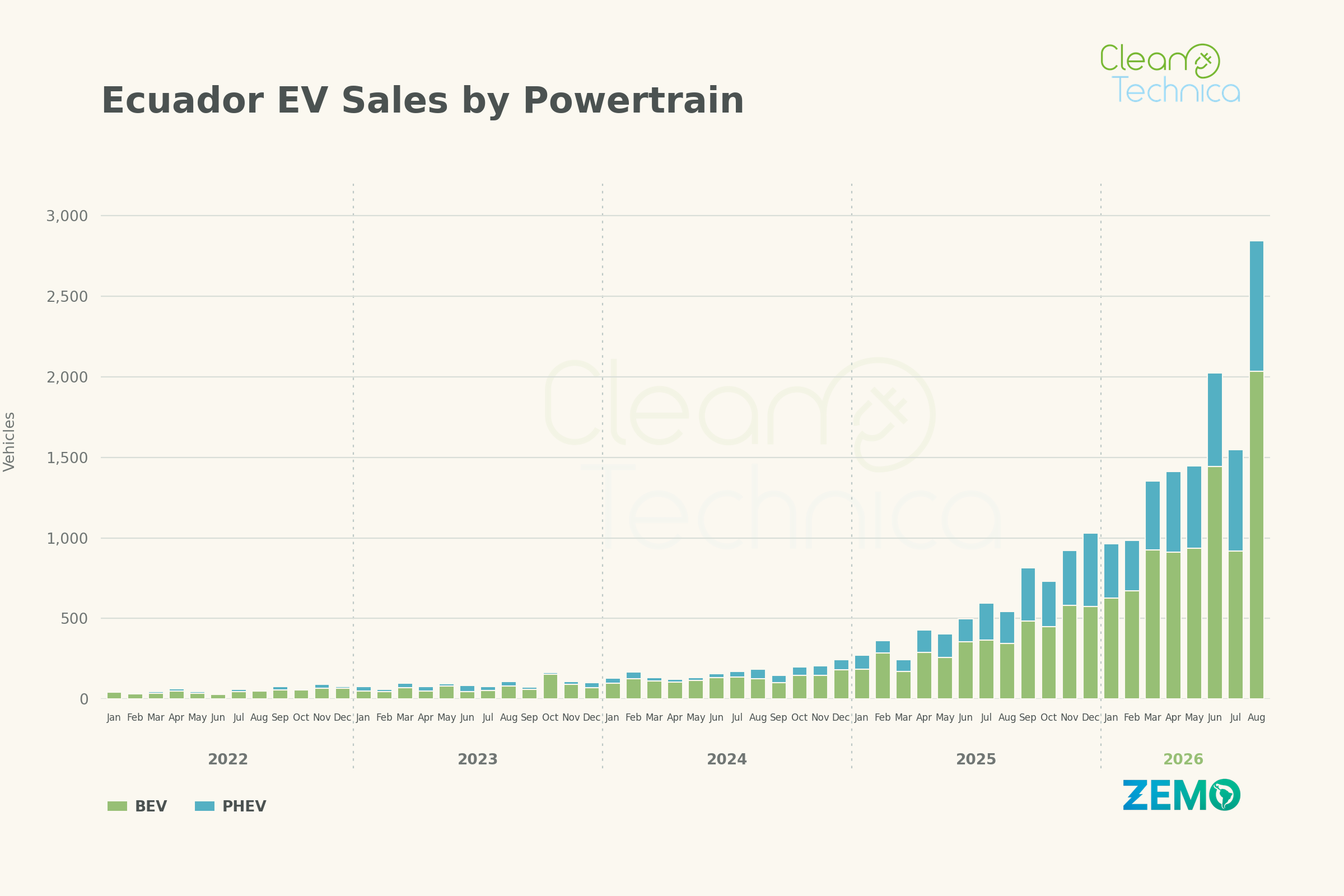
- Powertrain Composition: Unlike smaller regional peers where BEVs completely eclipse plug-in hybrids, Ecuador maintains a robust 70/30 split between BEVs and PHEVs. August 2026 underscored this momentum, with BEV sales crossing the 2,000-unit milestone for the first time and PHEVs exceeding 800 units.
- Competitive Market Realignment: While Chinese manufacturer BYD initially dominated over 70% of Ecuador’s nascent EV market in 2024, increased global competition has diversified the landscape. BYD’s market share has settled below 30%, making room for legacy automakers adapting to the shift—most notably Chevrolet, utilizing rebranded Chinese imports, and Kia, capitalizing on its European-made EV2.
Chronology of an EV Revolution
Ecuador’s journey from a stagnant automotive market to a burgeoning EV hub has unfolded in distinct phases over the past several years, punctuated by macroeconomic shifts and policy adjustments.
2023: The Bottom of the Roster
Back in 2023, independent regional analyses placed Ecuador firmly at the back of the pack in Latin America. EV sales trickled in at marginal volumes, constrained by high upfront vehicle costs, a lack of charging infrastructure, and deeply entrenched consumer reliance on internal combustion engine vehicles (ICEVs). Reaching even a fraction of a percent in market share required sustained advocacy from local automotive associations.
Late 2024 to 2025: The First Tipping Point
The market began to shift as localized incentives, tax exemptions, and tariff reductions took effect. By mid-2025, market share crept past the 2% mark and hovered near 3%. Despite a simultaneous domestic electricity crisis, consumer interest in electrified transport accelerated. By December 2025, cumulative adoption milestones were shattered as lower-cost models entered the market, pushing total historical registrations past the 1,000-unit threshold.
2026: The Exponential Surge
The year 2026 marked a structural inflection point. Fuelled by the elimination of universal gasoline and diesel subsidies by the central government, the total cost of operating internal combustion vehicles rose sharply. Simultaneously, a wave of ultra-affordable electric crossovers and rugged rural-oriented EVs hit showrooms. By August 2026, monthly sales approached 3,000 units, and overall electrified market penetration neared 20%, cementing Ecuador’s status as Latin America’s rising star.
Supporting Data and Market Analysis
A granular review of ZEMO-LA data and statistics provided by the Association of Automotive Businesses of Ecuador (AEADE) illustrates the mechanics of this rapid transition.
Powertrain and Segment Breakdown
Historically, market trackers focused exclusively on pure electric vehicles (BEVs) in Ecuador. However, updated methodologies integrating comprehensive PHEV tracking reveal a more complete picture of consumer preferences.
The powertrain split maintains a consistent 70% BEV to 30% PHEV equilibrium throughout 2026. This indicates that while consumers increasingly embrace fully electric daily drivers, a significant segment of the market still relies on plug-in hybrids to mitigate range anxiety across Ecuador’s mountainous and geographically diverse terrain.

The Broader Automotive Landscape
Crucially, Ecuador’s EV boom is occurring concurrently with a post-pandemic recovery in total vehicle sales. Unlike markets such as Uruguay, where EV adoption actively cannibalized and reversed combustion-engine sales, Ecuador’s traditional fuel-based vehicles (ICEVs, mild hybrids, and traditional hybrids) have also enjoyed a record-breaking 2026.
Data from the January–August period demonstrates that fossil-fuel vehicle sales surpassed any equivalent period dating back to 2018, doubling the totals recorded during the economic contraction of 2020. This indicates that the overall automotive pie is expanding, though market analysts project that tightening economic pressures will soon allow EVs to actively decelerate and eventually reverse ICEV growth.

Brand and Model Dominance
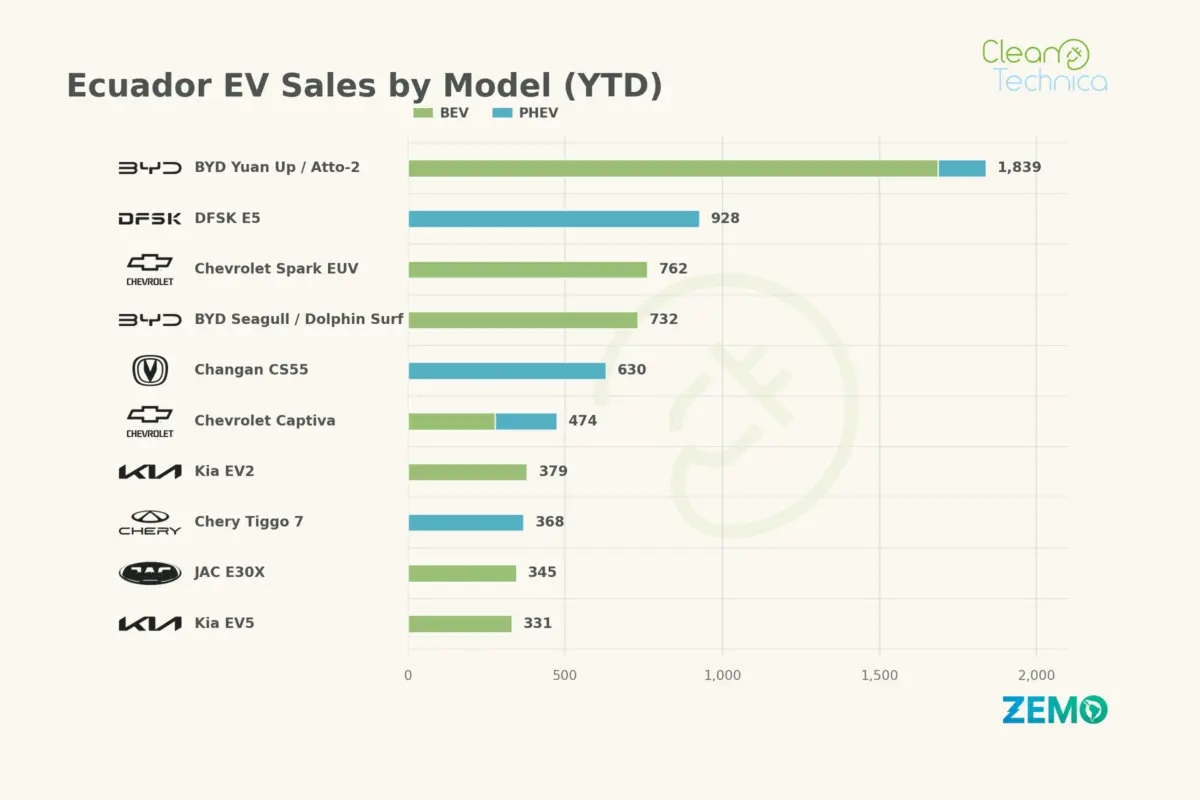
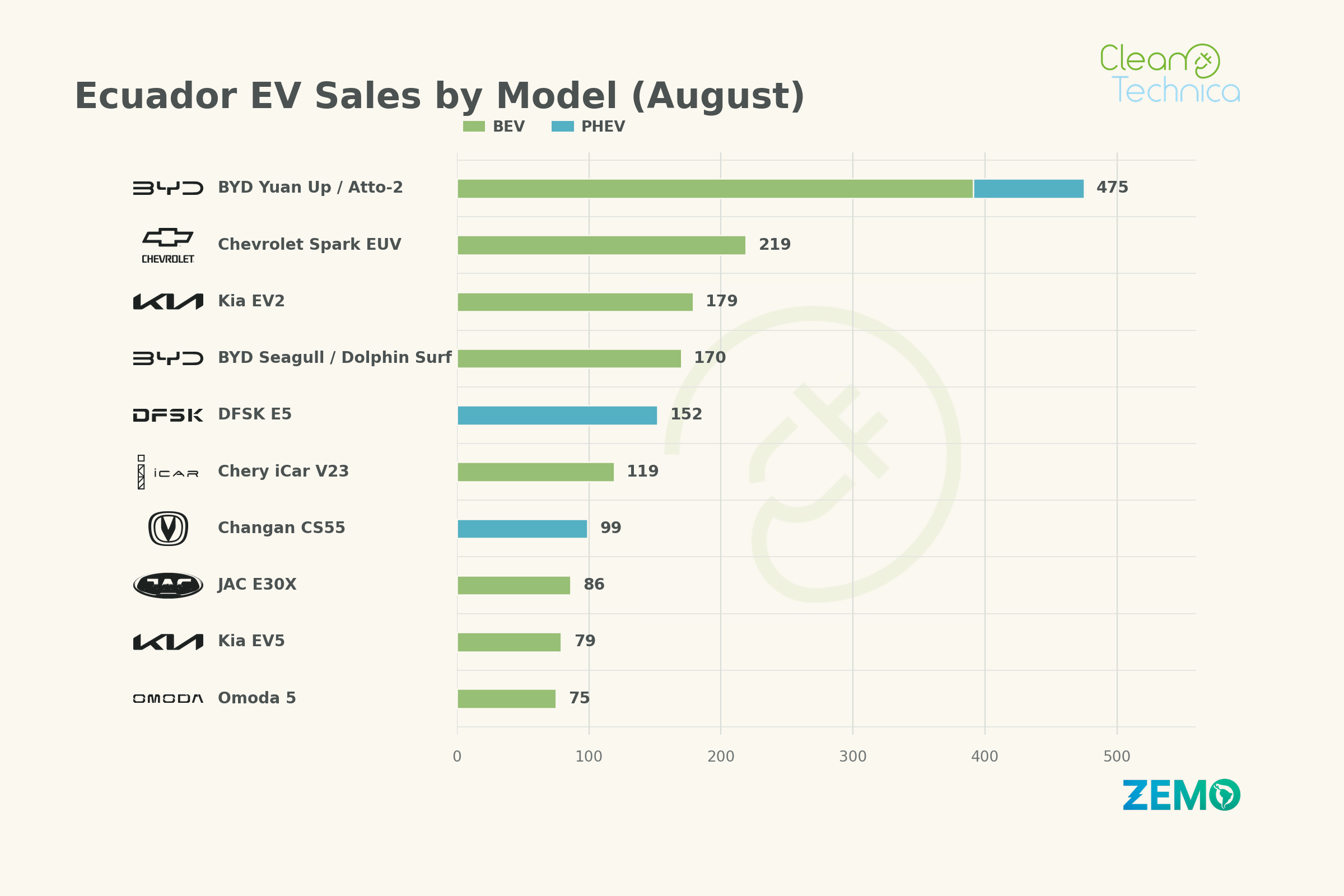
- Brand Rankings: BYD continues to hold the leadership position year-to-date with roughly 30% of the market, though its historical monopoly has waned. General Motors’ Chevrolet brand has captured second place through strategically rebranded Chinese electric vehicles, while Dongfeng and DFSK maintain strong positions. Notably, Kia secured a top-five position year-to-date—and seventh place in monthly models—driven entirely by the rapid success of its European-manufactured EV2, despite it only being on sale for three months of the year.
- Model Rankings: The compact BYD Yuan Up commands the top spot on the sales charts, followed by the DFSK E5 plug-in hybrid SUV and the Chevrolet Spark EUV (derived from the Baojun Yep Plus architecture). The ultra-affordable BYD Seagull captures fourth position, flanked by offerings from Changan and Chery.
Official Responses and Policy Shifts
The acceleration of electric mobility in Ecuador cannot be viewed in isolation from macroeconomic policy and governmental intervention.
For years, successive administrations maintained heavy subsidies on fossil fuels, artificially depressing the cost of gasoline and diesel and dampening the economic incentive for consumers to switch to alternative powertrains. However, fiscal pressures and broader geopolitical shocks—including disruptions tied to international conflicts affecting global fuel markets—forced a decisive policy reversal. The government ultimately phased out broad gasoline and diesel subsidies, replacing them with targeted social assistance programs directed exclusively at essential operators, such as diesel bus and truck fleets.
This policy shift, paired with long-standing tariff exemptions and import tax reductions for zero-emission vehicles, effectively altered the total cost of ownership calculus for everyday drivers. With fossil-fuel refueling becoming markedly more expensive, the lower operational and maintenance costs of electric vehicles transformed from an environmental talking point into an undeniable economic imperative.
Implications for the Regional and Global Automotive Industry
Ecuador’s rapid ascent offers critical lessons for emerging markets worldwide, signaling broader shifts in international manufacturing competitiveness and vehicle utility.

The Rise of Affordable Global Alternatives: The Kia EV2
For years, the narrative surrounding affordable electric mobility was dominated almost exclusively by Chinese automakers. However, the unexpected success of the Kia EV2 in Ecuador challenges this paradigm.
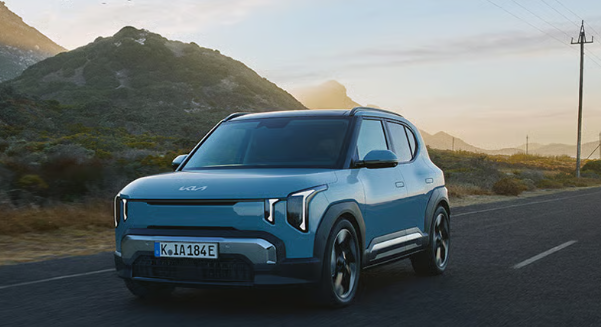
Produced in Slovakia, the EV2 represents one of the first European-manufactured electric vehicles to hit Latin American markets at a commercially viable price point. Retailing at approximately $23,000, the compact crossover matches the pricing of competing Chinese models like the BYD Yuan Up while offering comparable range and packaging, despite utilizing a slightly smaller battery and a shorter wheelbase.

Industry analysts note that while certain components—such as the vehicle’s battery cells—may be sourced from Asian supply chains, the successful delivery of a competitively priced European-engineered EV demonstrates that legacy global automakers can scale down costs and mount a credible challenge to Chinese market dominance if they commit to the segment.
Expanding the Envelope: The Chery iCar V23
Equally transformative is the introduction of lifestyle- and utility-focused electric vehicles tailored to rugged environments. The arrival of the Chery iCar V23 (sometimes styled as the iCaur V23) signals the breaching of the last stronghold of internal combustion engines: affordable, rugged off-roaders designed for rural and unpaved terrain.
Priced competitively alongside legacy internal combustion 4x4s like the Suzuki Jimny at around $28,000, the iCar V23 targets consumers in rural regions, the Andes, and areas with underdeveloped infrastructure. While questions remain regarding its real-world energy efficiency—preliminary specifications suggest an unusually high energy consumption paired with an 81 kWh battery pack under optimistic testing cycles—its form factor and pricing structure illustrate the expanding versatility of modern EV platforms.
Conclusion
Ecuador’s transition from an automotive laggard to a vibrant electromobility hub highlights how rapidly consumer markets can pivot when economic alignment, targeted taxation policy, and affordable product availability converge.

What began as a marginal niche three years ago has matured into a dynamic, increasingly competitive marketplace closing in on a 20% adoption rate. As global manufacturers introduce specialized models tailored to diverse regional needs—from European urban crossovers to rugged Andean off-roaders—Ecuador’s EV revolution serves as a blueprint for developing nations navigating the global energy transition. If neighboring countries fail to accelerate their own timelines, Colombia may soon find itself relinquishing its regional standing to this unexpected Andean powerhouse.
