

OXFORD — In a discovery that upends decades of conventional planetary science, researchers at the University of Oxford have uncovered compelling evidence that Mars once harbored massive, highly evolved magmatic systems deep within its interior. Published in the prestigious journal Nature Astronomy, the findings reveal that the Red Planet managed to orchestrate complex geological recycling processes typically associated exclusively with Earth—all without the aid of plate tectonics.
For generations, scientists categorized Mars as a "stagnant lid" world. Unlike our dynamic home planet, whose outer shell is fractured into constantly shifting tectonic plates that drive volcanism and forge continents, Mars possesses a unified, immobile crust. Because of this architectural simplicity, planetologists long assumed that Martian geological history was similarly straightforward, limited to basic volcanic outpourings and static cooling.
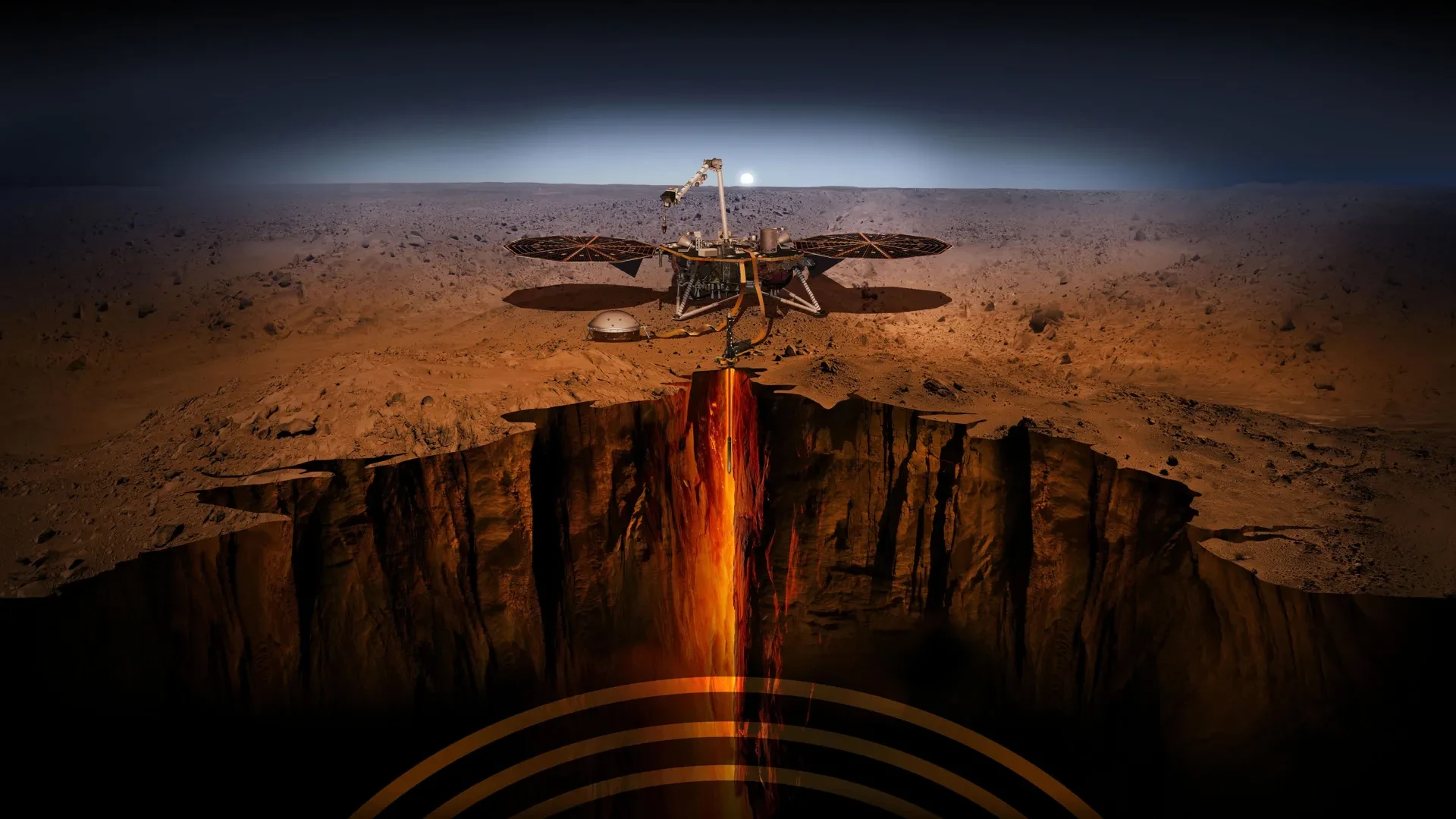
The new study shatters that paradigm. By deploying advanced statistical models to parse seismic data harvested by NASA’s retired InSight lander, the research team identified a mysterious subterranean boundary situated roughly 24 kilometers beneath the Martian surface. This boundary marks a profound transition in rock composition, pointing to the existence of an ancient, planet-spanning magmatic system that rivaled Earth’s in its complexity.
The implications of this discovery stretch far beyond the red dust of Mars. By demonstrating that complex crustal recycling can occur on a stagnant-lid world, the findings suggest that the prerequisites for planetary habitability may be far more common across the cosmos than previously believed.
Chronology of a Breakthrough: From InSight Data to Subterranean Discovery
The roadmap to this paradigm-shifting discovery began years before the final data crunching, rooted in the engineering triumphs and quiet listening of NASA’s InSight mission.
2018: InSight Listens to the Heartbeat of Mars
In November 2018, NASA’s InSight (Interior Exploration using Seismic Investigations, Geodesy and Heat Transport) lander touched down smoothly on the equatorial plain of Elysium Planitia. Its primary mission was singular and unprecedented: to place the first high-sensitivity seismometer directly onto the Martian surface.
For four Earth years, the Seismic Experiment for Interior Structure (SEIS) instrument sat vigil, recording the subtle tremors of the Martian interior. InSight captured thousands of seismic events, ranging from low-frequency marsquakes generated by tectonic stresses cooling the shrinking planet to violent high-frequency waves hurled across the globe by dramatic meteoroid impacts.
Unlocking the 24-Kilometer Mystery
Among the data packets beamed back to Earth was a peculiar, sharply defined seismic boundary sitting uniformly at a depth of approximately 24 kilometers. While earlier analyses by the InSight science team noted this structural transition within the upper crust, its physical meaning remained an enigma. Was it simply an ancient impact basin floor? Did it represent a shift in cooling rates, or something fundamentally more profound?
To answer this, researchers from Oxford’s Departments of Earth Sciences and Statistics formed a cross-disciplinary alliance. They recognized that raw seismic velocities—the speed at which shockwaves travel through rock—are intimately tied to mineralogy, temperature, and pressure.
Thermodynamic Modeling and Statistical Rigor
Rather than relying on single-variable guesses, the Oxford team constructed a massive computational matrix. They paired sophisticated thermodynamic rock-physics modeling with rigorous statistical algorithms, comparing the InSight seismic signatures against hundreds of theoretical mineral compositions.
By testing how different rocks would behave under the precise temperature and pressure regimes found at various depths beneath Mars, the team managed to isolate the exact chemical makeup required to produce the seismic velocities observed by InSight.
The results were startling. Below the 24-kilometer mark, the seismic profile matched "ultramafic" rocks—dense materials packed with iron and magnesium, but severely starved of silica. Above that boundary, however, the rocks shifted decisively toward a "mafic" composition, boasting a distinctly higher proportion of silica and lighter chemical constituents.
Supporting Data: Decoding the Subsurface Anatomy of Mars
The revelation of a silica-rich upper layer resting atop an iron-and-magnesium-heavy lower layer tells a dramatic story of ancient planetary alchemy.
+--------------------------------------------------------+
|              MARTIAN CRUSTAL STRATIGRAPHY              |
+--------------------------------------------------------+
| 0 km  - Surface                                        |
|       |                                                |
|       | MAFIC ROCKS (Silica-rich, lighter minerals)    |
|       |                                                |
| 24 km - The Oxford Boundary (Seismic Discontinuity)    |
|       |                                                |
|       | ULTRAMAFIC ROCKS (Iron/Magnesium-rich, dense)  |
|       |                                                |
+--------------------------------------------------------+
According to the study, this stratified architecture is the direct footprint of extensive internal differentiation—a process geologists call fractional crystallization operating on a grand, planetary scale.
The Engine of Transcrustal Magmatism
In the deep past, immense pools of molten rock (magma) stalled deep within the Martian crust. As these colossal magma reservoirs slowly cooled over millions of years, minerals with higher melting points—specifically dense crystals rich in iron and magnesium—precipitated out and sank toward the bottom of the chamber, forming the ultramafic layer identified below the 24-kilometer boundary.
Concurrently, the remaining melt, enriched in silica and lighter chemical elements, became buoyant and migrated upward. This chemically evolved magma accumulated in massive systems throughout the upper crust.
On Earth, this exact type of multi-tiered magmatic processing is intimately linked to the formation of continental crust, typically occurring in subduction zones and beneath volcanic arcs where plates collide and melt. For Mars to replicate this type of internal chemical refining without the conveyor belt of plate tectonics forces geologists to rethink how planets concentrate rare elements and build complex upper crusts.
Furthermore, the geographical scale of this phenomenon is staggering. The seismic and compositional data suggest that this buried layer is not a localized anomaly; it potentially extends across hundreds, if not thousands, of kilometers, particularly dominating the vast northern lowlands of Mars. This indicates that ancient Mars was not merely peppered with simple, isolated shield volcanoes like Olympus Mons, but was instead energized by interconnected, planet-spanning magmatic complexes—a phenomenon known as transcrustal magmatism.
Official Responses and Expert Perspectives
The publication in Nature Astronomy has sent ripples through the international planetary science community, prompting enthusiastic responses from researchers who see the study as a milestone in comparative planetology.
Dr. Tobermory Mackay-Champion, lead author of the study—who conducted the research while at the University of Oxford’s Department of Earth Sciences and has since moved to the University of Bristol—emphasized how thoroughly the findings challenge historical assumptions.
"We’ve traditionally assumed that volcanism on Mars was relatively simple compared to that on Earth," Dr. Mackay-Champion explained. "Our models show that Mars was capable of sustaining large, long-lived magmatic systems where molten rock evolved and reprocessed itself throughout the entire crust. This raises exciting possibilities for how common such complex evolutionary systems might be on rocky planets throughout the broader cosmos."
Co-author Professor Jon Wade, also from the Department of Oxford’s Earth Sciences division, contextualized the discovery within the grander quest to understand Earth’s uniqueness in the universe.
"One of the big questions in planetary science is whether Earth is unique," Professor Wade noted. "If Mars could develop this kind of complex crust without plate tectonics, then maybe the environmental conditions needed for habitability can emerge on a much wider variety of planets than we previously realized—including rocky worlds that were previously dismissed due to their small size or apparent lack of tectonic activity."
Independent researchers have similarly praised the clever synthesis of InSight data with thermodynamics. By bridging the gap between raw geophysics and petrology, the Oxford-led team has demonstrated the immense scientific value of long-term landed missions, proving that seismic echoes from marsquakes can unlock secrets hidden deep beneath alien soils.
Broader Implications: Redefining Planetary Habitability
To understand why a 24-kilometer-deep boundary of iron-rich rock matters to the search for extraterrestrial life, one must look at how planets cycle the elements necessary for biology.
The Mechanics of Habitability
On Earth, plate tectonics serves as the ultimate planetary recycling machine. It drags surface materials down into the fiery mantle, where they melt, mix, and are subsequently regurgitated back onto the surface via volcanism. This perpetual churning does more than just build continents; it acts as a planetary thermostat. It regulates atmospheric carbon dioxide, stabilizes global climates, and cycles water and volatile elements—such as sulfur, nitrogen, and phosphorus—that are vital for carbon-based life.
Because plate tectonics drives this life-sustaining cycle on Earth, astrobiologists have long maintained a strict bias: to find a truly habitable rocky world elsewhere in the universe, one should look for a planet exhibiting active plate tectonics. Planets lacking this dynamic engine were often written off as cold, dead, and geochemically sterile "stagnant lid" worlds.
Mars Breaks the Mold
The Oxford study directly challenges this dogmatic view. By proving that Mars achieved sophisticated crustal evolution and large-scale magmatic recycling without plate tectonics, the research demonstrates that alternative pathways to geological complexity exist.
If a stagnant-lid planet can cook, differentiate, and reprocess its crust through internal magmatic plumbing alone, it opens the door to a broader suite of geochemical environments. These processes could have successfully outgassed greenhouse gases, created localized hydrothermal systems, and concentrated vital nutrients on early Mars for long enough to nurture prebiotic chemistry or primitive microbial life.
Beyond Our Solar System
The implications scale up exponentially when applied to exoplanetology. As space telescopes like NASA’s James Webb Space Telescope (JWST) and future direct-imaging missions characterize the atmospheres and surfaces of rocky exoplanets orbiting distant stars, scientists will increasingly look for signs of geological activity.
Many of these alien worlds will be too massive or too distant to support Earth-style plate tectonics, or they may possess single-plate stagnant lids due to different water inventories or mantle temperatures. The Martian precedent proves that a lack of tectonic plates does not preclude a rich, complex interior life. Worlds that were once dismissed as evolutionary dead ends may, upon closer inspection, harbor the complex mineralogical foundations necessary to support life, fundamentally expanding the boundaries of the habitable zone across the galaxy.
