

Main Facts
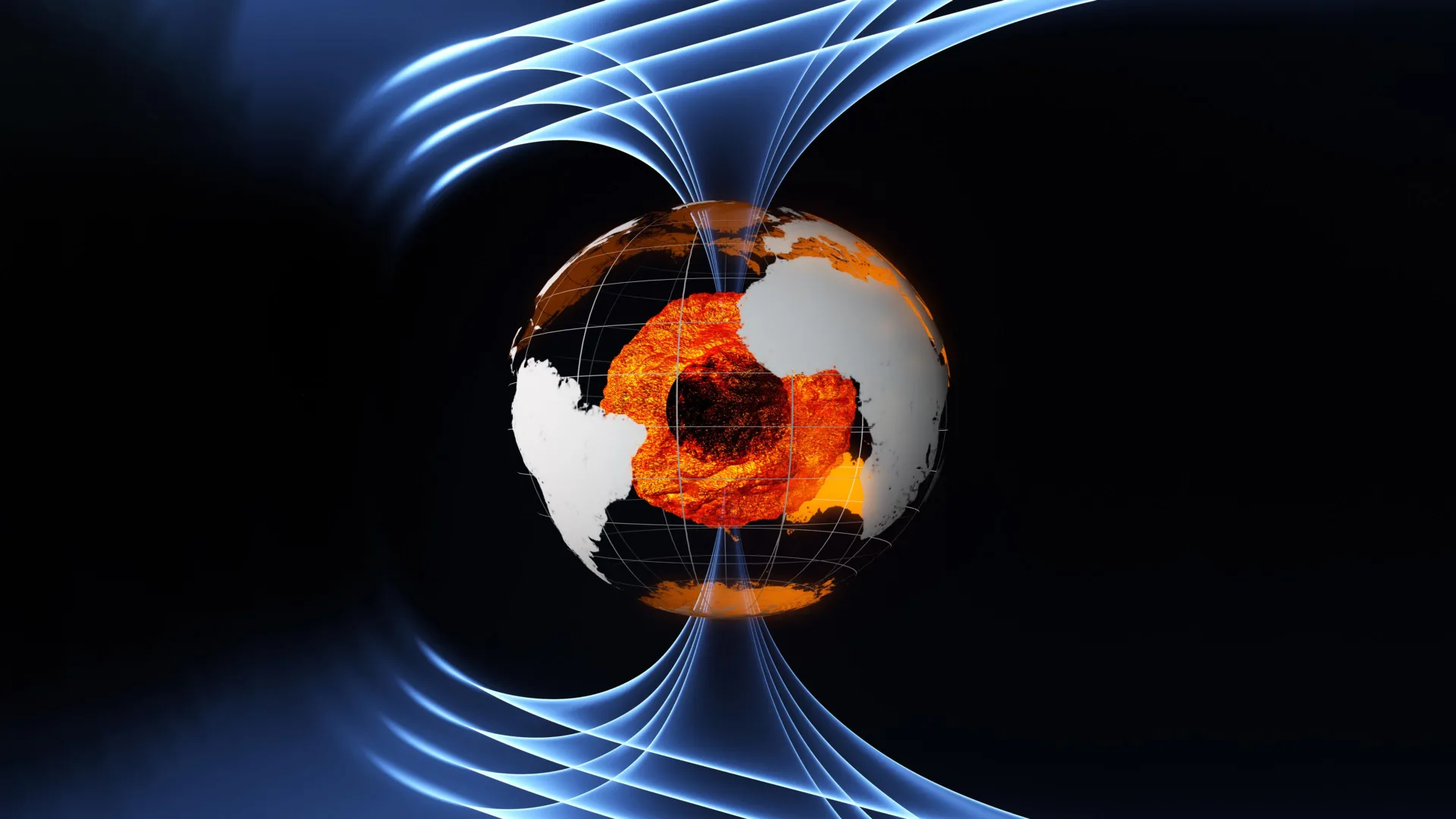
Deep beneath the Pacific Ocean, roughly 2,200 kilometers (1,367 miles) below the Earth’s surface, a massive, hidden river of liquid iron has abruptly changed course. For generations, geophysicists believed that the convective currents of molten metal driving our planet’s magnetic field followed a relatively stable, predictable routine, characterized primarily by a slow, creeping westward drift. However, a groundbreaking study published in the Journal of Studies of Earth’s Deep Interior reveals that in 2010, a vast region of electrically conducting fluid beneath the equatorial Pacific underwent a violent and unexpected reversal, shifting from a weak westward flow into a powerful eastward stream.
This startling geological event challenges long-held assumptions about the stability and dynamics of Earth’s outer core. Rather than acting as a sluggish, uniform engine, the core appears capable of rapid, turbulent fluctuations that can alter planetary-scale fluid dynamics within a single decade. The discovery was made possible by combining nearly three decades of ground-based magnetic observations with cutting-edge spaceborne data captured by a constellation of international satellites, most notably the European Space Agency’s (ESA) advanced Swarm mission.
The implications of this discovery stretch far beyond theoretical geophysics. The fluid motions within the outer core are responsible for generating the geomagnetic field—the invisible shield that deflects dangerous solar radiation and protects Earth’s atmosphere. Understanding how and why these deep currents shift is crucial not only for mapping the inner workings of our planet but also for improving navigational systems, safeguarding satellite operations, and comprehending the complex space weather that impacts modern technological infrastructure.
Chronology of the Discovery
Tracing the invisible movements of a fluid layer buried beneath thousands of kilometers of rock and mantle requires a meticulous synthesis of historical and modern datasets. The timeline of this scientific breakthrough spans decades of technological advancement in both ground-based monitoring and space exploration.
- 1997–2010 (The Baseline Era): For decades, scientists studying localized variations in Earth’s magnetic field deduced that the vast majority of the outer core’s circulation moved in a westward direction. Ground-based magnetic observatories, supplemented by early-generation satellite missions such as Denmark’s Ørsted mission (launched in 1999) and Germany’s CHAMP mission (launched in 2000), provided continuous monitoring of the planet’s magnetic signature, painting a picture of a largely stable, albeit slowly evolving, geodynamo system.
- 2010 (The Turning Point): Without warning, a broad region of iron-rich fluid situated deep beneath the equatorial Pacific Ocean broke from historical norms. Instead of continuing its weak westward drift, the molten material accelerated dramatically, adopting a powerful eastward trajectory. Because this shift occurred entirely out of sight, it went undetected in real-time, only to be uncovered later through retrospective data analysis.
- 2013 (The Arrival of Swarm): ESA launched its three-satellite Swarm constellation into carefully coordinated polar orbits. Equipped with ultra-sensitive magnetometers, the Swarm trio began providing unprecedented spatial and temporal resolution of Earth’s magnetic field, allowing researchers to isolate magnetic signals originating specifically from the core-mantle boundary from those generated by the crust, ionosphere, and magnetosphere.
- 2017 (The Geomagnetic Jerk): The dynamic activity within the core manifested near the surface as a "geomagnetic jerk"—a sudden, sharp change in the secular acceleration of Earth’s magnetic field. This surface anomaly provided researchers with a crucial breadcrumb, prompting deeper investigations into the fluid dynamics occurring at the base of the mantle.
- 2020 (Peak and Subsequent Decline): According to the newly published research models, the powerful eastward flow beneath the Pacific reached its peak intensity around 2020 before beginning a noticeable deceleration. This sudden slowing has raised new questions about whether the 2010 reversal was merely a transient fluctuation, part of a repeating multi-decadal oscillation, or the establishment of an entirely new core circulation regime.
- 1997–2025 (The Comprehensive Study Period): By integrating historical data from the Ørsted and CHAMP missions with the continuous, high-precision streams of the ESA Swarm and CryoSat missions, researchers successfully reconstructed a comprehensive 28-year timeline of core dynamics, ultimately publishing their findings to unveil the Pacific reversal to the global scientific community.
Supporting Data and Observational Methodology
Observing the interior of the Earth presents a monumental technological challenge. Direct sampling is impossible; the deepest scientific drilling project ever attempted, the Kola Superdeep Borehole in Russia, reached a mere 12.2 kilometers into the crust—not even a fraction of the distance required to pierce the mantle, let alone reach the outer core. Instead, scientists must act as planetary detectives, reading the faint magnetic whispers escaping from the deep interior.
The research team relied on an intricate combination of space-based and ground-based data collected between 1997 and 2025. The core of this dataset came from ESA’s Swarm mission, supplemented by the older Ørsted and CHAMP spacecraft, alongside CryoSat data and global network ground observatories.
The three Swarm satellites, orbiting in tandem, act as a high-precision magnetic laboratory in space. Because the magnetic field generated by the liquid outer core is superimposed over magnetic signals originating from Earth’s magnetized crust, electrical currents in the ionosphere, and interactions with the solar wind in the magnetosphere, separating the core signal requires exceptional engineering. The Swarm constellation’s synchronized orbits and sensitive vector magnetometers allow scientists to filter out external and crustal noise, leaving a pristine view of the magnetic fluctuations born at the core-mantle boundary.
Through this multi-satellite approach, researchers detected wave-like accelerations and rapidly shifting flow structures that would have been completely obscured within the noisier confines of ground-only datasets. The data revealed that the convective churning of liquid iron—a dense soup of molten metal kept at extreme temperatures and pressures—can generate localized jets and accelerations capable of shifting hemispheric flow patterns in a geological blink of an eye.
Furthermore, the data analysis highlighted a fascinating correlation: the sudden spike in eastward flow beneath the Pacific neatly coincided with behavioral shifts observed in Earth’s solid inner core, as inferred through advanced geodesy and seismological studies. This suggests that the outer core and inner core do not operate in isolation, but are instead locked in a complex, dynamic feedback loop.
Official Responses and Expert Insights
The study has sent ripples through the international geophysics community, prompting leading researchers and space agency officials to re-evaluate existing models of planetary interiors.
Frederik Dahl Madsen of the University of Edinburgh’s School of Geosciences, who served as the lead author of the study, emphasized the profound questions raised by the discovery.
"The large-scale flow reversal beneath the Pacific raises new questions about the behavior of Earth’s deep interior," Madsen stated. "Scientists now want to understand whether the reversal represents a short-lived fluctuation, part of a repeating oscillation, or a new stable equilibrium for core circulation. Continued monitoring will be essential to determine how the flow evolves over the coming years."
Addressing the broader implications of deep-Earth connectivity, Madsen noted that the timing of the Pacific flow anomaly corresponds directly with changes in the inner core.
"The rise of the strong eastward flow in the Pacific is contemporary with a change in behavior in the inner core, as inferred from geodesy and seismology, and we hypothesize that these changes in the deep interior are associated with the changes in flow beneath the Pacific," he added.
From the perspective of mission management, ESA officials highlighted the indispensable role that long-duration satellite monitoring plays in uncovering planetary-scale phenomena that would otherwise remain entirely hidden.
Anja Stromme, ESA’s Swarm Mission Manager, pointed out that while the satellites were launched shortly after the dramatic reversal event of 2010, their continuous data streams have proven vital for understanding the aftermath and tracking core evolution.
"Although Swarm was launched after the dramatic reversal event of 2010, it has provided high-precision data that tell us about Earth’s inner core in the period that followed," Stromme explained. "Importantly, Swarm provides continuous global coverage over many years, allowing scientists to track how core dynamics evolve over time rather than relying only on ground-based magnetic observatories. Long-duration satellite magnetic measurements allow researchers to follow changes in the geodynamo in near-real-time and improve models of Earth’s magnetic field evolution. Future missions such as Swarm will play a crucial role."
Elisabetta Iorfida, ESA’s Swarm Mission Scientist, underscored how the findings challenge orthodox geological theories regarding outer core stability.
"This study shows that regional changes can emerge rapidly within just a decade," Iorfida observed. "The findings may also help scientists investigate possible interactions between Earth’s outer core, inner core, lower mantle and, therefore, give more insights into core-mantle boundary, which is a critical region for the deep Earth dynamics."
Iorfida concluded that spaceborne observation has fundamentally changed our relationship with the planet’s deep interior.
"This research raises intriguing questions about how Earth’s deepest layers are dynamically connected. As the magnetic field continues to evolve, satellite missions are providing an increasingly detailed view of the dynamic processes unfolding deep inside our planet, revealing that Earth’s core may be far more variable and complex than once believed."
Implications for Science and Society
While the violent churning of liquid iron thousands of kilometers beneath our feet poses no direct physical threat to human life, property, or surface climate systems, the broader implications of understanding Earth’s core dynamics are profound.
The Planetary Shield
At the heart of the matter is the geodynamo—the self-sustaining mechanism wherein thermal convection and the Coriolis effect turn Earth’s outer core into a planetary-scale dynamo. This moving liquid metal generates the geomagnetic field, which extends far out into space to form the magnetosphere. Without this invisible barrier, the solar wind—a relentless stream of high-energy charged particles streaming from the Sun—would strip away Earth’s atmosphere, erode our water supply, and render the surface uninhabitable. Tracking anomalies like the Pacific flow reversal helps scientists model how the geodynamo might fluctuate, weaken, or shift over geological and historical timescales.
Practical Applications and Space Weather
On a more immediate, practical level, Earth’s magnetic field is intimately tied to modern technology. Changes in core flow patterns influence secular variation—the gradual drifting of the magnetic poles and local distortions in the magnetic field strength. These shifts directly impact:
- Navigation Systems: Commercial aviation, maritime shipping, and military operations rely on accurate magnetic models (such as the World Magnetic Model) to calibrate compasses and navigation systems. Unpredicted surges in core dynamics can accelerate the drift of the magnetic north pole, requiring more frequent updates to global navigation grids.
- Satellite Operations: Satellites operating in low-Earth orbit are sensitive to variations in the magnetosphere and ionosphere, which are modulated by the core’s magnetic field. Understanding core dynamics improves space weather forecasting, helping operators protect critical communication and earth-observation satellites from solar radiation storms.
- Geophysical Research: The boundary between the liquid outer core and the solid lower mantle is one of the most chemically and thermally active regions on Earth. Insights gained from surface magnetic anomalies allow seismologists and geodynamicists to probe this boundary with unprecedented fidelity, shedding light on mantle plumes, plate tectonics, and deep-Earth thermal convection.
A New Paradigm for Earth Sciences
Ultimately, the discovery of the Pacific flow reversal marks a paradigm shift in how geophysicists view the deep Earth. The old assumption of a slow, unchanging, predominantly westward conveyor belt has been decisively shattered by satellite-era precision. Earth’s core is revealed to be a turbulent, responsive, and highly dynamic realm—a restless engine whose inner workings continue to surprise scientists, proving that even after centuries of scientific inquiry, our home planet still holds profound and unexpected secrets just beneath its crust.
