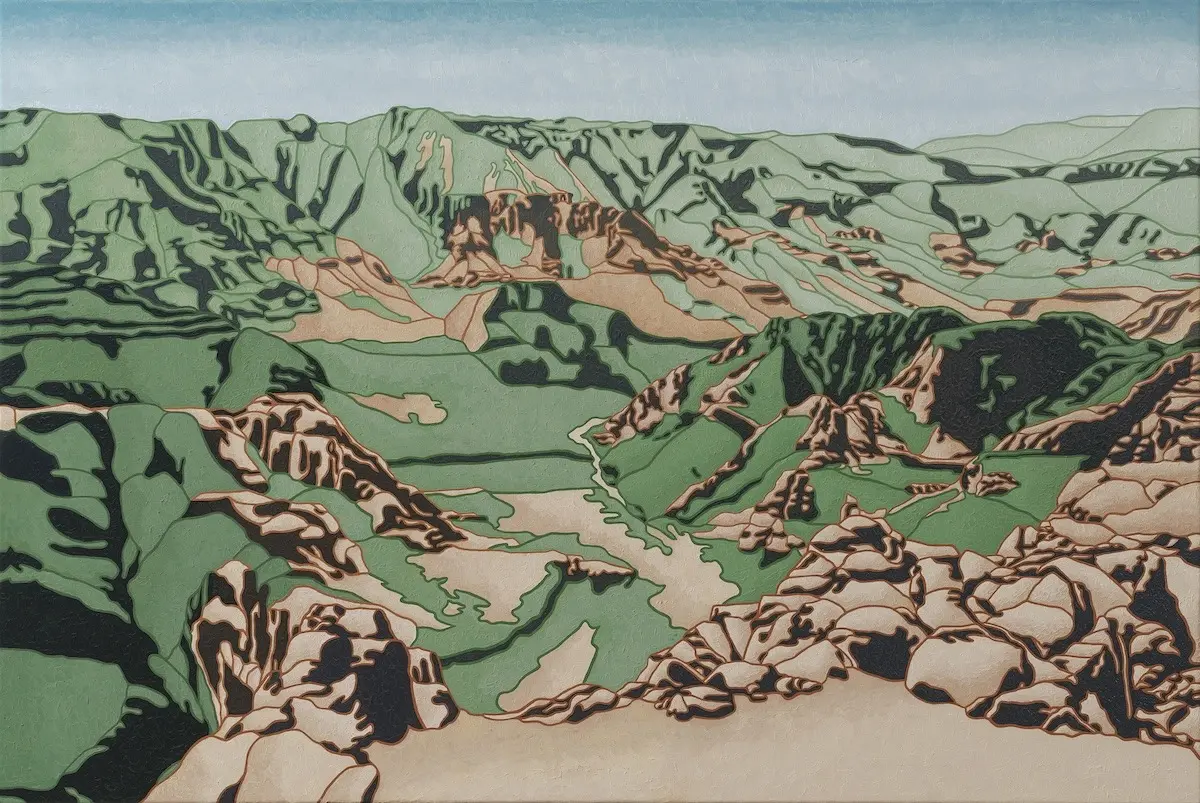
Arizona-based landscape artist Carson Bilger is redefining how contemporary viewers experience the American West through a distinctive artistic vocabulary that merges rigorous planar analysis with a bold, graphic aesthetic. Rather than striving for hyper-realistic replication, Bilger deconstructs sprawling vistas into three-dimensional geometric forms, ultimately rebuilding them as a mosaic of flat planes. This signature methodology allows structural integrity, light, and shadow to emerge from the canvas with the ethereal quality of a faded memory.
A master’s degree in illustration heavily informs Bilger’s artistic perspective, lending his work a precise graphic sensibility where calculated lines guide the viewer’s eye, and sophisticated color harmonies establish the narrative of the scene. His creative process bridges reality and imagination, beginning with on-the-go travel, photographic documentation, and ballpoint pen sketches, and culminating in expansive, richly textured oil paintings.
Represented by the esteemed Western Gallery and frequently featured in prominent publications like Southwest Art magazine, Bilger explores profound philosophical questions surrounding human perception, time, and memory. His work challenges the notion that a landscape is a static, singular entity. Instead, his canvases invite viewers to ponder how environmental context, shifting vantage points, and temporal changes drastically alter our interpretation of physical space.
Chronology: The Evolution of Bilger’s Artistic Process
The trajectory of Carson Bilger’s career is marked by a steady refinement of technical skill, conceptual depth, and scale. Understanding how his creative practice has evolved reveals the deliberate steps behind his mesmerizing canvases.
Formative Years and Academic Foundation
Long before developing his current style, Bilger immersed himself in the principles of visual storytelling, culminating in the pursuit and completion of a master’s degree in illustration. This academic training proved pivotal. While many fine artists shy away from heavy graphic structures, Bilger embraced them. His foundational studies taught him how to orchestrate visual weight, direct the human eye across a two-dimensional surface, and prioritize spatial hierarchy. This background laid the groundwork for his unique fusion of fine art painting and graphic design principles.
The Development of Planar Analysis
As Bilger spent more time painting the expansive and complex landscapes of the American West, he sought a method to tame their overwhelming scale. He began experimenting with planar analysis—a technique borrowed from industrial design and figure drawing wherein complex, organic forms are broken down into simpler, interconnected geometric facets. Over the years, this process matured. Bilger notes that his methods gradually adapted to become increasingly accurate representations of the vivid visions held within his mind, transforming chaotic natural vistas into ordered, structured compositions.
Transitioning from Small Studies to Monumental Canvases
Bilger’s workflow follows a strict chronological progression from raw observation to finished gallery piece:
Field Documentation: The process invariably begins out in the field, utilizing travel and photography to capture the initial essence of an actual experience and place.
Ideation and Sketching: Back in the studio, Bilger selects compelling compositions, translates his ideas into quick ballpoint pen sketches, and maps out value structures in his sketchbook.
Preparatory Studies: Historically, Bilger relied primarily on watercolor for his preparatory works. However, as the physical scale of his finished paintings expanded, he transitioned to acrylics. This medium shift provided him with a truer, more immediate sense of color relationships before committing to oil on canvas.
Final Execution: The journey concludes with large-scale oil paintings—such as the 32-by-48-inch Ease the Mind and the expansive 36-by-72-inch It Would Never End—where thick layers of paint, textural brushwork, and meticulous blending bring the vision to life.
Supporting Data: Dimensions, Mediums, and Technical Framework
To fully appreciate Carson Bilger’s artistry, one must examine the structural data, technical parameters, and material choices that govern his studio practice.
Scale and Medium Specifications
Primary Medium: Oil on canvas, favored for its malleability, depth, and ability to hold rich textural brushstrokes.
Preparatory Medium: Acrylic paint (transitioned from watercolor to better gauge color accuracy for larger pieces) and ballpoint pen.
Notable Works and Dimensions:
Ease the Mind: Oil on canvas, 32 x 48 inches.
It Would Never End: Oil on canvas, 36 x 72 inches.
Bilger relies on a structured, multi-step technical framework when translating a three-dimensional landscape into a two-dimensional format:
Spatial Hierarchy: This is the primary consideration in Bilger’s creative assessment. He meticulously calculates how individual topographical sections recede into the distance to cleanly define the horizon line.
Light and Color Balancing: Once the spatial structure is established, Bilger analyzes how light interacts with the terrain. He pays close attention to how sharp shadows contrast against the natural colors of the landscape, and how atmospheric perspective washes out distant tones.
Contained Abstraction: At close range, Bilger’s canvases reveal a surprising level of micro-detail. Through deliberate blending, thick paint application, and textural brushstrokes, he creates "contained abstraction" within individual geometric shapes. This ensures that every inch of the canvas functions as a distinct, miniature composition when viewed up close.
Official Responses and Artist Statements
Carson Bilger’s philosophy is deeply intertwined with his artistic output. Through numerous reflections on his own practice, the artist has articulated the core drivers behind his creative journey.
On the Translation of Memory and Vision
Addressing how his internal concepts manifest on canvas, Bilger reflects on the organic nature of his technique:
"Over the years, my process developed so that the paintings became increasingly more accurate representations of the visions in my mind."
He notes that planar analysis feels entirely intuitive when drawing, offering a logical solution to the daunting task of converting sprawling, multifaceted landscapes into flat art:
"The approach feels natural when drawing and logical when trying to create something flat out of sprawling and complex landscapes."
On Paradox and Perception
Bilger is profoundly influenced by the psychological aspects of spatial perception—specifically how two people can stand in the exact same geographic location and walk away with entirely different experiences based on time, weather, context, and personal vantage point. This phenomenon drives his broader philosophical inquiries:
"It speaks to an idea that I have been contemplating, which is that things that are diametrically opposed can coexist."
This perspective manifests visually in his work, proving that a singular landscape can simultaneously feel familiar and foreign, structured and organic, concrete and ephemeral.
On Engaging the Viewer
Bilger’s ultimate goal is to craft artworks capable of commanding a viewer’s sustained attention. By treating his lines as narrative elements, he constructs multiple visual entry points across the surface of the canvas. Explaining the micro-architecture of his brushwork, he notes:
"I’m trying to create a sort of contained abstraction within each individual shape. This way when the piece is viewed up close, the viewer can see the little, singular compositions that make up the whole."
Implications: The Future of Contemporary Western Landscape Art
Carson Bilger’s innovative approach carries significant implications for the broader genre of Western landscape painting and contemporary fine art as a whole.
Bridging Traditionalism and Modernism
For decades, Western landscape art has frequently leaned toward either romanticized realism or stark minimalism. Bilger bridges this historical divide by injecting a thoroughly modern, graphic sensibility into traditional subject matter. By utilizing planar analysis, he strips away the superficial busyness of nature, forcing the viewer to confront the underlying geometry of the earth. This style appeals to contemporary collectors who appreciate both classical craftsmanship and avant-garde structural abstraction.
Redefining Spatial Engagement in the Digital Age
In an era dominated by fast-paced digital imagery and short attention spans, Bilger’s canvases offer a deliberate antidote. By designing works that require extended viewing—rewarding the observer with hidden micro-compositions upon closer inspection—he champions a slower, more meditative mode of art appreciation. His paintings remind us that looking at art is an active, investigative process rather than a passive visual consumption.
Expanding the Philosophical Boundaries of Art
Ultimately, Bilger’s exploration of memory, perception, and coexistence elevates landscape art from mere topographical documentation to conceptual philosophy. When viewers gaze upon works like Ease the Mind or It Would Never End, they are not just looking at mountains, valleys, and skies; they are witnessing a visual manifestation of how the human mind processes experience, time, and space. As Bilger continues to exhibit through premier institutions like Western Gallery, his work stands as enduring proof that a place can remain fundamentally the same while offering infinite, shifting perspectives.