

By Global Science Correspondent
Scientists have unlocked a critical piece of one of geology’s most enduring puzzles: why volcanoes with seemingly identical chemical compositions can erupt in radically different ways. For decades, volcanologists have grappled with the unpredictable nature of subterranean magma chambers, where two neighboring vents or subsequent eruptions from the same system can oscillate wildly between effusive, slow-moving lava flows and explosive, high-altitude lava fountains.
Now, an international research team led by The University of Manchester has identified a heat-driven process deep within the Earth’s crust that changes our fundamental understanding of how magma behaves. Published in the prestigious journal Nature Communications, the study points to a phenomenon known as "superheating"—a state where magma becomes significantly hotter than the temperature threshold required for mineral crystals to remain stable. This intense thermal spike, researchers discovered, can effectively wipe the slate clean of microscopic crystal "seeds," fundamentally altering the physical properties of the magma and stalling crystallization for hours as the molten rock rushes toward the surface.
The discovery bridges a major knowledge gap in volcanology. By demonstrating how a magma’s pre-eruptive thermal history dictates its viscosity, ascent speed, and gas retention, the findings offer new pathways for improving volcanic hazard assessments and eruption forecasting worldwide.
Main Facts: The Physics of Superheating and Magma Dynamics
At the heart of the new study is a sophisticated look at the microscopic architecture of magma. Magma is not a uniform liquid; rather, it is a complex, high-temperature slurry composed of silicate liquid, dissolved gases, and suspended mineral crystals. The presence, size, and abundance of these crystals—along with their growth rates—dictate how fluid or sluggish the magma becomes.
When magma undergoes superheating, two critical transformations occur at a microscopic level:
- Dissolution of Crystal Seeds: Extreme heat systematically dissolves tiny pre-existing crystals that would otherwise act as templates, or "seeds," for new mineral growth.
- Structural Reorganization: The intense thermal energy reorganizes the liquid silicate structure at a molecular scale, rendering the internal environment far less favorable for new crystals to nucleate and grow.
These microscopic alterations have macroscopic consequences. Without a network of crystals to thicken the mixture, the magma remains remarkably fluid and mobile. This low viscosity allows the molten rock to accelerate rapidly as it ascends through conduits in the Earth’s crust. Furthermore, the fluidity of the magma affects how easily dissolved volcanic gases can—or cannot—escape.
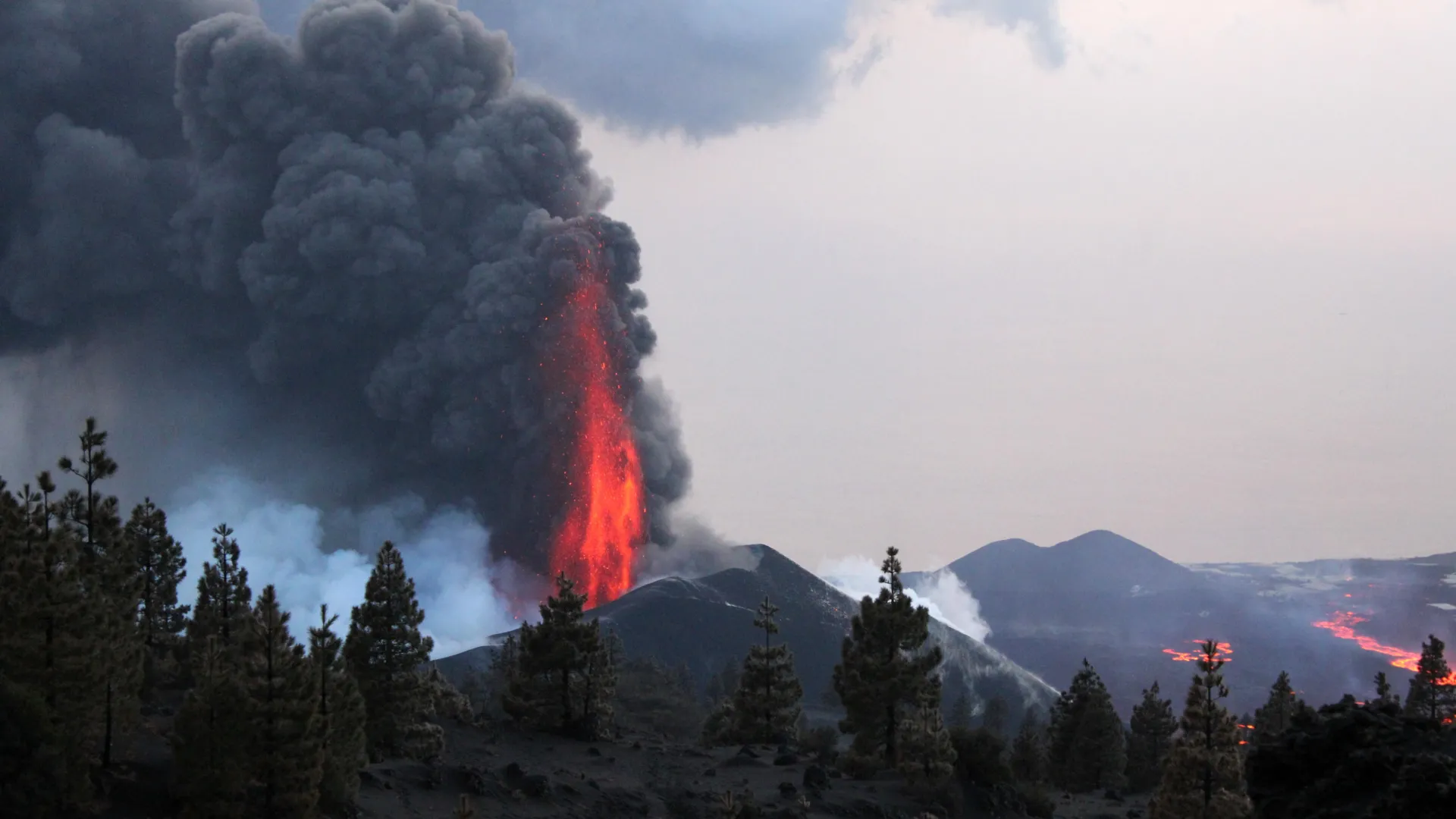
If magma remains fluid and rises swiftly, gases remain trapped under escalating pressure until they violently vent at the surface, fueling dramatic lava fountains. Conversely, if crystals form early, the magma thickens into a sluggish, viscous paste. This slow-moving sludge allows gases to steadily bleed off, typically resulting in a far more subdued, effusive eruption.
Chronology: From the 2021 Tajogaite Eruption to Breakthrough Lab Discoveries
The journey toward this scientific breakthrough spans from the slopes of a violently active Spanish island to some of the most advanced synchrotron facilities in Europe.
The 2021 La Palma Eruption
The investigation began in the wake of the devastating 2021 Tajogaite eruption on La Palma, Canary Islands. The eruption, which lasted for 85 days, provided volcanologists with an unprecedented bounty of fresh geological material. Researchers collected pristine samples of juvenile magma directly tied to the event, hypothesizing that these specific rocks had experienced intense thermal anomalies—such as injections of fresh, hotter basaltic magma into the reservoir—prior to and during their ascent through the crust.
Recreating the Subterranean Furnace
To test their hypotheses, the Manchester-led team sought to recreate the extreme conditions of a subterranean magma chamber in a controlled laboratory environment. This required cutting-edge technology capable of probing opaque, high-temperature liquids in real time.
At the Diamond Light Source—the UK’s national synchrotron science facility—the researchers employed high-speed synchrotron X-ray microtomography. Using a newly developed, X-ray transparent pressure vessel, the team was able to literally look inside the magma as it was subjected to simulated volcanic temperatures and pressures. They watched in real time as crystals dissolved, struggled to form, and altered the physical structure of the liquid.
Complementary ex-situ experiments were simultaneously conducted in Prague. These extended tests allowed scientists to monitor larger batches of magma samples over much longer temporal windows, ensuring that the short-term synchrotron observations aligned with prolonged physical processes.
The Eight-Hour Threshold
The experimental results yielded a stark contrast that stunned the research team. When standard magma samples—those that had not undergone superheating—were subjected to cooling and ascent conditions, they began forming new crystals in a mere 20 minutes.
In sharp contrast, magma samples that had experienced strong superheating exhibited a dramatic nucleation delay. Crystal formation was suppressed for more than eight hours.
Armed with these empirical measurements, the team integrated the data into advanced numerical models of magma ascent, mapping out how the delayed crystallization altered the journey of magma traveling upward through the Earth’s crust over a span of several miles.
Supporting Data: Experimental Metrics and Modeling Insights
The integration of laboratory observations with numerical simulations provided quantifiable metrics that tie thermal history directly to volcanic hazards.
| Experimental Parameter | Non-Superheated Magma | Superheated Magma |
|---|---|---|
| Onset of Crystallization | ~20 minutes | >8 hours |
| Magma Viscosity | High (thick, sluggish) | Low (fluid, mobile) |
| Ascent Speed | Moderate to slow | Rapid |
| Gas Release Potential | Gradual, efficient escape | Trapped, explosive potential |
| Primary Eruptive Style | Effusive lava flows | Dramatic lava fountains |
The numerical models demonstrated that a delay in crystallization exceeding eight hours acts as a mechanical catalyst. By maintaining low viscosity over prolonged vertical transport distances, the magma can surge upward at unprecedented velocities. This velocity profile prevents gases from diffusing out of the melt efficiently. When the magma finally breaches the surface, the sudden decompression of gas-rich, highly fluid material creates the spectacular jetting seen in explosive lava fountains.
On the other hand, when superheating is absent or minimal, the rapid generation of crystals within the first 20 minutes dramatically spikes the magma’s viscosity. The thick, sluggish mixture ascends at a crawl, granting volcanic gases ample time to percolate upward and vent safely into the atmosphere, preempting high-pressure explosions and encouraging gentle, effusive lava oozing.
Official Responses and Expert Perspectives
The study has garnered widespread attention within the international geosciences community for shifting the paradigm of how scientists view pre-eruptive magma dynamics.
Dr. Barbara Bonechi, Research Associate at The University of Manchester and lead author of the study, emphasized the technological leap that made these discoveries possible.
"The history of crystal and bubble growth can dramatically control how a magma erupts; in particular, as more crystals grow, they eventually have a dramatic effect on magma viscosity," explained Dr. Bonechi. "Until now, we did not fully understand the dynamics of crystal growth for magmas that received an injection of superheat just before ascent. But using our exciting and newly developed X-ray transparent pressure vessel combined with synchrotron X-ray microtomography, we can actually observe these processes ‘in situ’."
Co-author Dr. Margherita Polacci, Senior Lecturer in Volcanology at The University of Manchester, underscored the broader implications of the research for disaster preparedness and real-time monitoring.
"Current volcanic hazard models typically focus on magma chemistry, gas content and pressure changes," noted Dr. Polacci. "This work suggests that pre-eruptive thermal history and crystallization kinetics may also play an important role in controlling magma ascent and eruptive behavior, with implications for volcanic hazard assessment."
Implications: Rewriting Volcanic Hazard Models
The revelation that thermal history and crystallization kinetics are central drivers of volcanic behavior carries profound implications for communities living in the shadow of active volcanoes.
Historically, volcano observatories have relied heavily on geophysical and geochemical indicators—such as ground deformation (measured via GPS and InSAR), seismic swarms indicating rock fracturing or fluid movement, and the flux of volcanic gases (like sulfur dioxide and carbon dioxide) measured via satellite and ground-based spectrometers. While these tools are indispensable for detecting when magma is moving, they have historically struggled to accurately predict how that magma will behave once it breaches the surface. Two eruptions with identical gas contents and similar chemical signatures can produce vastly different hazards depending on whether they behave explosively or effusively.
By integrating the newly discovered effects of superheating into numerical hazard models, volcanologists can begin to account for the "hidden" thermal history of ascending melts.
- Enhanced Interpretation of Monitoring Data: When monitoring networks detect deep-seated magma injections—often heralded by deep long-period earthquakes—scientists can now better infer that this fresh, hot magma may be superheating resident chambers, setting the stage for rapid, fluid ascent and potentially fountain-forming eruptions.
- Refined Evacuation Timelines: Civil protection agencies rely on accurate eruption style forecasts to establish evacuation zones. Knowing whether an impending eruption will manifest as slow-moving lava flows (which can be mapped and tracked over days or weeks) or sudden, high-energy fountaining and ash emissions allows authorities to issue more precise, timely warnings.
- A New Frontier in Petrology: The study opens up a new sub-discipline within petrology focused on crystallization kinetics under non-equilibrium thermal conditions. Researchers worldwide are now racing to apply these experimental frameworks to other active volcanic arcs, from the Andes to the Cascades and the Mediterranean.
As volcanology continues to evolve from an observational science into an increasingly predictive discipline, the fires of La Palma’s Tajogaite eruption—and the sophisticated beamlines of the Diamond Light Source—have illuminated a path forward. By peering into the microscopic crystal structures forged in the Earth’s furnace, humanity is gaining a sharper lens through which to anticipate the raw, untamed power of the planet beneath our feet.
