

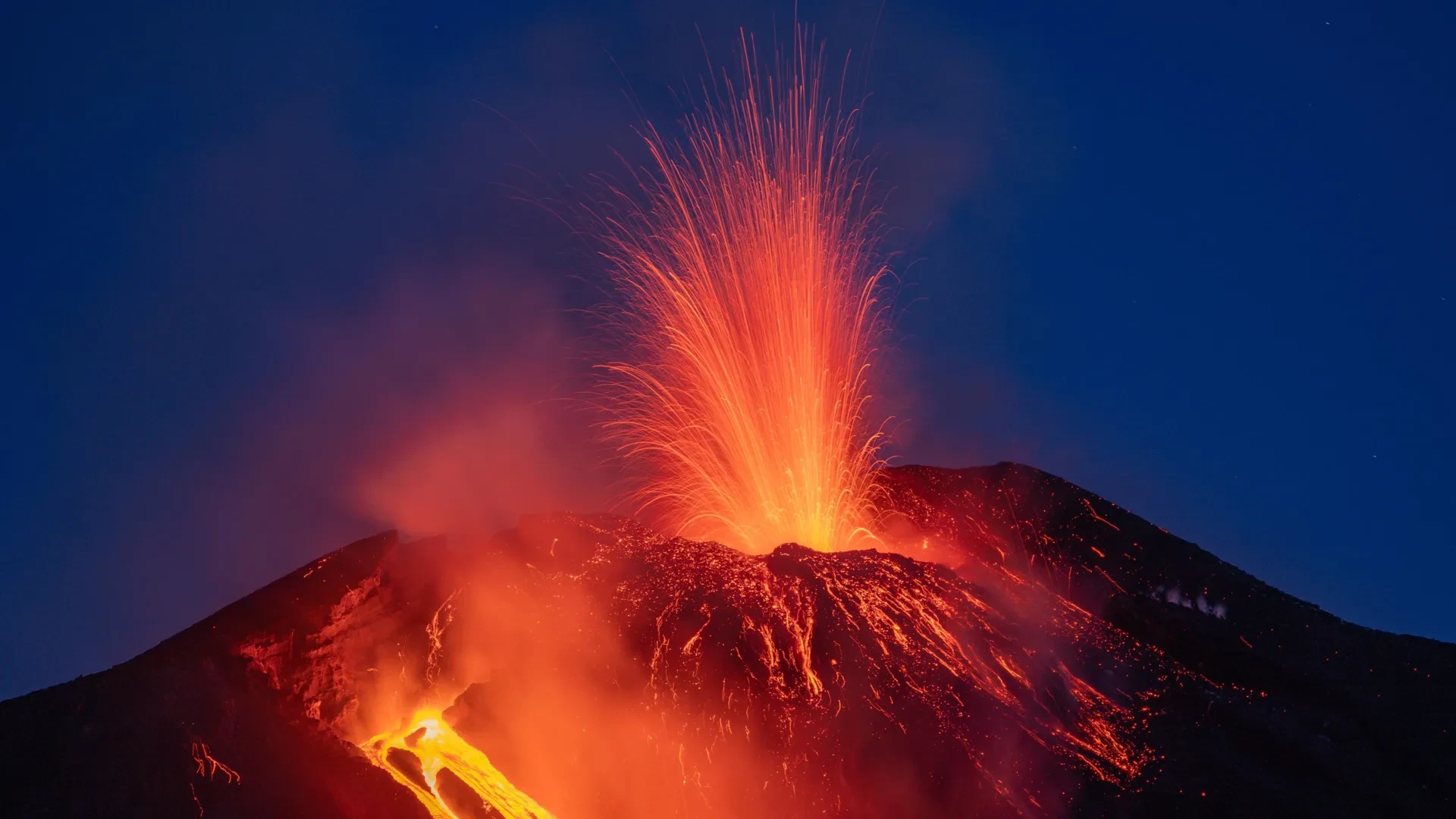
ITHACA, N.Y. — Deep beneath the rumbling slopes of Italy’s Mount Etna lies a complex, shifting labyrinth of magma and gas that has captivated scientists, historians, and mythmakers for millennia. For centuries, volcanologists have known that this subterranean network feeds Europe’s most active volcano. However, a groundbreaking new study led by researchers at Cornell University has uncovered a startling reality: even a single volcano can operate through entirely disparate internal mechanisms, utilizing radically different pathways and speeds to unleash its fury upon the surface.
Published recently in the journal Geochemistry, Geophysics, Geosystems, the research offers an unprecedented look into the subterranean "plumbing systems" that dictate volcanic behavior. By reconstructing two of the most significant and violent eruptions in Mount Etna’s ancient history, the Cornell-led team discovered that magma can travel along vastly different routes—moving at speeds ranging from a sluggish, multi-week crawl to a violent, hair-trigger ascent completed in a matter of hours.
The findings do more than rewrite the geological history of a single Italian landmark. By introducing cutting-edge analytical techniques to the study of volcanic gas and crystal structures, the research provides a vital new framework that could fundamentally improve the predictive models used by emergency managers and scientists to assess risks for future eruptions worldwide.
Main Facts
At the heart of the study is a fundamental question in modern volcanology: What turns a subterranean flow of molten rock into a catastrophic explosion?
A volcano’s explosiveness is governed by a delicate interplay of physical properties, chief among them the viscosity (flowability) of its magma and the concentration of trapped volatile materials—gases that rapidly expand and separate from the liquid rock as underground pressure drops.
To explain this dynamic, lead investigator Esteban Gazel, the Charles N. Mellowes Professor in the Department of Earth and Atmospheric Sciences in the Cornell Duffield College of Engineering, uses an everyday analogy: "Imagine a bottle of soda. If you open that bottle without agitating it, you can drink it, but if you shake it up, all the bubbles get separated really fast, and you have an explosion. Volcanoes work in a similar way, and my lab is trying to quantify these processes."
Historically, the scientific community regarded water as the primary volatile responsible for driving volcanic explosions. However, a major paradigm shift occurred in 2023 when Gazel’s research group demonstrated that carbon dioxide ($textCO_2$) can independently trigger explosive volcanic activity.
Building on this breakthrough, the research team utilized an innovative technique pioneered in Gazel’s lab using Raman spectroscopy. This method allows scientists to analyze microscopic crystals formed deep within the magma during its ascent. Trapped inside these minerals are tiny gas bubbles—measuring a mere 1 to 10 percent of the thickness of a human hair.
"That technique gives us the density of $textCO_2$, and using a state equation we can transform that density into pressure, and pressure can be transformed into depth," explained Maxim Gavrilenko, a former postdoctoral researcher at Cornell and the study’s first author. "Then we apply those techniques to these explosive eruptions, and we are able to reconstruct the plumbing system with an unprecedented precision."
By applying this methodology to Mount Etna, the team revealed that the volcano’s behavior is dictated by a competitive balancing act between two distinct volatile species: carbon dioxide and water. When $textCO_2$ dominates past a certain threshold, it acts as a deep-earth trigger, propelling magma violently toward the surface in hours. Conversely, when water concentrations are higher, the eruption is controlled and delayed at much shallower depths.
Chronology: Reconstructing Etna’s Ancient Cataclysms
To test their techniques, the researchers focused on Mount Etna. While generally perceived by the public as a gentler giant compared to high-explosive subduction-zone volcanoes, Etna’s geological archive hides terrifying events of extreme violence. The research team analyzed two distinct eruptions separated by millennia, mapping the chronological life cycle of the magma leading up to each disaster.
The 122 B.C. Plinian Eruption: A Multi-Week Stalling Event
One of the most destructive events in Mount Etna’s recorded history occurred in 122 B.C. This catastrophe was classified as both "mafic" (involving magnesium- and iron-rich magma with relatively low initial viscosity) and "Plinian"—the most explosive and violent class of volcanic eruptions, named in honor of Pliny the Elder, who famously documented the catastrophic 79 A.D. burial of Pompeii by Mount Vesuvius.
To piece together this ancient event, collaborators and co-authors Terry Plank of Columbia University and Bruce Houghton of the University of Hawaii, Manoa, traveled to the slopes of Etna to systematically collect and archive geological samples.
Back in the laboratory, the Cornell-led team sequenced and measured the chemical signatures locked inside the mineral crystals. The chronological reconstruction revealed a complex, multi-stage journey:
- Deep Origin: Magma feeding the 122 B.C. cataclysm originated at a staggering depth of approximately 22 kilometers beneath the surface.
- The Slow Ascent: Rather than rushing directly to the surface, the magma began a slow, measured upward migration.
- The Shallow Reservoir: The rising magma stalled at a much shallower depth—between 2 and 5 kilometers underground. Here, it lingered for several weeks, gradually releasing trapped gases before the final, catastrophic breach occurred.
The Fall Stratified Eruption: A High-Speed Subterranean Ascent
For comparison, the team turned their analytical lens toward an even older event: the "Fall Stratified" eruption, which rocked the region nearly 4,000 years ago.
The chronological data revealed a radically different narrative. In this instance, the magma bypassed the lingering shallow holding patterns characteristic of the 122 B.C. event:
- Deeper Mantle Roots: The magma originated even deeper within the Earth’s mantle, initiating its ascent from depths between 24 and 30 kilometers.
- Blistering Speed: Driven by a vastly higher concentration of carbon dioxide, the magma surged upward with immense velocity. Instead of taking weeks to stall and evolve, the molten rock traveled from the deep mantle to the surface and erupted within a matter of hours.
Supporting Data and Collaborative Insights
The contrasting timelines of the 122 B.C. and Fall Stratified eruptions highlight the complex chemical drivers operating beneath Mount Etna. According to the researchers, Etna is one of the rare locations on Earth where carbon dioxide and water compete directly as primary volcanic drivers.
"Some volcanoes are only high $textCO_2$, mostly in oceanic islands, and some volcanoes are mostly controlled by water, such as the ones in subduction zones," Gazel noted. "Etna is one of the few volcanoes in the world where you have the two volatile species competing. This shows that at a certain threshold of $textCO_2$, the eruption will come from very deep and really fast, but when you have a higher threshold of water, then the process is controlled at shallow levels."
This chemical bifurcation provides quantitative proof that minor shifts in volatile composition can completely alter the mechanical behavior of a volcanic system. The integration of high-resolution Raman spectroscopy with thermodynamic state equations has successfully bridged the gap between microscopic mineral analysis and macro-scale geophysical phenomena.
In addition to Gavrilenko and Gazel, the research paper was co-authored by Cornell postdoctoral researchers Kyle Dayton and Ellyn Huggins, alongside Anna Barth of the University of California, Berkeley. The comprehensive study was made possible through primary financial support provided by the National Science Foundation.
Official Responses and Scientific Implications
The broader implications of the Cornell-led study extend far beyond academic volcanology. Traditional hazard assessment models have often relied on generalized assumptions about magma ascent rates and storage depths. However, demonstrating that a single volcano can switch between deep, rapid, $textCO_2$-driven eruptions and shallow, delayed, water-influenced events complicates—and improves—how scientists must view risk.
Gazel and his team are wasted no time expanding the scope of their methodology. The analytical approach pioneered on Mount Etna is currently being deployed to study active volcanic systems in Chile, the Hawaiian Islands, and other high-risk geological hotspots around the globe.
"Ideally this should be done in every volcano on the planet," Gazel asserted. "This is data we need for physical models of eruptions that are the base of risk assessment."
By accurately mapping where magma initiates its journey, tracking the precise speeds of its ascent, and identifying which specific gases act as the primary engines of destruction, modern science is moving closer to creating high-fidelity, predictive simulations. For communities living in the shadow of active volcanoes, these models represent an indispensable tool for saving lives through more reliable early warnings and targeted evacuation planning.
Mythology Beneath the Mountain: Science Meets History
Beyond its rigorous scientific contributions, the research serves as a reminder of how deeply intertwined Mount Etna is with human history and culture. For millennia, civilizations have looked to the towering Sicilian peak not merely as a geological hazard, but as a site of profound mythological significance.
In ancient Greek mythology, Mount Etna was believed to be the subterranean prison of the monstrous giants Typhon and Enceladus, cast into the earth after their epic defeat by the Olympian gods. The rumblings, smoke, and fiery outbursts of the volcano were attributed to the imprisoned titans thrashing beneath the crust.
Fascinatingly, Gazel sees a poetic and eerie parallel between these ancient myths and the actual subterranean structures revealed by his team’s advanced geological mapping.
"There may be the two giant mythological monsters under Etna," Gazel remarked with a smile. "And if you look at the plumbing system of the Plinian eruption, it’s like Typhon, because it’s elongated and serpentine, and the other one is Enceladus, because it’s kind of smaller. If you work in Etna, it’s hard not to be connected to history, classical work and great food."
As researchers continue to decode the microscopic signatures locked within Etna’s crystal archives, they are peeling back layers of both geological and cultural heritage—proving that the fiery heart of the mountain still has ancient secrets left to tell.
