

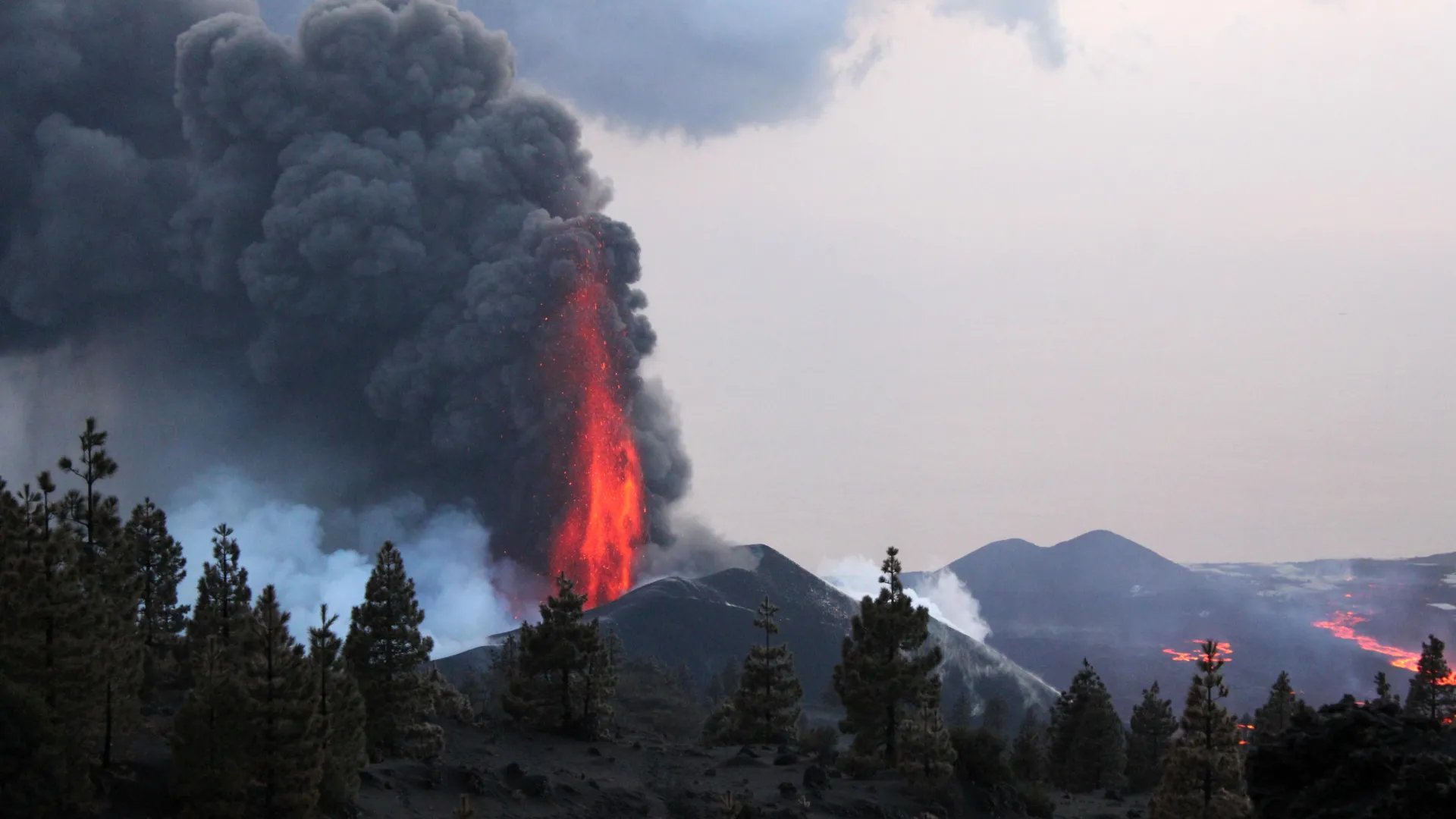
MANCHESTER, UK — For centuries, volcanologists have faced a confounding geological puzzle: why do volcanoes sharing nearly identical chemical compositions, sourced from the same tectonic environments, erupt in drastically different ways? While one vent might gently ooze sluggish rivers of molten rock, another nearby fissure can explode into towering, incandescent lava fountains.
Traditional geological models have long pointed to chemical composition, gas content, and overall pressure changes as the primary drivers behind these divergent personalities. However, an international team of researchers led by The University of Manchester has uncovered a missing piece of the puzzle. By training high-powered X-ray beams on molten rock, scientists have identified a heat-driven subterranean mechanism known as "superheating." This process fundamentally alters the internal architecture of magma long before it breaches the Earth’s surface, acting as a master switch that can dictate the violence, speed, and style of an eruption.
The findings, published in the journal Nature Communications, not only solve a long-running debate regarding the thermal history of magmas but also offer a potential new tool for hazard assessment and eruption forecasting worldwide.
The Anatomy of an Eruption: Main Facts
At the heart of the breakthrough is the behavior of crystals within ascending magma. As molten rock journeys from the deep mantle toward the surface, it experiences drops in temperature and pressure. Ordinarily, this cooling prompts minerals to precipitate out of the melt, forming solid crystals. These crystals act like grit in oil, increasing the liquid’s viscosity (thickness) and changing how easily volcanic gases can escape.
The new study demonstrates that when magma undergoes "superheating"—a state where the liquid is heated beyond the temperature at which its constituent crystals remain stable—the physical properties of the melt change dramatically.
Intense, localized heat acts to dissolve tiny, pre-existing crystals that would otherwise serve as microscopic "seeds" (or nuclei) for the growth of new mineral structures. Simultaneously, the extreme heat reorganizes the magma at a microscopic level, making its internal chemical structure far more uniform and resistant to new crystal formation.
By removing these crystal seeds and homogenizing the melt, superheating delays the crystallization process. Because crystal content directly governs magma viscosity, a delayed crystallization keeps the magma remarkably fluid for extended periods. This reduction in thickness allows the molten rock to accelerate as it rushes toward the surface, setting the stage for high-energy events like dramatic lava fountains. Conversely, when crystals form early, the magma thickens, slows down, and permits trapped gases to bleed off gradually, resulting in a gentler, effusive ooze.
A Timeline of Discovery: From La Palma to the Synchrotron
The road to uncovering this subterranean thermal mechanism spans from the fiery slopes of the Canary Islands to some of the world’s most advanced particle physics laboratories.
The 2021 Tajogaite Eruption
The investigation began with raw material from one of recent history’s most notable European eruptions: the 2021 Tajogaite eruption on La Palma in the Canary Islands. The months-long eruption reshaped the island’s landscape, destroying thousands of properties and releasing immense rivers of lava. Geologists collecting samples from the event suspected that the magma had experienced complex thermal histories—potentially being superheated both prior to eruption and during its rapid transit through the Earth’s crust.
Recreating the Depths of the Earth in Prague and Oxfordshire
To test their hypothesis, the research team needed to observe the unobservable: the birth of crystals inside opaque, glowing-hot magma under extreme pressures.
First, the scientists conducted ex-situ experiments in Prague. These preliminary trials allowed the team to subject Tajogaite magma samples to carefully controlled regimes of intense heat and pressure, observing the structural changes over extended periods.
Next, the team traveled to the Diamond Light Source—the UK’s national synchrotron science facility located in Oxfordshire. There, utilizing a newly developed X-ray transparent pressure vessel combined with synchrotron X-ray microtomography, the researchers achieved a scientific first: they watched, in real time (in situ), as crystals formed inside the simulated volcanic environment.
The Eight-Hour Delta
The experimental results revealed a striking contrast between thermally treated and untreated samples.
When magma that had not been subjected to superheating was cooled under standard ascent conditions, it began nucleating and growing crystals within a mere 20 minutes. However, when the magma samples experienced strong superheating prior to cooling, crystal formation was suppressed for more than eight hours.
Armed with these precise, empirically derived nucleation delays, the researchers fed the data into advanced numerical models designed to simulate how magma moves, decompresses, and evolves as it travels upward through kilometers of continental or oceanic crust.
Supporting Data and Quantitative Insights
The integration of synchrotron observations with numerical fluid-dynamics modeling yielded quantitative metrics that validate the team’s theories.
- Viscosity Shifts: Without crystals to impede flow, superheated magma maintains a significantly lower viscosity during the critical initial phases of ascent.
- Ascent Velocity: Fluid-dynamic models demonstrated that low-viscosity magma can scale the crustal conduit at accelerated speeds, creating the hydrodynamic conditions necessary to sustain massive lava fountaining episodes.
- Gas Escape Mechanics: In delayed-crystallization scenarios, dissolved gases remain trapped within the fluid matrix until the magma reaches much shallower depths, where rapid decompression triggers explosive exsolution. In contrast, early-crystallizing magma forms a porous, interconnected network that allows volatiles to bleed off safely over time.
These variables illustrate why two eruptions with identical bulk chemical compositions can manifest entirely different surface hazards. The deciding factor is not merely what the magma is made of, but the thermal path it traveled on its way to the surface.
Official Responses and Expert Perspectives
The implications of the study have drawn praise from the wider geological community, marking a shift in how researchers view pre-eruptive magma dynamics.
Dr. Barbara Bonechi, Research Associate at The University of Manchester and lead author of the study, emphasized the technological leap that made these discoveries possible.
"The history of crystal and bubble growth can dramatically control how a magma erupts; in particular, as more crystals grow, they eventually have a dramatic effect on magma viscosity," Dr. Bonechi explained. "Until now, we did not fully understand the dynamics of crystal growth for magmas that received an injection of superheat just before ascent. But using our exciting and newly developed X-ray transparent pressure vessel combined with synchrotron X-ray microtomography, we can actually observe these processes ‘in situ’."
Co-author Dr. Margherita Polacci, Senior Lecturer in Volcanology at The University of Manchester, highlighted how the findings challenge traditional paradigms in volcanic risk assessment.
"Current volcanic hazard models typically focus on magma chemistry, gas content and pressure changes," Dr. Polacci noted. "This work suggests that pre-eruptive thermal history and crystallization kinetics may also play an important role in controlling magma ascent and eruptive behavior, with implications for volcanic hazard assessment."
Global Implications for Volcanic Hazard Assessment
As populations expand closer to active volcanic zones—from the flanks of Mount Vesuvius in Italy to the restless calderas of the Pacific Ring of Fire—accurate forecasting remains an urgent humanitarian imperative. Emergency managers rely heavily on real-time geophysical monitoring, such as ground deformation measurements, seismic tremors, and gas emission rates, to anticipate volcanic awakenings and order evacuations.
However, interpreting these signals is notoriously difficult. Two volcanoes showing identical seismic unrest can behave entirely differently when they breach the surface.
By identifying superheating and crystallization kinetics as critical control variables, this research offers volcanologists a new lens through which to interpret monitoring data. If scientists can better understand the thermal signatures and crystallization histories of a restless magma plumbing system, they may soon be able to anticipate whether an upcoming eruption will manifest as an easily manageable effusive flow or a hazardous, fountain-driven crisis.
While further research is needed to map out how common superheating is across different global tectonic settings, Manchester’s synchrotron experiments have brought clarity to the dark, molten heart of the Earth. The furnace below, it turns out, keeps secrets written not just in its chemistry, but in the fiery history of its heat.
