

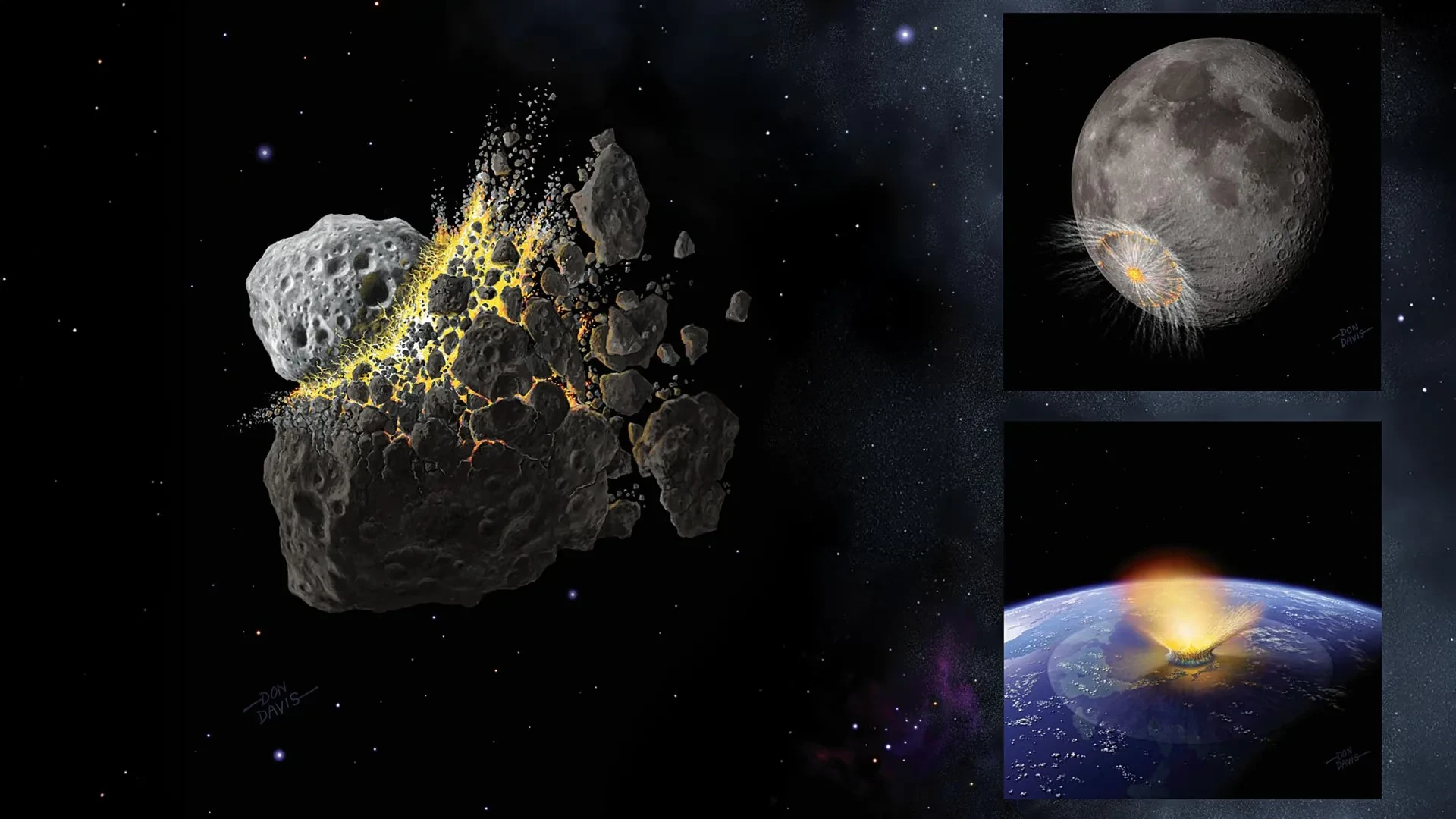
WASHINGTON — In the endless, silent theater of the cosmos, cataclysms often unfold over epochs, leaving fingerprints that take scientists generations to decode. A groundbreaking study led by the Southwest Research Institute (SwRI) has unveiled a dramatic chapter in planetary history: roughly 800 million years ago, a colossal, violent collision within the main asteroid belt triggered a prolonged, systemic wave of impacts that battered the inner solar system.
The investigation, spearheaded by planetary scientist Dr. William Bottke, suggests that the shattering of the parent object of the Eulalia asteroid family sent a torrential blizzard of debris cascading toward Earth, the Moon, and Mars. Far from being isolated events of cosmic vandalism, these impacts may have fundamentally altered the geological architecture of multiple worlds, potentially playing a decisive role in shifting Earth’s climate and steering the evolutionary course of its biosphere.
Main Facts: The Eulalia Breakup and the Inner Solar System Barrage
At the heart of the new study is a sophisticated celestial detective story. Scientists have long known that Earth’s history is punctuated by impacts, yet piecing together the timeline of ancient bombardments has proven exceptionally difficult. While the famous Chicxulub impact—which struck Mexico’s Yucatán Peninsula 66 million years ago and wiped out the nonavian dinosaurs—is firmly etched into the geological record and linked to a mass extinction, far older events are notoriously elusive.
Earth is a geologically active planet. Volcanoes continually manufacture fresh rock, plate tectonics relentlessly reshape continents and swallow ocean floors, and the ceaseless grinding of weather breaks down exposed landscapes. Together, these dynamic terrestrial processes act as a planetary eraser, burying or completely destroying ancient impact craters.
To circumvent this terrestrial amnesia, researchers turn to the static, unmoving surfaces of neighboring worlds, most notably the Moon.
"The heavily cratered surface of the Moon serves as a reminder of the large impacts in Earth’s past," explained Dr. Bottke, an executive director in SwRI’s Solar System Science and Exploration Division in Boulder, Colorado, and lead author of the study. "So far, only the Chicxulub impact event 66 million years ago has been strongly linked to a specific effect on life, namely the mass extinction of the dinosaurs."
Because the Moon lacks plate tectonics, flowing water, and a substantial atmosphere, its surface preserves an ancient, undisturbed archive of impacts. Previous lunar research—based on the estimated ages of major impact craters and the analysis of impact glass collected during NASA’s Apollo missions—suggested that the Moon experienced a sharp, unexplained surge in large impacts around 800 million years ago.
The SwRI-led study provides the missing piece of the puzzle: a mechanism in the main asteroid belt capable of producing that exact lunar spike. Through advanced computer modeling, the research team connected the lunar bombardment to the catastrophic breakup of the parent body that formed the Eulalia asteroid family. Located on the precipice of a powerful gravitational gateway created by Jupiter, the destruction of this carbon-rich parent object hurled mountains of shrapnel across the inner solar system for more than a hundred million years.
Chronology: A Multi-Million-Year Cosmic Siege
To understand how a single collision in the distant asteroid belt could initiate a multi-hundred-million-year planetary siege, researchers had to reconstruct the timeline using collisional and dynamical models.
The Trigger Event (Approx. 800 Million Years Ago)
A primitive, carbonaceous chondrite-like body—containing some of the oldest materials, water-bearing minerals, and organic compounds formed in the solar system—collided with another asteroid in the main belt. The precise location of this impact was crucial. It occurred directly on the brink of the gravitational 3:1 mean motion resonance with Jupiter, a region known as the J3:1 resonance.
Immediate Debris Dispersal (0 to 10 Million Years Post-Impact)
In the J3:1 resonance, an asteroid completes precisely three orbits around the Sun for every single orbit completed by Jupiter. The gas giant’s repeated gravitational nudges destabilize objects in this zone, acting as a cosmic "escape route" that flings asteroids out of the main belt and into elongated, planet-crossing orbits.
According to the study’s simulations, the position of the Eulalia parent body made its destruction exceptionally consequential. Roughly half of the resulting fragments were thrust almost immediately into the J3:1 resonance, scattering planetary debris throughout the inner solar system and kicking off the impact spike recorded on the Moon.
The Yarkovsky Effect and the Secondary Barrage (10 to 150 Million Years Post-Impact)
The cosmic bombardment did not stop with the initial spray of shrapnel. Over the following 100 to 150 million years, another 25% of the remaining fragments gradually migrated into the J3:1 resonance through a subtle thermodynamic phenomenon known as the Yarkovsky effect.
The Yarkovsky effect occurs when an asteroid absorbs sunlight and subsequently reradiates that thermal energy away as infrared radiation. Because the asteroid rotates and heats unevenly, the escaping heat generates a microscopic, continuous thrust. Over millions of years, this gentle thermal pressure slowly alters the orbits of asteroid fragments, steering them inexorably into the gravitational trap of the J3:1 resonance and ensuring a prolonged, multi-epoch wave of impacts.
Supporting Data: Decoding the Lunar and Terrestrial Evidence
The validity of the SwRI study rests on a convergence of planetary dynamics, geochemical analysis, and crater chronology.
Researchers rely heavily on impact glass to date ancient collisions. When an asteroid strikes a planetary body at hypervelocity, the immense kinetic energy instantly melts surrounding rock. The molten ejecta cools rapidly into impact glass, trapping chemical and chronological markers inside. By radiometrically dating these glass beads retrieved from Apollo lunar samples, scientists can pinpoint when ancient impacts occurred.
When these lunar impact dates were lined up against dynamical models of the main asteroid belt, a striking statistical match emerged. The Eulalia family formation date and the mechanics of the J3:1 resonance aligned perfectly with the timing of the lunar impact surge.
Furthermore, the data allows scientists to scale up the bombardment numbers for Earth. Because Earth is significantly larger than the Moon and possesses much stronger gravitational pull, its cross-section for catching stray space debris is vastly superior. Mathematical modeling indicates that for every large impactor that struck the lunar surface during this 800-million-year-ago barrage, roughly twenty objects of equal or greater size slammed into Earth.
While plate tectonics and weathering have erased the vast majority of these terrestrial craters, the sheer volume of incoming material ensures that Earth endured an unprecedented planetary pounding.
Official Responses and Expert Perspectives
The findings have generated considerable discussion within the planetary science and astrobiology communities, highlighting a growing shift toward viewing impact history not as random noise, but as a series of major, family-driven asteroid showers.
Dr. Bottke emphasizes that while the connection between the Eulalia breakup and the inner solar system impact wave is robust, interpreting its secondary consequences requires careful, multidisciplinary research.
"These rare events, triggered by large, well-positioned collisions in the main asteroid belt, bombard all inner solar system worlds," Bottke noted. "So, evidence preserved on the Moon’s static surface can be used to infer what happened on Earth and Mars in ancient times."
Other researchers in the fields of geology and planetary evolution have praised the study for bridging the gap between asteroidal dynamics and terrestrial history. By utilizing the Moon as a celestial proxy, the research provides a viable framework for understanding periods of Earth’s history that were previously considered complete blanks.
Astrophysicists also point out that identifying the specific source families in the main belt—such as Eulalia—opens the door to finding other historical asteroid showers. If the breakup of a single family could pepper the inner solar system for 150 million years, similar cosmic accidents in deep time may have played recurring roles in shaping the solar system’s inner rocky planets.
Implications: Climate, Biology, and Planetary Evolution
The most provocative aspect of the SwRI study lies in its timing. The peak of this intense asteroid barrage—occurring roughly 800 million years ago—coincides remarkably with a period of sweeping global cooling and dramatic evolutionary shifts in Earth’s biosphere.
While the study does not definitively prove that the asteroid shower caused these terrestrial changes, the chronological overlap presents an extraordinary hypothesis for future scientific inquiry.
"Given that the peak of this barrage coincides with a period of widespread cooling and major shifts in our biosphere, it is tempting to suggest that the former produced the latter," Bottke said.
On Earth, a sustained influx of massive impactors would have lofted immense quantities of dust into the atmosphere, potentially blocking sunlight, inducing rapid climatic cooling, and disrupting marine and terrestrial ecosystems long before the rise of complex animal life.
The consequences were not limited to Earth. Mars, too, stood directly in the crosshairs of the Eulalia debris field. According to the research team’s models, the sustained bombardment on the Red Planet would have triggered catastrophic episodes of intense seismic shaking. Intriguingly, these modeled impact spikes line up temporally with documented surges in ancient Martian volcanic activity, illustrating how a single catastrophic collision in the distant asteroid belt could exert profound, system-wide mechanical and thermal feedbacks across multiple terrestrial worlds.
As planetary scientists continue to refine impact records and explore the chemical signatures of primitive carbonaceous chondrites, this research serves as a humbling reminder: the fate of life and landscapes on Earth is inextricably bound to the chaotic, clockwork mechanics of the deep solar system.
