

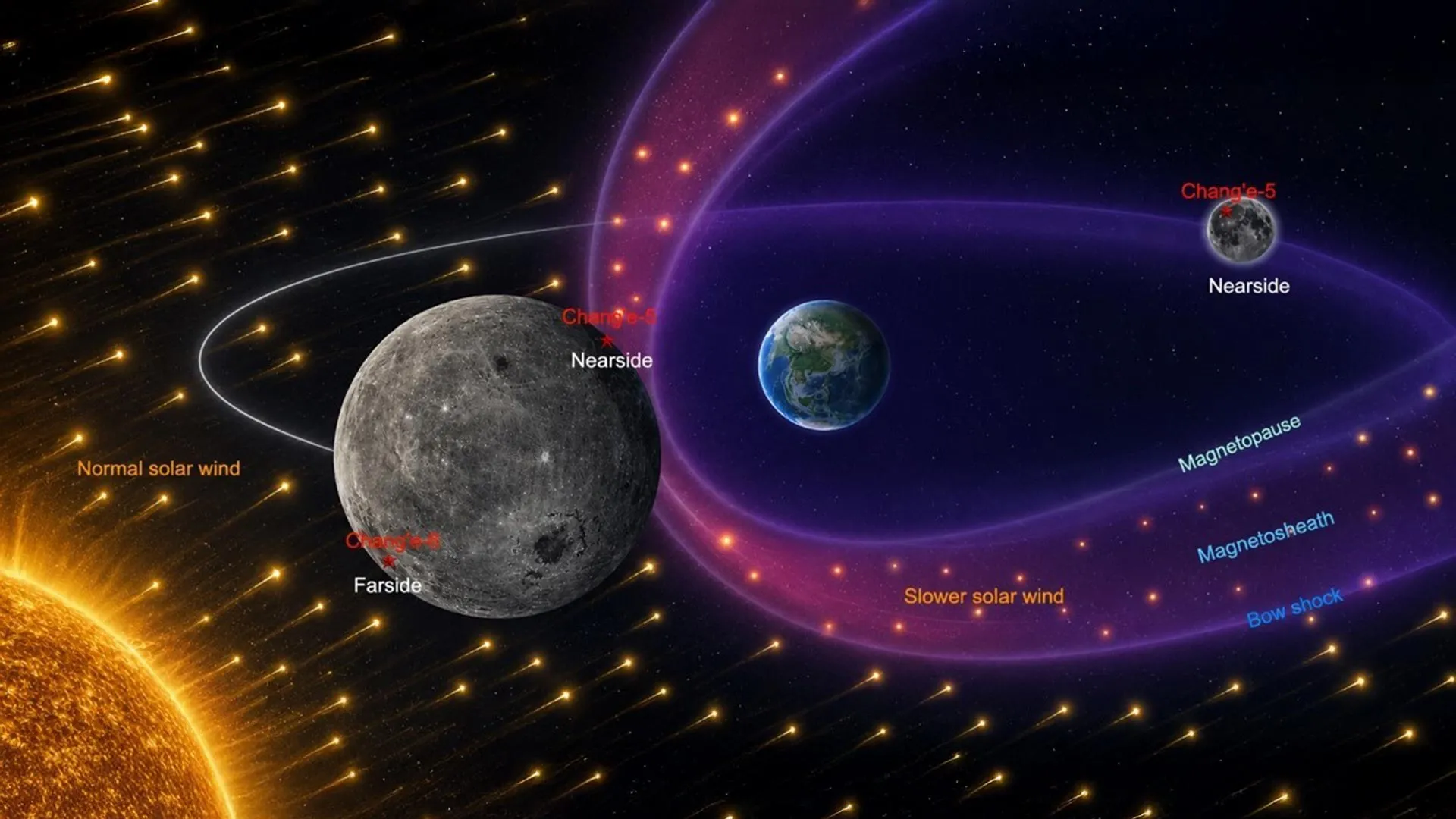
BEIJING — For billions of years, the Moon has stood as a silent witness to the relentless fury of the solar wind, enduring a ceaseless storm of charged particles ejected from our star. Devoid of a thick atmosphere or a global intrinsic magnetic field to shield its terrain, the lunar surface has absorbed this cosmic bombardment unmitigated. However, groundbreaking new research reveals a profound celestial asymmetry: the Moon’s near side and far side have not experienced this violent solar gale in the same way.
According to a landmark study published in the journal Nature Geoscience, particles striking the lunar near and far sides arrive at starkly different velocities, carry varying levels of energy, and leave behind distinct chemical footprints. An international team of scientists, anchored by the Institute of Geology and Geophysics (IGG) of the Chinese Academy of Sciences (CAS), has demonstrated that Earth itself is the architect of this disparity. Through the protective, speed-governing shield of its magnetosphere, our planet actively modulates the solar wind hitting the lunar near side, while leaving the far side completely exposed to the raw, unadulterated power of deep space.
This revelation upends long-held assumptions about uniform space weathering across the lunar globe. It transforms the powdery mantle of the Moon—known as the lunar regolith—into an unprecedented cosmic archive that not only preserves the history of the Sun, but also holds a long-sought fossil record of Earth’s ancient magnetic evolution.
Main Facts: Unlocking the Lunar Secret
The core finding of the research centers on a fundamental dichotomy between the two hemispheres of the Moon. Because the Moon is tidally locked with Earth, presenting essentially the same face to our planet throughout its orbit, the near side is perpetually oriented toward Earth, while the far side faces deep space.
This geometric relationship places the near side within the gravitational and magnetic sphere of influence of our home world. As Earth plows through space, it generates a vast, protective magnetic bubble known as the magnetosphere. Encasing this bubble is a turbulent transition zone called the magnetosheath. As the Moon completes its monthly orbit, it periodically plunges through this region.
Inside the Earth’s magnetosheath, the solar wind—a supersonic stream of protons, electrons, and minor ions normally screaming through space at roughly 400 kilometers per second—is drastically decelerated, dropping to speeds of approximately 200 kilometers per second. This cosmic speed bump primarily affects the lunar near side.
Conversely, the lunar far side is permanently shielded from Earth’s magnetic wake. It remains fully exposed to the pristine, unobstructed solar wind streaming directly from the Sun.
To prove this hypothesis, researchers analyzed precious cargo brought back by China’s historic Chang’e 6 mission: exactly 1.935 grams of regolith excavated from the South Pole-Aitken basin on the lunar far side. By examining the concentrations and isotopic compositions of noble gases trapped within these grains, scientists found undeniable proof that far-side particles penetrated deeper into the soil and underwent more intense isotopic fractionation than anything ever recovered from the near side.
Chronology: From Near-Side Blindness to Far-Side Discovery
To understand how planetary scientists arrived at this paradigm-shifting conclusion, it is necessary to trace the timeline of lunar sample exploration, which for decades suffered from a profound geographic bias.
The Apollo and Luna Era: A Near-Side Monopoly
From the late 1960s through the mid-1970s, NASA’s Apollo missions and the Soviet Union’s automated Luna probes successfully delivered hundreds of kilograms of lunar material back to Earth. These samples revolutionized planetary science, offering the first direct look at the composition of the Moon.
However, every single gram of regolith brought back during this golden era originated from the lunar near side. Because missions were constrained by communication lines, landing safety, and orbital mechanics, the mysterious far side remained entirely out of reach. For half a century, scientists attempted to model solar wind interactions using exclusively near-side data, assuming that solar wind implantation was a globally uniform process.
The Chang’e Program Breakthroughs
The tide began to turn in the 21st century with the rapid advancement of China’s lunar exploration program.
- December 2020: The Chang’e 5 mission successfully touched down on the near side of the Moon (in the Oceanus Procellarum region) and returned 1.731 kilograms of younger volcanic regolith to Earth. This provided a crucial modern baseline for near-side solar wind studies.
- June 2024: The Chang’e 6 mission achieved a historic engineering and scientific triumph by landing in the South Pole-Aitken basin—one of the largest, deepest, and oldest impact craters in the solar system, located squarely on the lunar far side. The ascender successfully lifted off from the far side, performed humanity’s first lunar-orbit rendezvous and sample transfer from the far side, and returned the precious 1.935-gram regolith sample safely to Earth.
Laboratory Analysis and Publication
Following the curation of the Chang’e 6 samples in Beijing, an elite team led by postdoctoral researcher Xuhang Zhang and supervised by Professor He Huaiyu at the IGG began meticulous high-precision mass spectrometry analyses. Collaborating with researchers from the University of Science and Technology of China and members of the Chang’e 7 volatile payload team, the researchers isolated noble gases from the far-side soil grains. By comparing these isotopic ratios directly against Chang’e 5 near-side data, the team mapped out the profound differences in solar wind exposure, culminating in their peer-reviewed publication in Nature Geoscience.
Supporting Data: What the Noble Gases Reveal
The physical mechanism of solar wind implantation relies on the fact that charged particles carry kinetic energy. When they strike exposed mineral grains in the lunar regolith, they embed themselves nanometers to micrometers deep into the crystal lattices.
Because volatile elements such as helium (He), neon (Ne), argon (Ar), krypton (Kr), and xenon (Xe) are chemically inert—meaning they rarely react or bond with other elements—they act as pristine, incorruptible time capsules. Once trapped, they remain locked in place unless heated to extreme temperatures.
Isotopic Fractionation in Neon
One of the most striking pieces of data emerged from the analysis of neon isotopes. The Chang’e 6 regolith exhibited an average $^20textNe/^22textNe$ ratio of $11.34 pm 0.22$.
This value is significantly lower than the neon isotope ratios measured in all previously studied near-side samples from Apollo and Chang’e 5. Crucially, the far-side ratio closely matches the theoretical composition predicted by extreme solar wind fractionation models. This proves that the far side experienced a harsher, more direct onslaught, causing lighter isotopes to behave differently than heavier ones during high-energy plasma interactions.
Penetration Depth in Krypton and Xenon
Further proof of energy disparities came via stepwise heating experiments, which release trapped gases at incrementally rising temperatures.
When researchers heated the Chang’e 6 material, xenon delivered by the solar wind was released predominantly at high temperatures, forming a sharp, single high-temperature peak. By contrast, Chang’e 5 samples from the near side displayed a dual-peak release pattern, with substantial quantities of xenon escaping at both low and high temperatures.
Planetary physicists interpret this thermal release profile as a direct indicator of implantation depth:
- Shallow Implantation (Near Side): Slower, lower-energy solar wind particles—decelerated by Earth’s magnetosheath—do not punch deeply into the soil. They lodge closer to the surface of the mineral grains, releasing their trapped volatile gases earlier during heating experiments.
- Deep Implantation (Far Side): Faster, higher-energy particles unhindered by Earth’s magnetic shield slam deep into the mineral grains, requiring extreme thermal energy to shake them loose.
Quantitative models developed by the team estimate that roughly 25% of the total solar wind exposure recorded at the Chang’e 5 near-side landing site was influenced by this slower, magnetosheath-filtered flow. The Chang’e 6 far-side site showed absolute zero evidence of this protective deceleration.
Official Responses and Perspectives from the Scientific Community
The publication of the Nature Geoscience study has sent ripples through the international planetary science and heliophysics communities, drawing high praise for the precision of the analysis and the unique value of the Chang’e 6 samples.
"For decades, we treated the Moon as a passive, uniform target in the path of the solar wind," noted an independent European space physicist not involved in the study. "These findings demonstrate that the Earth-Moon system is dynamically intertwined. We are not just looking at lunar geology; we are seeing the direct footprint of Earth’s invisible magnetic shield etched into alien soil."
Professor He Huaiyu of the Institute of Geology and Geophysics emphasized the unprecedented nature of the samples. "Without the Chang’e 6 mission, this discovery would have remained entirely impossible," He stated in a press briefing following the publication. "The far side of the Moon gives us a clean baseline of true solar wind behavior, while the near side records the interference of our own planet. It is equivalent to having a control group in a planetary-scale experiment."
Dr. Xuhang Zhang, the lead author of the study, highlighted the methodological triumph of utilizing noble gases. "Noble gases are remarkably stubborn. They don’t lie about their history," Zhang explained. "By reading the isotopic signatures and the thermal release curves of krypton and xenon, we effectively read a historical ledger of particle velocity that spans millions of years of exposure."
Implications: Rewriting Earth-Moon History and Future Exploration
The implications of this discovery stretch far beyond academic curiosity, opening profound new avenues for both Earth history and future human space exploration.
A Fossil Record of Earth’s Ancient Magnetism
Perhaps the most exciting implication proposed by the research team is the potential to use lunar regolith as a deep-time archive of Earth’s magnetic history.
Earth’s magnetosphere is not static; it has evolved over billions of years as our planet’s core has cooled, solidified, and churned. Variations in the strength and size of the magnetosphere directly alter the dimensions and properties of the magnetosheath, which in turn changes the proportion of slowed solar wind reaching the lunar near side.
By analyzing ancient, deeply buried layers of lunar regolith—stratified over billions of years—scientists may soon be able to reconstruct the historical fluctuation of Earth’s magnetic shield. When cross-referenced with terrestrial paleomagnetic data, these noble gas signatures could offer a revolutionary method for tracking how Earth’s geodynamo behaved in deep geological time, long before complex life walked the planet.
Rethinking Space Weather and Volatile Resource Utilization
As space agencies worldwide set their sights on establishing permanent human outposts on the Moon—particularly in the polar regions—understanding the distribution of solar wind-delivered volatiles becomes a matter of mission-critical importance.
Solar wind implantation is a primary mechanism for delivering hydrogen, helium-3, and water-forming ions to the lunar surface. Knowing that solar wind energy flux varies dramatically between hemispheres means that resources like trapped volatiles will not be uniformly distributed across the globe. Engineers and mission planners must account for these distinct planetary-scale shielding effects when prospecting for in-situ resource utilization (ISRU) materials.
A More Complex Cosmic Neighborhood
Ultimately, the study serves as a humbling reminder of the intricate interplay governing our cosmic neighborhood. The Sun, Earth, and Moon are bound together in a complex gravitational, magnetic, and particulate dance.
The far side of the Moon, long romanticized as a dark, silent hemisphere shielded from the electromagnetic chatter of human civilization, has now spoken. In whispering its secrets through microscopic atoms of neon, krypton, and xenon trapped in lunar dust, it has revealed how our own home planet casts a long, protective shadow across the void of space.
