

Main Facts
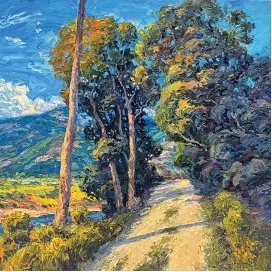
The enduring allure of the natural world continues to serve as the beating heart of contemporary representational art. A newly released special advertising showcase highlights the profound ways in which landscapes and wildlife inspire modern creators. Featuring prominent works such as Brad Teare’s striking 40-by-40-inch oil on canvas, Country Lane, the exhibition underscores the dynamic relationship between artists and the environment.
At its core, this artistic movement is driven by observation and translation. Whether working en plein air—painting directly in the open air—or returning to the controlled environment of the studio with sketches, memory, and photographic references, artists continue to find infinite subjects just beyond their doorsteps. The featured collection brings together diverse perspectives, proving that the great outdoors is not merely a static background, but an active, breathing muse that provokes deep emotional and aesthetic responses.
Chronology of Artistic Engagement with the Outdoors
To understand the weight and relevance of contemporary landscape and wildlife art, it is vital to trace the historical lineage that paved the way for today’s creators. The relationship between the artist and the wilderness has evolved significantly over centuries:
- Pre-19th Century Realism and Romanticism: For centuries, nature was often viewed through a mythological, religious, or highly idealized lens. It wasn’t until the rise of the Romantic movement in the late 18th and early 19th centuries that wilderness began to be appreciated for its raw, untamed power and emotional resonance.
- The Mid-19th Century Breakthrough: The invention of portable oil paints in tubes during the mid-1800s revolutionized how artists interacted with nature. Suddenly, painters were no longer chained to their indoor workshops. Movements like the Hudson River School in the United States and the Barbizon School in France took artists out into the literal fields, forests, and mountains.
- Late 19th to Early 20th Century Impressionism: Impressionists discarded rigid academic rules in favor of capturing fleeting moments of light, shadow, and atmosphere. This laid the direct groundwork for modern plein air painting, emphasizing immediate sensory perception over meticulous detail.
- The Mid-to-Late 20th Century Conservation Era: As industrialization expanded and natural habitats shrank, landscape and wildlife art took on a new urgency. Artists began acting as visual historians and advocates for conservation, documenting fragile ecosystems before they vanished.
- The Modern Digital and Hybrid Era (Present Day): Today’s artists utilize a sophisticated blend of traditional techniques and modern conveniences. While many still hike into the backcountry with heavy easels and oil paints, others leverage digital photography, drone footage, and advanced studio setups to interpret grand vistas and intimate forest floors, as seen in contemporary showcases.
Supporting Data and Artistic Insights
The economic, cultural, and psychological impact of nature-inspired art remains robust within the global fine art market. According to recent art market analyses, representational landscape and wildlife art consistently ranks among the most stable and collectible genres for both seasoned investors and first-time buyers.
The Anatomy of a Masterpiece: Case Study of Country Lane
Brad Teare’s oil on canvas piece, Country Lane (measuring 40 x 40 inches), serves as a prime case study for contemporary landscape execution. Large-format square compositions present unique spatial challenges and opportunities for artists:
- Scale and Immersion: A 40-inch canvas creates an immersive visual field, drawing the viewer’s eye past the frame and directly onto the gravel and sun-dappled paths of the rural route.
- Textural Manipulation: Through the versatile medium of oil paint, artists build rich textures—impasto highlights on foliage, smooth glazes on shadowed lanes, and energetic brushwork that mimics the chaotic yet harmonious structure of natural flora.
- Color Theory in the Wild: Natural scenes rarely rely on pure pigments; instead, they require complex color mixing to capture the shifting atmospheric perspective, where distant elements take on cool, muted blue-gray tones while foreground elements pop with warm earth hues.
Official Responses and Perspectives from the Art Community
Curators, critics, and the artists themselves have weighed in heavily on why nature continues to hold such a powerful monopoly on creative expression, particularly in an increasingly digital and urbanized society.
Art historian Dr. Elena Vance notes that the modern obsession with environmental art is a direct psychological counterweight to screen fatigue. "When people look at a meticulously crafted landscape painting, they are not just looking at trees and dirt," Vance explains. "They are looking at time slowed down. They are seeing hours, days, and sometimes a lifetime of careful observation distilled into a single visual experience."
Prominent wildlife and landscape painters echo this sentiment, emphasizing that the physical act of creating art outdoors is a deeply humbling experience.

"When you stand before a massive canyon, a dense thicket, or a quiet country lane, you realize very quickly how small you are," shares one contributing studio artist. "Your job isn’t to conquer the landscape on the canvas; it’s to listen to it. Every shadow tells a story about the time of day, every bent branch tells a story about the wind, and your brush is simply the translator."
Furthermore, gallery owners report a surge in demand for works that celebrate local topography. Collectors are increasingly seeking out art that reflects their immediate geographic surroundings or cherished vacation sanctuaries, transforming their residential and commercial spaces into sanctuaries of calm.
Implications for the Future of Art and Conservation
The ongoing celebration of nature through the medium of paint carries profound implications that stretch far beyond the walls of galleries and private collections.
1. The Intersection of Art and Environmental Advocacy
Historically, artists have played pivotal roles in environmental preservation. The monumental landscape paintings of the American West by artists like Albert Bierstadt and Thomas Moran were instrumental in convincing the U.S. Congress to establish Yellowstone as the world’s first national park. Today, contemporary landscape and wildlife artists continue this legacy. By capturing the fragile beauty of endangered habitats, they foster a profound sense of stewardship among collectors and the general public. An investment in nature-inspired art is frequently an investment in ecological awareness.
2. The Evolution of Artistic Techniques in a Changing World
As climate patterns shift, urban sprawl accelerates, and natural landscapes transform, the subject matter available to artists is also changing. Painters are documenting landscapes that may look drastically different in a decade. This grants contemporary nature art an invaluable documentary value, freezing fleeting moments of seasonal light, vanishing wildlife populations, and evolving ecosystems in time.
3. The Therapeutic Power of Visual Nature
From a psychological standpoint, the integration of natural motifs into daily human environments has been scientifically proven to reduce stress, lower blood pressure, and improve cognitive function. As contemporary artists continue to push the boundaries of texture, light, and composition—translating outdoor adventures into indoor masterpieces—they provide society with a vital emotional lifeline.
Ultimately, the special spotlight on works like Country Lane reminds us that no matter how advanced or digital our civilization becomes, humanity’s primal connection to the great outdoors remains unbroken. Through the eyes and hands of talented artists, we are invited to step outside, slow down, and truly see the wild world waiting just beyond our doors.
