

Main Facts
Following a sluggish start to the year, global new energy vehicle (NEV) giant BYD has firmly recaptured its momentum, delivering an impressive 456,713 passenger vehicles in September 2026. This performance marks a robust 5.4% increase compared to August 2026 and a significant 16.2% leap over September 2025.
A closer look at the data reveals a profound structural shift in consumer demand away from transitional technologies and firmly toward pure electrification. While BYD’s overall growth is noteworthy, battery electric vehicle (BEV) sales outperformed the company’s broader portfolio by a wide margin. BEV sales surged 6.6% month-over-month and an extraordinary 33.2% year-over-year, climbing from 205,050 units in September 2025 to 273,143 units in September 2026.
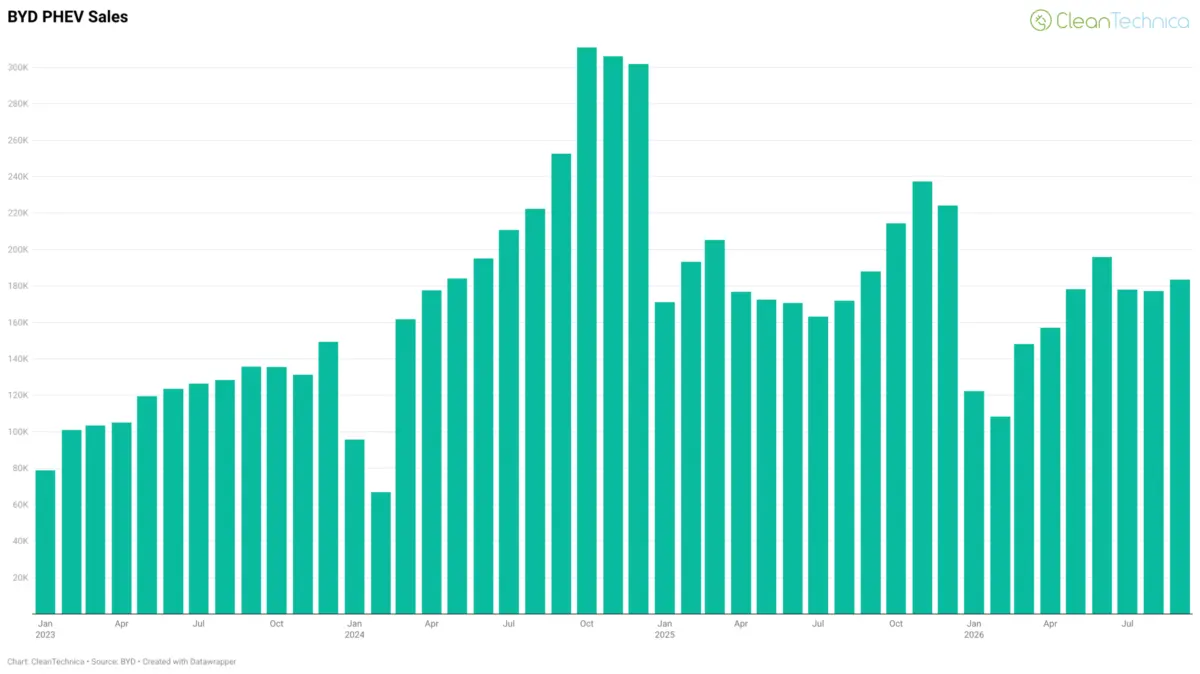
Conversely, plug-in hybrid electric vehicle (PHEV) sales experienced a cooling phase. Although PHEV deliveries rose 3.6% from August to September 2026, they suffered a 2.4% year-over-year decline, dropping from 188,010 units in September 2025 to 183,570 units in September 2026. This divergence highlights a critical market development: consumers are increasingly bypassing hybrid options in favor of long-range, fully electric platforms.
Despite an early-year slump that temporarily dragged down cumulative metrics, BYD’s aggressive late-summer recovery has nearly erased its year-to-date deficits. Total passenger vehicle sales for the first three quarters of 2026 stand at 3,078,544—down just 4.4% from the 3,218,862 vehicles delivered during the same period in 2025. Meanwhile, cumulative BEV sales for the first nine months of the year have officially entered positive territory, rising 1.5% to 1,629,957 units compared to 1,605,903 units in 2025.

Chronology of the 2026 Sales Trajectory
To understand BYD’s current dominance in the autumn of 2026, it is essential to examine the temporal arc of the company’s performance over the past twenty-one months.
Q1–Q2 2026: Navigating Headwinds
The automotive landscape at the onset of 2026 presented severe macroeconomic hurdles. Global inflationary pressures, aggressive price wars orchestrated by legacy automakers and emerging rivals alike, and shifting regional subsidy frameworks caused BYD’s early-year deliveries to stall. During the first quarter, consumer hesitation dampened sales velocity, particularly for dual-engine plug-in hybrids that had previously driven rapid market penetration. Competitors rolled out competing EV architectures, forcing BYD to recalibrate its manufacturing output and supply chain logistics.
Mid-2026: The Pivotal Turning Point
By the end of the second quarter, however, the tide began to turn. BYD’s continuous technological refinements—including next-generation battery safety features, improved charging speeds, and aggressive cost-optimization strategies—began to resonate strongly with buyers. Production lines geared toward next-generation BEVs achieved optimal efficiency, allowing the company to ramp up inventory precisely as global demand for pure electric models rebounded.
September 2026: Acceleration and Consolidation
September served as the crystallization of this mid-year turnaround. Delivering nearly 457,000 passenger vehicles in a single month demonstrated not only manufacturing resilience but also sustained consumer appetite. The month shattered previous production bottlenecks, proving that BYD’s pivot toward high-volume BEV manufacturing was entirely aligned with market demand. The performance successfully bridged the gap between early-year stagnation and long-term annual growth targets.

Supporting Data and Comparative Metrics
A rigorous analysis of BYD’s operational data underscores the profound evolution occurring within the company’s product mix. Because BYD exclusively manufactures new energy vehicles split between BEVs and PHEVs, every shift in market preference directly impacts the balance between these two categories.
Monthly Snapshot (September 2025 vs. September 2026)
- Total Passenger Vehicles:
- September 2025: 393,060 units
- September 2026: 456,713 units
- Growth: +16.2% year-over-year (and +5.4% month-over-month from August 2026)
- Battery Electric Vehicles (BEVs):
- September 2025: 205,050 units
- September 2026: 273,143 units
- Growth: +33.2% year-over-year (and +6.6% month-over-month)
- Plug-in Hybrid Electric Vehicles (PHEVs):
- September 2025: 188,010 units
- September 2026: 183,570 units
- Growth: -2.4% year-over-year (despite a +3.6% month-over-month recovery)
Year-to-Date Performance (First Three Quarters: 2025 vs. 2026)
- Cumulative Total Passenger Vehicles:
- Q1–Q3 2025: 3,218,862 units
- Q1–Q3 2026: 3,078,544 units
- Trend: -4.4% (rapidly closing the gap due to Q3 acceleration)
- Cumulative BEV Sales:
- Q1–Q3 2025: 1,605,903 units
- Q1–Q3 2026: 1,629,957 units
- Trend: +1.5% (officially returned to positive annual growth)
- Cumulative PHEV Sales:
- Q1–Q3 2025: 1,612,959 units
- Q1–Q3 2026: 1,448,587 units
- Trend: -10.2% (reflecting structural consumer migration away from hybrids)
These figures illustrate that while PHEVs once matched BEVs almost evenly in volume during the first three quarters of 2025 (1.61 million PHEVs vs. 1.60 million BEVs), the landscape has decisively tilted. By the third quarter of 2026, BEVs have pulled ahead significantly, accounting for roughly 1.63 million units compared to 1.45 million PHEVs.
Official Responses and Industry Context
While official corporate press releases from executive leadership at BYD emphasize satisfaction with the September rebound, industry analysts and market observers have offered deeper contextual insights regarding these figures.
Industry analysts note that BYD’s ability to weather a sluggish first quarter and rebound with consecutive months of record-breaking deliveries highlights the strength of its vertically integrated business model. By manufacturing critical components—including semiconductors, battery cells, and electric motors—in-house, BYD retains superior control over profit margins and supply chain fluidity compared to traditional original equipment manufacturers (OEMs).
Furthermore, trade associations and transport policy experts have pointed out that the stagnation in PHEV sales is not unique to BYD. Across major international markets, as public charging infrastructure expands and battery costs continue to decline, consumers increasingly view plug-in hybrids as an unnecessary technological stepping stone. Drivers are displaying a clear preference for the lower maintenance costs, simpler powertrains, and extended all-electric ranges offered by dedicated BEV platforms.
Strategic Implications for the Global EV Market
BYD’s September 2026 sales report carries profound implications for the global automotive industry, signaling trends that will likely shape manufacturing strategies for years to come.
1. The Death Knell of the Hybrid Compromise?
The year-over-year decline in BYD’s PHEV sales—coupled with the explosive 33.2% growth in BEV deliveries—suggests that consumer confidence in pure electric mobility has reached a tipping point. For years, hybrids were championed as the pragmatic choice for drivers hesitant about range anxiety. However, as battery energy densities improve and ultra-fast charging networks proliferate globally, the psychological barrier to pure electric ownership is eroding. Automakers heavily reliant on hybrid transitions may find themselves forced to accelerate their pure-play EV timelines.
2. Intensifying Global Competition
With cumulative BEV sales for 2026 now in positive annual growth and overall passenger vehicle sales closing in on 2025 parity, BYD has proven its capacity for rapid recovery. This resilience poses a formidable challenge to international competitors. As BYD continues to expand its footprint across Europe, Latin America, Southeast Asia, and other key regions, Western and Japanese automakers face mounting pressure to streamline their own production costs and enhance vehicle software capabilities.

3. Supply Chain Dominance as a Shield
BYD’s vertical integration has once again proven to be its greatest competitive advantage. In an economic climate characterized by persistent inflation and volatile commodity pricing, the company’s ability to absorb cost pressures while aggressively scaling up production allows it to maintain aggressive pricing strategies. This structural advantage ensures that BYD will remain a central pillar in the global transition away from fossil-fueled transportation, setting a rigorous benchmark for the entire clean technology sector.
