

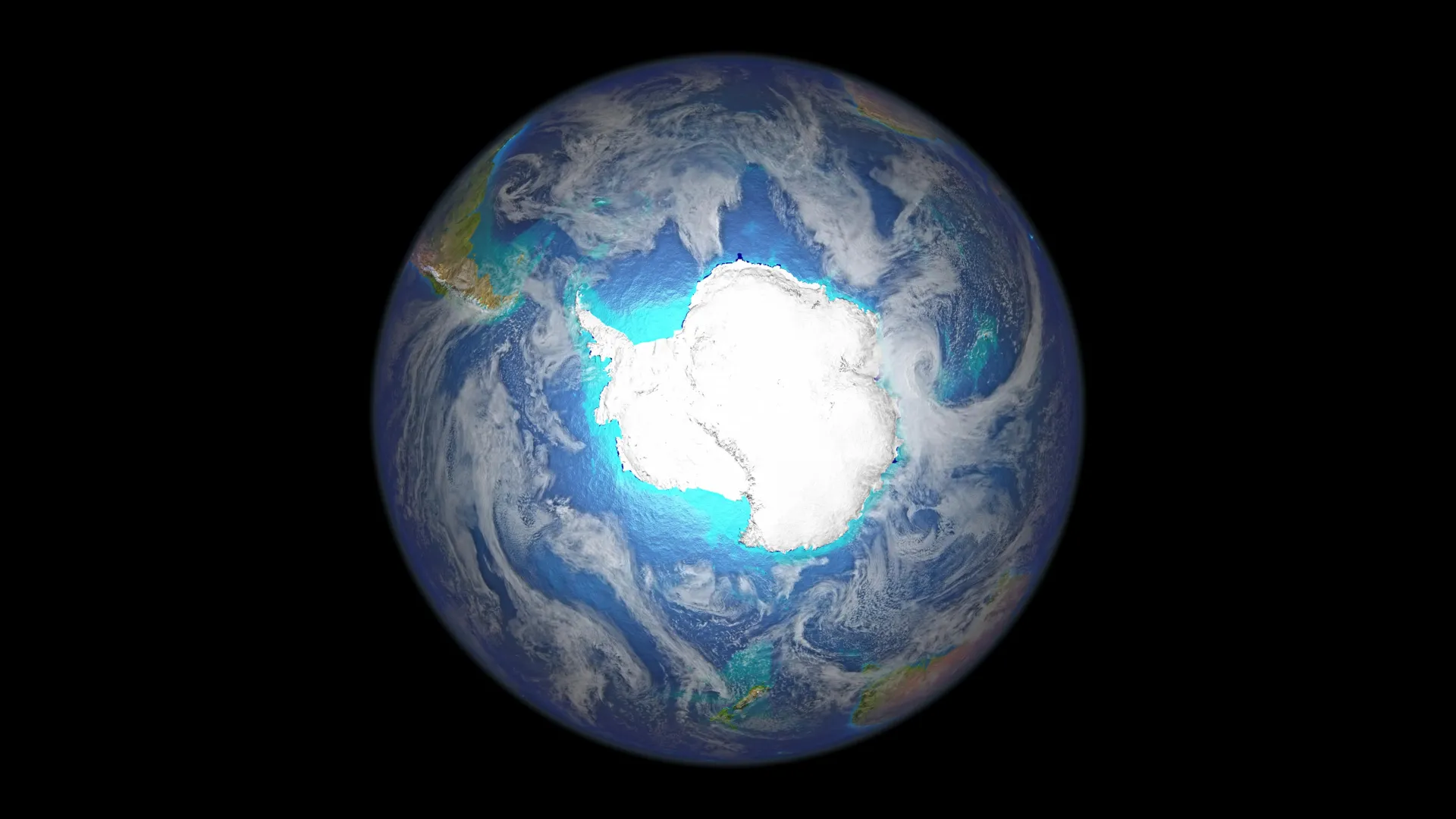
SEOUL, SOUTH KOREA — In a discovery that fundamentally reshapes our understanding of planetary mechanics and ancient climatology, a new study published in the prestigious journal Nature Geoscience reveals that the Antarctic ice sheet underwent a violent and dramatic metamorphosis roughly one million years ago. According to the research, the Earth’s largest mass of locked freshwater shifted from a relatively stable, sluggish behemoth into a hyper-responsive entity, acutely sensitive to the subtle rhythms and shifts of global climate forcing.
The groundbreaking research was spearheaded by an international team of scientists at the IBS Center for Climate Physics (ICCP), located at Pusan National University in South Korea. By peering deep into the climatic history of the Pleistocene epoch, the team has not only resolved a decades-long geological mystery regarding how the Southern Hemisphere’s ice reacted to ancient global cooling, but they have also sounded a sobering alarm regarding the future stability of the world’s coastlines.
As global leaders grapple with modern anthropogenic warming and accelerating sea-level rise, this study serves as a stark reminder that Earth’s cryosphere does not always retreat or advance in a slow, predictable linear fashion. Instead, ice sheets are capable of crossing critical tipping points, shifting abruptly into states of heightened vulnerability.
Main Facts: Unlocking the Secrets of the Mid-Pleistocene Transition
At the heart of the research is the Mid-Pleistocene Transition (MPT), a major climatic upheaval that occurred between 1.2 million and 700,000 years ago. During this epochal window, the rhythm of Earth’s ice ages fundamentally transformed. Prior to the MPT, global glacial cycles were relatively brief and mild, occurring roughly every 41,000 years, largely dictated by changes in the tilt of Earth’s axis. However, following the transition, these cycles lengthened significantly—stretching out to approximately 100,000 years—and grew substantially colder, harsher, and more expansive.
While geologists and paleoclimatologists have long known about the MPT through deep-sea sediment cores and ice-core analyses, the precise behavior of the Antarctic ice sheet during this pivotal era remained shrouded in mystery.
The new ICCP study establishes several critical takeaways:
- The Threshold Effect: When atmospheric carbon dioxide ($CO_2$) levels dropped below a critical threshold of approximately 240 parts per million (ppm), the Antarctic ice sheet crossed a tipping point.
- Amplified Sensitivity: Post-transition, the ice sheet ceased its sluggish behavior and became vastly more responsive to external climate forcing, fluctuating dramatically in volume with every push and pull of ocean and atmospheric temperatures.
- Complex Feedback Loops: The rapid expansion of ice was not driven by a single factor, but rather by a complex web of marine, atmospheric, and tectonic-isostatic feedbacks that locked the planet into its modern, intense glacial cycles.
- Modern Implications: Because ice sheets can experience nonlinear, abrupt shifts in sensitivity, modern projections of sea-level rise may need to account for hidden thresholds that, once crossed, could accelerate ice loss far beyond current expectations.
Chronology: Reconstructing Three Million Years of Earth History
For decades, one of the greatest roadblocks in polar science was the absolute scarcity of high-resolution, long-term climate records capable of testing how massive ice sheets behaved under ancient, radically different global conditions. Proxy data from ice cores can only peer back about 800,000 years, leaving the crucial window of the Mid-Pleistocene Transition largely obscured.
To shatter this scientific barrier, the ICCP research team deployed a state-of-the-art paleoclimate simulation, a computational marvel recently developed at the South Korean institute. This model successfully reconstructed global climate patterns, temperatures, and precipitation across an expansive three-million-year timeline.
The chronological reconstruction and methodological workflow unfolded through several distinct phases:
Phase 1: High-Resolution Paleoclimate Modeling
The team fed the multi-million-year global climate data into the advanced Penn State University ice-sheet-ice-shelf model. This sophisticated software is designed to track minute changes in ice sheet movement, internal temperatures, surface elevation, and thickness across both Antarctica and the Northern Hemisphere. Crucially, the model also simulates the complex, highly dynamic behavior of floating ice shelves, including those tethered to the massive Ross and Weddell Seas.
Phase 2: Supercomputing Powerhouses
Running a simulation of this magnitude requires staggering computational muscle. Utilizing one of South Korea’s premier supercomputers dedicated exclusively to basic science research, the team crunched petabytes of data. This generated a physically consistent, continuous picture of how Earth’s major ice sheets evolved, grew, and fractured as atmospheric and oceanic conditions shifted over the course of three million years.
Phase 3: Pinpointing the Transition
By analyzing the output of these comprehensive simulations, the researchers were able to virtually step back in time. They watched as the Antarctic ice sheet crossed the critical MPT threshold. Before this period, the ice sheet was constrained by warmer baseline temperatures and higher atmospheric greenhouse gas concentrations. As global cooling progressed and atmospheric $CO_2$ plunged below the 240 ppm mark, the simulations showed a stark divergence: the ice sheet began expanding aggressively and fluctuating wildly in tandem with orbital-scale climate cycles.
Supporting Data and Mechanisms: Why Antarctic Ice Expanded Rapidly
The simulation data provided a microscopic look at the physical mechanics that allowed Antarctic ice to expand so aggressively during the MPT. The researchers identified a powerful feedback loop driven by the interaction between the ocean, the atmosphere, and the solid Earth beneath the ice.
1. Sub-Ice Melting Reductions
During the deep glacial periods of the MPT, global ocean temperatures plummeted. This cooling had an immediate, profound effect on the ocean waters circulating beneath the massive floating fringes of the Antarctic ice sheet—the ice shelves that extend far out into the Southern Ocean. With colder water washing over their underbellies, basal melting slowed to a crawl. This preservation of ice shelf mass acted as a stabilizing buttress, holding back the immense flow of grounded interior ice and allowing the continent’s ice sheets to thicken and march outward toward the continental shelf breaks.
2. Glacial Isostatic Adjustment (Bedrock Uplift)
Simultaneously, the planet experienced a massive redistribution of water. As immense volumes of water were locked up into continental ice sheets across the Northern and Southern Hemispheres, global sea levels dropped by an astonishing 50 to 100 meters compared to modern levels.
This dramatic fall in sea level removed an immense weight of water from the ocean floor, particularly along the margins of Antarctica. Relieved of this hydrostatic pressure, the bedrock beneath the floating and grounded Antarctic ice shelves began to slowly rebound and rise upward—a process known as glacial isostatic adjustment. This tectonic-isostatic uplift provided a shallow foundation that physically supported further thickening and stabilization of coastal ice, anchoring the expanded ice sheets firmly in place for millennia.
Official Responses and Expert Insights
The study has generated immense discussion within the global cryospheric and paleoclimate communities, underscoring the vital role that South Korean research institutions are now playing in frontier Earth sciences.
Dr. Kyung-Sook Yun, a researcher at the IBS Center for Climate Physics and the lead author of the study, emphasized the non-linear nature of the discoveries.
"After this transition, the Antarctic ice sheet reacts much more strongly to changes in climate forcing," Dr. Yun explained. "This indicates that the system does not evolve gradually, but instead becomes more responsive after crossing a particular threshold in the climate system."
Professor Axel Timmermann, Director of the IBS Center for Climate Physics and co-author of the research, pointed out the ominous parallels between ancient transitions and modern global warming trends.
"Our findings suggest that the Antarctic ice sheet was more sensitive to external forcings than previously assumed," Prof. Timmermann warned. "This also raises important questions about its future response to global warming."
Independent glaciologists not involved in the study have praised the research for its methodological rigor. By successfully bridging the gap between paleoclimate data and high-performance ice sheet modeling, the ICCP team has provided the scientific community with a new benchmark tool for testing polar resilience.
Implications: A Warning for Future Sea-Level Rise
While the events described in the study took place hundreds of thousands of years ago, their implications for the modern world are both profound and deeply unsettling.
For generations, public discourse and even early climate models often treated ice sheets as sluggish, stubborn blocks of ice that would take millennia to respond to shifts in atmospheric chemistry. Ice was viewed as slow to melt, slow to retreat, and bound by gentle, predictable linear trajectories.
The Nature Geoscience study shatters this comforting assumption. By demonstrating that the Antarctic ice sheet possesses critical tipping points—thresholds where a seemingly stable system can suddenly flip into a state of heightened sensitivity—the research warns that modern anthropogenic emissions could push the polar ice sheets into uncharted and volatile territory.
Today, atmospheric carbon dioxide levels have soared past 420 ppm, far eclipsing the 240 ppm threshold that governed the MPT. While the ancient transition was driven by a drop in greenhouse gases leading to glaciation, the underlying lesson of the physics remains identical: Earth’s climate and cryosphere systems are dominated by non-linear tipping points.
If Antarctica’s modern ice sheet crosses critical thermal thresholds under the weight of current global heating, the resulting response may not be a slow, manageable trickle of meltwater. Instead, it could trigger rapid, dynamic collapses of marine-terminating ice shelves and accelerated sliding of interior glaciers. With hundreds of millions of people currently residing in low-lying coastal mega-cities across the globe, understanding these abrupt historical transitions is no longer just an academic exercise in ancient history—it is a vital roadmap for humanity’s coastal future.
