

Published: September 30, 2026
From the Yoga Journal Archives (Originally published in the November–December 1982 issue)
Main Facts
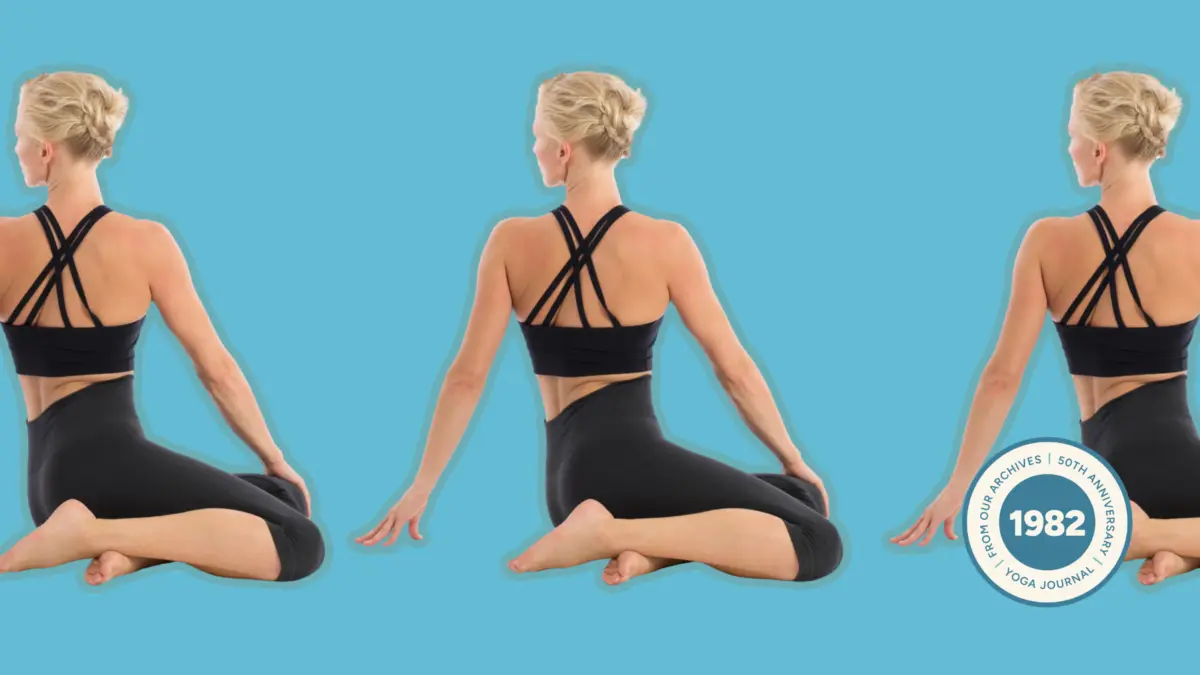
In the expansive landscape of yoga asana, spinal twists occupy a unique, restorative position. Among them, Seated Twist—known by its Sanskrit name, Bharadvajasana (named after the revered sage and character from the Indian epic the Mahabharata)—stands out as a foundational beginning-level posture. Historically celebrated for its remarkable accessibility, this pose is uniquely adaptable for practitioners with limited flexibility, older adults, and pregnant students.
At its core, Bharadvajasana stretches the intricate network of ligaments binding the vertebrae together, fostering a greater, healthier range of motion across all vertebral segments. This enhanced mobility not only eliminates minor, persistent areas of muscular and fascial tightness that impair posture, but it also frees the practitioner to move through more complex asanas with grace and safety.
However, mastering the pose requires an acute understanding of alignment—specifically, keeping a level base. The foundational mechanics of the posture demand that both buttocks remain anchored to the floor while the pelvis softly engages in the rotation. Far from being a rigid physical exercise, the classical approach to Bharadvajasana, deeply rooted in the teachings of legendary yoga master B.K.S. Iyengar, treats the asana as a moving meditation. It bridges anatomical precision with a profound philosophical framework of surrender, patience, and self-realization.
Chronology
To understand the enduring relevance of Bharadvajasana, it helps to trace its journey from ancient narrative roots to modern pedagogical frameworks:
- Ancient Epochs: The posture takes its name from the sage Bharadvaja, a central figure in the Mahabharata and a legendary Vedic poet. The asana itself evolved through oral and experiential traditions as part of classical hatha yoga, designed to prepare the body for extended periods of seated meditation.
- The Mid-20th Century Revival: The global popularization of yoga brought traditional seated twists to Western practitioners. Groundbreaking texts such as B.K.S. Iyengar’s Light on Yoga (first published in 1966) meticulously codified the alignment, therapeutic benefits, and structural nuances of Bharadvajasana, establishing it as a staple in modern syllabi.
- December 1982: Yoga Journal published a definitive guide on the mechanics, anatomical safety, and philosophical underpinnings of the Seated Twist, emphasizing the critical protection of the sacroiliac joint and shifting the cultural paradigm away from forced stretching toward mindful release.
- Present Day (2026): As part of Yoga Journal’s ongoing Archives series, the foundational insights from 1982 are revisited. In an era dominated by high-intensity fitness trends and hyper-extended flexibility goals, the teachings of Bharadvajasana offer a vital counter-movement toward somatic awareness, joint longevity, and injury prevention.
Supporting Data & Anatomical Insights
The human spine is a marvel of engineering, yet it is profoundly vulnerable to compensatory tension when surrounding joints are restricted. To safely execute a spinal twist, practitioners must decode the complex interplay between the pelvis, hips, shoulders, and vertebrae.
Protecting the Sacroiliac (S-I) Joint
The pelvis serves as the vital communicating link between the trunk (the spinal column) and the lower extremities (the legs). It connects to the hip joints at its lower end and the sacrum at its upper end.
When a student attempts to twist the spine while holding the pelvis rigidly stationary, severe torque is generated at the sacroiliac (S-I) joint. Because the S-I joint possesses relatively little structural support from surrounding soft tissues, this artificial force can lead to chronic strain, discomfort, or injury.
This anatomical reality is especially critical for female practitioners. Women are statistically more susceptible to S-I strain due to several biological factors:
- The female pelvis is structurally less deep.
- It inherently lacks the density and stability found in the male S-I joint.
- Hormonal fluctuations associated with menstruation, pregnancy, and lactation naturally loosen the ligamentous support structures surrounding the joint.
To safeguard the pelvis, the base of the movement must remain level to the floor. By allowing the pelvis to move smoothly into the twist as an organic continuation of the spinal column—rather than keeping it locked—practitioners completely eliminate dangerous torque at the S-I junction.
Freeing the Girdles: Shoulders and Hips
The health and suppleness of the spine are inextricably linked to the freedom of the shoulder and pelvic girdles. Major joint restrictions inevitably trigger spinal compensation:
- Tight shoulders cause an individual to slouch, throwing the thoracic spine out of alignment.
- Unevenly tight hips often result in an excessive inward curve of the lower back (lordosis).
When any single portion of the spinal column is disturbed, the entire structural chain must compensate to keep the body upright. Conversely, when the shoulder and hip joints are liberated from chronic holding patterns, spinal asymmetries dissolve. The spine naturally "springs" back into its optimal, gently curving shape—a physiological truth that applies not only to Bharadvajasana and other twists, but to the entire spectrum of yoga practice.
Philosophical Implications: Surrender Over Force
Modern fitness culture frequently approaches physical disciplines as artificial frameworks forced upon an unwilling body and mind to achieve an aesthetic ideal. Yoga, however, challenges this transactional paradigm.
While authentic yoga practice demands rigorous discipline, that discipline does not stem from aggressive physical molding or coercion. Instead, true discipline is found in the art of letting go. Yoga does not seek to alter the path of the self; rather, it clears away the internal and external roadblocks that obscure the journey. Through asana practice, one does not transform into someone else—they simply become more fully themselves.
Classical yoga philosophy teaches that humanity embodies the eternal Atman—the spark of the divine residing within. To believe one can or should force this divine vehicle into an artificial shape is an expression of asmita (egoism), one of the most formidable obstacles on the spiritual path.
The Physical and Mental Expression of Surrender
- Physical Surrender: Manifests not as weakness, but as softness and structural ease.
- Mental Surrender: Manifests through the breath, specifically the exhalation.
When practicing Bharadvajasana, every phase of movement should unfold gradually, paired with a slow exhalation that allows the spinal column to adjust organically. By blending persistence with patience, the asana ceases to be an act of physical imposition and instead becomes a natural expression of a harmonious body and mind.
Step-by-Step Guide: How to Practice Seated Twist (Bharadvajasana)
For those seeking to integrate this restorative posture into their regular routine, follow these classical instructions adapted from the archives:
- Initial Setup: Sit comfortably on the floor with both legs extended straight out in front of you.
- Leg Placement: With a slow exhalation, bend both knees and sweep them to the left side of your buttocks. Carefully tuck your left ankle into the natural arch of your right foot.
- Anchoring the Base: Ensure both buttocks remain firmly connected to the floor. If one buttock elevates, it is far better to allow the knees to widen slightly or to place a folded yoga mat/blanket beneath the lifted (right) buttock for support.
- Arm and Shoulder Action (Right Side): Exhaling deeply, lift your right arm straight up toward the ceiling. Keeping the arm elevated and away from the floor, sweep it around your back to catch your left arm just above the elbow. Ensure you roll your right shoulder outward rather than letting it collapse inward toward your chest.
- Arm and Shoulder Action (Left Side): Reach your left arm across your body, placing the palm face-down and hooking it firmly beneath the outside of your right knee.
- Initiating the Twist: Keeping your buttocks level on the floor while allowing your left pelvis to slide forward organically, initiate the twist from the base of the spine. Move slowly to the right, strictly timing all movements with your exhalations.
- Head and Gaze: Your head can turn naturally with the spinal rotation, or you may look back over your left shoulder, ensuring your eyes remain parallel to the horizon.
- Completion: Hold the posture for several steady breaths. Exhale as you slowly unwind and return to center. Repeat the entire sequence on the opposite side.
A Note to Teachers and Instructors
Yoga educators play a pivotal role in keeping students safe while facilitating deep somatic exploration. Bharadvajasana is exceptionally versatile, offering unique variations for diverse student populations:
- Utilizing the Wall for Beginners: Instructors can have beginner students practice the pose facing a wall. The student sits with their shoulders positioned at a right angle to the wall at shoulder height, standing slightly farther apart than shoulder-width. On an exhalation, students press gently against the wall to initiate the twist.
- Therapeutic Benefits for the Midback: The wall-assisted variation is particularly effective for targeting the thoracic (midback) region, an area where modern students frequently accumulate chronic tension and immobility due to desk work and device usage.
- Support for Pregnancy: During the later stages of pregnancy—when traditional deep twists are contraindicated due to abdominal restriction—the wall-assisted Seated Twist offers pregnant students a safe, effective alternative. It provides the precise leverage needed for spinal mobility without placing pressure across the developing abdomen.
- Correcting Asymmetries: Instructors should continuously monitor pelvic alignment. If a student struggles with uneven buttocks, the strategic use of a folded blanket or adjusted sitting posture will preserve the integrity of the sacroiliac joint and foster a sustainable, pain-free practice.
Acknowledgement: The foundational instructional principles and anatomical insights embedded within this retrospective feature draw inspiration from the teachings of B.K.S. Iyengar and his masterwork, Light on Yoga.
