

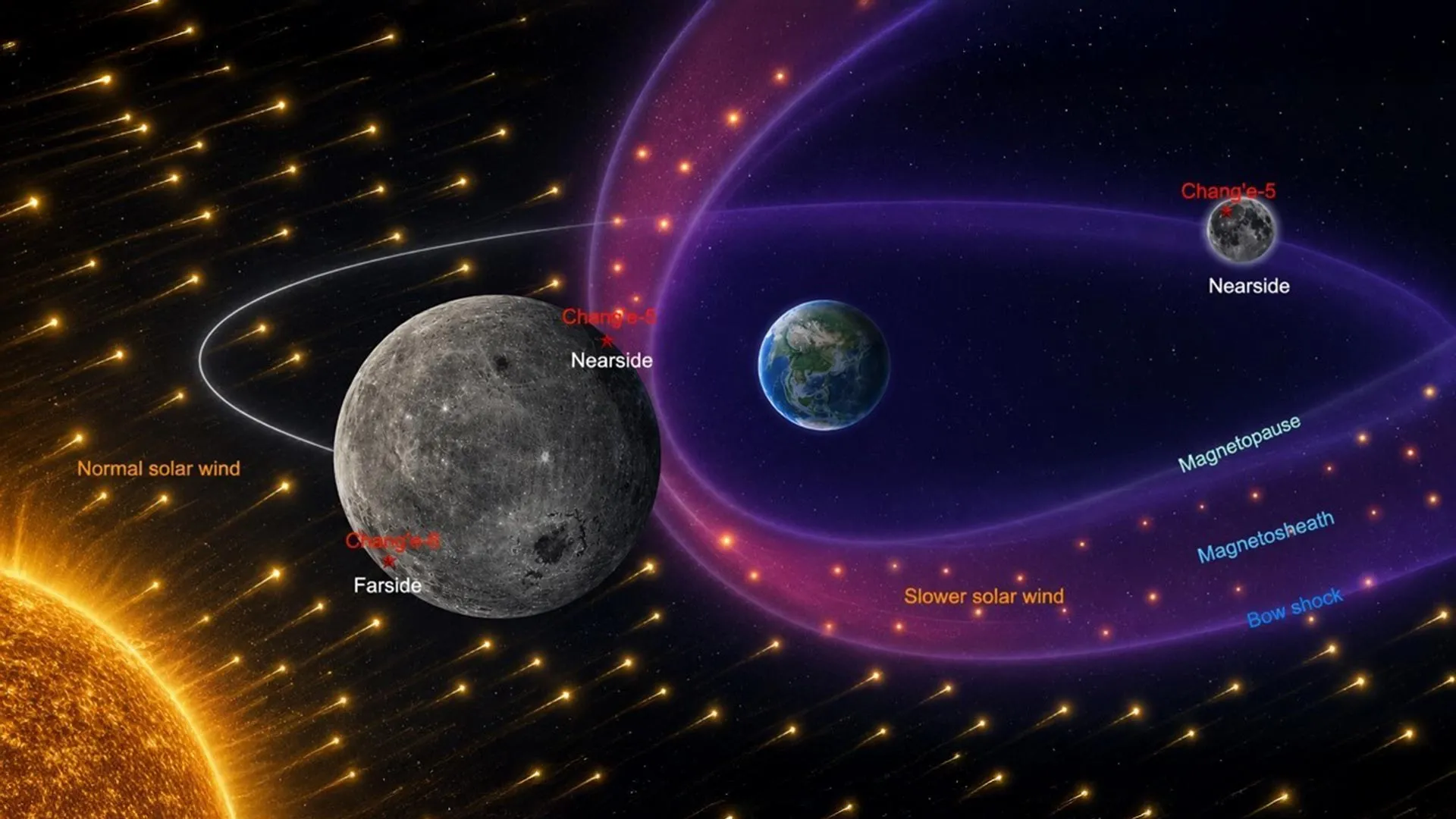
Main Facts
For billions of years, the Moon has stood as a silent, unshielded sentinel in the vacuum of space, enduring an unceasing, high-speed gale of charged particles streaming from the Sun. Devoid of a dense atmosphere or a global intrinsic magnetic field to deflect this cosmic onslaught, the lunar surface is constantly peppered by the solar wind. However, groundbreaking new research reveals a profound cosmic asymmetry: the Moon’s near side and far side have not experienced this relentless bombardment in the same way.
According to a landmark study recently published in the prestigious journal Nature Geoscience, particles striking the lunar near side and far side arrive at vastly different speeds, carry distinct levels of energy, and leave behind drastically unique chemical footprints. An international team of scientists—led by researchers from the Institute of Geology and Geophysics (IGG) of the Chinese Academy of Sciences (CAS)—discovered that this striking hemispheric contrast is orchestrated by Earth itself. Specifically, our planet’s colossal magnetic bubble, the magnetosphere, acts as an invisible speed governor, selectively slowing down solar wind particles before they strike the face of the Moon that always looks toward home.
This revelation was made possible by analyzing pristine lunar material returned by China’s historic Chang’e 6 mission. By comparing these far-side samples with near-side samples previously brought back by the Chang’e 5 mission, scientists have obtained the first direct physical evidence of how Earth’s magnetic field fundamentally alters the space environment surrounding our celestial neighbor. The findings not only rewrite our understanding of space weathering on airless bodies but also open an unprecedented window into reconstructing the ancient history of Earth’s magnetic shield.
Chronology
To understand how scientists unlocked this cosmic mystery, it is helpful to trace the timeline of discovery, technological milestones, and analytical breakthroughs that led to this pivotal moment in planetary science.
The Decades of One-Sided Exploration
For decades, humanity’s understanding of the lunar surface was strictly limited to what could be observed, sampled, and analyzed from the Moon’s near side—the hemisphere locked in a synchronous orbit, perpetually facing Earth. During the Apollo and Luna eras of the late 1960s and 1970s, followed by decades of orbital remote sensing, scientists gathered a wealth of data regarding solar wind implantation. They understood that noble gases like helium, neon, argon, krypton, and xenon—chemically inert elements that do not react with surrounding minerals—were trapped securely inside the top layers of the lunar regolith (soil).
These noble gases served as a natural archive, recording the history of the Sun. Yet, a glaring scientific blind spot persisted. Because no sample return missions had ever successfully touched down on the rugged, heavily cratered lunar far side, researchers had no way to perform direct, laboratory-grade comparisons to test whether solar wind particles hit both hemispheres equally. Theoretical models hinted at differences caused by Earth’s magnetic wake, but without physical far-side samples, these hypotheses remained unproven.
The Chang’e 6 Breakthrough
The turning point arrived in mid-2024 with the triumph of China’s Chang’e 6 mission. Venturing into the South Pole-Aitken basin—one of the largest, deepest, and oldest impact craters in the entire solar system, located squarely on the lunar far side—the spacecraft executed a flawless landing, scooped up precious regolith, and successfully launched the samples back to Earth.
In total, Chang’e 6 delivered 1.935 grams of far-side soil to scientists on Earth. While seemingly modest in weight, this physical treasure trove provided the exact missing puzzle piece. For the first time, researchers had in their possession a pristine archive of solar wind interactions from the hemisphere of the Moon that never sees Earth.
Laboratory Analysis and the "Speed-Governing" Discovery
Following the secure delivery of the samples, a dedicated team led by postdoctoral researcher Xuhang Zhang and supervised by Professor He Huaiyu at the Institute of Geology and Geophysics (CAS) launched an intensive analytical campaign. Collaborating with colleagues from the University of Science and Technology of China and members of the Chang’e 7 volatile payload team, the researchers deployed high-precision mass spectrometry to measure the concentrations and isotopic compositions of helium, neon, argon, krypton, and xenon trapped within the regolith grains.
As the data rolled in, the chronological sequence of discovery accelerated. First, distinct isotopic ratios in neon revealed severe fractionation on the far side. Second, step-heating experiments tracking xenon release showed deep, high-energy particle penetration unique to the far-side soil. Finally, synthesizing these clues with orbital mechanics of the Earth-Moon system, the team realized they were tracking the physical signature of Earth’s magnetosheath. The chronology shifted from a simple collection of extraterrestrial dust to a comprehensive mapping of Earth’s magnetic influence across deep space.
Supporting Data
The conclusions published in Nature Geoscience are anchored in rigorous quantitative data gathered from sophisticated laboratory instruments. The physical differences between near-side and far-side regolith provide undeniable proof of differential solar wind bombardment.
Neon Isotopes and Isotopic Fractionation
One of the most immediate indicators of differing solar wind exposure appeared in neon isotope measurements. Neon has two primary stable isotopes found in solar wind: $^20textNe$ and $^22textNe$. Lighter isotopes are typically more volatile and susceptible to thermal or physical alteration, a process known as isotopic fractionation.
- Chang’e 6 Far-Side Data: The regolith retrieved from the South Pole-Aitken basin yielded an average $^20textNe/^22textNe$ ratio of 11.34 ± 0.22.
- Comparison with Near-Side Samples: This value is substantially lower than measurements recorded in all previously studied near-side lunar soils.
- Theoretical Alignment: The 11.34 ratio closely matches the theoretical composition predicted by astrophysicists for extreme solar wind fractionation. This indicates that the far side experienced an unmitigated, highly energetic bombardment that drove pronounced isotopic sorting.
Krypton, Xenon, and Thermal Release Patterns
Heavier noble gases like krypton and xenon provided crucial insights into the kinetic energy of the incoming solar wind particles. When lunar soil is subjected to controlled, stepwise heating in a laboratory, trapped gases are released at specific temperature thresholds depending on how deeply they are embedded in the mineral grains.
- The Near-Side Pattern (Chang’e 5): Previous analyses of Chang’e 5 samples from the near side revealed a bimodal release pattern for xenon, with substantial amounts being liberated at both low and high temperatures. This suggested shallower implantation, where many particles remained trapped near the surface grains where they could be easily dislodged or affected by secondary space weathering.
- The Far-Side Pattern (Chang’e 6): In stark contrast, xenon extracted from the Chang’e 6 far-side material was released almost exclusively at high temperatures, forming a single, pronounced peak.
- Physical Implication: In planetary science, deeper particle implantation requires higher kinetic energy. The single high-temperature peak demonstrates that solar wind particles penetrated much deeper into the crystalline lattices of the far-side regolith, proving they arrived with greater speed and energy than their near-side counterparts.
Quantifying Earth’s Braking Effect
The research team quantified the spatial extent of Earth’s interference by examining the orbital dynamics of the Moon. As the Moon executes its monthly orbit around Earth, it spends a significant portion of its time passing through the magnetosheath—a turbulent buffer zone surrounding Earth’s primary magnetosphere.
- Solar Wind Deceleration: Within the magnetosheath, the solar wind—which typically hurtles through interplanetary space at an average velocity of roughly 400 kilometers per second (km/s)—is dramatically decelerated down to approximately 200 km/s.
- Near-Side Exposure: Because the near side of the Moon faces Earth, it routinely plunges into this slowed-down plasma flow. Consequently, lower-energy particles lack the velocity to penetrate deep into the regolith, resulting in shallower implantation and different isotopic signatures.
- Far-Side Isolation: Conversely, the far side of the Moon remains completely shielded from this terrestrial speed-governing effect. Because it faces outward into the interplanetary void, it is continuously battered by the full, uninterrupted force of the pristine solar wind.
- Proportional Impact: Researchers estimate that approximately 25% of the total solar wind exposure recorded at the Chang’e 5 near-side landing site was subjected to this slower, buffered flow. In contrast, the Chang’e 6 far-side site showed zero evidence of receiving this protective, braking influence.
Official Responses and Expert Insights
The publication of these findings has generated substantial excitement within the global planetary science community, prompting enthusiastic commentary from the study’s authors and independent space researchers alike.
Perspectives from the Lead Investigators
Xuhang Zhang, the lead author of the study and a postdoctoral researcher at IGG, emphasized the profound nature of discovering Earth’s signature imprinted on an alien world.
"For decades, we treated the Moon as a passive recorder of solar activity, assuming that all parts of its surface experienced the solar wind in roughly the same manner," Zhang noted during a media briefing discussing the paper. "What these far-side samples have shown us is that Earth is an active participant in shaping the lunar environment. We are not just looking at a solar record; we are looking at a combined record of the Sun and Earth interacting across tens of thousands of kilometers of space."
Professor He Huaiyu, who supervised the research at the Chinese Academy of Sciences, highlighted the technical precision required to extract these answers from less than two grams of dust.
"The noble gases are exceptionally shy markers—they do not bond chemically, which makes them pristine messengers, but it also makes them incredibly challenging to interpret without absolute precision," Professor He explained. "By deploying state-of-the-art mass spectrometry on the Chang’e 6 material, our team was able to untangle the thermal release peaks of xenon and neon with a degree of accuracy that simply wasn’t possible during the Apollo era. This work validates the immense scientific value of far-side sample return missions."
Broader Scientific Acclaim
International planetary scientists not directly involved in the study have also praised the research for opening new pathways in comparative planetology. Dr. Elena Vance, a senior researcher in lunar geology who reviewed the findings, noted that the study bridges a critical gap between space physics and traditional geology.
"We’ve known theoretically that Earth’s magnetosphere has a vast tail and a turbulent sheath extending far out into cislunar space," Dr. Vance said. "However, having physical, ground-truth data from the lunar far side that proves this magnetic shield acts as a literal speed governor on solar particles is a major milestone. It changes how we model space weathering not just on the Moon, but on any moon or asteroid orbiting a magnetized parent planet in our solar system or beyond."
Implications
The confirmation that Earth’s magnetosphere fundamentally dictates the nature of solar wind bombardment on the lunar far side carries wide-ranging implications for multiple branches of science, ranging from astrophysics to the future of human space exploration.
A New "Fossil Record" for Earth’s Magnetic History
Perhaps the most exciting implication of the study is the potential to use lunar soil as a deep-time archive of Earth’s own geological evolution. Earth’s magnetic field is not static; it fluctuates in intensity, shifts its magnetic poles, and has evolved dramatically over the course of 4.5 billion years. However, finding direct geological evidence of Earth’s ancient magnetic field strength—especially from billions of years ago—is notoriously difficult because plate tectonics and erosion constantly recycle and destroy Earth’s crustal rocks.
The researchers propose that the heavy noble gases trapped within deep lunar regolith layers could act as "fossil records" of historical interactions between the solar wind and Earth’s magnetosphere. As the strength or geometry of Earth’s magnetic shield changed in the deep past, the boundaries and density of the magnetosheath would have shifted accordingly, altering the deceleration profile of solar particles hitting the Moon. By dating older stratigraphic layers of lunar regolith—particularly on the far side where the pristine baseline can be accurately subtracted—scientists may soon possess a novel way to reconstruct the paleomagnetic history of our home planet over billions of years.
Redefining Space Weathering and Resource Utilization
For decades, lunar scientists have studied space weathering—the process by which micrometeorites and solar wind alter the optical, chemical, and physical properties of surface dust. Understanding that space weathering operates differently on the near side versus the far side means that future lunar explorers cannot assume uniform soil conditions across the globe.
- Volatile Distribution: Solar wind implantation is a primary delivery mechanism for hydrogen, helium, and other volatiles to the lunar surface. Because these elements are implanted at different depths and energy levels depending on whether the region experiences Earth’s magnetosheath, the concentration and extraction potential of vital resources (such as hydrogen for water production) will vary systematically across the Moon.
- In-Situ Resource Utilization (ISRU): As space agencies and commercial entities plan for sustainable human outposts on the Moon, mapping the distribution of trapped volatiles is essential. The insights gained from Chang’e 6 provide a more sophisticated predictive model for where high-value trapped solar wind elements are most heavily concentrated.
A Complex Sun-Earth-Moon Nexus
Ultimately, this research demonstrates that the relationship binding the Sun, Earth, and Moon is far more intricate than textbooks previously portrayed. The Moon is not merely orbiting in empty space; it is dynamically interacting with Earth’s invisible magnetic armor every single month. By unlocking the microscopic secrets buried within 1.935 grams of far-side dust, science has taken a monumental step forward, proving that the silent, cratered face of the Moon holds active, living testimony to the protective power of our living planet.
