

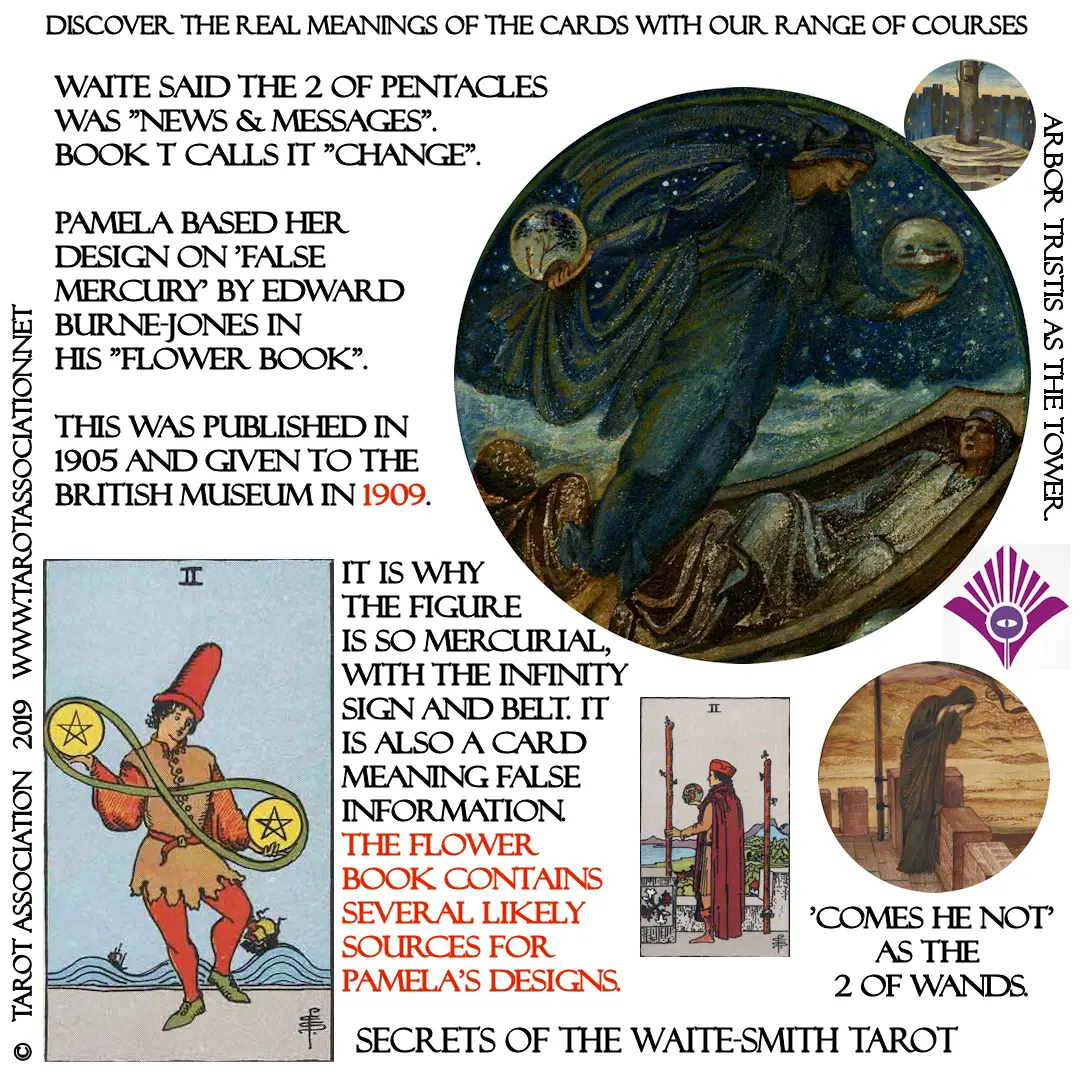
LONDON — For generations, modern tarot enthusiasts have looked at the Two of Pentacles and seen a familiar, albeit stressful, slice of everyday life. Commonly depicted as a figure juggling two coins amidst the rolling waves of an uncertain sea, the card has long been interpreted as a straightforward message regarding time management, financial budgeting, and the delicate balancing act required to keep multiple life domains afloat.
However, recent historical research into the foundational roots of the Rider-Waite-Smith deck suggests that practitioners have fundamentally misunderstood this iconic card for over a century. Far from being merely about balancing a checkbook or managing a busy schedule, the Two of Pentacles carries a much darker, more psychological subtext. According to newly resurfaced artistic influences and esoteric texts, it is, in fact, tarot’s original "gaslighting" card—a symbol rooted in deception, mercurial misdirection, and conflicting communication.
Main Facts: Unmasking the "Lord of Harmonious Change"
At its core, the modern consensus on the Two of Pentacles focuses on adaptability amid fluctuating circumstances. Yet, historical scrutiny reveals a stark divergence between contemporary pop-tarot readings and the esoteric foundations established by the Hermetic Order of the Golden Dawn, whose teachings shaped the modern tarot landscape.
In the Golden Dawn’s foundational Book T—the secret instruction manual that heavily influenced both A. E. Waite and Aleister Crowley—the card is officially titled the "Lord of Harmonious Change." Its traditional divinatory meanings paint a picture far more volatile than simple time management:
- Alternation of gain and loss, weakness and strength
- Wandering and discontent with any fixed condition
- Being industrious yet unreliable, and alternatingly talkative and suspicious
- Kind yet wavering, inconsistent, and intensely argumentative
This duality stems from the card’s complex astrological and Kabbalistic correspondences. Tied to Chockmah of Assiah (the Wisdom of Action on the Tree of Life) and the decan of Jupiter in Capricorn, the Two of Pentacles represents a rolling, transitional shift between currents—a dynamic that is vastly different from the static, fixed-axis spinning of the Wheel of Fortune or the measured pouring of Temperance.
When A. E. Waite drafted the Pictorial Key to the Tarot in 1909, he struggled to directly articulate these obscure Golden Dawn secrets. Instead, he categorized the card around a mixture of superficial gaiety and underlying trouble: “news and messages in writing, as obstacles, agitation, trouble, embroilment… Troubles are more imaginary than real.” In its reversed state, Waite warned of enforced gaiety, simulated enjoyment, bad omens, and injustice.
Waite’s shift away from pure physical balance toward conflicting communications and psychological trickery laid the groundwork for the true genius of the card’s visual design—a design engineered by artist Pamela Colman Smith, whose inspirations remained hidden in plain sight for more than a century.
Chronology: The British Museum, Edward Burne-Jones, and "False Mercury"
To understand how the Two of Pentacles acquired its psychological edge, one must trace a specific historical timeline connecting late-19th-century botanical illustration, British esoteric societies, and a fateful research trip to the British Museum.
- Pre-1909: Pre-Raphaelite artist Edward Burne-Jones privately prints and distributes a little-illustrated notebook filled with botanical and poetic drawings. In it, he visualizes the common folk names and Latin translations of herbs and flowers. Among them is Mercurialis perennis, commonly known as "Dog’s Mercury" or, more tellingly, "False Mercury." Unlike true mercury plants, this woodland perennial is notoriously and deceptively poisonous.
- 1909: Pamela Colman Smith and A. E. Waite visit the British Museum to draw inspiration for their collaborative deck, specifically studying the historic Sola Busca Tarot on display.
- 1909 (Late): Simultaneously, Burne-Jones’s private botanical notebook is officially donated to the British Museum, granting Smith direct access to its pages. Smith borrows Burne-Jones’s concept of "False Mercury"—a mercurial, illusionary figure—and adapts it into her now-famous illustration for the Two of Pentacles: a jugbler standing before a violently tossed ocean wave, presenting deceptive visions of safety and stability to distressed sailors.
- 1910: The Rider-Waite-Smith deck is published, cementing an image that visually coded maritime deception, unsteadiness, and false messaging into the very fabric of the minor arcana.
Supporting Data: Kabbalistic and Astrological Underpinnings
The esoteric machinery driving the Two of Pentacles relies heavily on the principles of planetary rulership and elemental manifestation.
| Esoteric Layer | Traditional Correspondence | Manifestation in the Two of Pentacles |
|---|---|---|
| Kabbalah | Chockmah of Assiah (Wisdom of Action) | The topmost pillar of force meeting the lowest of the four worlds; kinetic energy applied to material reality. |
| Astrology | Jupiter in Capricorn | "Expansion in Steadiness"—growth meeting structural boundaries, resulting in structural friction. |
| Elemental Ruler | Mercury (via botanical archetype) | Communication, intellect, trade, and swift movement—corrupted here into trickery and double-dealing. |
This data explains why the card oscillates so wildly in readings. Because Mercury rules communication, commerce, and information, a card tied to "False Mercury" inherently signals situations where the facts are being manipulated, words cannot be trusted, and individuals are being led down an illusory garden path.
Implications for Modern Tarot Readings
In contemporary practice, recognizing the Two of Pentacles as tarot’s original "gaslighting" card radically alters how readers should interpret it across various life domains. Moving past the superficial advice to simply "make a budget" or "slow down," modern practitioners are urged to look for deeper currents of manipulation and miscommunication.
Romance and Relationships
On the surface, the card highlights the give-and-take necessary to sustain a partnership. However, on a deeper level, it sounds an alarm bell against deliberate deception or gaslighting behavior. If a partner is playing hot and cold, or making you question your own perception of reality, the Two of Pentacles demands that you rigorously test the ground beneath your feet.
Finance and Resources
While budgeting is certainly implied, the presence of this card warns of financial sleight-of-hand. Someone may be misleading you regarding the true potential of an investment, a contract, or a joint venture. Verify all figures and refuse to rely on verbal assurances alone.
Career and the Workplace
When juggling multiple professional responsibilities, the card dictates that everything must be documented. Unclear directives or shifting goalposts in the workplace point to systemic miscommunication. Get verbal agreements in writing immediately to protect yourself from shifting corporate narratives.
Home, Education, and Spiritual Life
- Home: Juggling domestic duties requires establishing a functional rhythm, but watch out for family members shifting blame or failing to pull their weight while masking it as busyness.
- Education: Balance academic pursuits with external pressures, ensuring that your mental equilibrium is not being disrupted by outside misinformation or academic gaslighting.
- Spiritual Initiation: Representing Chockmah in Assiah, the initiate acts as a worker in the workshop—acknowledging the fundamental duality of the material world without falling victim to its illusions.
Official Responses and Yes/No Divinatory Consensus
Despite its underlying currents of deception, expert tarot analysts maintain that the Two of Pentacles remains an inherently dynamic, navigable card.
When framed as a Yes/No inquiry, the consensus among traditional and contemporary readers is a qualified YES. The overarching situation remains positive, but resolution will not come easily. Querents must brace for a series of pluses and minuses, progress and setbacks, approaches and retreats. Because the energetic vector ultimately leans toward long-term harmony, the final answer is affirmative—provided the individual refuses to be hoodwinked by false signals.
As the master maxim for the card dictates: "Balance your resources and keep it real during a period of positive change." In an age where digital communication is increasingly saturated with spin, misdirection, and psychological manipulation, the true, hidden message of the Two of Pentacles is more relevant today than it was when Pamela Colman Smith first sketched it in 1909.
