

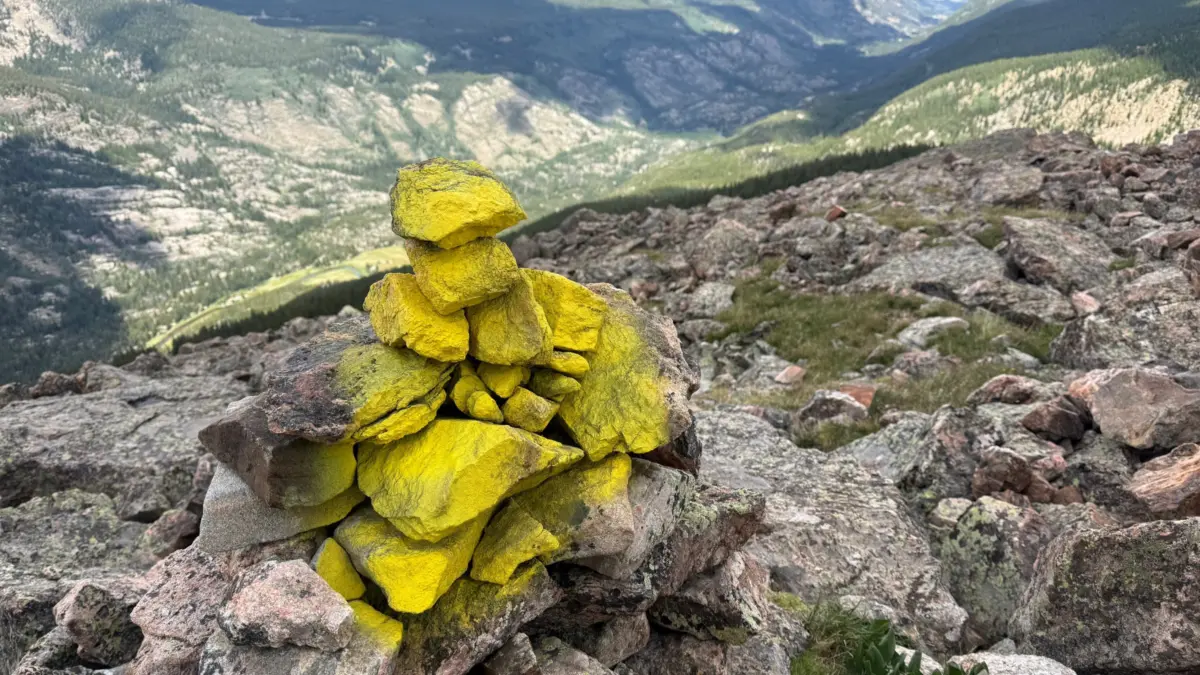
COLORADO — Federal authorities are actively investigating an act of severe environmental vandalism within a designated wilderness area in the Rocky Mountains. Rangers and conservation volunteers are facing a labor-intensive, delicate cleanup operation after unidentified individuals defaced natural trail markers on the iconic 14,005-foot Mount of the Holy Cross.
The incident, which came to light in late July 2026, involves at least five rock cairns that were heavily coated in bright-yellow spray paint. Conservation groups, land management agencies, and outdoor recreationists have universally condemned the act, highlighting the tensions between amateur trail intervention, federal wilderness regulations, and the preservation of pristine alpine ecosystems.
Main Facts
The core of the controversy centers on the defacement of foundational navigation tools in a fragile high-alpine environment.
- Location: Mount of the Holy Cross, a celebrated 14er (a peak exceeding 14,000 feet in elevation) located in Eagle County, Colorado, within the White River National Forest. Crucially, the mountain falls under congressionally designated wilderness protection, which imposes the strictest possible federal regulations on human modification of the landscape.
- The Damage: At least five traditional rock cairns—stacked piles of stones used by hikers to trace routes across boulder fields and tundra—were spray-painted a jarring, fluorescent yellow.
- The Perpetrators: Currently unidentified. However, eyewitness accounts submitted to conservation authorities have provided detailed descriptions of three suspects allegedly witnessed in the act weeks prior to its discovery.
- The Cleanup Dilemma: Because chemical pigments and binders in spray paint bond deeply to porous stone, standard scrubbing is often insufficient. Land managers and volunteers from the Colorado Fourteeners Initiative (CFI) must now painstakingly scrub the rocks or resort to burying hundreds of pounds of painted stone to completely remove the visual blight from the natural landscape.
- The Legal and Ethical Violation: Unauthorized modification of public lands is strictly prohibited. Operating without agency oversight bypasses environmental reviews, violates Leave No Trace ethics, and degrades the wilderness experience for all visitors.
Chronology of Events
While the discovery of the vandalism feels sudden, a timeline constructed from hiker reports and organizational alerts reveals that the alterations likely took place weeks before they were officially reported.
Early July 2026: The Act Is Committed
According to subsequent witness statements, the spray-painting likely occurred around July 11, 2026. Hiker Andrew Jahnke and his wife were descending from the summit of Mount of the Holy Cross when they encountered three men who appeared to have just finished applying bright paint to one of the trail’s signature cairns.
Jahnke provided a detailed description of the three suspects to advocacy groups:
- Suspect One: Estimated between 55 and 65 years old, sporting a white goatee, and wearing clothing styled to resemble a park ranger’s uniform, though noticeably devoid of formal official badges.
- Suspect Two: Estimated between the upper 60s and early 70s, clean-shaven, and dressed entirely in white.
- Suspect Three: Estimated in his 40s, wearing standard, non-descript hiking attire.
July 30, 2026: Discovery and Reporting
Weeks after the alleged vandalism took place, the situation came to official attention. The neighbor of a staff member for the Colorado Fourteeners Initiative (CFI) stumbled upon the altered cairns while hiking the peak and reported the defacement. CFI leadership was immediately notified, setting off an organizational response.
July 31, 2026: Public Outreach and Investigation
Lloyd Athearn, executive director of CFI, took to social media and media channels to publicize the event. In an email to Backpacker magazine and through public posts, Athearn detailed the extent of the damage. Simultaneously, the recreation staff officer at the U.S. Forest Service’s Minturn Ranger District was alerted, initiating an official federal investigation into the matter. Following CFI’s public call for information, Andrew Jahnke stepped forward to share his encounter from earlier in the month, providing investigators with critical eyewitness leads.
Supporting Data and Context
To understand why this incident has generated such intense blowback within the outdoor community, it is vital to examine the history of Mount of the Holy Cross and the philosophy of alpine trail management.
Navigational History of Mount of the Holy Cross
Mount of the Holy Cross has long been a revered, albeit challenging, destination for peak-baggers. In the early 2000s, land managers and conservation groups received numerous complaints from hikers struggling to navigate the complex descent from the summit. In response, the CFI meticulously established a defined summit trail, placing natural, unobtrusive navigational cairns to guide visitors safely without scarring the landscape. According to CFI, those strategic interventions successfully resolved wayfinding complaints for over two decades.
The Illusion of "Helpful" Vandalism
Speculation regarding the perpetrators’ motives points toward misguided benevolence—the belief that making trail markers brighter would prevent hikers from losing their way. However, wilderness experts aggressively reject this rationale.
"There was no need then and there is no need now for cairns to be painted bright colors," wrote Lloyd Athearn in a public statement. "Anyone who needs bright paint to navigate has no business being on the 14ers. Just stay home until you know how to climb them properly."
The Scale of Outdoor Graffiti
This incident is part of a broader, persistent nationwide challenge. From the red rock arches of Utah to the granite faces of the Sierra Nevada, public lands frequently suffer from unauthorized human marks. Whether it is hikers carving initials into trees, leaving permanent signatures with Sharpie markers on summit registers, or painting rocks, the underlying issue is the same: chemical permanence. Modern paints utilize synthetic binders and industrial pigments that resist natural weathering, meaning that once applied to alpine rock, they remain visible for decades unless manually remediated.
Official Responses and Perspectives
The discovery of the painted cairns triggered a sharp debate across online outdoor forums, forcing conservation leaders and land management representatives to draw bright lines between authorized environmental management and rogue alterations.
The Colorado Fourteeners Initiative (CFI)
CFI has taken a hardline stance against the vigilante painters. Executive Director Lloyd Athearn emphasized the sanctity of congressionally designated wilderness areas—the highest level of federal protection afforded to public lands. Athearn noted that it is completely unacceptable for private citizens to unilaterally decide that a landscape requires modification, regardless of their perceived intentions.
Addressing the "Longs Peak" Controversy
In the wake of CFI’s public announcements, social media users drew comparisons to the National Park Service (NPS). Critics pointed out that the NPS utilizes painted markers on slabby, complex sections of the Keyhole Route on Longs Peak to keep mountaineers on safe paths.
Athearn, however, explained that this comparison fundamentally misunderstands public land administration:
- Agency Authority vs. Vigilantism: Official markings on peaks like Longs Peak are executed by authorized agency representatives following comprehensive environmental and safety reviews. These are calculated administrative solutions designed to balance public safety with minimal resource disturbance—comparable to engineers determining whether a backcountry river warrants a bridge rather than a dangerous rock-hop.
- Accountability: Government agencies operate under legal frameworks that mandate public accountability and ecological stewardship. Unauthorized individuals painting rocks operate outside the law, without oversight, training, or ecological accountability.
U.S. Forest Service Action
The Minturn Ranger District of the White River National Forest has taken charge of the investigation. Forest Service personnel are evaluating the physical state of the painted rocks to determine if chemical or mechanical cleaning can restore the stone to its natural state. If remediation fails, rangers will face the laborious task of dismantling the cairns and burying the painted stones deep beneath the alpine soil, ensuring the chemical pigments are entirely hidden from public view.
Implications for the Outdoor Community
The Mount of the Holy Cross incident serves as a cautionary tale with wide-ranging implications for outdoor recreation, conservation ethics, and the future management of America’s high-altitude environments.
1. The Threat of "Self-Policing"
As outdoor recreation surges in popularity, trails across the American West are experiencing unprecedented foot traffic. This influx brings a demographic of visitors who may lack formal wilderness education. Incidents like this highlight the danger of "self-policing"—where well-meaning but ill-informed visitors take trail maintenance into their own hands, violating the core ethos of Leave No Trace.
2. Heightened Enforcement and Surveillance
Federal agencies are stretched thin across vast wilderness tracts, making direct surveillance of every trail impossible. However, incidents that capture public outrage often lead to increased ranger presence, stricter enforcement of wilderness laws, and potential crackdowns on minor infractions.
3. A Call for Public Cooperation
Conservation groups are doubling down on educational campaigns to remind the public that messing with natural trail features—even with good intentions—is a federal offense. CFI continues to appeal to the outdoor community, urging anyone with photographs, social media posts, or direct knowledge of the suspects involved in the Mount of the Holy Cross incident to step forward and contact authorities.
Ultimately, the bright-yellow cairns stand as a stark reminder of the fragile balance between human access and wilderness preservation. As conservationists work to bury or clean the remnants of this unauthorized project, the outdoor community is left grappling with a sobering truth: protecting America’s highest peaks requires not just physical labor on the trails, but a collective cultural commitment to leaving nature entirely untouched.
