

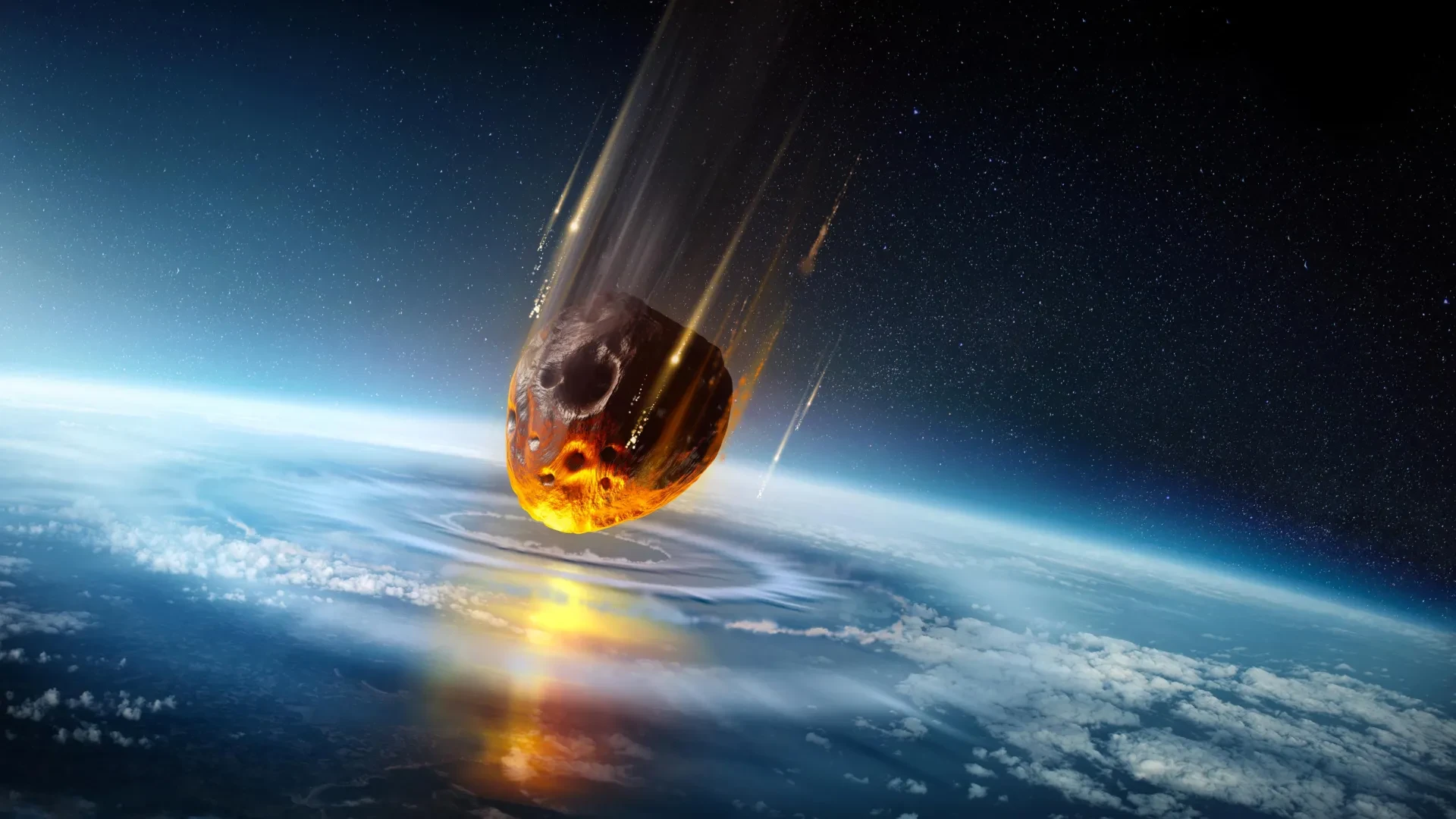
AUSTIN, Texas — In a discovery that upends decades of conventional geological wisdom, researchers at The University of Texas at Austin have successfully rewritten a pivotal chapter of North America’s impact history. By deploying cutting-edge radioactive dating and high-resolution imaging techniques, a team of geoscientists has determined that the massive Ames impact structure buried deep beneath Oklahoma is nearly 100 million years younger than previously believed.
The finding, published in the July edition of the journal Meteoritics & Planetary Science, does more than simply correct a local timeline. By stripping a major North American impact site from one geological epoch and reassigning it to another, the study forces scientists to rethink the chronology of cosmic bombardments, challenges long-held theories about ancient asteroid rings, and potentially links the Oklahoma crater to one of the most devastating mass extinction events in Earth’s history.
Main Facts: The Ames Crater Breakthrough
Buried miles beneath layers of sedimentary rock and agricultural topsoil in Major County, Oklahoma, the Ames impact structure is a colossal geological feature stretching for miles underground. While it is heavily obscured from surface view, the crater is well-known to industry insiders and scientists alike; it is not only a site of profound academic interest but also a remarkably prolific producer of oil and natural gas.
For generations, the prevailing scientific consensus slotted the Ames crater into a specific, dramatic narrative. It was widely regarded as a key member of the "Ordovician Meteor Event"—a cluster of major meteorite impacts across North America that supposedly occurred roughly 467.5 million years ago.
However, the new study led by UT Austin researchers shatters this hypothesis. By analyzing microscopic zircon crystals extracted from granite altered by the colossal force of the impact, the research team established that the meteorite actually struck Earth approximately 370 million years ago, during the Late Devonian period.
- The Old Timeline: ~467.5 million years ago (Middle Ordovician).
- The New Timeline: ~370 million years ago (Late Devonian).
- The Age Discrepancy: The crater is approximately 100 million years younger than previously estimated.
- The Broader Implication: The removal of the Ames structure from the Ordovician period undermines theories that Earth was once encircled by a Saturn-like ring of asteroid debris during that era. Instead, the newly established date places the impact uncomfortably close to the Frasnian-Famennian mass extinction event, which wiped out a massive proportion of marine life roughly 372 million years ago.
Chronology of a Discovery: From Fieldwork to Publication
The journey to rewriting Oklahoma’s geological history was arduous, spanning years of meticulous sample collection, technological advancement, and academic perseverance.
The Genesis of the Project
The project originated with Andrew Parisi, a former graduate student at UT Austin’s Jackson School of Geosciences. Recognizing anomalies in how impact structures were traditionally dated, Parisi took the initiative to travel to Norman, Oklahoma, where he secured a crucial rock core of the Ames structure from the archives of the Oklahoma Geological Survey. Parisi successfully extracted zircon crystals from the granitic material and initiated the foundational work of determining their ages before his passing in 2018.
Laboratory Analysis and Technological Precision
To uncover the true age of the crystals, the research team utilized uranium-lead (U-Pb) dating, widely considered the gold standard for determining the absolute age of ancient geological formations. When radioactive uranium decays into lead inside a zircon crystal at a known, steady rate, scientists can measure the ratio of these elements to pinpoint when the crystal was last reset by a high-temperature, high-pressure event—such as a meteorite impact.
Time and again, regardless of the analytical technique applied, the data pointed away from the Ordovician period.
"No matter what technique we used, it was coming back to this younger signal," noted lead author Elizabeth Catlos, an associate professor in UT’s Department of Earth and Planetary Sciences.
Verification Through NASA Collaboration
Because zircon is remarkably durable, it can sometimes retain the "memory" of multiple geological events over billions of years. To ensure that the younger dates genuinely reflected the cataclysmic impact rather than an older, pre-existing basement rock signature, the researchers partnered with NASA.
Using advanced imaging technologies—specifically cathodoluminescence and electron backscatter diffraction—the team examined the internal microstructures of the crystals. Under the extreme shock pressures of an asteroid impact, zircon recrystallizes in a distinct, chaotic, yet recognizable pattern. The NASA imaging confirmed that the crystals analyzed by the UT team had indeed recorded the instantaneous, violent shock of a hypervelocity collision approximately 370 million years ago.
Supporting Data: Why the Earlier Date Was Misleading
For decades, geologists accepted the Middle Ordovician date for the Ames crater without heavy skepticism. But why was the scientific community so profoundly mistaken for so long?
The answer lies in the nature of the evidence previously used to date the site. Prior to the UT Austin study, the Ames structure had never been dated using radiometric or absolute dating techniques. Instead, researchers relied entirely on biostratigraphy—dating rock layers based on the fossilized remains of ancient organisms found within them.
Specifically, geologists had discovered microscopic, highly durable teeth belonging to conodonts—an extinct, eel-like chordate creature—preserved in the impact-affected rocks. Because these specific conodont species were known to have lived during the Ordovician period, scientists naturally assumed the impact that trapped them occurred concurrently.
However, Catlos and her colleagues realized this biological evidence was deeply misleading. The conodont teeth were likely millions of years old, resting peacefully in older sedimentary layers, long before the asteroid ever struck. When the hypervelocity meteorite slammed into Oklahoma, it violently excavated, churned, and mixed ancient subsurface materials, incorporating the older fossils into the impact breccia while miraculously preserving their physical integrity.
By relying on biological proxies rather than direct mineral clocks, early researchers were essentially dating the age of the organisms swept up in the disaster, rather than the date of the disaster itself.
Official Responses and Expert Perspectives
The implications of the study have reverberated throughout the international geoscience community, prompting reflections on the methodologies used to map Earth’s catastrophic past.
Danny Stockli, dean of the Jackson School of Geosciences and a co-author of the study, emphasized the unmatched reliability of modern zircon geochronology in unravelling planetary history.
"These small crystals allow us to go back in time and learn about the major changes to Earth’s ancient landscapes," Stockli stated. He noted that the precision offered by U-Pb dating and modern electron imaging transforms how scientists view terrestrial impact structures. "It would be great to do this for more of the meteor impact sites across the continent so we could get a more accurate timeline for these major events."
The research also carries a poignant personal legacy for the team. In addition to the foundational work performed by the late Andrew Parisi, co-author Michael Brookfield, an affiliated researcher at the Jackson School, passed away before the manuscript was formally published. Their contributions, alongside the collaborative efforts of Research Professor Sean Gulick and Professor Emeritus Mark Cloos, ensured the study’s rigorous scientific foundation.
Reflecting on the shifting paradigms of Earth history, Catlos used a colorful analogy to describe the tectonic movement of data within geological theory:
"With this research, we’re basically taking a major pawn out of the Ordovician Meteor Event and dumping it into the Frasnian-Famennian event, and saying, ‘This is where this impact belongs.’"
Implications: Rewriting the History of Life and Extinction
The relocation of the Ames impact structure from the Middle Ordovician to the Late Devonian carries profound consequences that extend far beyond the borders of Oklahoma.
The Demise of the Ordovician Asteroid Ring Hypothesis
During the Middle Ordovician, Earth experienced an anomalous spike in meteorite impact craters across North America and Baltica. To explain this sudden cluster of impacts, some planetary scientists hypothesized that Earth, much like Saturn, was temporarily encircled by a massive ring of asteroid debris that slowly degraded and rained down onto the planet’s surface.
By removing the Ames structure—long considered a heavyweight anchor of this impact cluster—from the Ordovician timeline, the UT Austin study weakens the empirical foundation of the ancient asteroid ring hypothesis. If major craters once attributed to this single epoch are actually scattered across vastly different periods of geological history, the "ring of debris" theory loses significant ground, forcing scientists to find alternative explanations for clusters of impact craters.
A New Puzzle Piece for Mass Extinctions
Perhaps the most tantalizing implication of the new date is its proximity to the Frasnian-Famennian mass extinction. Occurring approximately 372 million years ago, the Frasnian-Famennian extinction event was one of the "Big Five" mass extinctions in Earth’s history, devastating shallow tropical marine ecosystems and wiping out a staggering percentage of marine genera, particularly reef-building organisms like stromatoporoids and corals.
For decades, geologists have debated the primary drivers behind these planetary-scale die-offs. Was life on Earth primarily imperiled by extraterrestrial forces—such as sudden, devastating meteorite impacts that blocked out the sun and disrupted global climate—or by internal terrestrial engines, such as protracted pulses of massive continental volcanism?
By placing the massive Ames impact event squarely on the doorstep of the Frasnian-Famennian boundary (within a margin of error of just a couple of million years), the UT Austin study reopens the door to extraterrestrial hypotheses for this specific extinction pulse. While more research is required to determine whether the Ames impact was globally catastrophic on its own or merely a contemporaneous coincidence, establishing precise, unassailable dates is the indispensable first step.
Ultimately, the study serves as a humbling reminder of the dynamic, ever-evolving nature of science. As researchers continue to apply advanced radiometric dating and microscopic imaging to North America’s buried scars, humanity’s biography of Earth is bound to undergo even more radical, eye-opening revisions.
