

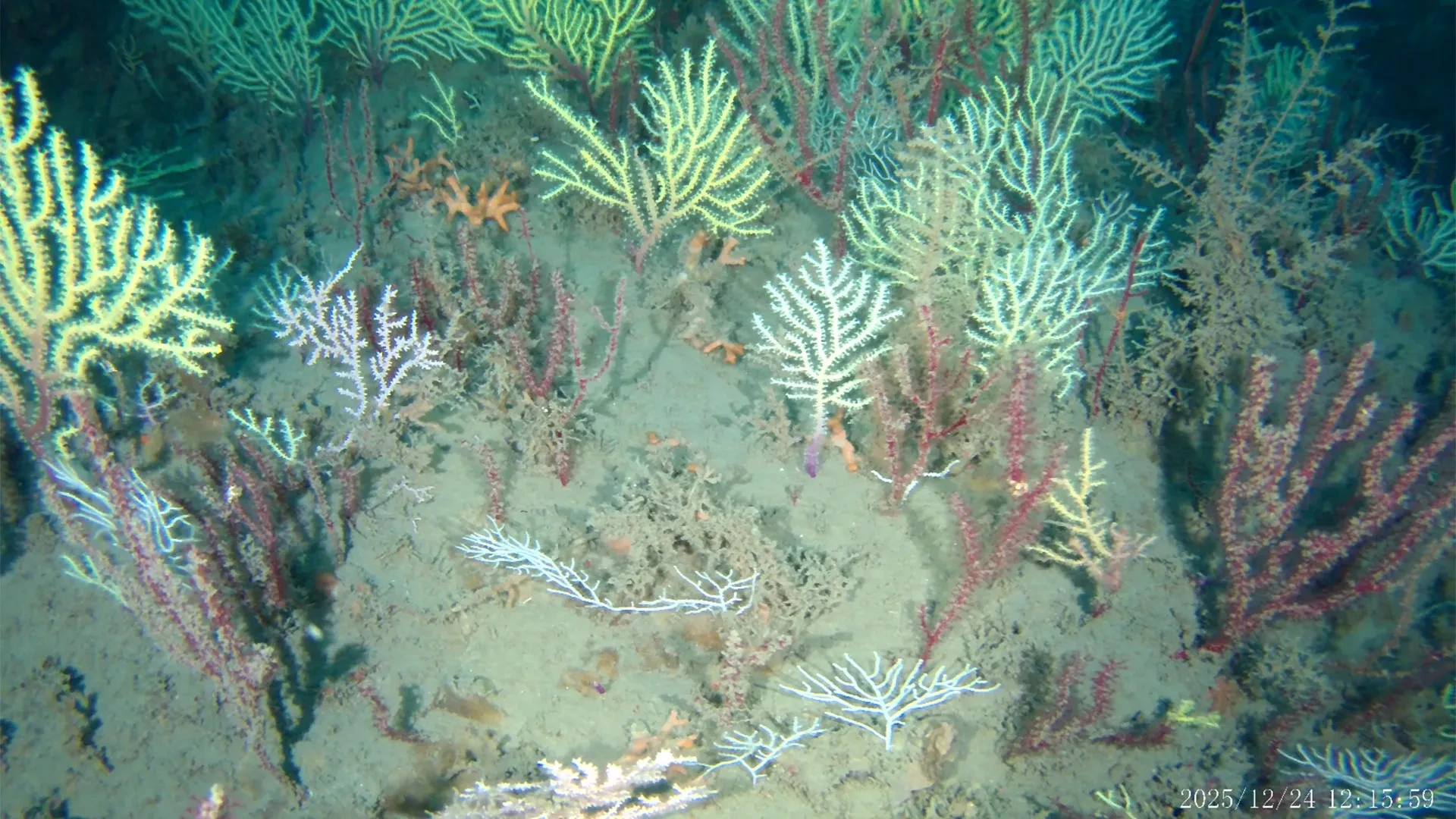
BENIN — In a stunning breakthrough that highlights just how much of the ocean remains unexplored, marine scientists have rediscovered a vibrant coral ecosystem off the coast of Benin. Long thought to be entirely dead and buried in historical obscurity, the reef is not only alive—it is remarkably healthy, teeming with diverse marine life more than 50 meters beneath the surface.
The discovery, detailed in the journal Frontiers in Marine Science, challenges decades-old assumptions regarding West Africa’s marine biodiversity. Led by a team from the Institut de Recherches Halieutiques et Océanologiques du Bénin (IRHOB), researchers utilized advanced modern technology to bring a forgotten underwater world back into the scientific spotlight. Experts say the finding suggests that numerous other marine ecosystems along the African coastline may be hiding in plain sight, waiting to be documented.
Main Facts: A Hidden Ecosystem Emerges from the Deep
The newly documented ecosystem sits more than 50 meters (roughly 164 feet) below the surface of the Gulf of Guinea continental shelf. Rather than forming a single, continuous, monolithic barrier like the famous shallow-water reefs of tropical paradises, this deep-water structure manifests as a series of patchy, scattered coral communities. These colonies cling tenaciously to rocky sections of the seabed where localized conditions prove favorable for survival.
During their initial visual sweeps, researchers identified an impressive array of biodiversity. The camera feeds captured:
- Eight distinct coral types, forming the structural foundation of the habitat.
- Eight unique fish species utilizing the reef for shelter, hunting, and breeding.
Among the marine life documented by the underwater camera systems were golden African snappers, blackbar soldierfish, Guinean angelfish, West African goatfish, Monrovia doctorfish, three-banded butterflyfish, and two distinct species of damselfish.
This discovery marks the first officially confirmed record of a living mesophotic coral ecosystem—reefs that thrive in deeper, twilight zones where sunlight is severely limited—along the entire continental shelf of the Gulf of Guinea.
Chronology: From 1960s Dismissal to Modern-Day Rediscovery
The story of this reef spans more than half a century, shifting from early exploratory disappointments to modern technological triumph.
The 1960s: The First Surveys and False Conclusions
The narrative began over sixty years ago during a series of marine surveys conducted off the West African coast. At the time, marine research was driven primarily by commercial and economic interests rather than pure conservation or biodiversity mapping. Those 1960s expeditions were designed explicitly to locate productive fishing grounds for the regional economy.
During their sweeps, researchers mapped what appeared to be the geological signatures of a deep-water coral reef stretching parallel to the coast. However, upon analyzing their primitive data and spot samples, the scientists of the era reached a disheartening conclusion: the reef was dead, likely an ancient relic of a bygone marine epoch rather than a functioning biological community. For decades, the site was filed away in archives as a marine wasteland—a geological skeleton lost to time.
The Modern Return: Equipping for Exploration
Decades later, a team of contemporary scientists led by Gérard Zinzindohoué of IRHOB took a fresh look at the historical archives. Armed with modern hypotheses regarding mesophotic ecosystems—reefs that adapt to lower light and cooler temperatures—the team suspected that the 1960s surveys might have fundamentally misinterpreted the site.
Securing modern technology, including high-resolution sonar and the specialized Deep Sea Camera System provided by the National Geographic Exploration Technology Lab, the researchers mounted an ambitious field campaign.
The Breakthrough Moment
The expedition was far from straightforward. Zinzindohoué and his crew faced grueling conditions at sea, battling rough weather, technical malfunctions, and the psychological weight of profound uncertainty.
The turning point came when the ship’s sonar equipment began picking up distinct geological signatures. "It was a mix of long days at sea, technical problems, and a lot of uncertainty," Zinzindohoué recalled. "Then we saw structures on the sonar that looked like they could be reef signatures, which gave us hope that we were close."
Following the sonar data, the team deployed an underwater drone alongside the National Geographic Deep Sea Camera System. Operating much like a trail camera setup deployed in a deep forest, the camera rig descended into the gloom.
"That was a big moment for us, because suddenly we could actually see the seafloor," said Zinzindohoué. "I still remember seeing those first images. It was a mix of excitement and disbelief, because after all this time thinking about this reef, suddenly there was something real in front of us."
Supporting Data and Technical Insights
To understand the magnitude of the discovery, scientists point to the unique nature of mesophotic coral ecosystems (MCEs). While shallow-water reefs rely heavily on intense sunlight to feed the symbiotic algae (zooxanthellae) living within their tissues, mesophotic corals have evolved mechanisms to survive in environments where light penetration drops significantly.
The Methodology
The research team executed a meticulous scanning strategy:
- Target Area Mapping: Guided by historical coordinates from the 1960s, the team scanned 11.5 kilometers of seafloor using advanced sonar systems.
- Target Identification: Out of this broad sweep, two primary zones displayed acoustic signatures strongly indicative of hard structures or reef formations.
- Visual Validation: The team deployed underwater drones and deep-sea cameras to capture high-definition visual evidence of the two target areas.
The resulting footage shattered the 60-year-old consensus. Instead of lifeless rubble, the cameras revealed complex biological micro-habitats where fish species swarmed around living coral colonies.
However, the scientists remain scientifically rigorous. Because the expedition relied exclusively on remote imaging and drone footage, no physical samples of the coral have been collected yet. Consequently, the precise species classifications derived from the video feed remain tentative until physical or genetic confirmation can be achieved through subsequent field missions.
Official Responses and Perspectives
The rediscovery has sent ripples through the international marine biology community, sparking renewed interest in the under-researched waters of West Africa.
Gérard Zinzindohoué emphasized that while the finding is historic for the region, it likely points to a broader systemic gap in global ocean mapping. "To our knowledge, this is the first confirmed record of a living mesophotic coral ecosystem on the Gulf of Guinea continental shelf," he stated. "However, I think what we found is probably not an exception. It is more likely a reflection of how little we still know about coastal regions in West Africa and elsewhere."
Zinzindohoué poses a compelling question to the scientific community: "If we were able to find this reef again after 60 years, how many others are still undocumented or simply forgotten?" While he firmly believes more undiscovered coral systems exist along the coast, he urges caution against sweeping generalizations. "We should not assume they are everywhere. Each discovery needs to be confirmed. Without going back into the field, we are really just guessing."
Other marine conservationists have echoed these sentiments, pointing out that West African waters have historically received a fraction of the research funding and technological deployment dedicated to regions like the Caribbean, the Great Barrier Reef, or the Indo-Pacific. This discovery proves that biodiversity hotspots may exist right in our backyards, completely overlooked due to a lack of modern observational tools.
Implications: A 40-Kilometer Mystery and Future Research
The implications of this rediscovery extend far beyond a single patch of seabed off Benin. It opens up sprawling new avenues for ecological research, conservation policy, and historical oceanography.
Expanding the Scope: The 40-Kilometer Barrier
Adding intrigue to the discovery is the scale of the original 1960s reports. Historical documentation suggested that the observed geological formations might not be isolated patches, but part of a massive, continuous coral barrier extending roughly 40 kilometers parallel to the coast of Benin.
The recent expedition surveyed only a fraction of this vast expanse, utilizing a limited number of visual transects. If the historical estimations hold true, the living ecosystem discovered by Zinzindohoué’s team may represent merely the tip of the iceberg.
"If I had all the grant money in the world, the first thing I would do is return to the site with a proper scientific diving and sampling program," Zinzindohoué noted. "These are ecosystems that are still poorly known in this part of the world, and every additional piece of information matters."
Unlocking Ocean History
Beyond mapping the sheer physical size of the system, researchers are eager to answer fundamental historical questions. For instance, science cannot yet determine whether the corals observed in the 1960s were genuinely dead—having suffered a historic die-off from which they miraculously recovered—or if the original researchers simply misidentified a patchy, deep-water ecosystem as a dead reef due to the technological limitations of the era.
Solving this mystery will require comprehensive historical analysis combined with modern paleoclimatic studies of the coral skeletons. Understanding how these organisms survived decades of changing ocean temperatures, shifting currents, and regional human impacts could provide critical clues about coral resilience in an era of rapid global climate change.
"For me, the most exciting part is about understanding the reef’s history, and what it can tell us about how the ocean in this region has changed over time," Zinzindohoué concluded. "It feels like we have only just started to read an archive that has been there for a very long time."
As the scientific community digests these findings, plans are already underway to secure additional funding and partnerships. The goal is clear: launch a comprehensive return expedition to sample, map, and protect a marine world that refused to die, waiting quietly in the deep for humanity to finally look closer.
