

Main Facts
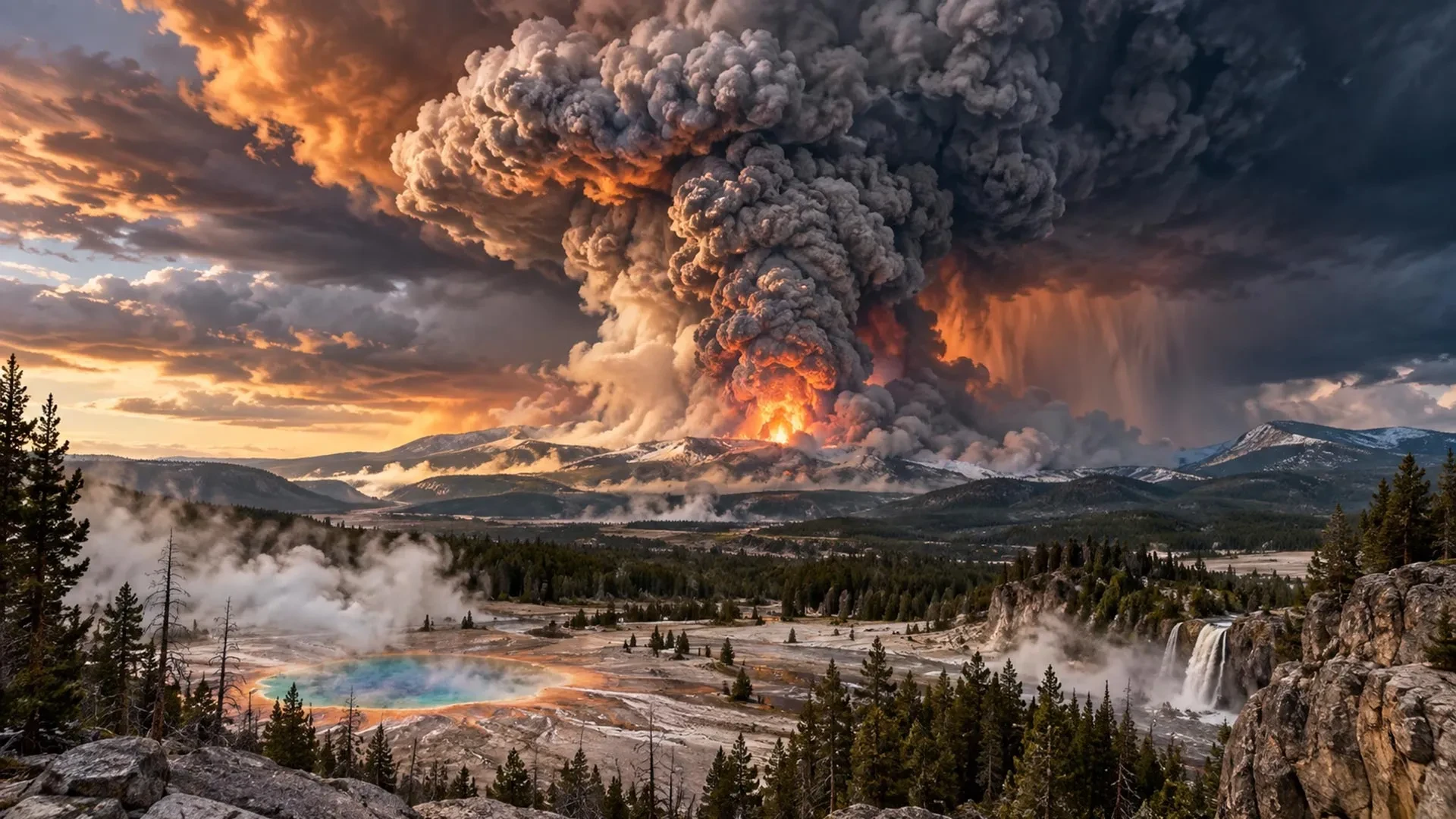
Roughly 631,000 years ago, a geological catastrophe unfolded in what is now northwestern Wyoming. A super-eruption of the massive volcanic system beneath Yellowstone National Park dispersed ash across much of North America, generated worldwide climate shifts, and shattered ecosystems hundreds of kilometers from the blast site. While no early humans witnessed this prehistoric cataclysm, modern scientific consensus agrees that a repetition of this scale today would pose an existential threat to modern civilization.
Volcanologists and disaster management experts rely on continuous, high-precision monitoring systems to track Yellowstone’s subterranean behavior. An array of instruments—including seismometers, GPS stations, strainmeters, thermal sensors, and gas-sampling units—measures the restless engine of the supervolcano around the clock. Although Yellowstone generates thousands of small earthquakes annually, the simultaneous escalation of earthquake swarms, migrating hypocenters, ground deformation (uplift), and altered gas emissions serves as the primary indicator of potential magma movement.
A worst-case scenario analysis reveals that a VEI-8 (Volcano Explosivity Index 8) super-eruption would not be a localized emergency; it would trigger a cascading global crisis. From immediate pyroclastic flows and infrastructural collapses to continent-wide agricultural failures, systemic economic recessions, and multi-year volcanic cooling episodes, a Yellowstone cataclysm would test the absolute limits of international cooperation, emergency preparedness, and human resilience.
Chronology of a Catastrophe
Understanding how a modern super-eruption would unfold requires mapping a theoretical timeline based on geological precedents, real-time monitoring capabilities, and disaster response models.
T-2 Months: The Initial Swarm
At the University of Utah Seismograph Stations, an analyst spots a series of sharp, anomalous spikes interrupting the baseline readings of Yellowstone’s earthquake monitors. While earthquake swarms are common in the 55-to-70-kilometer-wide caldera, this cluster is tightly concentrated and shows early signs of upward migration through the Earth’s crust. Following the Yellowstone Volcano Observatory (YVO) response plan, scientists coordinate with partner agencies. For now, most tremors are micro-earthquakes, and no surface deformation is detected. The decision is made to monitor closely.
T-1 Month: Unrest Escalates
Four weeks later, the situation deteriorates. The earthquake swarm continues its upward path, accompanied by narrow seismic zones beneath the caldera. GPS stations register opposing vectors—ground movement indicating accelerated surface uplift—confirmed by satellite radar. Strainmeters record rising tectonic stress. Although similar alerts occurred during historical non-magmatic episodes (such as the 2013–2014 uplift), the combination of accelerating ground deformation, shallowing tremors, and altered hydrothermal gas chemistry (rising carbon dioxide and sulfur dioxide) forces the YVO to raise Yellowstone’s Volcano Alert Level from "Normal" to "Advisory." The Federal Emergency Management Agency (FEMA) begins drafting large-scale evacuation frameworks in secret consultation with high-level officials.
T-2 Weeks: "It’s Gonna Blow!"
With shallow earthquakes becoming incessant and Old Faithful displaying erratic, unpredictable eruption intervals, the YVO holds an emergency press conference. The probability of a cataclysmic eruption within three weeks is estimated at 85% to 92%. The alert level jumps to "Watch," and the USGS issues an orange Aviation Color Code, rerouting commercial flights.
An evacuation zone extending 100 kilometers beyond the national park is established, impacting roughly 200,000 residents and thousands of tourists. Global leaders face a stark choice: mobilize international resources for a coordinated, cross-border resettlement of millions, or default to fragmented, restrictive border closures reminiscent of the COVID-19 pandemic. Bureaucratic hesitation, logistical hurdles, and self-evacuations by affluent populations create deep systemic fractures before the first drop of magma breaks the surface.

T=0: The Eruption
Seismic monitors are overwhelmed by an intense burst of shallow earthquakes. Initial activity manifests as violent phreatomagmatic explosions as rising magma encounters Yellowstone’s shallow hydrothermal system, instantly vaporizing millions of tons of water into superheated steam.
Hours later, gas-rich magma at temperatures between 650°C and 800°C breaches the surface. Expanding dissolved gases shatter the molten rock into pumice and ash, driving a towering eruption column 30 to 50 kilometers into the atmosphere. The column’s momentum propels an umbrella cloud outward in all directions. Partial column collapses generate scorching pyroclastic density currents that incinerate everything within tens of kilometers, resulting in immediate fatalities among remaining residents, wildlife, and emergency holdouts. Further casualties mount rapidly due to ash-induced vehicle accidents, respiratory failure, and infrastructure failures.
T+3 Days: Living in the Shadow
Three days into the continuous eruption pulses, Billings, Montana, Salt Lake City, Utah, and Boise, Idaho, are inundated with heavy ashfall. Day turns to twilight across southern Canada, the United States, and northern Mexico. Power grids fail globally as damp ash short-circuits transmission lines and substations. Water treatment plants, communication networks, and supply chains grind to a halt.
T+2 Weeks to T+4 Months: The Crisis of Survival
North America enters a phase of severe infrastructural paralysis. Accumulated ash collapses roofs, clogs drainage systems, and forms dense, concrete-like slurries during rainfalls. Agricultural sectors across multiple states are completely destroyed, sending global food prices soaring. While volcanic ash begins to settle domestically, sulfur dioxide injected into the stratosphere creates sulfate aerosols that reflect solar radiation, initiating a multi-year global cooling episode.
T+10 Years: Long-Term Recovery
A decade after the cataclysm, humanity adapts to a harsher, more agrarian existence. The global population experiences an estimated 0.7 to 1.3 billion excess premature deaths due to starvation, disease outbreaks (such as cholera and malaria), systemic healthcare failures, and long-term respiratory illnesses like silicosis and lung cancer caused by exposure to crystalline silica in the ash. Meanwhile, the atmospheric aerosol curtain slowly clears, allowing sunlight to return and prompting scientists to reassess whether the planet’s long-term trajectory has been permanently altered.
Supporting Data and Metrics
- Geological Scale: The last Yellowstone super-eruption (the Lava Creek eruption 631,000 years ago) and the Toba eruption in Indonesia 74,000 years ago represent VEI-8 events, the highest formal classification for explosive volcanism.
- Volcanic Temperatures: Erupting magma ranges from 650°C to 800°C, far exceeding the melting points of lead and zinc.
- Ash Distribution Models: Predictive simulations indicate that major cities like Billings, Montana, could receive up to 1.8 meters (nearly 6 feet) of heavy ash accumulation.
- Demographic and Health Impacts: Pre-existing global freshwater vulnerability affected roughly 4.4 out of 8.3 billion people prior to the disaster; post-eruption modeling suggests this figure could rise to 4.8 billion people, with global population estimates contracting to 7.9 billion.
- Climate Modification: Atmospheric modeling indicates a northern hemisphere-focused "volcanic cooling episode" capable of depressing regional and global average temperatures by approximately 1.5°C.
Official Responses and Governance
The management of a potential Yellowstone super-eruption tests the limits of civil defense institutions, scientific communication, and international relations:
- The Yellowstone Volcano Observatory (YVO): Operating as a consortium of the U.S. Geological Survey (USGS), the University of Utah, and the National Park Service, the YVO is tasked with balancing public transparency with panic mitigation. The agency utilizes structured alert levels (Normal, Advisory, Watch, Warning) and Aviation Color Codes to scale its warnings progressively.
- Emergency Management (FEMA): Federal agencies face the formidable challenge of planning large-scale evacuations for hundreds of thousands of individuals within primary hazard zones while anticipating secondary displacement waves numbering in the tens of millions.
- Global Diplomacy: International bodies are forced to navigate "disaster diplomacy." The stark choice between resource-sharing (humanitarian resettlement, cross-border housing, and food distribution) and national isolationism dictates whether humanity experiences systemic collaboration or catastrophic humanitarian triage.
Implications for Modern Civilization
The theoretical reactivation of the Yellowstone supervolcano serves as a profound stress test for contemporary society. It exposes the fragility of hyper-connected, technology-dependent global networks. A disaster of this magnitude demonstrates that advanced technological infrastructure—while capable of millimeter-level crustal monitoring—remains deeply vulnerable to primitive geological hazards like ash, rock, and sustained darkness.
Furthermore, the environmental aftershocks—spanning agricultural collapse, economic recession, and stratospheric cooling—illustrate the interconnected nature of Earth’s systems. Ultimately, while a Yellowstone super-eruption would radically alter the geopolitical, demographic, and ecological landscape of the planet, historical and scientific modeling confirms an encouraging reality: though it would reshape human civilization, it would not spell the extinction of the human species.
