

EDMONTON, Alberta — To the average person, a day is an absolute and unyielding construct: exactly 24 hours, dictated by the steady, predictable spin of our planet. It dictates our daily schedules, synchronizes global financial markets, and serves as the baseline for all human timekeeping. Yet, this unwavering constancy is an illusion.
Beneath the familiar rhythm of sunrises and sunsets lies a dynamic, restless world. Earth does not rotate at a perfectly uniform speed. While the fluctuations are infinitesimal—measured in mere milliseconds—they are entirely real, meticulously tracked by modern physicists, and deeply consequential for our understanding of planetary physics. Over extended periods, subtle shifts deep within the Earth’s interior cause days to subtly stretch or shrink.
For decades, the root cause of these temporal anomalies has eluded scientists. However, a groundbreaking study published on September 23 in the prestigious journal Nature has brought us closer than ever to solving this subterranean mystery. Authored by University of Alberta physics PhD student Huifeng Zhang and Professor Mathieu Dumberry, the research reveals a fascinating gravitational dance between Earth’s solid inner core and its rocky outer mantle. The findings not only explain how milliseconds are added to or subtracted from our days, but also suggest that Earth’s deepest, most inaccessible regions are far more pliable and dynamic than previously believed.
Main Facts: The Anatomy of a Millisecond Shift
At the heart of the discovery is the conservation of angular momentum—a fundamental law of physics stating that the total momentum of a closed system must remain constant.
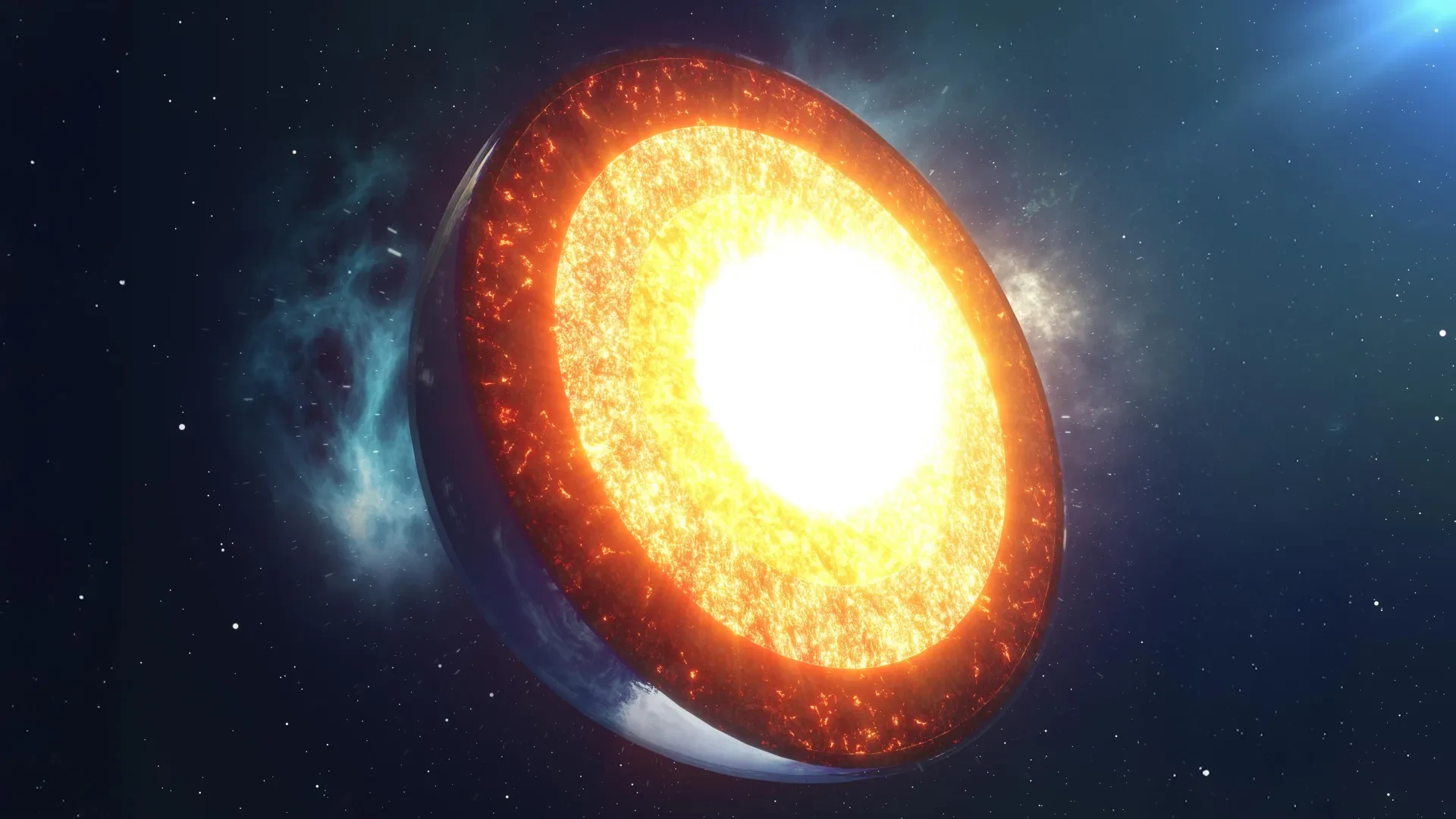
Earth is not a solid, uniform marble. Instead, it is a complex, layered machine consisting of:
- The Crust: The thin, rocky shell upon which all terrestrial life resides.
- The Mantle: A colossal, roughly 3,000-kilometer-thick layer of dense, silicate rock situated directly beneath the crust.
- The Outer Core: A roiling, turbulent ocean of liquid iron and nickel that generates Earth’s protective magnetic field.
- The Inner Core: A dense, solid ball of iron roughly the size of Pluto, subjected to immense pressures at the center of the world.
For roughly thirty years, geophysicists have known that the liquid outer core does not rotate in strict synchronization with the rest of the planet. Through tracking changes in Earth’s magnetic field, researchers discovered that the churning liquid core can gradually accelerate over several decades, only to decelerate during the subsequent decades.
Here is where the law of angular momentum asserts itself. As the liquid core speeds up in one direction, the mantle—along with the crust and everything on it—compensates by slowing down slightly. Conversely, when the core decelerates, the mantle speeds up. Because the mantle accounts for the vast majority of the planet’s mass, even minuscule variations in its rotational velocity are enough to alter the duration of a solar day by a few milliseconds.
Until now, however, the precise mechanism driving this momentum exchange across the vast distances separating the core and the mantle remained one of geophysics’ most persistent blind spots.
Chronology of a Decades-Long Geophysical Mystery
To understand the magnitude of Zhang and Dumberry’s breakthrough, it is helpful to trace the historical evolution of how humanity came to understand Earth’s variable rotation.
1. The Discovery of Decadal Fluctuations (Late 20th Century)
In the latter half of the 20th century, the advent of atomic clocks and space-geodetic techniques—such as Very Long Baseline Interferometry (VLBI) and Satellite Laser Ranging (SLR)—allowed scientists to measure Earth’s rotation with unprecedented precision. Researchers quickly realized that the length of a day (LOD) was not constant. Seasonal variations were easily explained by atmospheric winds and ocean currents, but longer-term, decadal fluctuations defied easy categorization.
2. The Core-Mantle Coupling Hypothesis (1990s–2000s)
By the 1990s, scientists hypothesized that electromagnetic coupling at the boundary between the liquid outer core and the lower mantle was responsible. As the liquid iron flowed through the magnetic field, it generated electrical currents, creating a magnetic drag known as "core-mantle boundary torque." While this electromagnetic friction played a significant role, mathematical models struggled to reconcile the sheer magnitude of the observed day-length changes using electromagnetism alone. A missing piece of the puzzle was required.
3. The Inner Core Revolution (2010s)
Attention soon shifted deeper inward, toward the solid inner core. Early studies suggested that the inner core might be rotating independently of the mantle and outer core at a slightly different speed—a phenomenon known as super-rotation. However, the exact mechanical coupling between this innermost sphere and the overlying mantle remained purely theoretical. How could a solid core separated by a fluid outer ocean exert influence on the rocky mantle thousands of kilometers above?
4. The September 2024 Breakthrough
The publication of Zhang and Dumberry’s study in Nature on September 23, 2024, marked a turning point. By constructing sophisticated numerical models, the University of Alberta researchers demonstrated that gravitational forces—not just electromagnetic ones—play a decisive, previously underappreciated role in bridging the gap between the inner core and the mantle.
Supporting Data: Gravity, Torque, and the Tug-of-War
The core mechanism proposed by Zhang and Dumberry centers on a phenomenon they term gravitational torque.
The inner core of the Earth is not a geometrically perfect sphere; its mass is unevenly distributed, featuring subtle irregularities, bulges, and density variations. As this lumpy, solid iron ball changes its rotational speed relative to the rest of the planet, its gravitational field interacts with corresponding mass distributions and irregularities in the lower mantle.
This creates a gravitational pull—a tug-of-war across the fluid outer core. When the inner core’s rotation accelerates or shifts position, its gravitational asymmetry pulls on the mantle, gently altering how quickly the rocky layer spins.
Yet, this gravitational force does not act in a vacuum. It is locked in a perpetual stalemate with a competing phenomenon: core-mantle boundary torque.
[Solid Inner Core]
       │
       ▼ (Changes rotational speed)
[Gravitational Torque] <──────> [Core-Mantle Boundary Torque] (Friction & Electromagnetic Drag)
       │
       ▼
[Mantle & Crust] ──> Alters the Length of a Day (by milliseconds)
As the liquid outer core flows, it generates friction and electromagnetic drag against the base of the mantle. This boundary torque acts as a stabilizing resistance, pushing back against the gravitational pull of the inner core.
According to Zhang and Dumberry’s models, the minor, observed variations in the length of a day are the direct result of this delicate equilibrium. Day-to-day and decade-to-decade fluctuations represent the shifting balance of power between the gravitational attraction of the inner core and the electromagnetic resistance at the core-mantle boundary.
Official Responses and Scientific Perspectives
The geophysical community has greeted the University of Alberta study with a mixture of enthusiasm and analytical validation, viewing it as a major step forward in deep-Earth cartography.
Dr. Jonathan Miller, a geophysicist unaffiliated with the study, noted the elegance of the mathematical modeling. "For years, we had two competing camps: those who believed electromagnetic forces were the sole driver of decadal length-of-day variations, and those who suspected gravity played a part but couldn’t prove it," Miller said. "Zhang and Dumberry have successfully quantified the gravitational interaction, providing a cohesive framework that reconciles observational data with physical theory."
Furthermore, the study’s implications extend far beyond the mere accounting of milliseconds. Perhaps the most startling conclusion of the research is that the inner core may be far more active than previously imagined.
Traditionally, scientists viewed the solid inner core as a rigid, unyielding mass slowly growing as Earth’s interior cools. However, Zhang and Dumberry’s calculations indicate that the inner core appears to "deform viscously" on a timescale of roughly a decade.
"When we look at the inner core, we tend to think of solid steel," co-author Mathieu Dumberry explained in commentary surrounding the release. "Yet our findings suggest that under the immense temperatures and pressures at the center of the Earth, the inner core is capable of deforming and changing shape over relatively short geological time scales—on the order of ten years. It is responding to forces with a level of fluidity that its solid state initially seems to forbid."
This viscous deformation acts as a release valve for the immense stresses building up at the planet’s center, fundamentally altering how geologists model the thermal and mechanical evolution of Earth’s interior.
Implications: Why a Millisecond Matters
While an adjustment of a few milliseconds may sound trivial to the layperson, understanding these deep-Earth dynamics carries profound practical and scientific implications.
1. Precision Navigation and Satellite Technology
In the modern era of global positioning systems (GPS), telecommunications, and interplanetary space exploration, absolute precision is paramount. Satellites orbiting Earth rely on exact rotational measurements to pinpoint locations on the surface. Even minor discrepancies in Earth’s rotational speed can introduce errors in navigation systems if not continuously accounted for by international timekeeping bodies, which periodically insert "leap seconds" into Coordinated Universal Time (UTC).
2. Unlocking Deep-Earth Dynamics
Direct observation of Earth’s center remains impossible. The deepest borehole ever drilled, the Kola Superdeep Borehole in Russia, reached a depth of just 12.2 kilometers—a mere scratch on a planet with a radius of approximately 6,371 kilometers. Because direct sampling is out of the reach of technology, scientists must rely on indirect proxies, such as seismic waves and variations in rotation, to probe the underworld.
By tying surface observations (the length of a day) to deep-interior mechanics (gravitational torque and inner core deformation), Zhang and Dumberry’s study opens a new window into the engine room of our planet. It provides a diagnostic tool for monitoring processes that occur thousands of kilometers beneath our feet, deep within the realm of high-pressure physics.
3. A Holistic View of Planetary Evolution
Ultimately, the research reinforces the interconnectedness of Earth’s systems. The rhythm of our days is not merely a consequence of orbital mechanics in the cold void of space; it is deeply tethered to the slow, convective churning of liquid iron in the outer core, the gravitational whispers of the solid inner core, and the elastic resistance of the mantle.
As researchers continue to refine these models, humanity gains a more profound appreciation for the complex, living machinery of the world we inhabit—a world where the passage of time on our wristwatches is quietly, ceaselessly negotiated by the roaring, molten heart of the Earth.
