

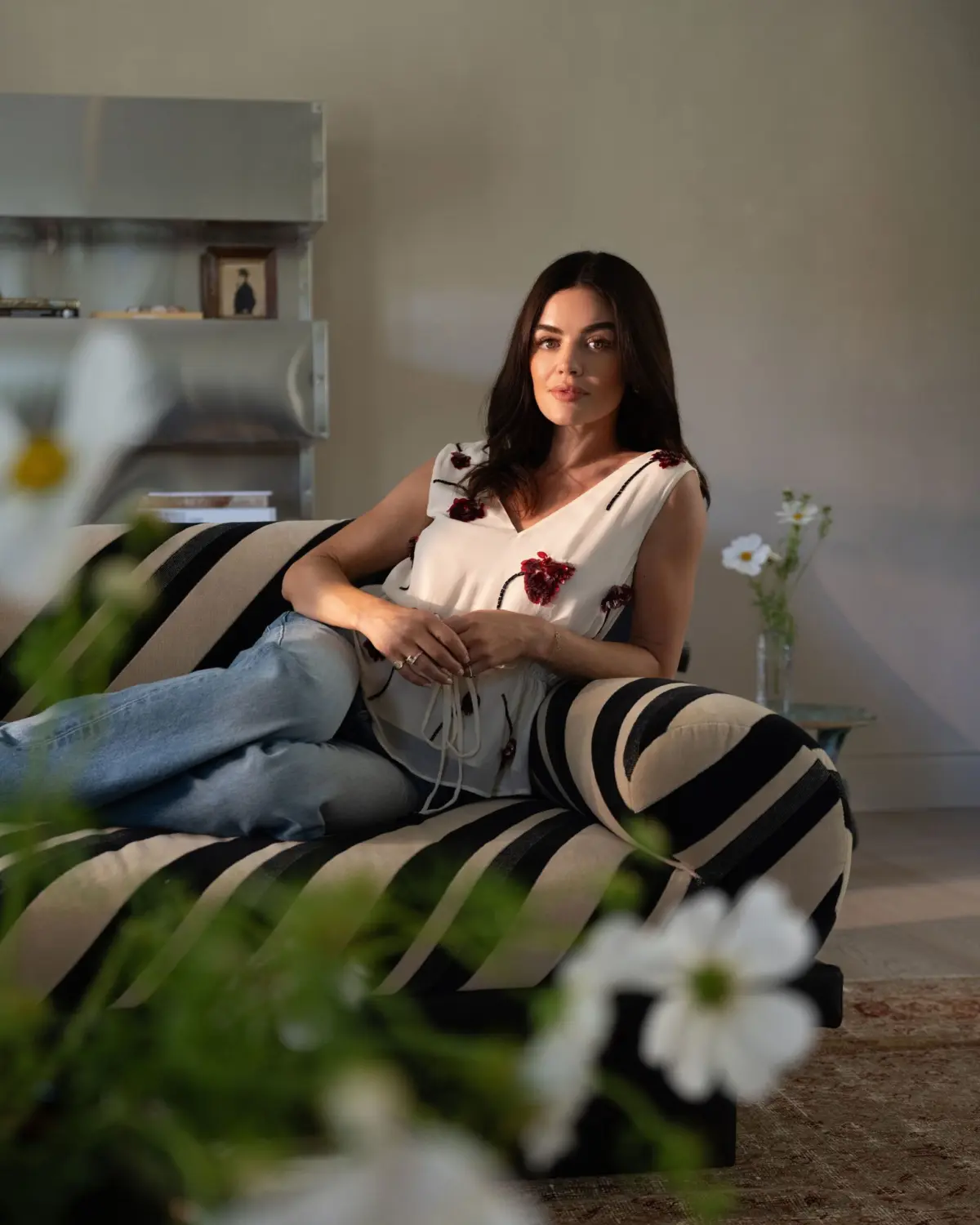
Main Facts
When actor Lucy Hale opened the doors of her 1940s Spanish-style Los Angeles home for a recent design feature, the emotional resonance of the space caught visitors and creators alike off guard. What began as a routine architectural walkthrough transformed into an intimate exploration of personal healing, mature self-actualization, and exceptional interior architecture.

The three-year-long redesign was masterminded by Ashley Drost and Marie Trohman of the Los Angeles-based design firm Proem. Known for their distinct ability to channel their clients’ inner psyches into physical spaces, the design duo coined a specific phrase for Hale’s aesthetic: "moody femme." The home is a masterclass in contrasting elements—romantic yet edgy, grounded yet whimsical, and deeply personal.
.jpg)
Spanning rich plum kitchen cabinetry, custom Kelly Wearstler-fabric sofas, an array of bespoke stained glass installations, and a carefully curated collection of vintage and contemporary art, Hale’s canyon retreat serves as a physical manifestation of her evolution. Far from a standard celebrity interior, the residence is a deeply spiritual sanctuary that maps the actor’s journey through sobriety, emotional maturity, and the reclamation of her independence.
.jpg)
Chronology: From Farmhouse Neutral to "Whimsigoth" Sanctuary
The timeline of Hale’s relationship with her Los Angeles property mirrors her own coming-of-age story in the public eye.

- 2019: Following the wrap of her starring run on the hit teen drama Pretty Little Liars, Hale purchased the Spanish-style canyon property. Seeking an escape from a decade spent under intense public scrutiny and the relentless demands of television production, she initially executed a safe, neutral, "farmhouse-y" renovation. At the time, Hale admits, she had not yet fully discovered her true personal style or settled into her identity as an independent adult.
- 2022: A pivotal turning point occurred when Hale achieved sobriety. Embarking on a dedicated journey of mental health and self-care, she began shedding the cycles of anxiety and depression that had marked her twenties. As her inner world shifted, she realized her physical environment needed to catch up with her emerging womanhood.
- The Proem Collaboration (2021–2024): Inspired by Proem’s work on Emma Chamberlain’s eclectic Los Angeles home featured in Architectural Digest, Hale enlisted Drost and Trohman. During their initial creative sessions, the designers identified a distinct, enchanting energy in the actor, which they dubbed a "good witchy" or "whimsigoth" aesthetic. Over three years, every square foot of the home was systematically reimagined, replacing bland neutrals with a rich, cinematic palette of aubergines, deep plums, terracottas, and blush tones.
- Present Day: The completed sanctuary stands as a deeply personal castle where Hale lives alongside her two Maltipoos, Elvis and Ethel. The home honors her past, supports her present, and holds space for her future.
Supporting Data and Design Specifications
The transformation of Hale’s property relied on a meticulous curation of bespoke architecture, antique finds, and high-end textiles executed by top-tier artisans and designers.

Exterior and Entryway
- The Pomegranate Surround: Los Angeles plaster artist Marli Arizona sculpted a custom pomegranate doorway surround—symbolizing prosperity and abundance—paired with a door knocker from DeVol and exterior sconces from Hudson Valley Lighting.
- Foyer & Hallways: Guests are greeted by a vintage, life-size sheep sculpture (affectionately named George by Hale’s mother) with origins tracing back to either the Czech Republic or the Rose Bowl Flea Market. An archway features hand-painted Tabarka tile that extends up the stairs. Overhead hangs a Haunt Pendant by Jane Hallworth from Blackman Cruz, paired with an antique Malayer rug from Woven and a 20th-century Danish shearling settee from 1stDibs.
Living and Media Spaces
- The Living Room: Proem designed a custom sofa upholstered in a bold Kelly Wearstler fabric for Kravet, balanced by a Pierre Augustin Rose sofa in pink Pierre Frey fabric, a Haos aluminum bookshelf from Love House, a neon sconce by Draga & Aurel via 1stDibs, and an antique Ravar Kerman rug.
- The Media Room: Outfitted with a vintage modular sofa by Pamio, Toso, and Massari upholstered in Schumacher velvet, the room features Dedar wall coverings, a vintage coffee table from 1stDibs, and custom Pindler curtains over a loomed merino wool rug from Marc Phillips. The bar area features an Elvis Presley lamp sourced from an upstate New York antiques shop, paired with Rose Uniacke barstools from Una Malan.
Kitchen and Dining
- The Kitchen: Taking aesthetic cues from Kirsten Dunst’s LA kitchen (designed by Jane Hallworth), the space features rich, ripe-plum cabinetry, antique scallop sconces from Collier Webb, an antique runner from Woven, and a female sculpture by Agnes Baillon & Eric De Dormael named "Doris" after Hale’s great-grandmother.
- The Breakfast Nook: Features a custom Dedar woven-leather banquette by Landon Cole, a Kolho chair from The Future Perfect, Hector Finch pendant lighting, and Offering Flowers artwork by Muroda Toyoshiro acquired via Pierce & Ward.
- The Dining Room: Features a Christophe Delcourt table with Collection Particulière from The Future Perfect, Caribou armchairs in beet leather by Ochre via David Sutherland, an Italian Murano chandelier from 1stDibs, and textile art by Sarah Rosalena.
Primary Suite and Bathrooms
- The Bedroom: Anchored by a low-slung nubuck leather Paola Navone Paris bed from Baxter (designed for easy access by her dogs), the room features 1950s Osvaldo Borsani for Tecno lounge chairs, an antique Italian Art Nouveau chandelier, and French élitis linen wallpaper that mimics intricate architectural molding.
- The Primary Bathroom: Lined with Portola Roman Clay in Costes, the space boasts a Monrovia copper bathtub from Magnus Home Products, Fireclay Tile, an antique rug from Rug & Kilim, a John Greene Design medicine cabinet, and Art Deco Murano glass sconces.
- Powder Room & Office: The powder room highlights Anna Glover Studio wallpaper and a custom stained glass window by Ben Tuna (the Glass Cowboy). The minty-green office utilizes Portola Roman Clay in Birdie, a South Loop Loft ash wood desk, and a Christopher Farr snake-and-pomegranate rug.
Official Responses and Designer Perspectives
The emotional weight of the project was not lost on the creative team. Reflecting on the intense collaborative process, interior designer Ashley Drost noted the profound resonance of the space: "It’s romantic but edgy at the same time. I don’t have a name for her, but she’s definitely a her."

Co-designer Marie Trohman echoed this sentiment, emphasizing how the home’s dark, moody palette and rich textures directly reflect Hale’s internal healing. "This house has been very healing for me," Hale shared during interviews. "I have had heartbreak in this home. I got sober in this home. It feels very divine for me to be living here at this specific moment."

Rather than following fleeting interior design trends, the team focused on unbridled self-expression. Hale noted that her primary goal was ensuring every square inch elicited genuine excitement: "I want every corner of this house to make me excited. That is such a cool place to be in."

Implications: The Rise of "Whimsigoth" and Personal Sanctuaries in Celebrity Real Estate
Lucy Hale’s home redesign highlights a broader cultural shift in celebrity real estate and interior design. For decades, high-profile figures favored ultra-minimalist, sterile, and hyper-curated modern aesthetics designed primarily for visual impact on social media. Hale’s canyon sanctuary represents a distinct departure toward "Whimsigoth" and "moody femme" interiors—styles that prioritize emotional grounding, tactile comfort, personal history, and eccentric storytelling over showroom perfection.

Furthermore, Hale’s narrative underscores the therapeutic power of space. By designing a home that directly mirrors her journey through sobriety, grief, and self-discovery, she sets a new standard for intentional living. The integration of family heirlooms—such as "Dad’s chair," the altar for departed loved ones, and custom stained glass windows reminiscent of her grandparents’ home—transforms the property from a mere Hollywood residence into a living biographical museum.

Ultimately, Hale’s home proves that interior design can serve as an active participant in personal evolution. As she reflects on her future, the actor remains certain of one thing: though her life and career will continue to grow and shift, this home will forever remain her anchoring sanctuary—a testament to a woman who designed her space entirely on her own terms.
