

Main Facts: A Bold Blueprint for Modern Hollywood Living
When actor Lucy Hale set out to design her Los Angeles home, she didn’t look to contemporary minimalism or sterile mid-century trends for inspiration. Instead, she leaned into a design ethos that is as distinctive as it is captivating: "fun, instinctive, and a little witchy."
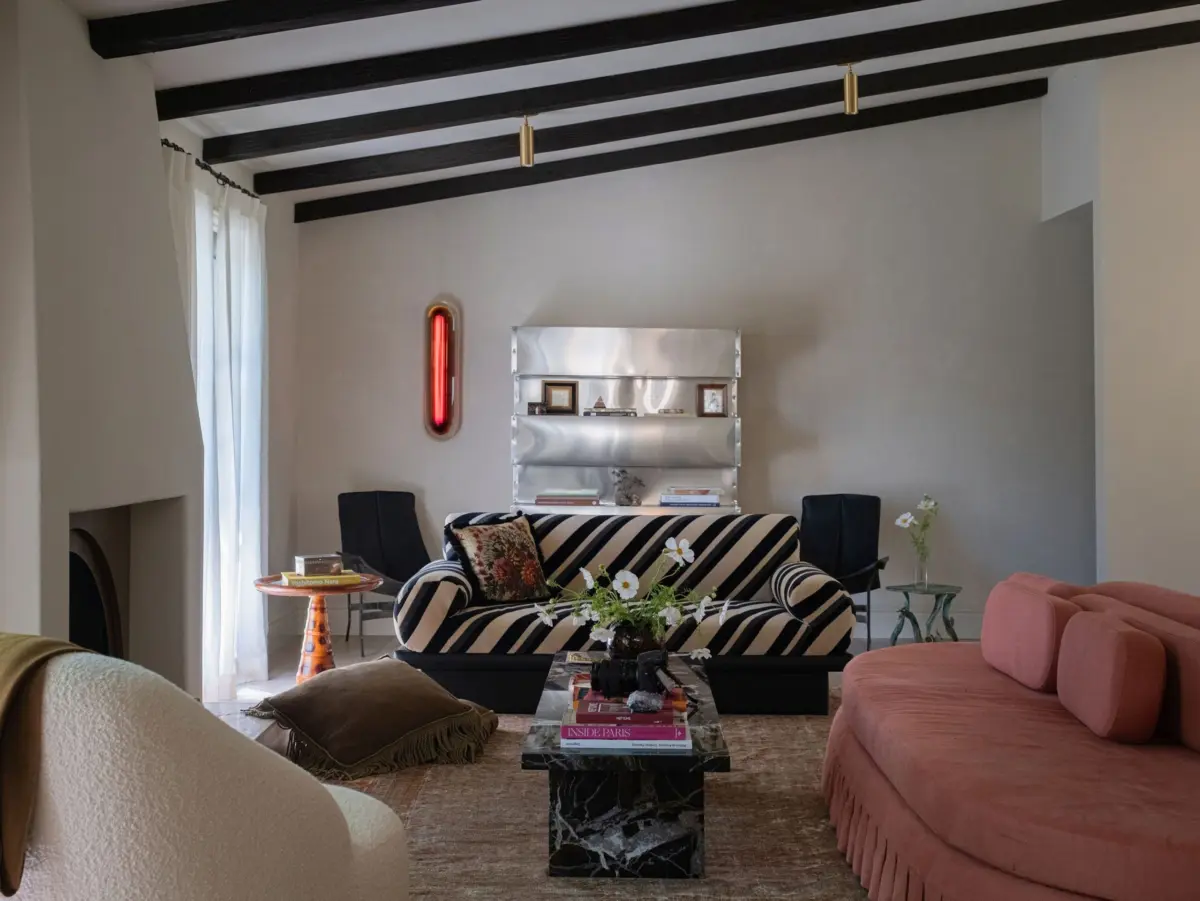
Collaborating with interior designers Ashley Drost and Marie Trohman of the acclaimed studio Proem—with styling by Paige Wassel and photography captured by Grant Legan—Hale crafted a space that proudly defies traditional design rules. The living room serves as an immediate testament to this philosophy. Beneath a sloped ceiling lined with exposed dark-wood beams sits a marble coffee table anchored by colorful hardcovers and an artfully drooping bouquet of white cosmos.
The seating arrangement is an exercise in high-stakes visual harmony: a dusty-rose pink couch sits across from an upholstered statement sofa featuring a bold black-and-white striped fabric designed by Kelly Wearstler. Atop the graphic print rests a fringed, floral Gucci pillow. By textbook design standards, the pairing shouldn’t work. Yet, in Hale’s hands, it triumphs.
Throughout the residence, unexpected, handpicked details—such as a life-sized, two-foot-tall sheep statue and an Elvis lamp—function as whimsical conversation starters. However, nowhere is Hale’s sophisticated yet playful design instinct more brilliantly expressed than in her masterclass use of throw pillows. Soft furnishings across the home act as tactile bridges between contrasting textures, eras, and motifs, proving that comfort and high-concept interior styling can coexist seamlessly.
Chronology: From Blueprint to Bohemian Reality
The realization of Lucy Hale’s Los Angeles haven did not happen overnight; it was a carefully curated evolution rooted in collaboration, spontaneity, and creative trust between the actor and the Proem design team.
Phase One: Establishing the Foundation
At the onset of the project, Drost and Trohman recognized that Hale possessed a remarkably clear vision of how she wanted her space to feel, even if some of her ideas challenged traditional design boundaries. Rather than reining in her impulses, the designers chose to act as editors, allowing Hale’s personality to dictate the home’s emotional resonance. The structural elements—such as the dramatic wooden beams and expansive natural light—were established early on, creating a warm, organic envelope for the more eccentric additions to follow.

Phase Two: The Accidental Magic of Move-In Day
During the frantic days of moving in, the now-iconic vintage Gucci floral pillow found its way onto the bold Kelly Wearstler-designed striped sofa almost by accident. While a conventional designer might have immediately corrected the pairing, the Proem team recognized its genius. The floral motif against the stark graphic stripe was wonderfully disruptive, anchoring the room with a sense of personalized irreverence that defined the aesthetic direction for the rest of the house.
Phase Three: Refining the Wild Accents
As the entertainment room took shape, Hale insisted on incorporating round animal-print pillows—a choice that initially gave the design team pause. Drost and Trohman experimented with several alternative options to soften the look, but Hale stood her ground. Ultimately, the leopard print proved essential, introducing a layer of depth and playful luxury that completed the room’s glamorous homebody atmosphere.
Supporting Data: The Anatomy of Hale’s Pillow Selection
Hale’s home proves that throw pillows are not merely functional accessories for lumbar support, but powerful tools for storytelling and spatial transformation. A closer examination of her interior styling reveals a masterclass in texture, pattern mixing, and spatial psychology.
Designer Florals and Graphic Clashes
The juxtaposition of botanical prints against heavy geometrics is a recurring theme in Hale’s living spaces. By combining vintage floral textiles with graphic stripes, the home avoids feeling overly precious or curated. Instead, it projects an effortless nonchalance.
For those looking to replicate this look, pieces like the Anthropologie Gwendolyn Jacquard Floral Pillow ($88) or the lavish LA DoubleJ Floral Fringe Cushion ($330) offer a similar blend of botanical whimsy and high-fashion edge.
Wild Accents and Animal Prints
In the entertainment room, animal-print accents prevent the softer watercolor color palette from feeling monochromatic or flat. The circular silhouette of the leopard-print pillows breaks up the rigid lines typical of standard upholstery.

Homeowners seeking to channel this fierce yet sophisticated energy can look to luxury textiles such as the Scalamandrémie Panthera Lumbar Pillow (available via Lulu and Georgia for $468) or the Williams Sonoma Scalamandrémie Animal Pillow Cover ($299), both of which bring an undeniable touch of timeless feline elegance to a neutral sofa.
Vintage Touches and Pastoral Landscapes
In the primary bedroom, Hale’s bed features three pillows embroidered with pastoral landscapes and lush forests in rich shades of blue, green, and cream. This display was the result of a creative pivot. The design team initially considered hanging a traditional historical Aubusson tapestry on the wall. However, recognizing that a wall hanging might render the space too formal or museum-like, they translated the concept into plush pillows. This single adjustment transformed historical texture into something intimate, tactile, and thoroughly lived-in.
Those wishing to incorporate similar heritage textiles can turn to options like the Arhaus Sagamond Pillow (marked down from $265 to $186) or the Williams Sonoma Scalamandrémie Ridge Pillow Cover ($259–$369).
Provençal-Inspired Pieces and Metallic Warmth
In the meditation room, a tufted velvet daybed in deep gray is elevated by ornate golden pillows. In a space dedicated to quiet reflection, the gold introduces an inviting, warm luminescence that counters the coolness of the velvet. Furthermore, the dainty florals on the pillows create a visual dialogue with the wispy yellow flora on the adjacent side table, while the silken fabric diffuses the ambient glow of the pendant light.
To achieve a similarly serene yet opulent sanctuary, designers recommend pieces like the Josh Young x Williams Sonoma Home Jardiniere Pillow Cover ($169) or the dramatic Mind the Gap Chinoiserie Pillow ($249).
Official Responses and Creative Insights from the Designers
The success of Lucy Hale’s home lies in the rare synergy between celebrity client and professional designers. Ashley Drost and Marie Trohman of Proem have been vocal in praising Hale’s fearless design instincts.

“We let our client’s fun, instinctive, and witchy taste lead the way,” Drost explained when discussing the overarching design philosophy of the residence. “Surprising, irreverent details handpicked by Lucy—like a two-foot-tall sheep statue and an Elvis lamp—are each conversation starters, but her approach to textiles truly pulls the narrative together.”
Reflecting on the accidental placement of the vintage Gucci pillow on the Kelly Wearstler sofa, Drost noted, “It landed on the Wearstler sofa almost by accident during move-in and just stayed. The floral against the graphic stripe was unexpected, personal, and a little irreverent.”
Echoing this sentiment regarding the animal-print debate in the entertainment room, Trohman admitted, “We were a little scared of the leopard at first and tried a few other options. But Lucy politely asked for them back, and she was right. Paired with the softer watercolor print, it feels playful, unexpected, and very much like her.”
Regarding the bedroom’s embroidered pastoral pillows, Trohman added, “We initially wanted to hang up a true Aubusson tapestry because we loved the history and texture, but the wall hanging felt too formal. Turning that idea into a pillow makes it feel much more lived-in.”
Implications: What Hale’s Home Signals for Modern Interior Design
Lucy Hale’s Los Angeles residence arrives at a fascinating cultural juncture for interior architecture and home decor. For years, the design world was dominated by minimalist uniformity, neutral-toned palettes, and hyper-curated spaces that often felt more like showrooms than human habitations. Hale’s home represents a sharp, refreshing departure toward maximalist individualism and emotional resonance.
1. The Death of the Safe Palette
By successfully pairing dusty-rose pink with graphic black-and-white stripes and floral Gucci accents, Hale demonstrates that modern luxury is no longer about adhering to strict color rules. Instead, it is about narrative cohesion derived from personal identity. When a home reflects the eccentricities, travel memories, and psychological inclinations of its owner—whether "witchy," glamorous, or bohemian—it achieves a timeless authenticity that trend-chasing interiors cannot replicate.

2. High-Low Textural Layering
The reliance on statement pillows across various rooms underscores a broader shift in how people consume home goods. Consumers are increasingly investing in statement textiles—such as jacquards, vintage tapestries, and embroidered silks—as accessible entry points to high-end interior design. Rather than committing to permanent architectural alterations or expensive furniture overhauls, homeowners are using soft furnishings to dynamically shift the mood of a room.
3. The Rise of the "Glamorous Homebody"
Hale’s space caters perfectly to the post-pandemic lifestyle where the home is simultaneously a private sanctuary of wellness (as seen in her meditation room) and a vibrant space for entertaining. The blend of moody, grounding elements—like exposed wood and dark velvet—with whimsical, lighthearted accessories reflects a generation of homeowners who prioritize spaces that nurture both their mental well-being and their desire for creative self-expression.
Ultimately, Lucy Hale’s home proves that the most successful interior design is not born from design manuals, but from intuition, courage, and a willingness to let your personality take center stage.
