

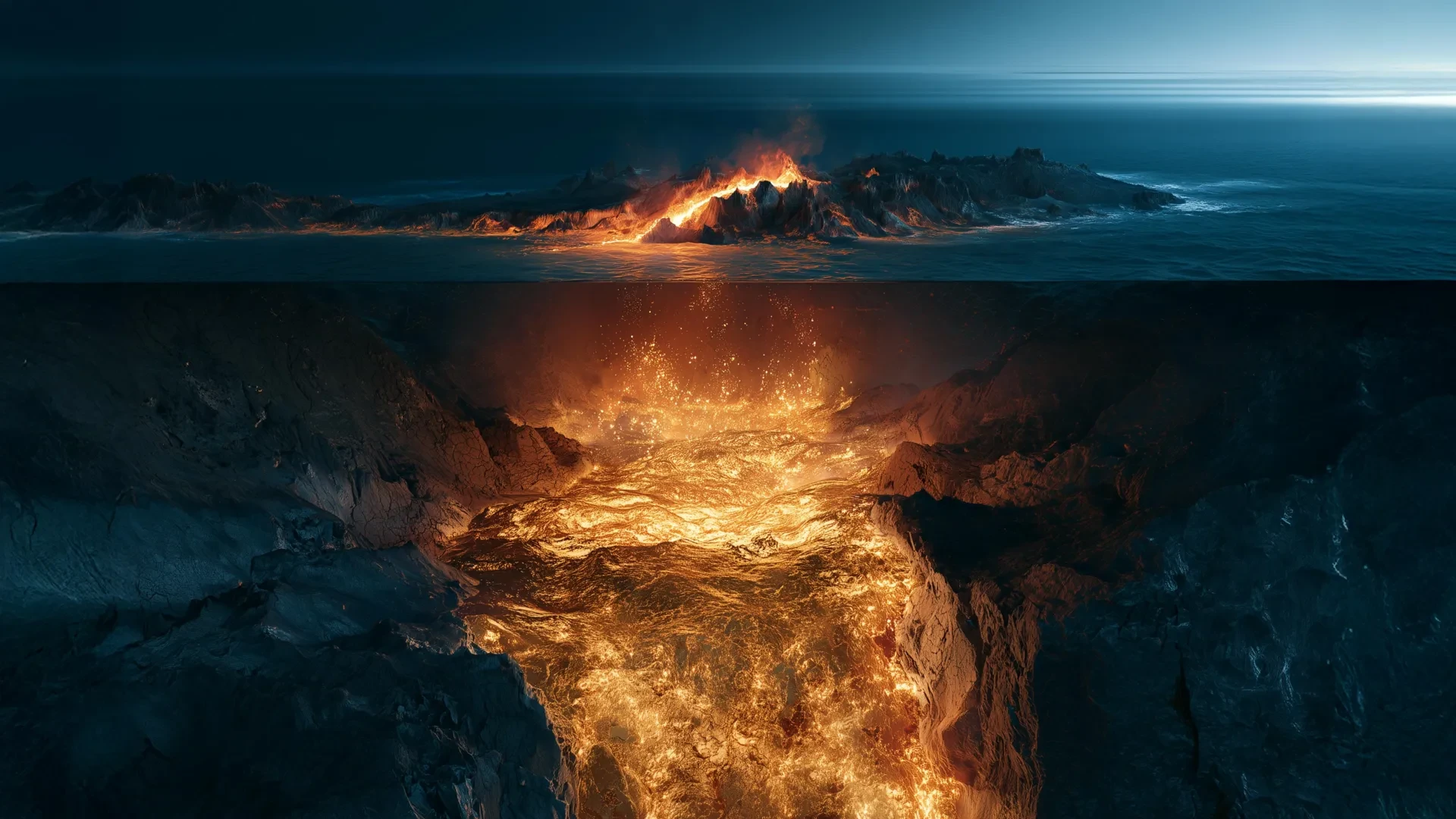
KIEL, GERMANY — Deep beneath the churning blue expanses of the world’s oceans, a subterranean alchemy is at work. For decades, geologists have marveled at an enduring geological puzzle: why certain chains of volcanic islands, born from the violent collisions of tectonic plates, are exceptionally rich in gold.
Now, an international team of researchers has peered miles beneath the ocean floor to uncover Earth’s hidden "gold kitchen." Led by Dr. Christian Timm, a marine geologist at the GEOMAR Helmholtz Centre for Ocean Research Kiel, a newly published study reveals that the secret to these precious metal deposits does not lie solely in the crustal processes near the surface. Instead, it begins deep within the Earth’s mantle, driven by a complex, multi-stage melting engine fueled by water.
The findings, derived from an exhaustive analysis of volcanic glass samples dredged from the seafloor, offer the clearest picture yet of the primordial life cycle of gold—shifting our understanding of how precious metals are manufactured, concentrated, and transported from the dark recesses of the planet’s interior to the upper crust.
Main Facts
The new study centers on the geological dynamics of island arcs—sweeping, crescent-shaped chains of volcanoes that develop above subduction zones. These are regions where one tectonic plate dives, or subducts, beneath another into the Earth’s mantle.
Key takeaways from the research include:
- The Multi-Stage Melting Engine: Gold enrichment is not the result of a single, isolated volcanic event. Rather, it requires high-degree, repeated (multi-stage) melting of a mantle source that has already been depleted by earlier geological activity.
- The Role of Water: While scientists previously suspected that water released from the descending tectonic plate directly leached or controlled the gold, the new data reveals a more nuanced role. Water acts as a powerful catalyst that lowers the melting point of mantle rock, driving the intense, extensive melting required to release the metal.
- Sulfide Breakdown: In the Earth’s mantle, gold is preferentially bound within sulfide minerals. During standard, low-intensity melting, these minerals remain intact, trapping the gold. However, under high-temperature, water-assisted conditions, the sulfide minerals break down completely, dumping their cargo of precious metals directly into the rising magma.
- Pristine Clues: By analyzing primitive volcanic glass samples from the Kermadec island arc north of New Zealand, researchers found gold concentrations several times higher than those typically found in mid-ocean ridge basalts.
Despite these elevated levels, the rocks examined in this study are not commercially viable. The gold concentrations—reaching up to six nanograms per gram of rock—are far too diffuse for mining. Economically exploitable deposits require concentrations orders of magnitude higher, meaning near-surface secondary processes are still required to concentrate the metal into mines. However, the mantle establishes the crucial starting conditions long before the magma ever erupts.
Chronology: Unraveling the Geological Detective Story
To understand how scientists arrived at these conclusions, it is necessary to retrace the timeline of the research and the geological history locked within the samples themselves.
Phase 1: The Seafloor Expedition
The journey began thousands of feet beneath the ocean surface. Researchers targeted the Kermadec island arc and the adjacent Havre Trough, located north of New Zealand in the southwest Pacific Ocean. This region is a classic intra-oceanic subduction zone, characterized by intense submarine volcanism and hydrothermal activity.
Using specialized marine research vessels, the team collected 66 volcanic glass samples directly from the seafloor. Volcanic glass forms when submarine lava erupts into the freezing abyss of the deep ocean and cools almost instantaneously. This thermal shock acts as a geological time capsule, freezing the magma’s chemical composition in place and preventing the slow crystallization that typically alters mineral structures over time.
Phase 2: Laboratory Analysis of Primitive Samples
Back in the laboratory, the researchers sorted through the haul, focusing specifically on primitive glasses. These rare samples preserve the pristine chemistry of the original magma before it underwent fractionation or interacted significantly with the overlying crust.
Using high-precision mass spectrometry, the team measured gold at infinitesimally low concentrations—down to parts per billion. To cross-reference their findings, they measured gold alongside a suite of other chalcophile ("sulfur-loving") elements, including silver, copper, selenium, and platinum. Because these elements behave predictably relative to one another during melting processes, their chemical ratios served as a fingerprint of the conditions deep inside the mantle.
Phase 3: Discovering the Anomaly
When the analytical data was compiled, a striking anomaly emerged. The gold concentrations in the Kermadec samples were not only high for mantle-derived rocks—reaching up to six nanograms per gram—but the gold-to-copper ratios were vastly superior to those measured in fertile mantle rocks or primitive mid-ocean ridge basalts.
Furthermore, the silver-to-copper ratios mirrored those found in the ambient mantle, pointing to a specific, high-temperature thermal regime. The chemical clues collectively signaled a mantle source that had undergone a complex history: it had been depleted by an initial melting event, only to be subjected to subsequent, water-rich melting phases later on.
Supporting Data and Geochemical Metrics
The strength of Dr. Timm’s research lies in its rigorous geochemical dataset. By comparing the behavior of gold with other sulfur-loving (chalcophile) elements, the team was able to model the thermodynamic conditions required to mobilize the precious metal.
| Geochemical Parameter | Typical Mantle / Mid-Ocean Ridge Basalt | Kermadec Island Arc (This Study) |
|---|---|---|
| Max Gold Concentration | Low to moderate (~0.5 – 1.5 ng/g) | Up to 6 nanograms per gram of rock |
| Gold-to-Copper Ratio | Standard baseline values | Significantly elevated above fertile mantle norms |
| Sulfide Mineral Stability | Stable during low-degree melting | Completely broken down at high melting thresholds |
| Melting Regime | Single-stage decompression melting | High-degree, multi-stage, water-assisted melting |
The data disproved the team’s initial hypothesis. Researchers had long assumed a direct correlation: that water squeezed out of the subducting oceanic plate carried dissolved gold straight up into the overlying mantle wedge.
Instead, the data revealed that water’s primary function is mechanical and thermal. It acts as a fluxing agent, lowering the solidus temperature of the mantle rocks and forcing them to melt much more extensively than they would under dry conditions.
Once the melting degree crosses a critical threshold—and temperatures exceed the sulfide liquidus—the host sulfide minerals disintegrate. Trapped gold, along with platinum and selenium, is abruptly liberated from the crystal lattices of the dissolving sulfides and swept upward into the rising mantle melt.
Official Responses and Expert Insights
Dr. Christian Timm and his colleagues at GEOMAR have opened a new window into the geochemical lifecycle of precious metals, garnering attention across the geological community.
"Our research shows that hydrous mantle melting beneath island arcs is a key driver of gold enrichment," explains Dr. Christian Timm, lead author of the study and marine geologist at GEOMAR. "In these settings, the mantle behaves like a multi-stage melting system that progressively concentrates gold."
Addressing the pivot in their scientific assumptions regarding water, Timm noted:
"We initially assumed that water released from the subduction zone directly controlled gold enrichment. However, our data show that water mainly facilitates mantle melting. The key factor for high gold concentrations is the high—and in part repeated—degree of melting."
The transition from locked mineral to mobile magma is fundamentally governed by this sulfide breakdown. As Timm emphasizes:
"Gold in the mantle is commonly bound in sulfide minerals. At high degrees of melting, these minerals break down, releasing their gold completely into the melt. Our results demonstrate that gold enrichment is not the result of a single melting event, but of multiple stages. Only repeated melting allows gold to become strongly concentrated in the magma."
Summarizing the poetic and scientific weight of the discovery, Timm concludes:
"We are effectively looking at the first step in the life cycle of gold. It begins with the transfer of gold from the mantle into a melt that eventually forms volcanoes. The alchemy starts long before the metal reaches the surface."
Broader Implications for Science and Industry
While the rocks analyzed in the Kermadec arc are far too lean to spark a modern gold rush, the implications of this study ripple far beyond academic mineralogy. They provide a foundational framework for understanding several major geological phenomena.
1. Decoding Hydrothermal Ore Deposits
Along submarine island arcs, deep-sea hydrothermal vents—often referred to as "black smokers"—spew mineral-rich, superheated fluids into the ocean. These systems are known to precipitate massive sulfide deposits on the seafloor that contain unusually high concentrations of copper, zinc, silver, and gold.
The mechanism identified by Timm and his team—multi-stage, water-assisted mantle melting—may explain where these hydrothermal systems derive their anomalous gold budgets in the first place. By establishing that the mantle pre-conditions the magma with high gold concentrations, scientists have linked deep interior processes directly to seafloor mineral deposits.
2. Rewriting Subduction Zone Models
For decades, economic geologists have focused heavily on crustal-scale processes—such as the boiling of hydrothermal fluids, fractional crystallization, and magmatic degassing—to explain how ore deposits form. This study shifts the paradigm downward, suggesting that the chemical destiny of metals like gold is written miles beneath the Earth’s crust long before crustal concentration mechanisms ever take over.
3. Future Research Horizons
The research team acknowledges that while the mantle’s "gold kitchen" has been illuminated, many questions remain. Future expeditions will need to test whether this multi-stage melting model applies uniformly to other subduction zones around the Pacific Ring of Fire, or if regional variations in plate velocity, mantle composition, and subducting sediment create different geochemical signatures elsewhere.
Ultimately, the study bridges the gap between planetary geodynamics and economic geology. By proving that Earth’s mantle operates as a sophisticated, multi-stage refinery, scientists are one step closer to decoding the complete biography of the world’s most coveted metal—from its ancient cosmic origins to the volcanic cauldrons of the deep ocean floor.
