

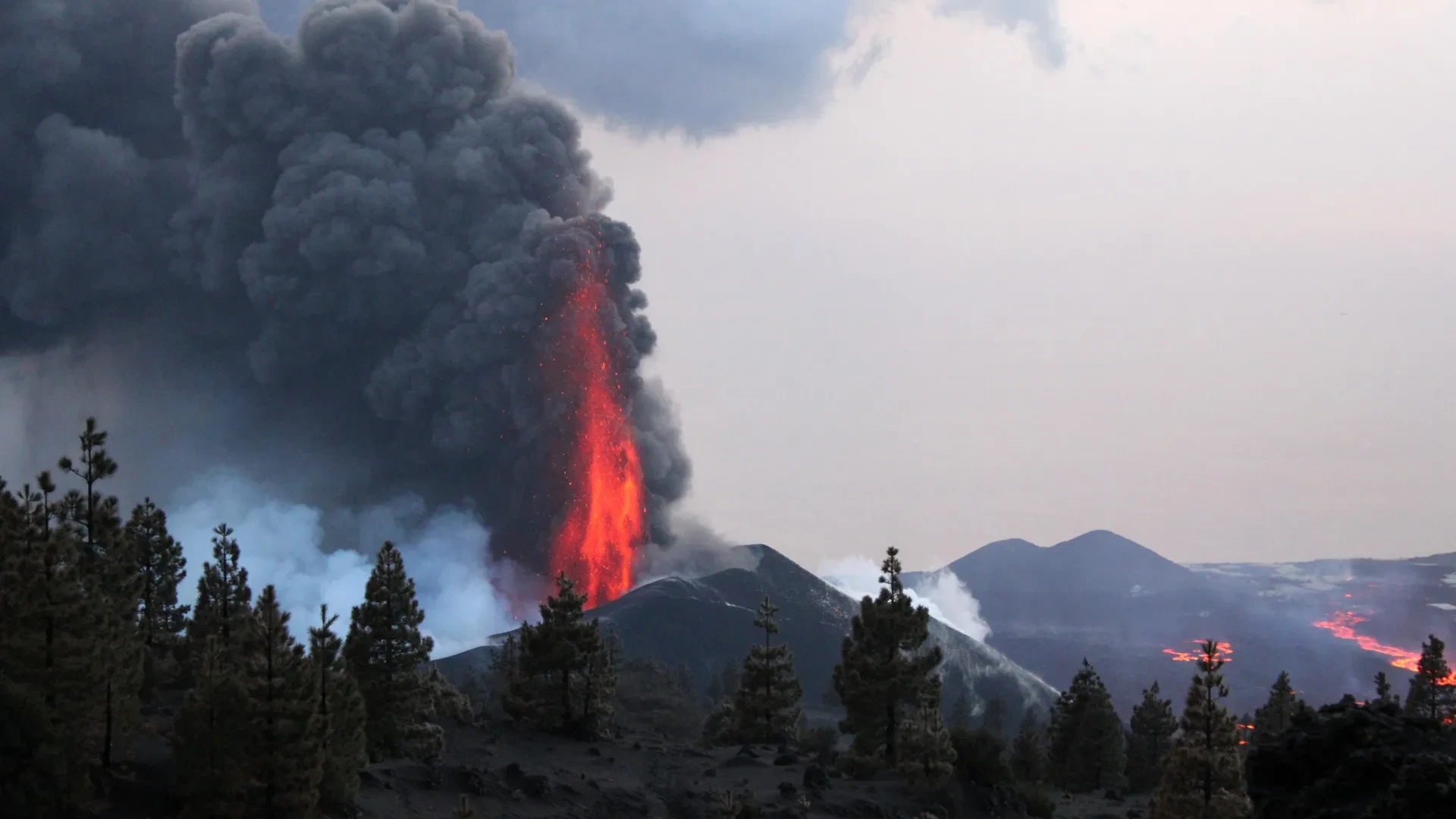
MANCHESTER, UK — For centuries, volcanologists have faced a confounding geological riddle: why do volcanoes with nearly identical chemical compositions, gas contents, and local pressure environments sometimes erupt in radically different ways? While one vent may feed a towering, explosive curtain of fire, another of the same lineage might quietly bleed thick, sluggish streams of lava across the landscape.
Now, an international team of researchers led by The University of Manchester has uncovered a crucial, previously overlooked piece of the puzzle. By peering deep into the microscopic mechanics of molten rock, scientists have identified a heat-driven process called "superheating" that fundamentally alters how magma behaves as it surges toward the surface. Published in the journal Nature Communications, the breakthrough study demonstrates that intense, transient bursts of heat can completely erase the microscopic "seeds" of crystal growth, delaying crystallization for hours and keeping magma fluid enough to fuel dramatic, high-energy eruptions.
The findings not only solve a long-standing debate regarding magma’s thermal memory, but they also offer volcanologists a powerful new lens through which to interpret real-time monitoring data, potentially reshaping how future volcanic hazards are assessed across the globe.
Main Facts: The Anatomy of Superheating
At the heart of the new study is the behavior of crystals within ascending magma. As molten rock travels from deep within the Earth’s crust toward the surface, it typically cools, triggering the nucleation and growth of tiny mineral crystals. These crystals act like grit in a lubricant, dramatically increasing the viscosity—or thickness—of the magma. The thickness of this subterranean slurry dictates how easily trapped volcanic gases can escape, which in turn determines whether an eruption will be violently explosive or gently effusive.
However, the Manchester-led team discovered that if magma experiences "superheating"—a state where the liquid becomes significantly hotter than the temperature threshold at which its constituent crystals can remain stable—a dramatic transformation occurs.
- Dissolution of Crystal Seeds: Intense heat acts as a thermal eraser, completely dissolving pre-existing microscopic crystals that would otherwise serve as scaffolding or "seeds" for the growth of new mineral phases.
- Microscopic Reorganization: Beyond simply melting old crystals, superheating restructures the magma at an atomic and microscopic level. The liquid becomes more uniform and homogenous, creating a hostile environment for new crystal nucleation.
- Altered Viscosity and Gas Escape: By keeping the magma crystal-free and remarkably fluid during its initial ascent, superheating changes the physical properties of the rising plume. This fluidity accelerates the ascent rate and prevents gases from escaping easily, setting the stage for high-pressure phenomena such as dramatic lava fountains.
By demonstrating that a magma’s thermal history—specifically whether it received an injection of heat just before ascent—can completely override expectations based purely on chemical composition, the study introduces a paradigm shift in physical volcanology.
Chronology: From the Slopes of La Palma to the Synchrotron Beamline
The path to these discoveries bridges fieldwork on a recent European eruption with some of the world’s most advanced experimental physics facilities.
Phase One: The 2021 Tajogaite Eruption
The investigation began in the aftermath of the September 2021 eruption of the Tajogaite volcano on La Palma, in the Canary Islands, Spain. The months-long eruption provided scientists with a pristine, well-documented suite of volcanic products. An international team collected raw, unmodified magma samples directly linked to the event. Geochemical and petrological analysis suggested that parts of this magma supply had likely experienced significant thermal anomalies—or superheating—prior to and during its rapid transit through the Earth’s crust.
Phase Two: Recreating the Crucible in the Lab
To test their hypotheses, the researchers needed to observe what happens inside magma under the exact pressures and temperatures found kilometers beneath a live volcano. To achieve this, they turned to state-of-the-art laboratory infrastructure.
At the Diamond Light Source—the UK’s national synchrotron science facility located in Oxfordshire—the research team utilized an innovative, newly developed X-ray transparent pressure vessel. Combined with synchrotron X-ray microtomography, the setup allowed the scientists to literally look inside the magma while it was being heated and pressurized, capturing crystallization processes in situ and in real time.
Complementary ex-situ experiments were simultaneously conducted in Prague, Czech Republic. These off-line trials allowed the research team to monitor larger batches of magma samples over extended time horizons, validating the synchrotron observations and ensuring that the physical phenomena recorded were consistent across different analytical scales.
Supporting Data: The Eight-Hour Delay
The experimental results yielded stark, quantifiable contrasts between magma that had experienced superheating and magma that had not.
When baseline magma samples—those that had not been subjected to intense superheating—were subjected to cooling and ascent conditions, they began nucleating and growing crystals almost immediately. Within 20 minutes, a robust network of mineral crystals began to develop, rapidly increasing the fluid’s internal friction and viscosity.
In dramatic contrast, samples that had been subjected to strong superheating exhibited a profound kinetic barrier to crystallization. The intense thermal spike delayed the formation of any new crystals for more than eight hours.
The Numerical Models
To understand how these laboratory timescales translate to actual volcanic systems, the researchers integrated their empirically measured nucleation delays into advanced numerical models of magma ascent. These computer simulations tracked how columns of molten rock behave as they are driven upward through the Earth’s crust.
The mathematical outputs revealed a clear fork in the road for volcanic behavior:
- The Superheated Path (Rapid Ascent): A prolonged crystallization delay of eight hours or more keeps the magma remarkably fluid and mobile. Unhindered by a web of growing crystals, the magma surges rapidly toward the surface. As it breaches the vent, the sudden drop in pressure causes dissolved gases to expand violently, giving rise to spectacular lava fountains and energetic eruptive pulses.
- The Standard Path (Sluggish Ascent): When crystals form rapidly within the first 20 minutes of ascent, the magma thickens into a viscous paste. This heavy, sluggish material moves much more slowly toward the surface. The leisurely pace gives dissolved gases ample time to bleed out gradually and harmlessly through fractures in the conduit, culminating in a gentler, effusive eruption characterized by steady, creeping lava flows.
Official Responses: Perspectives from the Research Team
The implications of the study have reverberated across the volcanological community, highlighting the necessity of integrating thermodynamic histories into hazard assessment frameworks.
Dr. Barbara Bonechi, a Research Associate at The University of Manchester and lead author of the study, emphasized the technological leap that made these discoveries possible.
"The history of crystal and bubble growth can dramatically control how a magma erupts; in particular, as more crystals grow, they eventually have a dramatic effect on magma viscosity," Dr. Bonechi explained. "Until now, we did not fully understand the dynamics of crystal growth for magmas that received an injection of superheat just before ascent. But using our exciting and newly developed X-ray transparent pressure vessel combined with synchrotron X-ray microtomography, we can actually observe these processes ‘in situ’."
Dr. Margherita Polacci, Senior Lecturer in Volcanology at The University of Manchester and co-author of the research, pointed out how the findings challenge conventional approaches to volcanic forecasting.
"Current volcanic hazard models typically focus on magma chemistry, gas content, and pressure changes," Dr. Polacci noted. "This work suggests that pre-eruptive thermal history and crystallization kinetics may also play an important role in controlling magma ascent and eruptive behavior, with implications for volcanic hazard assessment."
Implications: Rewriting Volcanic Hazard Models
Volcanic eruptions pose persistent threats to millions of people living in active tectonic zones around the world. Accurate forecasting of whether an impending eruption will manifest as a slow, manageable lava flow or an explosive, fountain-driven hazard is vital for civil protection agencies tasked with ordering evacuations and mitigating infrastructure damage.
Traditionally, monitoring networks rely on seismic data, ground deformation measurements, and gas emissions to infer what is happening beneath a volcano. When scientists analyze erupted materials, they typically focus on bulk chemistry and volatile content to reconstruct the magma’s journey.
The Manchester-led study demonstrates that looking solely at chemistry and pressure is no longer enough. By proving that a brief thermal pulse deep within the plumbing system can alter crystallization kinetics hours later—thereby flipping the switch between effusive and fountain-forming behavior—the research provides a missing link in hazard forecasting.
Moving forward, volcanologists will need to incorporate thermal history and crystallization kinetics into numerical simulations of volcanic conduits. By combining real-time geophysical monitoring with a deeper understanding of how heat resets magma’s microscopic clock, scientists will be better equipped to decode the subterranean whispers of restless volcanoes—ultimately providing communities with more accurate, timely warnings before the earth gives way.
